Last week, I wrote about some of the low tech ways of dealing with returned concrete, as well as hardened concrete recycling (creating recycled concrete aggregate). Check it out here. In this blog, I'd like to point out a few more ways to manage the problem of excess, returned concrete, mainly leftover, fresh concrete at the concrete plant, not hardened concrete arising from activities like construction or demolition activities.
So what are some more options for dealing with excess concrete materials? Here's a few:
- Use a hydration control admixture. Put the returned concrete "to sleep" by slowing or stopping hydration, and "reawakening" later by batching on top or treating with other admixtures. Then, resell the concrete as if it were a brand new batch. Concrete can be held for a few hours, or even longer (including overnight). I posted a comment on a LinkedIn group I belong to about this, and a producer mentioned that he might not be able to sleep at night knowing his mixer trucks had unhardened concrete sitting in the barrels overnight, but to each his own! Many concrete producers use HCA, and they work very well for them.
- Allow the returned concrete to harden on site, then crush and make recycled concrete aggregate. A good idea, but this can take up a lot of room on the site, and involve a lot of handling and work, and therefore a lot of capital (a concrete crusher isn't cheap). Depending on your market, this can be a good idea, but the investment in space, manpower and capital can be daunting. Recycled concrete is a valuable product in some markets, particularly those which are located far from sources of quarried stone. One drawback is that concrete producers who do this also face getting into the crushing and/or waste management business (since this is viewed as recycling in many areas), which may include significant regulatory hurdles like recycling permits and high fees.
- Use a concrete reclaimer. A concrete reclaimer can take the unhardened concrete, use a washing process to separate the aggregate out of the concrete leaving a cement/water slurry, and recover the aggregate for further concrete production. Truly recycling. In fact, a well-designed concrete reclaimer system can also allow recovery and reuse of the water / cement slurry ("process water" / "grey water") for either further reclaimer use, or further concrete production. Think of that - equipment that can manage the problem of returned concrete, produce reusable materials, and result in complete recycling. That's impressive! Concrete reclaimers have faced some challenges over the years in making inroads into the concrete market, but many within the industry (and not just the concrete reclaimer salesmen) believe that in the future most concrete plants will have concrete reclaimers.
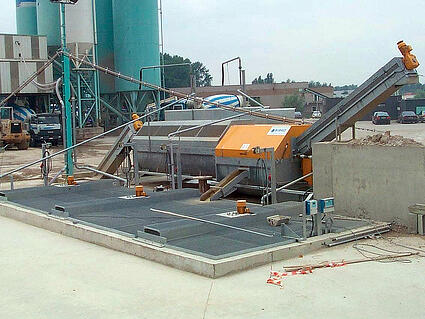
I always like the analogy of tools in a toolbox, and a home builder. Try and build a house with just a hammer, and you're going to have a very difficult time of it. You need numerous other tools to do the job properly. That's kind of the same way it usually is with concrete recycling at concrete plants - you need to have several tools at your disposal. Perhaps you make some blocks, batch new concrete on old when possible, and use a concrete reclaimer for the bulk of the returned concrete and for end-of-day barrel washout. Or, it might be some blocks and hardened concrete recycling. The best at this seem to use several different techniques in combination to solve the problem of excess concrete materials.
What do you do? Whatever you do with regards to concrete reclaimers and concrete recycling, consider your goals:
- You must be in compliance with all applicable environmental and operating regulations.
- Your choice should blend in as seamlessly as possible with site operations. Remember, you're in the concrete business, not in the concrete reclaiming business.
- It should be within the grasp of your personnel, in terms of manpower, level of expertise, etc.
- You should seek a real return on investment from your choice. It's not waste, it's your product at your site. Your product represents money: materials, manpower, enegery use, water consumption, etc. Expect to get some financial return, even if its modest.
Whatever you choose, concrete producers of all kinds need to do something. The days of letting concrete materials build up into a concrete mountain on a plant site are over.