The small hazardous waste details that create big problems... and how to take control before it costs you.
If you’re responsible for environmental compliance at your facility, here’s the truth you already know in your gut: hazardous waste violations aren’t usually caused by one catastrophic oversight.
They’re caused by dozens of small, overlooked details that pile up over time - the “we’ll fix it later” moments that eventually add up to a citation, a fine, or worse, a public enforcement notice.
At RMA, we’ve reviewed hazardous waste programs across manufacturing plants, distribution centers, marine terminals, utilities, and transportation hubs. We’ve seen the same patterns repeat again and again... and when regulators visit, they notice those same patterns too.
The good news? These problems are usually fixable with the right attention and training. But the first step is knowing what to look for. So, here are the eight most common red flags we encounter in hazardous waste programs - and what they say about your facility’s compliance health. And if you think you might need a hand with any of them, reach out to us here!
Table of Contents
1. Containers Without Labels (or With the Wrong Ones)
This one seems so simple, yet it’s one of the most frequent violations we find during audits.
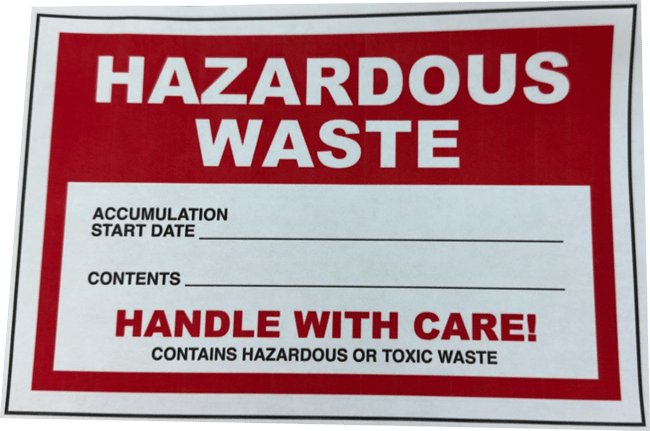
Every container that holds hazardous waste (whether it’s a 55-gallon drum, a small parts bucket, or a storage tote) must be labeled correctly and completely.
That means:
- Clearly marked with the words “Hazardous Waste”
- Identified with the contents or waste type
- Labels that are legible, durable, and visible
- And no faded handwriting, peeling tape, or water-damaged stickers
We often find drums sitting in a back corner with no labels, illegible writing, or incomplete descriptions. To an inspector, that’s an immediate red flag because it screams disorganization and risk.
And if the fire department or a regulator walked into your facility and saw unlabeled containers, they’d question your overall control of hazardous materials on-site. Not something you want your local authorities to think about you!
This is one of the easiest problems to fix, but also one of the most revealing when ignored.
2. No Accumulation Start Dates or Containers Stored Too Long
Another common and costly mistake: containers without accumulation start dates.
EPA regulations require that every container in a Central Accumulation Area (CAA) be clearly marked with the date accumulation began. For Satellite Accumulation Areas (SAAs), waste must be moved promptly once the container is full, typically within three days.
We regularly see:
- Containers in CAAs with no visible date
- Containers sitting beyond the 90-day or 180-day limit (depending on generator status)
- “Forgotten” waste drums that no one claims ownership of
If an inspector spots old or unmarked drums, they’ll immediately ask: "do you know your generator status?”
Because improper storage often signals a deeper issue... that your team doesn’t fully understand whether you’re a large quantity or small quantity generator, and what that means for your time limits.
3. Misclassified Hazardous Waste Generator Status
Your generator status determines almost everything about your hazardous waste obligations, from how long you can store waste to how you must train your staff and report annually. Unfortunately, many facilities get this wrong.
We’ve seen:
- Facilities calling themselves “small quantity generators” but shipping out enough waste each month to qualify as “large quantity.”
- Annual reports that don’t align with manifest volumes.
- Assumptions made without actual data, for example, “we’ve always been a small generator” rather than tracking quantities.
Regulators catch these mismatches fast. They simply compare your manifests to your reported generator status, and if they don’t line up, they assume the rest of your program might be out of sync too.
4. Mixed or Incompatible Wastes in the Same Container
This one can even be dangerous! We’ve seen used oil mixed with solvents, acids mixed with caustics, and flammable materials stored in plastic containers not rated for them.
When incompatible wastes are mixed:
- You can create uncontrolled chemical reactions (heat, pressure, toxic gases)
- Disposal becomes significantly more expensive and complicated
- And you lose traceability of what’s actually in that drum
Mixing wastes tells inspectors that your procedures aren’t being followed, or worse, that your staff doesn’t understand what’s hazardous and what’s not.
This is one area where training and visual management go a long way. Label clearly, segregate properly, and never rely on “that’s how we’ve always done it.”
5. Lack of Training (or Training the Wrong People)
Speaking of training... a solid hazardous waste training program is one of the most powerful (and most neglected) parts of a hazardous waste program.
We frequently audit sites where:
- Employees responsible for handling or managing waste have never been trained
- Training is outdated or only provided once at hire
- The wrong people get trained (for example, administrative staff instead of forklift operators or maintenance leads)
- There’s no written documentation of who was trained or when
Regulations require that employees involved in hazardous waste management be trained within six months of hire and annually thereafter.
But beyond compliance, training is what prevents small mistakes from becoming violations (or accidents).
When an inspector asks, “who’s responsible for hazardous waste here - and have they been trained?” that’s your moment of truth. If your team can’t confidently answer, it’s a red flag that more problems are likely hiding under the surface.
6. Poor or Missing Hazardous Waste Manifests
Hazardous waste manifests are your proof of compliance; it's the documentation that shows exactly where your waste went, who handled it, and that it arrived safely at a permitted facility.
But many facilities either:
- Don’t keep copies at all,
- Keep only the generator copy without the signed return copy,
- Or never reconcile manifests against what the transporter reports.
That’s a big problem. Regulators expect to see a “cradle-to-grave” paper trail for every hazardous waste shipment. Missing manifests make it look like you lost control of the waste - and that’s one of the fastest ways to draw enforcement action.
Every manifest should tell a complete story, from generation to disposal. If it doesn’t, fix it now, before an inspector asks for documentation you can’t produce!
7. Disorganized or Incomplete Hazardous Waste Documentation
Even if your physical operations are solid, your paperwork can make or break your inspection. Regulators want to see not just compliance in practice, but compliance on paper.
Your hazardous waste files should include:
- Waste determinations (lab analyses, Safety Data Sheets, etc.)
- Training records
- Weekly inspection logs
- Contingency plans and emergency contact lists
- Annual or biennial reports
- All shipping manifests and land disposal notifications
When records are incomplete, outdated, or scattered across multiple desks and inboxes, it signals a lack of control. Think of documentation as your “defense file.” If you were asked to prove compliance tomorrow, could you?
If not, now’s the time to get organized... before you have to explain why something’s missing.
8. Housekeeping and Other Environmental Red Flags
Inspectors don’t view your hazardous waste program in isolation. They look at your site holistically, and they notice what your facility looks like the moment they walk in.
If housekeeping is poor, secondary containment is stained or cracked, spill kits are empty, and storm drains are oily or discolored, those are warning signs.
Inspectors assume (often correctly) that if your visible areas look sloppy, your recordkeeping probably does too. It’s simple pattern recognition. Regulators know that when one area of compliance is weak, others tend to follow.
A clean, organized, and well-maintained facility communicates control, care, and competence - long before you hand over a single document.
What to Do if Your Facility Has These Hazardous Waste Red Flags
If you’re reading this list and thinking, “Yeah, we’ve got a few of those,” don’t panic - you’re not alone.
Almost every facility we visit has at least a few gaps. Compliance isn’t about perfection; it’s about control, awareness, and improvement.
Here’s how RMA helps facilities fix these issues before they become enforcement cases:
Hazardous Waste Program Audits
We walk your site, review your documentation, and assess your practices against federal and state regulations. You’ll get a clear, prioritized action plan, not a stack of confusing citations.
Staff Training (for the Right People)
We deliver hands-on, role-specific training so everyone who handles hazardous waste (not just EHS staff) understands labeling, storage, and recordkeeping.
Documentation Systems That Work
We help you organize your hazardous waste records into a system that’s inspection-ready and sustainable, so you’re never scrambling for a manifest or training certificate again.
On-Call Environmental Consulting
When complex issues come up - from waste classification to enforcement response - you’ll have experienced experts ready to help, without the bureaucracy of a big firm.
Our goal isn’t just to “keep you out of trouble.” It’s to make your compliance program simple, consistent, and confident.
The Cost of Hazardous Waste Consulting
We believe in transparency, and that starts with pricing. That’s why we built a Hazardous Waste Services Pricing Calculator below!
It gives you an instant, no-obligation estimate based on your facility type and the services you’re considering. No hidden fees. No sales pressure.
It’s quick, easy, and helps you understand your options before you ever reach out to us directly.
Getting Help with Your Hazardous Waste Program
At RMA, we’ve seen what happens when hazardous waste programs slip, but we’ve also seen how quickly they can be turned around with the right focus and training.
So if you’re serious about reducing risk, controlling costs, and passing inspections with confidence, now’s the time to take action. Because once you get that “knock at the door,” it’s too late to wish you’d gotten ahead of it.
Let’s fix it before it becomes a problem. Reach out to us here to get your hazardous waste program back on track today!