What Is Universal Waste and What Does It Mean for Your Facility?
Have you ever heard someone throw around the term “universal waste” and quietly wondered what that actually means? Is it just another word for hazardous waste? Is it less serious? Or is it one of those regulatory phrases that sounds simple but can trip you up fast?
We get these questions all the time. And here’s the honest truth: universal waste is still hazardous waste. It just comes with a different set of management rules. If you’re not sure how your facility’s waste streams are classified, that uncertainty can turn into risk quickly. If you’d rather get clarity now instead of dealing with fines later, you can always reach out to our team at RMA here.
Let’s break this down in plain language so you know exactly where you stand.
Table of Contents
What Is Universal Waste Under RCRA?
Universal waste is a specific category of hazardous waste regulated under the Resource Conservation and Recovery Act, also known as RCRA.
The EPA created the universal waste category to make it easier for businesses to collect and recycle certain common hazardous wastes without having to comply with the full set of traditional hazardous waste generator requirements.
But here’s the key point we always emphasize: universal waste is still hazardous waste. It simply has streamlined rules designed to encourage proper handling and recycling.
Under federal regulations, universal waste includes five main categories:
- Batteries
- Pesticides
- Mercury-containing equipment
- Lamps, including fluorescent and certain specialty bulbs
- Aerosol cans
And when we say "lamps", we mean the bulbs themselves. Not the fixture or the wiring or the ballast. To make matters more confusing, technically older ballasts can contain PCBs, which fall under entirely separate regulations. That's a topic for another day, but you can see how misclassification can easily start to create real compliance issues.
Oh, and one more important detail: some states expand the federal list. Electronics, antifreeze, or even paint may qualify as universal waste in certain states. So if you operate in multiple states, you cannot assume the rules are identical everywhere. We see this mistake more often than you might think!
What Do I Have to Do at My Facility If I Have Universal Waste?
If your facility generates universal waste, you still have clear regulatory responsibilities. The rules are simpler than full hazardous waste requirements, but they are not optional.
Let’s walk through the core requirements.
1. Properly Identify Universal Waste at Your Facility
This is where everything starts!
You must correctly determine whether your waste actually qualifies as universal waste. Misidentifying something as universal waste when it does not qualify can expose you to enforcement action. And vice-versa.
We often get calls from facilities that assumed something “must be universal waste” because it seemed common or low risk. That assumption can get expensive.
If you are unsure whether your batteries, lamps, or equipment qualify, this is exactly the kind of thing we review with clients before it becomes a problem. You can contact us here if you need a second set of eyes!
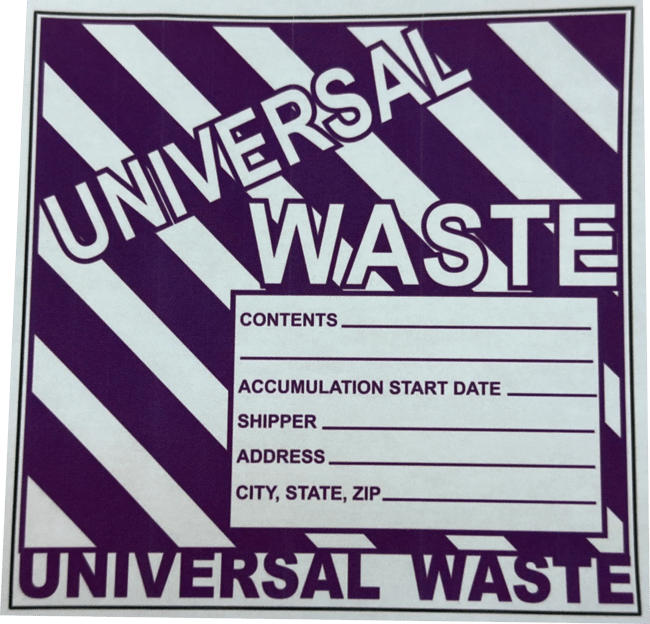
2. Appropriate Labeling of Universal Waste Containers
Labeling is not just a best practice. It is required by law, and it's one of the easiest things to do right... or wrong!
Containers must be clearly marked with phrases such as:
- Universal Waste – Lamps
- Universal Waste – Batteries
- Universal Waste – Aerosol Cans
The labeling must be visible and accurate. This helps employees, inspectors, and emergency responders quickly identify what is inside.
It sounds simple. It is simple! But still, we regularly see containers sitting in maintenance rooms with no labels at all. That's an easy citation and fine during an inspection.
3. Comply with Universal Waste Accumulation Time Limits
Universal waste cannot sit indefinitely.
Under federal rules, universal waste may generally be accumulated for up to one year (but again, your state could have different limits!). That timeline starts from the day that the waste is generated or created. And that burden of proof falls on you as the operator of the facility.
That means that you must be able to demonstrate how long the waste has been on site. That usually means marking containers with an accumulation start date or maintaining a clear tracking system.
If you can't show when the clock started, regulators may (and probably will) assume the worst. This is one of those small administrative details that can turn into a big compliance headache if you don't have a clean system for keeping up with it.
4. Proper Container Management for Universal Waste
You probably could have guessed this for yourself, but you can't throw all of your universal waste into a big heaping pile or into the dumpster out back with the rest of your trash. Storage conditions matter.
Containers must be:
- Structurally sound
- Closed
- Managed in a way that prevents leaks or releases
That last bullet means that batteries need to be protected from short-circuiting. Lamps should not be crushed (unless your state specifically allows it under defined conditions!). Mercury-containing equipment must be handled carefully to prevent breakage. That kinda thing.
We often tell clients that housekeeping speaks volumes during inspections. If universal waste is scattered, open, or poorly managed, it sends the wrong message immediately!
5. Send Universal Waste to an Authorized Destination Facility
Universal waste must ultimately be sent to an authorized destination facility, typically for recycling. The whole point of these regulations is to make sure that hazardous universal wastes don't end up in a landfill (or worse!). In the end, universal wastes should be recycled by someone who is approved to do so.
To be extremely clear: you can't simply throw it in the trash. And you can't send it just anywhere.
Part of staying compliant is making sure your transporter and receiving facility are properly authorized. If you're unsure whether your current disposal pathway meets requirements, that's something we can help verify before it becomes an issue.
Used Oil vs. Universal Waste: Clearing Up a Common Confusion
Let’s clear up one of the biggest misconceptions we hear: used oil is not universal waste.
Used oil is regulated under its own section of RCRA with separate storage, labeling, and management standards. Containers must be labeled “Used Oil,” not “Universal Waste.”
And here's another important point: there is no formal regulatory category called “waste oil.” That term gets used casually, but it does not correspond to a specific rule set. Call your used oil "used oil". Not "universal waste". And not "waste oil".
We get it, it's confusing terminology. And we've seen it time and time again: when terminology gets sloppy, compliance can get sloppy too.
Managing Your Universal Waste Properly
Most universal waste compliance issues don't come from intentional violations. They come from assumptions: assuming something qualifies, assuming simplified rules mean minimal oversight, or assuming inspectors will not look too closely.
The reality is that universal waste violations can still carry serious consequences. And if regulators determine something was misclassified, you could suddenly be dealing with full hazardous waste violations instead. We have seen facilities spend far more fixing a mistake than they would have spent preventing it!
If you're thinking, “This feels more complicated than I realized,” that's normal. Unfortunately, environmental regulations aren't designed to be intuitive. They are designed to be enforceable.
That’s where we come in. At RMA, we help facilities sort through waste classifications and tighten up management procedures, including confirming whether a waste stream truly qualifies as universal waste, reviewing labeling and storage practices, setting up accumulation tracking systems, and verifying disposal pathways.
If you want to review your universal waste program or simply confirm that what you are doing lines up with the regulations in your state, let’s talk. Universal waste may sound like no big deal, but getting it right protects your facility, your team, and your bottom line.