The Most Common SPCC Violations We See And How Much SPCC Fines Cost Businesses
If your facility has oil on site, there's a good chance you already know the name "SPCC", even if you're not entirely sure what your obligations are or whether your current plan is actually in good shape. And if you're being honest about it, there's also a good chance the plan is sitting in a binder somewhere, last touched by someone who no longer works there, covering operations that have changed since it was written.
That's not an unusual situation. It's actually one of the most common ones we encounter. This article walks through the six most common SPCC violations we see at real facilities, why they happen, what they can cost when something goes wrong, and how to get things back on track. If you'd like a hand with your SPCC Plan or just want to know where you stand, you can reach out to RMA here and we'll help you figure it out.
Table of Contents
What Is An SPCC Plan And Who Needs One?
Before getting into the violations, a quick refresher is worth having. SPCC stands for Spill Prevention, Control, and Countermeasure. If your facility stores more than 1,320 gallons of oil aboveground, you are very likely required to have a plan, regardless of where in the United States you operate. That threshold applies broadly and catches a lot of facilities that assume they're too small or too simple to be covered.
An SPCC Plan is not just a document to check a box. It's supposed to be a living part of your operations, something that reflects how your facility actually works, gets reviewed regularly, drives real inspections, and informs how your team responds when something goes wrong. Unfortunately, that's not how it plays out at most sites. If you want a fuller picture of what an SPCC Plan actually involves, our article on what an SPCC Plan is is a good starting point, and our SPCC Plan quick guide covers the essentials in one place. If you're not sure whether your facility is required to have one at all, our four-step guide to figuring out if you need an SPCC Plan walks you through it.
The Six Most Common SPCC Violations
These are the violations we encounter most often at facilities across the country, and they come with real consequences when a regulator shows up or a spill happens.
1. No SPCC Plan At All
This is the most obvious violation and, unfortunately, still one of the most common. If your facility meets the threshold and you don't have a plan, you're out of compliance. Full stop. It doesn't matter how long you've been operating without one or how many years have passed without anyone asking. The requirement exists, and the absence of a plan is the single most straightforward finding a regulator can make. If someone in your industry, your trade group, or your consultant has told you that you need one, that's the time to act, not the time to weigh whether the odds of getting caught are low enough to justify waiting.
2. No Inspection Records, Or Pre-Filled Inspection Records
Missing inspection records are a common finding, but pre-filled inspection records are worse. We see this more than people might expect: inspection logs filled out in advance, all at once, clearly not reflecting actual field observations. This is the kind of recordkeeping practice that goes far beyond a simple compliance gap. In extreme cases, it can lead to serious consequences, including criminal charges. Inspection records exist to document what was actually observed at your facility on a given date. They need to reflect reality, and they need to be completed as inspections happen, not after the fact in bulk. Our article on the top ten things to do during your SPCC monthly inspections is a practical guide to doing this correctly.
3. Improper Secondary Containment
Secondary containment problems show up in a lot of different forms. Drums sitting on the floor without spill pallets. Tanks with no containment around them at all. Containment structures that are undersized for the volume they're supposed to hold. And our personal favorite: containment areas with cracks, holes, or gaps that would render them completely ineffective in an actual spill event. A containment structure with a hole in it works about as well as a swimming pool with a golf ball-sized gap in the wall. The point of secondary containment is to actually contain a spill, and if the structure can't do that, it doesn't satisfy the requirement regardless of whether it exists on paper.
4. Untrained Staff Or No Documentation Of Training
Annual SPCC training is a baseline requirement, not an optional one. Anyone at your facility who handles oil needs to receive documented training on a regular basis. We see facilities where training hasn't happened in years, and we see facilities where training may have happened informally but was never documented. Both are problems. The regulation doesn't just require that training occur. It requires that it be documented. If you can't prove it happened, from a compliance standpoint, it didn't happen. Our articles on whether annual SPCC training is required and what SPCC training should actually include cover the specifics in detail.
5. Outdated Or Missing Five-Year Reviews
Your SPCC Plan is required to be reviewed at a minimum every five years. We regularly work with facilities that have plans sitting on a shelf that are ten, fifteen, or even twenty years old without any updates. Operations change. Equipment gets added or removed. Storage configurations shift. Personnel change. If your plan doesn't reflect your current operation, it's not really your plan anymore. It's a historical document describing a facility that may no longer exist in the form it depicts. Beyond the regulatory requirement, an outdated plan creates practical problems too, because in an actual emergency, your team would be referencing information that doesn't match what's actually in front of them. Our article on SPCC Plan five-year reviews explains what that process actually involves, and our piece on when and how to update your SPCC Plan helps you figure out where you stand.
6. A Plan That Exists But Has Never Been Used
This last one is in some ways the most frustrating, because the facility did the right thing by getting a plan developed. They just never followed through with actually implementing it. No training, no inspections, no documentation, no sign that the binder has ever been opened. A plan that exists on paper but has no connection to day-to-day operations offers almost no real protection, and in our experience, this is exactly the situation that tends to draw the strongest regulatory response. A facility with no plan at all might be able to argue ignorance. A facility with a complete plan that was deliberately never implemented has a much harder case to make.
Why SPCC Violations Are So Common
If these violations are so serious, why do they happen at so many facilities? The honest answer is that SPCC enforcement is surprisingly weak across most of the country. Most state regulators don't check SPCC Plans because the regulation is federal, not state-level. It's simply not within their jurisdiction. And the EPA, which does have jurisdiction, rarely inspects small or mid-sized facilities proactively. Unless there's an actual spill or someone files a complaint, the odds of a routine inspection at most facilities are low.
That dynamic means a lot of facilities have gone years, sometimes decades, without anyone asking about their SPCC Plan. And when nobody asks, things get deprioritized. Plans don't get updated. Training doesn't happen. Inspection records go blank. The compliance muscle atrophies because there's no external pressure keeping it active. Our article on who enforces SPCC Plans gets into the regulatory structure in more detail, and it's worth understanding before you assume your facility is unlikely to face scrutiny. Because the other thing that's true is that spills happen when you least expect them, and when they do, the enforcement picture changes very quickly.
What SPCC Violations Can Actually Cost: A Real Example
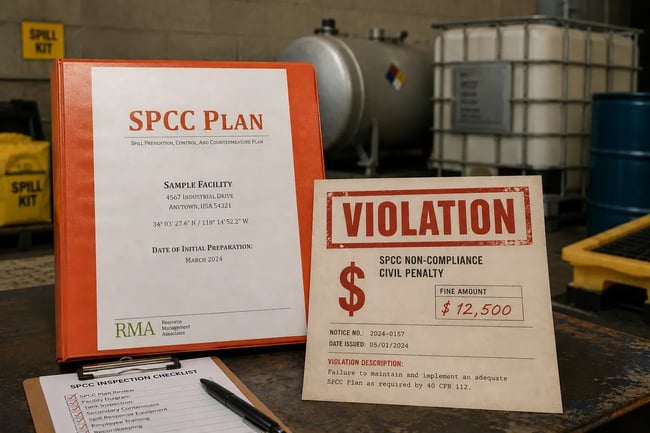
SPCC violations can carry penalties of up to $68,445 per violation, per day. Most violations won't reach that ceiling, but five and six-figure penalties for small and medium-sized facilities are genuinely common in moderate to severe cases.
To make that concrete, here's a situation we worked through with a client. About ten years ago, we told this facility they needed an SPCC Plan. The cost at the time would have been around $3,000 to develop. They declined. They hadn't seen the EPA in years, didn't want to spend the money, and decided to take their chances.
If they had gotten the plan and maintained it properly over that decade, the total investment would have looked something like this: roughly $3,000 upfront to develop the plan, plus perhaps 10-20% of that annually for training, spill kit restocking, and maintaining containment equipment, plus around $1,000 every five years for an outside review and update. All in, over ten years, they might have spent around $10,000 to stay fully compliant.
Instead, they had a spill. A significant one, caused by a disgruntled employee who vandalized the property and released thousands of gallons of oil into a wetland. They reported it to the state. The local fire department and police responded. State regulators arrived. And then the EPA showed up and asked for a copy of the SPCC Plan.
There wasn't one.
The initial discussions with the EPA about penalties started in the low millions. Their final settlement with the government alone came to approximately $85,000. That figure doesn't include attorney fees, the cost of bringing us in to get them into compliance, developing the plan they should have had years earlier, and training their staff. It also doesn't include the spill kits they had to purchase, the secondary containment infrastructure they were required to build, or the business interruption costs from having operations disrupted during the response and remediation process. When everything was added up, this mistake cost them well over $100,000.
Compare that to the $10,000 they would have spent doing it right from the beginning. Non-compliance cost them more than TEN TIMES what compliance would have. And the spill itself wasn't even a foreseeable equipment failure. It was vandalism. The cause didn't matter once regulators were on site and there was no plan to show them.
That's the real cost of SPCC violations, and it's why the math on getting a plan and maintaining it is so straightforward once you look at it clearly. Our article on everything you need to know about SPCC Plans covers the full picture, and if you're trying to get a sense of what proper SPCC compliance actually costs, our SPCC Plan costs explained article breaks down the numbers in detail.
How RMA Helps Facilities Get Back Into SPCC Compliance
When facilities come to us with SPCC issues, the situation usually falls into one of two categories:
-
Either they never had an SPCC plan/program and need one built from scratch, or;
-
They have an SPCC plan/program that's outdated, incorrect, or was never properly implemented and needs to be revamped.
In both cases, the process starts with understanding what's actually going on at the facility. We visit the site, review what exists or confirm that nothing does, and figure out what needs to happen to get into compliance. From there, we develop (or update) the plan, make sure it accurately reflects current operations, train the team on what the plan requires and why it matters, and set up proper inspection procedures so compliance doesn't quietly drift again after we leave. The goal is to set a facility up to handle things correctly going forward.
For facilities managing multiple locations, our article on handling SPCC Plans across multi-facility operations explains how remote development can make that process significantly more efficient. And if you're an environmental manager looking to move quickly on a plan development or update, our guide to speedy SPCC Plan development is worth a read.
Final Thoughts On SPCC Violations And Compliance
SPCC violations are common, but they're also entirely preventable. The six violations covered in this article, no plan, missing or falsified inspection records, inadequate secondary containment, untrained staff, outdated five-year reviews, and plans that exist but are never used, all share one thing in common: they happen when the system isn't being actively managed. And they stop happening when someone takes ownership of the program and actually runs it.
The good news is that no matter where your facility is starting from, it's always fixable. A plan can be developed. An outdated plan can be updated. Staff can be trained. Inspection procedures can be put in place. Secondary containment issues can be corrected. None of this is complicated in principle. It just requires someone to make it happen.
If you're not sure where your SPCC program stands, or if you know it needs attention and have been putting it off, the right time to address it is before something goes wrong. Not after. If you have questions or want to talk through your situation, contact RMA here. We're here to help you get it right.