Why Mixing the Two Can Turn a Routine Discharge Into a Permit Violation
If you run a concrete plant, you've got water coming from a lot of different directions. Rain falls on your yard and stockpiles. Trucks get rinsed out. Mixer drums get washed down. Reclaim systems collect whatever's left over from the day's pours. At some point, almost every plant asks the same question: is this stormwater, or is it process water, and does it even matter which one it is?
It matters more than most people think, because the two are regulated very differently, and mixing them together can turn a permitted discharge into a violation without anyone realizing it happened. In this article, we'll walk through how to tell stormwater and process water apart at a ready-mix plant, what happens when the two mix together, whether treating process water changes anything, and what you can actually do to keep your systems separated and your discharges compliant. If you want help sorting through how any of this applies to your specific plant, you're welcome to reach out to RMA anytime.
Table of Contents
TL;DR
Stormwater comes from precipitation hitting your yard, stockpiles, and equipment. Process water comes from plant operations, like washout, rinsing, reclaim systems, and dust control. Most ready-mix plants only have permit coverage to discharge stormwater, not process water, so once the two mix (commingled water), the whole volume generally has to be managed as process water, even if it started out mostly rain. Treating or clarifying process water can improve its quality, but it doesn't change its legal classification or automatically give you permission to discharge it. The fix is keeping the two systems physically separated wherever possible and knowing exactly what your specific NPDES or state stormwater permit does and doesn't authorize.
What Counts as Stormwater at a Ready-Mix Concrete Plant?
The easiest way to think about stormwater is to ask where it came from. Stormwater is precipitation, plain and simple. It's rain or snowmelt running across your yard, your aggregate stockpiles, your parking areas, and any other exposed surfaces at the plant. As it moves across the site, it can pick up sediment, oil residue, cement dust, and other pollutants, which is exactly why most ready-mix plants need an NPDES or state industrial stormwater permit in the first place.
Here's the part people get wrong: stormwater being dirty doesn't mean it's automatically process water. Cloudy, gray-tinted runoff from a rainstorm that crossed your stockpiles is still stormwater. What matters for classification purposes isn't how the water looks. It's where the water came from.
What Counts as Process Water at a Concrete Plant?
Process water is water that comes from your operations, not the sky. At a ready-mix plant, that usually includes mixer drum washout, chute and truck rinsing, equipment washdown, pavement washdown near the batch plant, stockpile wetting for dust control, water pulled from reclaim or settling systems, and any other water your plant uses or generates as part of making concrete.
Process water at a concrete plant tends to carry a heavier load of suspended solids and elevated pH than typical stormwater, since it's picking up things like cement fines directly rather than diffuse runoff. That's part of why regulators treat it as its own category, separate from the stormwater discharges most industrial permits are built around.
How Do You Tell Stormwater and Process Water Apart?
There's a simple field test that works well: check what's happening on a dry day. If water is flowing across your site or collecting in a basin during a stretch of dry weather, it didn't fall from the sky. That's a strong sign you're looking at process water, whether it's washout, a leaking valve, dust-control overspray, or reclaim water that isn't fully contained.
Walking the site during dry weather is one of the fastest ways to find sources you might not have accounted for. It's also a good habit to build into your routine stormwater inspections, not just something you do once when setting up a Stormwater Pollution Prevention Plan.
Does Your NPDES Stormwater Permit Cover Process Water?
This is where a lot of ready-mix plants run into trouble. Most facilities operate under an NPDES or state industrial stormwater permit, and it's easy to assume that having "a permit" means you're covered for whatever water leaves the site. That's usually not the case. Stormwater general permits, including the ones many concrete producers use, are typically written to authorize stormwater discharges specifically. They generally do not authorize the discharge of process wastewater, even in small volumes, even if it's been treated, and even if it's mixed with a much larger volume of rain.
There are exceptions. Some state programs issue permits that authorize certain limited process wastewater discharges under specific conditions, and some plants operate under different permit types entirely depending on their state and their setup. That's exactly why "check your actual permit" isn't just a throwaway line. The general assumption that concrete producers make (that their stormwater permit covers everything leaving the property) is often wrong, and it's worth confirming against your specific permit language rather than the industry rumor mill.
For a broader look at how these permits work and what they typically require, our NPDES stormwater permit guide is a good starting point, and our guide for concrete producers specifically goes into more detail on how these rules apply to ready-mix and precast operations.
It's also worth understanding what permit you're actually operating under, since not every ready-mix plant is covered the same way. Some facilities discharge under a state-issued general industrial stormwater permit, others fall under a federal Multi-Sector General Permit framework, and some states have concrete-specific general permits with their own conditions attached. The permit type matters because it determines your monitoring parameters, your benchmark values, and, critically, exactly what category of discharge you're authorized to make. A plant that assumes its permit works the same way as the one down the road, just because they're both "stormwater permits," can end up out of compliance without changing anything about its actual operations.
What Happens When Stormwater and Process Water Mix Together?
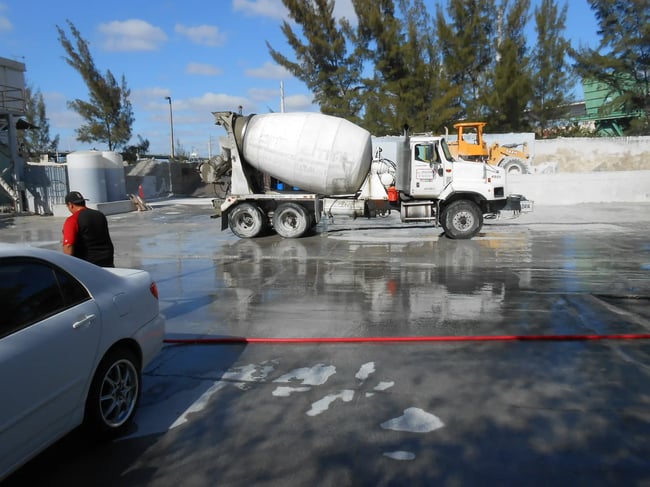
This is the piece that trips up a lot of plants. When process water mixes with stormwater, the result is generally referred to as "commingled water", and once that mixing happens, the whole volume typically needs to be managed as process water, not stormwater.
Picture a stormwater detention basin holding 5,000 gallons of rain runoff. If 100 gallons of washout water drains into that same basin, you don't end up with 4,900 gallons of stormwater and 100 gallons of process water sitting side by side. You end up with 5,100 gallons of commingled process water that you're now responsible for managing and, in most cases, can't simply discharge under your stormwater permit. A small washout event can effectively convert an entire basin's contents into something your permit doesn't cover.
That's the real financial and compliance risk here. It's not that a little washout water is dangerous on its own. It's that letting it reach a stormwater system can reclassify a much larger volume of water you were previously allowed to discharge.
Does Treating Process Water Change How It's Regulated?
Not on its own. Settling, filtering, clarifying, or adjusting the pH of process water can genuinely improve its quality, sometimes to the point where it looks and tests cleaner than the stormwater sitting next to it. But treatment changes the water's condition, not its origin. Treated process water is still process water.
Even if treated process water would meet typical discharge benchmarks on paper, meeting a water quality benchmark and having permission to discharge are two separate questions. A lot of plants conflate the two, assuming that clean-looking, well-treated water must be fine to send to a storm drain. Your permit, not the water's appearance or lab results, determines whether that discharge is authorized. If you're already tracking benchmark values on your stormwater samples, it's worth remembering those benchmarks apply to stormwater discharges, not to process water that happens to test clean.
How Do You Keep Stormwater and Process Water Systems Separate?
The practical goal is simple to state and harder to execute: keep process water inside its own system, and keep unnecessary stormwater out of it. A dry-weather walk of your plant is the best place to start. Trace every place process water is generated, including washout areas, reclaim systems, basins, drains, stockpile sprinklers, curbing, and stormwater inlets, and follow where that water actually goes rather than where you assume it goes.
From there, look specifically for crossover points between the two systems. Can process water reach a storm drain if a valve is left open or a hose is misdirected? Can rainfall get into your process-water system through an uncovered basin or an open reclaim pit, adding unnecessary volume you now have to manage as process water? Can a basin overflow during a heavy storm and carry commingled water off site? Is a dust-control sprinkler creating runoff outside the footprint it was designed for? Reducing the volume of process water you generate in the first place also reduces your exposure. Fixing leaks, avoiding unnecessary washdown, controlling rinse volumes, and looking for reuse or recycling opportunities within the plant all shrink the amount of water you have to manage and lower the odds of an accidental crossover. Many of the same best management practices that keep your stormwater samples clean also help keep process water contained.
Common Mistakes Ready-Mix Plants Make With Process Water and Stormwater
A few patterns show up again and again when we're out at concrete plants. The first is assuming that because a discharge point looks like it's mostly rainwater, it must be stormwater, without ever checking whether a reclaim pit or washout pad drains toward it. The second is treating process water and assuming that solves the permit question, when in reality it only solves the water quality question.
The third, and probably the most common, is basin design that doesn't account for commingling at all. Plants often build a single detention basin to handle "runoff" without separating the stormwater collection area from areas where washout or dust-control water is likely to end up. Once that basin fills during a storm and needs to be discharged, there's no clean way to separate what's stormwater from what's commingled process water, and the whole thing has to be treated as the more restrictive category.
The fourth is not documenting any of this. If a state inspector or EPA auditor asks how you know a particular outfall is stormwater-only, "we're pretty sure" isn't much of an answer. A site map showing where process water is generated, where it's contained, and how it's kept separate from stormwater collection areas is worth having on hand, both for your own operations and for audit or inspection preparation.
The fifth mistake is a training gap that shows up over time rather than all at once. The person who set up the site's drainage layout and understood exactly which drains were stormwater-only and which fed the process water system isn't always the person running the plant a few years later. Without that institutional knowledge written down, new operators, drivers, and yard staff can end up washing out in the wrong spot or redirecting a hose without realizing it changes the classification of everything downstream. Building that knowledge into your stormwater training program, rather than leaving it as tribal knowledge, is one of the cheaper fixes on this list and one of the most commonly skipped.
How RMA Helps Ready-Mix Concrete Plants With Stormwater and Process Water
We work with ready-mix concrete producers on this exact issue on a regular basis, and it's rarely as simple as "just build a wall between the two systems." Every plant's layout, permit language, and operations are a little different, which means the fix looks different too. We help you walk the site, identify where process water is actually being generated and where it's crossing into stormwater areas, and figure out what your specific NPDES or state permit does and doesn't allow.
From there, we can help with everything from SWPPP updates to basin design considerations to broader NPDES permitting support, so you're not guessing about whether a discharge is compliant. There's no pressure and no obligation to any of this. If you'd rather talk through your plant's setup with someone who does this for a living, reach out to RMA and we'll help you figure out where you stand.