EPA's Audit Policy Explained: How Self-Reporting Environmental Violations Can Reduce Penalties
If your facility finds its own environmental violation, you've got a decision to make: say nothing and hope, or tell EPA yourself. EPA's Audit Policy exists to make the second option less painful, and for the right violations it can wipe out a large part of the penalty. It doesn't work the way a lot of people assume, though, and the deadlines start running the moment someone finds the problem.
In this post we'll walk through how the policy works, who it's meant for, what separates the 100 percent reduction from the 75 percent one, and how the 21-day and 60-day deadlines play out. We'll also cover what doesn't qualify and how to decide whether disclosing makes sense. If you'd rather talk it through with someone before you do anything, you can reach out to RMA.
Table of Contents
TL;DR
EPA's Audit Policy can eliminate up to 100 percent of the gravity-based penalty when you find a violation through a systematic audit, report it within 21 days, and correct it within 60. Violations found outside a regular audit program can still earn a 75 percent reduction. EPA may still recover the money you saved by not following the rules, and the policy doesn't cover repeat problems, certain serious violations, or state penalties.
What Is EPA's Audit Policy and Why Does It Exist?
EPA's Audit Policy is built to get businesses checking their own compliance instead of waiting for a government inspection to turn up problems. If a company finds a violation on its own, reports it, and fixes it, EPA can reduce or even eliminate certain penalties. EPA gets more violations corrected, and the company gets a way out of full enforcement.
The practical benefit is time. A facility that discloses and corrects a problem can work through it without worrying quite as much about an inspector showing up tomorrow, finding the same violation, and treating it like any other enforcement case. Reports go to EPA through its online system, called eDisclosure.
Finding those problems usually starts with an environmental audit, which is a structured review of your permits, operations, and records. The policy rewards the facilities that do that kind of looking on purpose.
Who Can Use EPA's Audit Policy, and What About the Small Business Compliance Policy?
The Audit Policy is open to businesses of all sizes, but it's aimed most squarely at companies with more than 100 employees. If you have 100 or fewer, EPA has a separate program called the Small Business Compliance Policy, which is a little less strict. The two programs have different rules, so figure out which one fits your headcount before you plan anything around either.
One of the biggest differences between them is how you find the violation. The Audit Policy puts real weight on that, and we'll get into why in a few sections.
How Much of the Penalty Can EPA's Audit Policy Eliminate?
EPA penalties can have two parts. The gravity-based portion reflects how serious the violation was. The economic benefit portion represents the money your company saved by not following the rules. Under the Audit Policy, EPA can eliminate up to 100 percent of the gravity-based penalty. It can still go after the economic benefit.
Say a facility classified certain hazardous wastes as nonhazardous for several years and avoided thousands of dollars in specialized disposal costs. EPA could recover those savings even after wiping out the gravity-based penalty. That isn't automatic, though. EPA can also waive the economic benefit portion when the amount is insignificant, so for smaller violations it's entirely possible to disclose, correct the problem, and walk away without paying anything.
Why Would You Report a Violation if You Might Still Pay Something?
Because what you'd pay is almost always far less than what you'd face if EPA found the same violation during an inspection. Mistakes like the ones in our list of common audit findings are exactly the kind of thing a facility can find on its own, fix, and disclose before anyone else notices.
Why Does a Systematic Environmental Audit Matter for the Full Penalty Reduction?
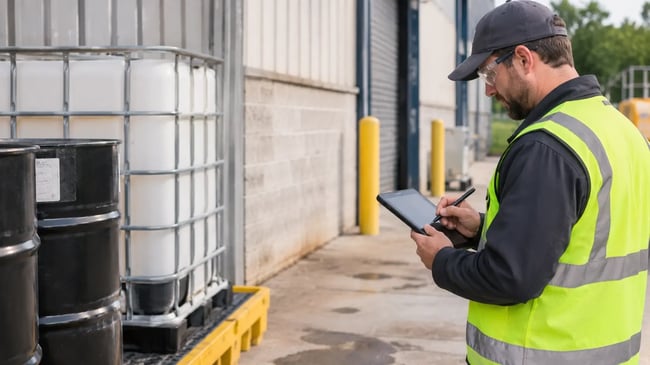
To get the full 100 percent reduction of the gravity-based penalty, your company generally needs to discover the problem through a systematic environmental audit or an established environmental management process. In plain terms, you need an organized process designed to find problems before a government inspector does. Stumbling across a violation one afternoon doesn't get you there.
Plenty of facilities meet that bar by bringing in an outside consultant to review permits, operations, and records on a regular schedule. Our post on who can do an environmental audit covers what a qualified auditor looks like and whether doing it in-house makes sense.
| How the violation was found |
Gravity-based penalty reduction |
| Through a systematic environmental audit or established environmental management process |
Up to 100 percent |
| Outside a regular, documented audit program |
75 percent, if the policy's other requirements are met |
What Documentation Do You Need to Show You Had a Real Process?
It has to be documented. You should be able to show that a real process for identifying violations was in place, with things like consultant correspondence, inspection logs, and audit reports. If a facility can't produce any of that, it's hard to argue the problem was found through a systematic effort.
What Are the 21-Day Reporting and 60-Day Correction Deadlines?
You generally need to report a potential violation to EPA within 21 calendar days of discovering it. You'll also generally have 60 days from discovery to correct it, though EPA may allow more time in some circumstances. Beyond the deadlines, you're expected to fix any resulting environmental harm, take steps to keep the problem from happening again, and cooperate with EPA.
| Requirement |
What it generally looks like |
| Report to EPA |
Within 21 calendar days of discovery, through eDisclosure |
| Correct the problem |
Within 60 days of discovery, with possible extensions |
| Fix resulting harm and prevent a repeat |
Required, along with cooperating with EPA |
The 21-day clock doesn't necessarily start when your final audit report is finished. If someone on the audit team spots a potential violation halfway through the work, a month before the written report lands, that can be the day the clock starts. Anyone planning an audit should decide up front who hears about findings in real time and who makes the call on disclosure. Our walkthrough of how an audit is run from start to finish shows where those mid-audit findings tend to surface.
Which Violations Don't Qualify for EPA's Audit Policy Penalty Relief?
The Audit Policy isn't automatic forgiveness. A few situations generally knock a violation out of the running:
- Finding the same problem over and over without making any progress fixing it. You can't keep reporting it and collecting reductions.
- Certain serious environmental violations, which are excluded outright.
- Problems discovered through government inspections.
- Problems found through testing or monitoring you're already legally required to perform.
There's also a limit on who's protected. The Audit Policy comes from federal EPA, so it doesn't automatically shield you from separate state penalties or state enforcement actions. A disclosure that goes well with EPA can still leave you dealing with your state agency, and you'll want to think through that side before you report anything.
How Much Does an Environmental Audit Cost Compared to a Penalty?
Environmental audits from RMA generally run between $3,000 and $10,000, depending on the size of the facility and how much ground the audit covers. Our post on what an environmental audit costs breaks down what moves the number up or down.
Penalty exposure sits on a different scale. As of the January 2025 inflation adjustments, federal civil penalty maximums are $124,426 per day per violation under RCRA and $68,445 per day under the Clean Water Act. Those are ceilings, not what most facilities pay, but they show why a few thousand dollars spent finding problems early is cheap by comparison. The pricing calculator below gives you a ballpark for the audit side based on your facility.
Should You Voluntarily Disclose a Violation Under EPA's Audit Policy?
It depends on the circumstances. You want to be sure the violation qualifies and that you understand what you're committing to before you report it. At the same time, you can't spend months deciding, because the reporting deadline starts when the problem is discovered.
The best time to learn how the policy works is before an audit begins. That way, if problems turn up, you can make an informed decision about disclosure instead of scrambling through a 21-day window. If you're still weighing whether an audit makes sense at all, start with whether your facility needs an audit, and read whether you have to report audit results before you commit to a plan. It's also worth knowing why a poorly run audit can hurt you, since a sloppy review can create records you'd rather not have.
You can absolutely manage all of this internally if your company has the people and the time. Nothing about the policy requires a consultant.
How Can RMA Help With Environmental Audits and EPA's Audit Policy?
We help businesses set up and run environmental audits, evaluate any problems we find, and work out whether the Audit Policy makes sense for the situation. When it's appropriate, we also help with the reporting and the corrections, so the problems get fixed properly while you take advantage of whatever penalty relief is available. You can read more about RMA's environmental audit process on our site.
There's no pressure and no obligation. If you'd like to talk through an upcoming audit or a violation you've already found, you can call us, email us, or contact us through the website. If you're better off handling it in-house, we'll tell you.

