Bringing in a Consultant for SPCC Support: Our Process Explained
If you've figured out that your facility needs an SPCC Plan, the next step feels less obvious than the first. You know you need something done. You're just not sure what it actually looks like to get it done. How do you pick a consultant? What do they actually do? Are they going to show up, poke around your facility for a day, and then send you a bill and a binder? How long until you have a plan in hand? And maybe the biggest question: is the whole thing going to be a headache?
We can't speak for every environmental consulting firm out there, but we can show you exactly how it works when you hire us. This article pulls back the curtain on RMA's SPCC process, from that first conversation all the way to the finished plan and what comes after. If you'd rather skip the reading and just talk to someone, reach out to RMA and we'll have a real conversation about your facility.
Table of Contents
Do I Even Need an SPCC Plan? Starting With the Right Question
Before we talk about the process, let's make sure we're solving the right problem. Not every facility that stores oil needs an SPCC Plan. The federal rule under 40 CFR Part 112 kicks in when your facility has the capacity to store more than 1,320 gallons of oil aboveground in containers of 55 gallons or larger, or more than 42,000 gallons underground. "Capacity" is the key word there. It's about what your containers could hold, not what's in them on an average Tuesday.
We've had people call us convinced they needed a plan who didn't, and people call us about something totally unrelated who absolutely did but had no idea. Both conversations are free, and we'd rather sort it out upfront than start a project that doesn't need to exist. If you're unsure where you fall, our complete guide on everything you need to know about SPCC plans walks through the thresholds, the types of oil that count (spoiler: it's basically all of them), and the three tiers of plans.
What Happens When You Reach Out
You can fill out a form on our website, send us an email, or pick up the phone. We're not picky about the method. What happens next is a conversation, and it's free.
This isn't a sales call where we try to close you before you hang up. It's a genuine back-and-forth. We'll ask about your facility, the types of oil you store, how many tanks and drums you have, whether there's an existing plan collecting dust somewhere, and what prompted you to reach out. Maybe it was an inspection. Maybe a new facility. Maybe you just looked at your plan for the first time in six years and realized half the information in it is wrong.
You can ask us whatever you want. How long things take. What it'll cost. Whether you can do it yourself. Whether your sister-in-law's engineering firm can stamp it. We'll give you straight answers. If we think you can handle a Tier I plan on your own using EPA's free template, we'll tell you that. If we think you're in over your head, we'll tell you that too. And if we're not the right firm for your situation, we'll say so and point you in the right direction.
The Three Reasons Facilities Hire Us for SPCC
After doing this for decades, the scenarios we see boil down to three buckets.
New SPCC Plan Development
You've crossed the storage threshold and need an SPCC Plan built from scratch. Maybe you just added a diesel tank. Maybe you expanded operations and your drum count crept up without anyone tracking it. Maybe you bought a facility that didn't come with a plan. Whatever the trigger, the plan needs to exist, and it needs to reflect your actual operation.
SPCC Plan Updates and Amendments
You have a plan, but it's out of date. Tanks have been added, moved, or removed. Emergency contacts are wrong. The site map shows a building that was demolished three years ago. Under the regulation, your plan has to reflect current conditions, and it has to be reviewed at least once every five years. We've written about how SPCC five-year reviews work if you're trying to figure out whether your plan needs a touch-up or a full redo.
SPCC Program Improvement
The plan itself might be fine on paper, but the program behind it isn't functioning. Monthly inspections aren't getting done. Nobody's been trained in two years. There's no documentation of anything. The plan says one thing and the facility does something else. This is more common than most people would admit, and it's usually what inspectors notice first.
From Agreement to Kickoff: How an SPCC Project Starts
If that initial conversation goes well and we both think it makes sense to move forward, we put together a Service Agreement. It's a clear document that outlines what we're doing, the timeline, and the cost. Once you sign, we're on your team.
We scope the agreement based on what we learned during that first conversation. A straightforward facility with one AST and a handful of drums is a different project than a multi-building operation with a tank farm, transformer oil, and hydraulic systems scattered across the property. The agreement reflects your situation, not a one-size-fits-all package.
One thing we flag early: some states have their own spill plan requirements on top of the federal SPCC rule. Pennsylvania has PPC Plans. New Jersey has DPCC Plans. Michigan has PIPPs. Louisiana has SPC Plans. If your facility is in a state with overlapping requirements, we identify that during scoping so you're not caught off guard later.
On-Site vs. Remote: Two Ways We Build Your SPCC Plan
For most projects, we visit your facility in person. We walk the site with you, identify every oil storage container, evaluate secondary containment, look at transfer and loading areas, check drainage pathways, and observe how oil is handled day-to-day. The goal is to understand how your facility actually operates so the plan we write matches reality.
We're not there to shut down your operations or lecture your crew. It's a collaborative walk-through. We take notes, photos, and measurements, ask questions about things that aren't obvious from looking (like seasonal changes in operations or delivery schedules), and generally try to learn everything we need to build a plan that works for you.
For facilities with simpler setups and good existing documentation (photos, site maps, tank specs), we can sometimes build the plan remotely. This is faster, often less expensive, and works especially well for facilities with a few tanks and drums in a relatively straightforward configuration. We've explained how remote SPCC development works in detail, and our article on what remote plans cost breaks down the pricing differences. For multi-site clients, remote development can be a game-changer in terms of both cost and turnaround time.
What's Actually in the Finished SPCC Plan
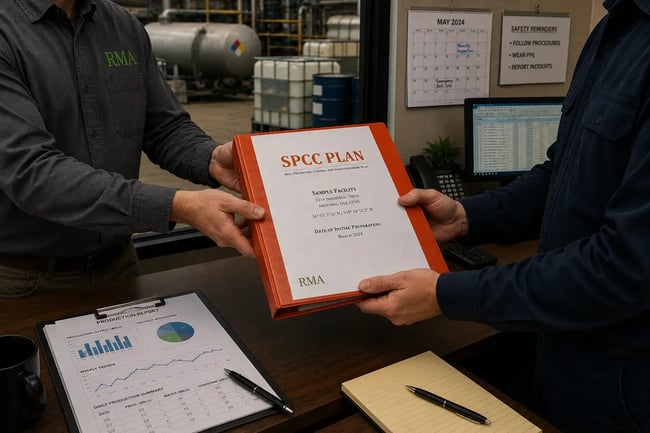
Your SPCC Plan is a real document, an actual book or binder that lives on-site at your facility and is available for immediate reference during an emergency or inspection. You can also keep a digital copy, but the regulation expects a physical version that's accessible even if the power goes out or the internet is down.
Every plan we deliver is facility-specific and includes a description of all oil storage at the facility, types, locations, and capacities. Site maps and diagrams showing where oil is stored and how a spill could travel. Details on secondary containment for every regulated container. Step-by-step spill response procedures. Inspection and maintenance schedules. Contact information for emergency responders and internal personnel. Staff training procedures. And recordkeeping requirements to keep the whole thing organized going forward.
If your plan requires PE certification (which is mandatory for facilities storing 10,000 gallons or more, or facilities with a recent spill history), a licensed Professional Engineer reviews and certifies the plan. That's built into the project. If you qualify for a Tier I or Tier II self-certified plan, we can still develop it for you, and many facilities choose to have a professional handle it even when self-certification is allowed. Our article on the different types of SPCC plans explains which tier applies to your situation.
The Difference Between an SPCC Plan and an SPCC Program
This is where a lot of facilities stop short. They get the plan, put it on the shelf, and assume they're compliant. The plan is the foundation, but compliance doesn't end when the binder arrives.
A functioning SPCC program means your team actually does the monthly inspections the plan requires. It means annual training happens and is documented. It means the plan gets reviewed every year and updated when things change, like new tanks, removed containers, or different emergency contacts. It means the five-year review gets done on schedule. And it means when a spill happens at 6 AM, someone on your team can grab the plan and know exactly what to do.
If you want us to help with the program side, we can. Training support, inspection templates and schedules, documentation systems, annual reviews, and periodic check-ins are all things we offer. Some clients just need the plan and handle the rest themselves. Others want ongoing support. Some fold SPCC into a broader full environmental program where we manage everything. We're flexible.
For the training piece specifically, SPCC training is required at least annually. If you want to handle it internally, we offer online SPCC training courses that your team can take on their own schedule, complete with documented completion certificates that inspectors want to see.
How to Know If We're the Right Firm for Your SPCC Needs
We're not the right fit for everyone, and we think that's important to say upfront.
If you don't meet the SPCC thresholds, you don't need a plan and you don't need us. If you're a very large organization operating hundreds of facilities, each with millions of gallons of oil, you may need a consulting structure built for that scale. We're a modest-sized firm with senior people doing the work. That model doesn't scale to 500 facilities, and we won't pretend it does.
Where we're the best fit is in the middle. Facilities storing anywhere from a few thousand to a few hundred thousand gallons across one to a few dozen locations. Companies that don't want to build a big internal compliance department but want their plan developed correctly, defensibly, and by people who actually know what they're doing. Organizations that are tired of getting generic templates from the cheapest bidder and want something that will hold up during an inspection.
What It Costs and How Long It Takes
SPCC pricing depends on the type of plan, facility complexity, location, and turnaround time. For a general range: Tier I and Tier II plans typically run $2,500 to $7,500, and full PE-certified plans run $4,000 to $15,000 or more. Multi-site clients often get bundled pricing.
We've built a free SPCC pricing calculator here on our website that gives you a realistic snapshot based on your specific situation. No email address required, no sales follow-up. Just put in your numbers and see what it looks like.
In terms of timeline, most projects take about a month or so from scheduling to final delivery. Rush jobs can sometimes get done in days. Remote plans are often faster. If you're doing it yourself and you qualify for a Tier I plan, it takes as long as it takes, but if you're unsure about the regulations, that DIY route tends to drag out and create more anxiety than it saves.
Is it worth the investment? Consider that EPA fines for not having a required SPCC Plan can reach $68,445 per day per violation. Run that math on even a short compliance gap and the cost of getting the plan done right starts looking very reasonable.
When you're ready, the first step is easy: start a conversation. We'll talk through your facility, figure out what applies, and give you an honest assessment of whether hiring us makes sense. If it doesn't, we'll tell you. If it does, we'll put together a clear scope and get to work. Reach out to RMA and let's figure it out together. You can also explore our SPCC service page, use the pricing calculator, or browse our SPCC Learning Center if you want to do more research first. Either way, the first conversation is free and there's no pressure.