SPCC Secondary Containment: 110% Capacity vs. the 25-Year, 24-Hour Storm Event
If you've ever tried to figure out how big your SPCC secondary containment needs to be, you've probably run into the question: do I just size it to 110% of my largest tank, or do I need to account for rainfall too? Maybe you're installing a new tank, updating your SPCC Plan, or trying to make sure your containment areas are set up correctly before an inspection. And like most things in the SPCC world, the answer isn't black and white.
We get this question all the time. We've talked with facility managers, engineers, other environmental professionals, state regulators, and EPA inspectors about it, and depending on who you ask, you'll hear a few different things. This article walks through how secondary containment sizing actually works so you can understand what's going on and make a good decision. If you want help evaluating your containment or your SPCC Plan, reach out to RMA and we'll take a look.
Table of Contents
What SPCC Regulations Are Asking You to Do
At its core, SPCC regulations require that your secondary containment is properly sized to prevent a discharge. That means if your largest tank fails, the containment needs to hold all of that oil and keep it from escaping. That's the baseline. Under 40 CFR 112.8(c)(2), secondary containment for bulk storage containers must be "sufficiently impervious to contain discharged oil" and sized to hold the capacity of the largest container plus "sufficient freeboard to contain precipitation."
That last phrase is the one that creates the confusion. "Sufficient freeboard to contain precipitation" is where the 110% rule and the 25-year, 24-hour storm event diverge, and where a lot of facilities end up undersized without realizing it.
Why 110% Capacity Doesn't Always Work For Outdoor Containment
A lot of people are familiar with the 110% rule. It's simple and easy to understand: take the volume of your largest tank and add 10%. So if you've got a 500-gallon tank, you build containment for 550 gallons. That works well in certain situations. For indoor or covered containment, it's generally a solid approach. The problem is when that same logic gets applied to outdoor containment areas.
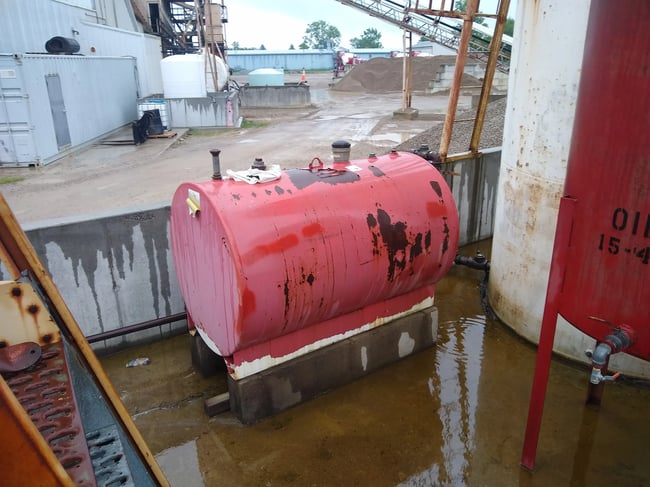
If it rains hard enough, that containment is going to start filling up, and now your available volume is shrinking before a spill even happens. On paper, everything looks compliant. In reality, the containment may not actually function the way it's supposed to during a worst-case scenario. This is where a lot of facilities get tripped up, and it's one of the most common things we flag when reviewing SPCC Plans. Our full guide on everything you need to know about SPCC Plans covers the broader containment requirements.
The 25-Year, 24-Hour Storm Event Is the Preferred Standard for SPCC Compliance
To account for the risk that rainfall poses to outdoor containment capacity, most regulators and EPA expectations land on something called the 25-year, 24-hour storm event. All that really means is the amount of rain your location could receive over a 24-hour period during a relatively rare but realistic storm. It's not the absolute worst storm imaginable, but it's a reasonable "design for this and you'll be covered" benchmark. For outdoor containment, this is generally what the EPA expects you to consider.
Here's how the math changes. Take that same 500-gallon tank with containment built to 550 gallons using the 110% rule. Now imagine your containment area is about 4 feet by 8 feet. If that area fills with just 6 inches of rainwater during a storm event, you've already lost roughly 120 gallons of capacity before anything even spills.
So realistically, your containment needs to hold 500 gallons of oil plus 120 gallons of precipitation, which means you need 620 gallons of capacity to be safe. That's a 70-gallon difference between the 110% approach and the 25-year, 24-hour calculation, and it's enough to mean the difference between containment that works and containment that overflows during a real event.
A single storm can eat up your freeboard quickly. That's why relying strictly on 110% for outdoor containment can fall short.
Where 110% Capacity Still Makes Sense for SPCC Complaince
This doesn't mean the 110% rule is wrong. It just means it has its place. If your containment is indoors or fully covered and protected from rainfall, 110% is typically a practical and widely accepted approach. There's no stormwater to worry about, so the calculation is much more straightforward: the largest tank volume plus 10%, and you're done. For these situations, the 110% rule does exactly what it's supposed to do, and there's no need to overcomplicate it.
Everyone Forgets About Displacement!
There's another detail that often gets overlooked, and that's displacement. If you've got multiple tanks sitting inside a containment area, those tanks take up physical space! That means the actual volume available to hold a spill is less than the total volume of the containment structure. The space occupied by the tank bases, piping, and any other equipment inside the containment reduces your effective capacity.
So now you're juggling three things at once. You need enough capacity for the largest single tank. You need to account for rainfall if the containment is outdoors. And you need to factor in the space being taken up by other tanks and equipment sitting in the containment area. It adds up quickly, and it's one of the reasons these systems get undersized more often than people realize. A containment area that looks plenty big on a site plan can turn out to be undersized once you subtract displacement and add precipitation.
Can You Get in Trouble for This?
Not necessarily, but it can absolutely come up during an inspection. If your containment is sized right at 110% and doesn't account for rainfall, an inspector may ask questions about it. At that point, you'll need to explain how you're managing the risk. Some facilities compensate with more frequent inspections of containment areas, active drainage procedures with manual valves, or pump-out protocols after rain events. But those are operational controls, and they need to be documented in your SPCC Plan and consistently followed. The time to think through that explanation is now, not when someone with a clipboard is standing in your tank farm.
The bigger risk isn't necessarily the inspection finding itself. It's the scenario where a tank actually fails during or after a storm, the containment can't hold the oil because it's already half full of rainwater, and you have a discharge. At that point, the containment sizing question becomes a lot more consequential than a paperwork deficiency. Our article on what you're required to do after an oil spill covers the reporting, cleanup, and follow-up obligations that come with a release.
Why Was 110% Allowed in the First Place?
At this point, a lot of people ask a very fair question: if the 25-year, 24-hour storm event is the better standard, why has everyone been using 110% for so long?
The short answer is that it used to be a lot harder to do anything else. Before everything was available online, figuring out rainfall data for your specific location wasn't simple. You had to know where to look, dig through technical resources, interpret the data correctly, and apply it to your site.The 110% rule was simple, easy to apply, and in many cases, especially for indoor or covered containment, it worked well enough. It gave facilities a way to move forward with compliance without getting stuck on complex calculations.
Fast forward to today, and the landscape looks very different. Rainfall data is now widely available. You can look up the 25-year, 24-hour precipitation value for your exact location through NOAA's Precipitation Frequency Data Server. Because of that, the expectation has shifted. The EPA knows this information is easy to access now, and when better data is readily available, the expectation is that you use it.
That's why, in practice, we consistently see regulators and inspectors leaning toward the 25-year, 24-hour storm event as the appropriate benchmark for outdoor secondary containment. While you'll still hear people reference 110%, and while it still makes sense for indoor or covered containment, relying on it for outdoor containment is becoming harder to justify.
Getting SPCC & Oil Spill Plan Help
Secondary containment seems simple until you really dig into it. A lot of facilities assume they're fine because they hit 110%, but once you factor in rainfall and displacement, that margin can disappear quickly. If you're not confident in your setup, or you're planning new containment and want to make sure you get it right from the start, it's worth having someone take a look.
We've reviewed SPCC Plans and containment systems across the country, and this is one of the most common areas where things fall short. Reach out to RMA and we'll help you figure out what makes sense for your facility. You can also visit our SPCC service page or use our pricing calculator to see what an updated or new plan might cost.