What the PAG-03 Stormwater Permit Involves From Application to Ongoing Compliance, and When It Makes Sense to Bring In Help
Nothing in Pennsylvania's rules says you have to hire a consultant to get a PAG-03 permit. Your facility can prepare the application, submit it, and run the permit on its own. Most facilities want to know whether they should, since the application package is a big job and the work doesn't stop once DEP approves it.
We're environmental consultants, so we're a little biased here. We've also done a lot of PAG-03 work for facilities throughout Pennsylvania, and we'll give you a straight picture of what's involved so you can decide for yourself. Below we walk through each stage, from picking the right permit to living with it after approval. And if you'd rather hand it off, you can reach out to RMA anytime.
Table of Contents
TL;DR
Yes, you can get a PAG-03 permit without a consultant, and no Pennsylvania rule says otherwise. The catch is the workload. You'll need to confirm PAG-03 is the right permit, map your site and drainage, write a facility-specific PPC Plan, collect stormwater samples, and answer DEP's technical questions, and then keep up with inspections, sampling, training, and reporting for as long as you hold the permit. In our experience most businesses hand that work off, but a simple site with someone who has the time can handle it in-house.
Can You Get a PAG-03 Permit Without a Consultant?
Yes. PAG-03 is Pennsylvania DEP's general NPDES permit for stormwater discharges from industrial activity, and nothing in it requires you to hire anyone to prepare your application. Your own staff can gather the information, write the plans, submit the paperwork, and run the permit afterward. Plenty of facilities do exactly that.
Our guide to Pennsylvania's PAG-03 stormwater permit covers the permit itself, and our answer to whether you can get an NPDES stormwater permit yourself covers the same question for any state.
Doing it yourself means four jobs: learning how the permit works, putting together the application package, working with DEP while it reviews your submission, and staying compliant for as long as you hold coverage. The sections below take those in order.
Is PAG-03 the Right Permit for Your Facility?
Your first job is figuring out whether PAG-03 is even the permit you need. That depends on what you do at the site, what sits outside where rain can reach it, and where your stormwater ends up. There are three possible answers: PAG-03 coverage, a No Exposure Certification, or an individual permit.
Some facilities qualify for a No Exposure Certification. To qualify, all of your industrial materials and activities have to be stored and conducted indoors or under a roof. It's a much lighter lift than PAG-03 coverage, but it has to be renewed every five years, and DEP doesn't offer it to facilities that discharge to High Quality or Exceptional Value waters. Our post on what no exposure means under an NPDES stormwater permit walks through how DEP looks at it.
Other facilities can't use the general permit at all and need an individual permit, which is a separate application on a different DEP form. Our breakdown of general, individual, and no-exposure permits shows how the three compare.
Getting this call wrong costs you either way. You can spend weeks on a PAG-03 package for a site that could have filed a No Exposure Certification, or build an application for a permit your facility doesn't qualify for.
How Do You Evaluate and Map Your Facility for a PAG-03 Application?
Once you know PAG-03 is the right fit, you have to understand your own site the way DEP wants to see it. That means identifying every potential source of pollutants, working out how stormwater moves across the property, and marking your drainage areas and outfalls.
All of that then has to become the site maps that go into the application. Plenty of facility managers who know their site cold have never drawn a drainage map, and learning mapping software at the same time as you're learning the permit is a lot at once. The software alone can turn into a project.
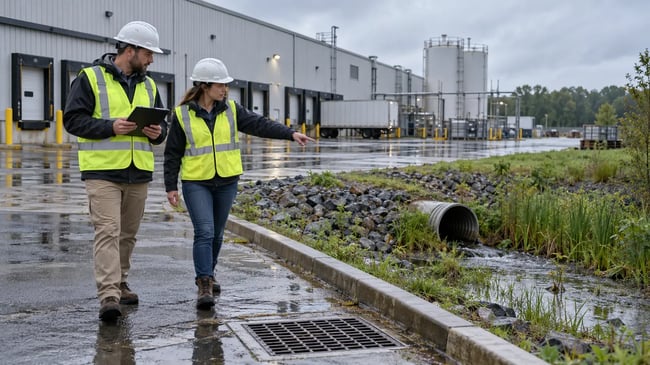
If you can, walk the site during a rainstorm or right after one. Water shows you where it really goes, and that's often not where the grading looks like it should send it. Low spots, cracked pavement, and a downspout dumping onto bare ground all show up fast when everything is wet.
The evaluation also drives everything after it. Which pollutant sources you find shapes what goes in your PPC Plan, and where your outfalls are decides where you'll sample. If the site walk misses something, the mistake shows up in every document that follows.
What Is a PPC Plan and What Does PAG-03 Require?
Next comes your PPC Plan. That stands for Preparedness, Prevention, and Contingency Plan, and it's Pennsylvania's version of what most other states call a SWPPP. It isn't the same document, though, so an example SWPPP from another state won't get you there. If you want the general idea first, our explainer on stormwater pollution prevention plans is a good starting point.
The plan has to be specific to your facility. It documents exactly how you prevent pollution on your site, and it covers everything else Pennsylvania requires it to include. It goes in with your application package. In our experience these plans can easily run past a hundred pages, so this isn't something you knock out in an afternoon.
If you're weighing whether to write it yourself, our post on developing your own SWPPP covers the same question for the more common version of the plan, and most of it applies here too.
How Does Stormwater Sampling Work for a PAG-03 Application?
Sampling runs on the weather's schedule, not yours. You have to work out which pollutants you're required to test for, wait for the right rain event, collect samples from the appropriate outfalls, get them to a lab, wait on the results, and work that data into the application. Which parameters apply depends on your industrial sector, and the reissued PAG-03 added Total Nitrogen and Total Phosphorus monitoring to every sector's requirements.
The application asks for stormwater quality data, including data on any pollutants that are causing impairment in the water your facility drains to. The lab also has to be able to meet DEP's target quantitation levels, so ask any lab you're considering whether it can before you hand over a sample.
Build the wait into your schedule. If you have a date you need coverage by, a dry stretch can stall the whole package, and nothing you do will speed up the rain.
The practical side takes some care. Our posts on taking your own stormwater samples, taking a good sample, and picking a water testing lab cover the details.
What Happens After You Submit Your PAG-03 Application to DEP?
Submitting isn't the finish line. DEP may come back with questions or ask you to provide additional information, and those questions can get technical. If you've spent years working with PAG-03, you can usually tell what the reviewer is asking for and what needs to change.
If this is your first time with the regulations, the same question can be really confusing. You might get a note from DEP and not fully understand what they're asking, let alone how to respond. And if the application has bigger problems, you end up making corrections, resubmitting information, and adding time to the process. Our post on common NPDES permit problems and how we fix them covers the kinds of issues we see.
Timing is the other issue. DEP sets the pace on its review, so any date you're working against, like a lease, a customer requirement, or a compliance deadline, needs some cushion built in. Someone who has dealt with DEP's reviewers before usually knows which questions are coming, and that saves rounds of back and forth.
What Does PAG-03 Compliance Look Like After DEP Approves Coverage?
Say DEP approves your coverage. Now you have to run your operation under the permit's rules, and that's a long-term job with its own calendar.
Ongoing PAG-03 Requirements
The recurring list includes required inspections, employee training, stormwater sampling, PPC Plan updates, and an annual report to DEP. Each has its own schedule, and missing one is easy when nobody owns the calendar. Our post on whether stormwater training is required covers the training piece, and if you want a way to train your team, we also have an online environmental training library.
Plan for who owns the calendar, too, and give that person a backup. When the one employee who ran the permit leaves, the schedule and the know-how often leave with them.
eDMR Reporting Under PAG-03
Your sampling results go to DEP as discharge monitoring reports, and Pennsylvania requires permittees to submit them through its eDMR system. If you haven't used it before, our guide to Pennsylvania's electronic DMR reporting shows how it works, and our post on what discharge monitoring reports are covers the basics.
What Happens When Your PAG-03 Sampling Results Come Back High
Results above your benchmark values come with obligations. Repeated exceedances can trigger a corrective action plan and added controls, and DEP can also tell you to apply for an individual permit instead. You want to understand those requirements before you get a bad result, not after. Our posts on benchmarks versus limits and what to do if your sampling results are high cover both sides of it.
Should You Do PAG-03 Yourself or Hire a Consultant, and What Does Help Cost?
In our experience most businesses hand PAG-03 to a professional, and the reason is simple. It's a lot to learn for something that isn't your actual business. That isn't true for every facility, though, and we'd rather you check the alternatives before you spend money.
When Doing PAG-03 Yourself Makes Sense
A small, simple site with one or two outfalls is a reasonable DIY candidate. So is a facility that turns out to qualify for a No Exposure Certification, since that path skips most of the work above. It also helps a lot if someone on your team has the time and doesn't mind reading permit language. You can split the job, too. Some facilities take their own samples and hire help for the plan and application. Our post on whether you need an environmental consultant at all gives you a way to think it through.
When Hiring PAG-03 Help Makes Sense
Help starts to pay for itself in a few situations:
- Your site has several outfalls or complicated drainage.
- Nobody on staff has the time to own the permit for years, not just weeks.
- You've already had trouble with a DEP review or a bad sampling result.
- You'd rather not become a PAG-03 expert on top of your real job.
What Does PAG-03 Consulting Help Cost?
It varies a lot, because it depends on your facility size, how many outfalls you have, how much sampling is needed, and what you already have in place. The fastest way to get a ballpark is our pricing calculator below. It's a quick, easy way to see a rough number without submitting an email or talking to anyone. That number is the cost of getting a professional's help from RMA, not DEP's fees or the cost of the permit itself. For more on the cost side, see how much a stormwater permit costs and browse our service pricing calculators.
How Can RMA Help With Your Pennsylvania PAG-03 Permit?
If you'd rather not figure all of this out yourself, that's what we do. RMA can determine which permit path applies, evaluate and map your facility, coordinate the required sampling, prepare your PPC Plan and application, handle any questions that come back from DEP, and help manage the ongoing requirements after your permit is approved. Your team doesn't have to become PAG-03 experts. If you want to see how we work first, our service and company fit guide and our NPDES permitting service page explain what we do and who we're a good fit for.
There's no pressure and no obligation. You can call us, send an email, or fill out the form on our website, and we'll talk through your facility and tell you what PAG-03 would involve for you. If it turns out you can handle it on your own, we'll tell you that too. Reach out to RMA whenever you're ready.