NPDES Stormwater Sampling Explained So You Collect the Right Sample the First Time
If your NPDES or stormwater permit tells you to collect a "grab sample" for one parameter and a "composite sample" for another, it's easy to assume the distinction doesn't matter much. It matters a lot. Collect the wrong type of sample and there's usually no fixing it after the fact. The lab can't turn a single bottle into a time-averaged composite, and it can't turn a composite back into a snapshot of one specific moment. You're left waiting for the next qualifying event or discharge to try again, which can mean missed reporting deadlines and a gap in your monitoring record.
In this article, we'll break down exactly what separates a grab sample from a composite sample, why permits require one over the other depending on the parameter, how the two sampling methods sometimes both apply to the same discharge, and what actually happens if you get it wrong. If you'd rather have someone walk your team through your specific permit's sampling requirements instead of piecing it together on your own, reach out to RMA and we'll help you sort out what you're actually required to collect.
Table of Contents
TL;DR
A grab sample is a single sample collected at one moment in time, generally within a 15-minute window, and it captures what the discharge looked like right then. A composite sample combines multiple smaller samples collected over a longer period, either at fixed time intervals or proportional to flow, to represent the discharge as a whole rather than a single instant. Your NPDES or stormwater permit tells you which method to use for each parameter, and sometimes the same sampling event requires both. There's no universally "correct" choice between the two. There's only what your permit specifies, and getting it wrong usually means you can't fix the sample after the fact.
What Is a Grab Sample Under an NPDES Permit?
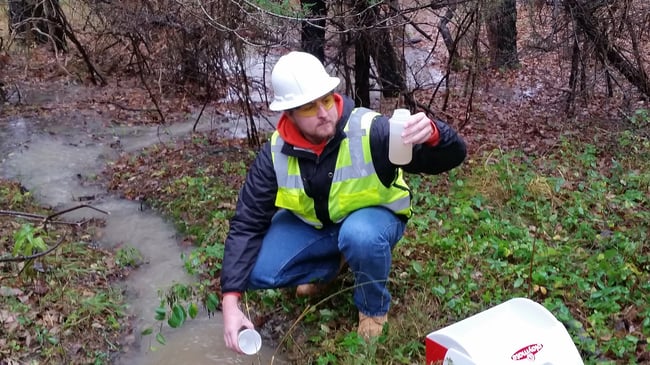
A grab sample is exactly what it sounds like. You collect one sample, in one bottle, at one point in time, from one location. EPA's own inspection guidance defines a grab sample as an individual sample collected over a period not exceeding fifteen minutes, meant to represent conditions at the moment it's taken. Think of it as a photograph of your discharge rather than a video. Whatever the water quality happens to be when you fill the bottle is what the laboratory analyzes, for better or worse.
That snapshot approach is useful, and sometimes required, when regulators want to know what conditions looked like at a specific point rather than averaged over hours. For industrial stormwater permits, this shows up most often as the "first flush" requirement. Under the federal stormwater regulations, permittees collecting grab samples for industrial activity discharges have to report data from a grab sample taken during the first thirty minutes of discharge, or as soon after that as practical, since pollutant concentrations in stormwater runoff are typically highest right at the start of a storm event and drop off from there.
Grab samples also tend to be the required method for parameters that can shift quickly or that would be altered by the mixing and storage involved in compositing. A discharge's pH, temperature, and residual chlorine level can all change meaningfully within minutes, sometimes because of the very act of collecting and combining samples over time. For those parameters, a permit typically wants to know what conditions actually were at a given moment, not a blended average that might mask the real picture.
What Is a Composite Sample Under an NPDES Permit?
A composite sample takes the opposite approach. Instead of one sample at one moment, you collect a series of smaller portions, called aliquots, at set intervals over a defined period, then combine them into a single sample that gets analyzed as one. If a grab sample is a photograph, a composite sample is closer to a short movie that gets condensed down to a single still frame representing the average of everything that happened while it was rolling.
The logic behind compositing is straightforward. Discharge conditions and flow rates change throughout a storm event or a production cycle, and a single grab sample only tells you about one moment. If you're trying to understand the overall pollutant load or average concentration over the course of a discharge, a well-built composite sample is going to be far more representative than any one grab could be. That's why parameters like BOD, TSS, and COD are so commonly required as composite samples. Regulators want the average picture, not a single frame that might happen to catch an unusually clean or unusually dirty moment.
Time-Weighted vs. Flow-Weighted Composite Samples
Not all composite samples are built the same way, and your permit or your testing lab may specify which type applies to your discharge.
A time-weighted composite collects equal-volume aliquots at fixed time intervals, regardless of how much water is actually flowing at each collection point. Federal stormwater sampling protocol under the industrial stormwater regulations calls for a minimum of three aliquots collected over the first three hours of discharge, with each aliquot separated by at least fifteen minutes, unless an automated flow-weighted sampler is used instead. Time-weighted compositing is simpler to execute manually, which is part of why it's common for facilities collecting samples by hand rather than with automated equipment.
A flow-weighted composite adjusts the volume of each aliquot based on the flow rate at the time it's collected. When flow is high, you collect a larger portion. When flow slows down, you collect less. The result more accurately reflects the actual mass of pollutants moving through the discharge rather than just the average concentration, but it requires a flow signal from a metering or monitoring device, which usually means an automatic sampler rather than someone manually filling bottles on a schedule. If your permit calls for a flow-weighted composite and you don't have the equipment to measure flow in real time, that's a conversation worth having with your consultant or your lab before your next qualifying event, not after.
Which Parameters Require Grab Samples vs. Composite Samples?
There's no universal rule that says grab samples are for one category of pollutant and composite samples are for another. It genuinely comes down to what your specific permit requires for each parameter, and that can vary by permit type, state, and industry sector. That said, a few patterns show up often enough to be worth knowing.
Parameters that are unstable or that change quickly are the most common candidates for grab sampling. pH, temperature, residual chlorine, oil and grease, and certain volatile compounds fall into this category, since compositing them over hours could let the result drift away from what actually happened at the outfall. Parameters that represent an overall load or average concentration, like BOD, COD, TSS, and many nutrients, are more often composite parameters, because a single moment doesn't tell the full story of what left the facility.
Where this gets confusing is that the same list of parameters can be treated differently permit to permit. A general industrial stormwater permit in one state might require a grab sample for a pollutant that a different permit, or a different sector, treats as a composite parameter. This is exactly why reading your own permit's monitoring table carefully matters more than memorizing a general rule of thumb. If you want a deeper look at how your results get evaluated once you have them, our article on stormwater benchmarks versus effluent limits walks through what happens after the sample is collected and analyzed.
Can One Sampling Event Require Both a Grab and a Composite Sample?
Yes, and this trips people up more than almost anything else in the sampling process. It's entirely normal for a single discharge event, whether that's a storm event or a continuous process discharge, to require a grab sample for one parameter and a composite sample for another during that same event. Your permit isn't asking you to pick one method for the whole sampling day. It's asking you to apply the correct method to each individual parameter on your monitoring list.
In practice, this means a facility might be out at the outfall collecting a quick grab sample for pH and residual chlorine at the same time an automatic sampler is running a multi-hour composite for BOD and TSS. Both are correct, and both are required, because they're answering different questions about the same discharge. Treating the whole event as "one sample" instead of a set of parameter-specific requirements is one of the more common ways facilities end up with incomplete or noncompliant monitoring data without realizing it until the DMR is due.
How Do You Know Which Sampling Method Your NPDES Permit Requires?
Your permit is the final word, full stop. Every NPDES and stormwater permit includes a monitoring requirements section, usually presented as a table, that lists each parameter you're required to test for along with the required sample type, frequency, and sometimes the specific timing window. That table is where the answer lives, not in a general guide like this one and not in what a similar facility down the road happens to do.
Pay close attention to language around timing as well as method. A permit might specify that a grab sample has to be collected within the first thirty minutes of discharge, or that a composite has to run over a minimum three-hour period with aliquots no more than a set number of minutes apart. Missing the timing window can invalidate an otherwise correctly collected sample just as surely as using the wrong method entirely.
If your permit language is unclear, contradictory, or references sampling procedures you haven't dealt with before, that's a reasonable point to loop in your consultant or your lab rather than guessing. Our article on collecting your own stormwater samples covers what's realistic to handle in-house and what tends to call for outside help, and our guide to taking a good stormwater sample goes through the mechanics of proper collection technique once you know which method applies.
What Happens If You Collect the Wrong Type of Stormwater Sample?
This is the part that makes getting the method right worth the extra attention up front. If you collect a grab sample when your permit requires a composite, or vice versa, there's typically no way for the laboratory to correct that after the fact. A grab sample can't be retroactively turned into a representative average of a multi-hour discharge, and a composite sample can't be unmixed to recover what conditions looked like at one specific moment. The sample you have simply isn't the sample your permit asked for.
In most cases, that means waiting for the next qualifying storm event or the next scheduled monitoring period to try again, which can push your data collection past a reporting deadline. Depending on your permit and your state program, missing a monitoring requirement can itself become a reportable issue on your discharge monitoring report, separate from whatever the underlying water quality results turn out to be. Repeated or unresolved monitoring failures can also draw closer scrutiny during an inspection. For context, federal Clean Water Act penalties currently top out around $68,445 per day per violation under the most recent penalty inflation adjustment, which is a good reminder that monitoring and reporting obligations aren't just paperwork, they're enforceable permit conditions in their own right.
Our article on reporting bad stormwater sampling results covers a related question we hear often, and if you're trying to make sense of a lab report after the fact, why NPDES lab results are so often confusing is worth a read too.
Coordinating With Your Lab Before You Collect NPDES Samples
Sample type isn't the only thing that has to line up before you head out to the outfall. Different analyses require different bottle types, preservatives, minimum sample volumes, holding temperatures, and holding times, and getting any of those wrong can invalidate a sample just as effectively as using the wrong collection method. Federal regulations under 40 CFR Part 136 spell out maximum holding times and preservation requirements by parameter, and your lab is the one who can tell you exactly what they need before you're standing in the rain trying to figure it out.
A quick call to your lab before a qualifying event, rather than after you've already collected samples, solves most of these problems before they happen. Ask what bottles and preservatives they'll provide for each parameter on your monitoring list, confirm holding times so you know your window for getting samples to them, and make sure everyone collecting samples on your team understands which method applies to which parameter. Our guide to getting better stormwater samples covers several of these practical, avoidable mistakes in more detail, and what to do with your samples after collection covers the handoff to the lab itself.
This coordination matters just as much for facilities that generate industrial process water alongside stormwater. Concrete producers, for example, often have both stormwater and process water discharge points with different sampling requirements running side by side, which makes knowing exactly which method and which lab protocol applies to which outfall even more important. Our guide to concrete plants and stormwater permits goes into that in more detail.
How RMA Helps With NPDES Grab and Composite Sampling
If you'd rather not sort through your permit's monitoring table, your lab's holding time requirements, and your team's sampling schedule on your own, that's a normal thing to want help with, and it's the kind of work we do regularly. We can walk through your specific permit with you, explain exactly which parameters require grab samples and which require composite samples, and help you build a sampling routine that your team can actually follow consistently instead of re-figuring it out every time a storm rolls through.
We also train facility staff directly on proper sampling technique, help you understand what your results actually mean once they come back from the lab, and manage the broader set of NPDES permit obligations that sampling is just one piece of, including deadlines, reporting, and what to do when results don't come back the way you hoped. There's no pressure and no obligation involved in a conversation. If you want a hand with any part of your NPDES or stormwater monitoring program, reach out to RMA and we'll help you figure out where you stand.