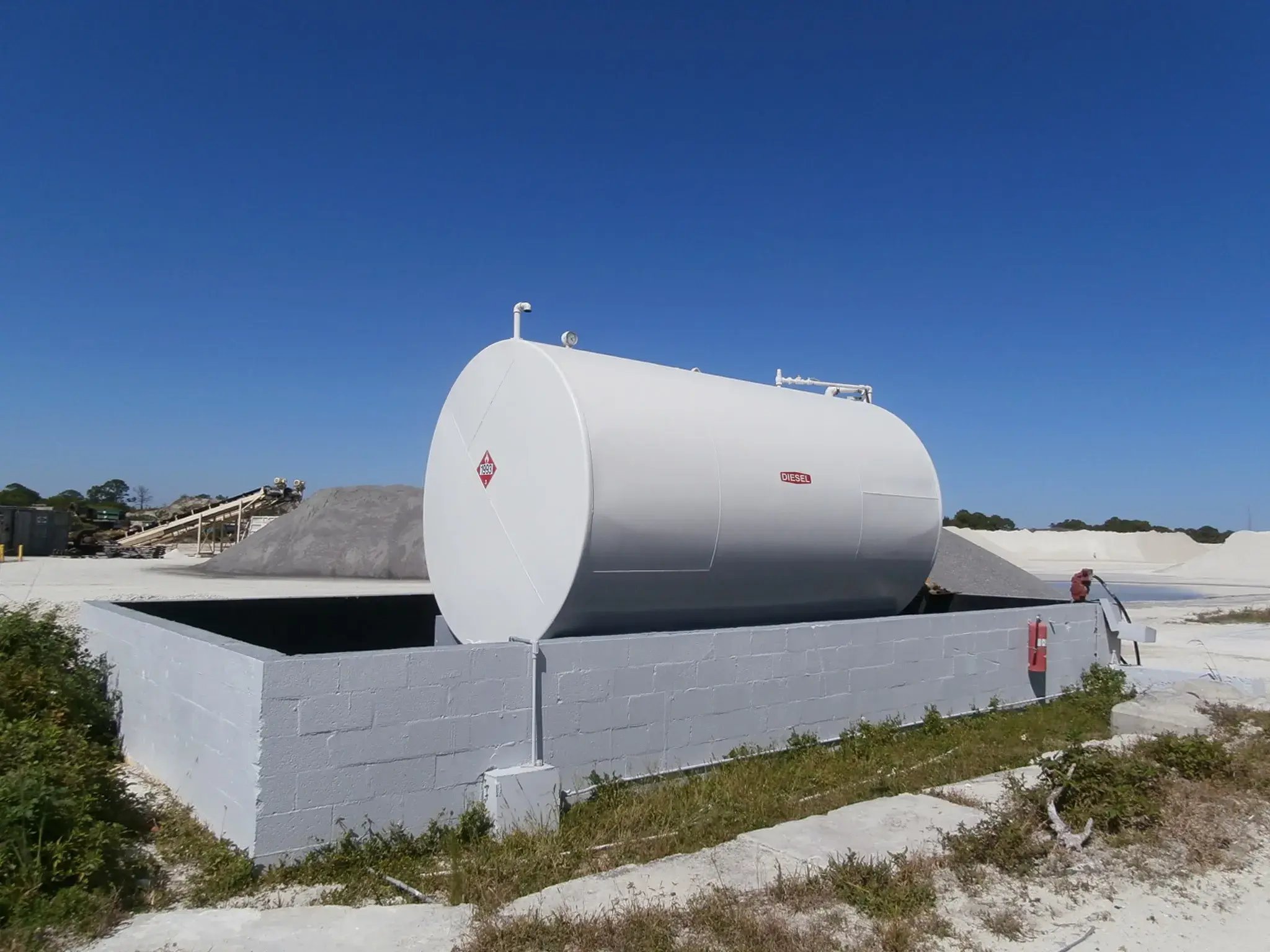
What's Involved in a Pennsylvania Tank Leak Cleanup, From the First Phone Call to DEP Sign-Off
A tank leak is a bad day, and a leak that reaches the soil or groundwater turns it into a project that can run for months or years. It might be a diesel tank behind the shop, a heating oil tank in a building you own, or a hydraulic oil container that failed. In Pennsylvania the path from "we found a leak" to "DEP signed off" follows a fairly predictable sequence: you report it, you stop the release and contain it, a consultant works out how far it spread, and then the contamination gets cleaned up to a standard DEP accepts.
This article walks through each stage at a high level, including how DEP's storage tank corrective action process and the Act 2 Land Recycling Program standards fit together, who pays, and when a lawyer belongs on the call. Every site is different, so treat this as a map and not a plan for your property. And if you're sorting out what your oil storage means for your spill prevention obligations, you can reach out to RMA at any point.
Table of Contents
TL;DR
After a tank leak contaminates soil in Pennsylvania, you generally have to notify DEP within 24 hours of confirming the release, stop and contain it, and then have a qualified consultant investigate how far the contamination spread. The cleanup has to meet one of Act 2's three standards (background, Statewide health, or site-specific), and DEP reviews reports at each stage. Costs and timelines swing widely from site to site, and DEP's approval doesn't automatically erase your liability, so most facilities bring in a remediation consultant early and an environmental attorney whenever penalties, neighbors, lenders, or insurers are involved.
Who Do You Have to Notify After a Tank Leak Contaminates Soil in Pennsylvania?
If there's a fire risk, strong vapors in an occupied building, or anyone's health is threatened, call 911 first. The agency calls come after that, and there can be more than one of them depending on what leaked and where it went.
For a leak from a tank regulated under Pennsylvania's Storage Tank and Spill Prevention Act, the rule at 25 Pa. Code § 245.305 requires the owner or operator to notify the appropriate DEP regional office as soon as practicable, and no later than 24 hours after confirming the release. DEP's guidance calls for a phone call to the regional office. A few narrow exceptions exist, such as certain petroleum releases that stay contained in a sump below its lowest penetration, so check your situation against the rule before assuming one applies. Suspected releases have their own investigation and reporting steps, and DEP's storage tank program pages lay them out.
Separately, Pennsylvania's Clean Streams Law and 25 Pa. Code § 91.33 expect immediate notice when a spill threatens or reaches waters of the Commonwealth, which includes ditches, drains, and sewers that lead to streams. The rule doesn't set a minimum quantity, and DEP's guidance is to call in rather than guess whether you're under some threshold. DEP runs a 24-hour emergency hotline at 1-800-541-2050 with on-call staff in each regional office.
On the federal side, oil that reaches waters of the United States or leaves a sheen on the water has to be reported right away to the National Response Center at 1-800-424-8802. Our article on when you have to report an oil spill and how the sheen rule works covers that trigger in more detail.
One more layer applies if your facility needs an SPCC Plan. An SPCC Plan is the written federal oil spill prevention plan required when aboveground oil storage capacity is over 1,320 gallons (counting only containers of 55 gallons or more) or buried capacity is over 42,000 gallons. If your storage puts you over that line, you'll need a plan, and if you already have one, a release is a good reason to pull it out and see whether it needs changes. Under 40 CFR 112.4, a facility with a plan that discharges more than 1,000 gallons in a single discharge to navigable waters, or more than 42 gallons in each of two discharges within any 12-month period, has to send a written report to the EPA Regional Administrator, which for Pennsylvania means EPA Region 3. EPA can then require plan amendments. You can read more about who enforces SPCC plans and what a plan is in our overview of SPCC plans.
Here's how the whole sequence fits together for a release from a regulated storage tank:
| Stage |
What Happens |
Where It Comes From |
| Notification |
Call DEP's regional office within 24 hours of confirming the release, plus any state, federal, or SPCC notices that apply |
25 Pa. Code § 245.305, § 91.33, 40 CFR 112.4 |
| Initial response |
Stop the source, contain and recover product, protect water, and take interim steps to remove immediate hazards |
25 Pa. Code § 245.306 |
| Site characterization |
Sample soil and groundwater, map the contamination, and report findings to DEP |
25 Pa. Code §§ 245.309 and 245.310 |
| Remedial action plan |
Propose how you'll clean up and which Act 2 standard you'll meet |
25 Pa. Code § 245.311 |
| Remediation |
Carry out the plan, with progress reports to DEP |
25 Pa. Code § 245.312 |
| Completion report |
Show the standard was attained, then DEP takes final action |
25 Pa. Code § 245.313 |
What Does Initial Response Look Like After a Tank Leak?
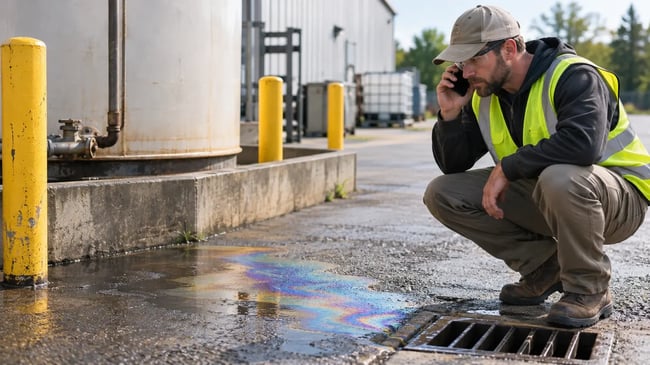
The first job is to stop the release at its source and keep it from spreading. In practice that means emptying or isolating the leaking tank, transferring product to a safe container, and putting down absorbents or berms to hold what's already out. Storm drains and any path to a stream, ditch, or neighboring property get blocked or protected first. Most facilities call an emergency response contractor for this part, since the right equipment and disposal arrangements are what keep a small spill from becoming a big one.
The storage tank cleanup rules also contemplate interim remedial actions, which are early steps to abate an immediate hazard or stabilize the site before the full investigation is done. That might mean removing visibly stained soil, recovering free product from the ground, or venting a building with petroleum vapors in it. If contamination threatens a drinking water supply, the rules include provisions about affected or diminished water supplies, and the responsible party can be expected to deal with that quickly.
Two habits pay off later. First, document everything as it happens, including photos, estimated quantities, the timeline, and who you notified and when. Second, don't haul excavated soil off site without a plan. Storing contaminated soil on site has its own rules in the regulations, and disposal depends on how the soil is classified, so your consultant should sort that out before the trucks show up.
How Does Site Characterization Work After a Pennsylvania Tank Release?
Once the emergency is under control, the question becomes how far the contamination went. Site characterization is the investigation that answers it. A consultant typically advances soil borings or digs test pits, installs monitoring wells, and sends samples to a lab for the substances involved. They look at how deep groundwater is, which direction it moves, and what sits downgradient, such as supply wells, streams, utilities, and basements where vapors could collect.
The results go into a site characterization report that DEP reviews. A good one describes the source, how the contamination has moved, and who or what could be exposed to it, and it proposes which Act 2 standard you'll aim for. The regulations include professional seal requirements for certain reports, so expect a licensed professional such as a geologist or engineer to be involved. Sometimes the investigation reveals that more work is needed, which is normal, since a single round of sampling rarely maps a plume completely.
This is also the stage where the cost picture starts to firm up. Before you have data, any estimate is a guess. After you have it, a consultant can tell you whether you're looking at a limited excavation or something that will require groundwater treatment and long-term monitoring.
How Do Act 2 Cleanup Standards Apply to a Tank Leak Cleanup?
Act 2, Pennsylvania's Land Recycling and Environmental Remediation Standards Act of 1995, sets the cleanup targets that most remediation in the Commonwealth is measured against, and the storage tank corrective action process uses those standards. It offers three main options, and a site can use one standard or combine them, for example one for soil and another for groundwater.
| Standard |
How It Works |
Where It Tends to Fit |
| Background |
Clean up to the levels present at the site before the release, or levels unrelated to it |
Smaller releases that can be fully removed, or sites where some contamination came from somewhere else |
| Statewide health |
Meet published numeric limits for each substance in soil and groundwater |
The most common path for typical commercial and industrial sites with clear, measurable contamination |
| Site-specific |
Use a risk assessment to set cleanup levels based on how people and the environment could be exposed |
Complicated sites where the numeric limits are hard to reach, with more analysis and more public involvement |
Act 2 also has a special industrial area provision that only certain sites qualify for. The standard you pick shapes everything downstream: how much soil comes out, whether groundwater needs treating, how long monitoring runs, and whether use restrictions like an environmental covenant come into play. Some of those controls aren't available under the background standard, so the choice isn't just about the finish line.
The pathway also depends on the source. DEP's storage tank corrective action rules cover releases from storage tanks regulated under the Tank Act. A leak from a drum, a piece of process equipment, or a tank that falls outside the program may be handled under different authority, including the Clean Streams Law and Act 2 directly. Your consultant and DEP's regional storage tank staff can tell you which track you're on.
Liability deserves a careful read, and it's a legal question more than a technical one. DEP's own regulation says that its acceptance of a report or a remedial action doesn't by itself release you from civil or criminal liability, while Act 2 separately provides liability relief tied to attaining a standard for the specific contamination identified at the site. An environmental attorney can tell you how those two pieces apply to your facts.
With the standard chosen, you submit a remedial action plan describing how you'll get there. DEP can approve it as submitted, approve it with changes, disapprove it, or direct other work, and if a responsible party doesn't act, DEP has the authority to step in and recover its costs.
The methods vary with the contamination. For soil, the most familiar approach is excavation and off-site disposal, which works well for limited, shallow releases. Deeper or more spread-out soil contamination might call for treatment in place, such as soil vapor extraction or injecting materials that help break down petroleum. For groundwater, options range from pumping and treating water to in-place treatment, and in some cases a plan proposing monitored natural attenuation, where natural processes reduce contamination while you watch it with regular sampling, can be approved if the data supports it. Where vapors could reach a building, mitigation such as a sub-slab system may be part of the answer, and DEP has vapor intrusion guidance that consultants follow.
Once remediation starts, DEP expects progress reports, with the first generally due about three months after the plan is put into action unless DEP sets a different interval. Then you have to prove you're done. Meeting a standard means collecting enough clean results, often over several rounds of sampling, to demonstrate attainment under Act 2's rules. A simple excavation might wrap up in months. A groundwater plume can take years.
How Does a Tank Leak Cleanup Get Closed Out With DEP?
The finish line is a remedial action completion report. It presents the data showing the selected standard was attained, and for the site-specific standard it includes additional final report elements. DEP reviews it and takes final action, and the responsible party has notification duties along the way as well. Keep copies of everything, including lab data, DEP correspondence, disposal records, and any environmental covenant, because you'll be asked for them again.
A closed-out release doesn't disappear from the record. DEP publishes information on confirmed storage tank releases reported since the Tank Act took effect in 1989, so buyers, lenders, and the consultants who prepare Phase I environmental site assessments will find it. That's another reason a clean paper trail matters when you sell, refinance, or lease the property later.
What Does a Pennsylvania Tank Leak Cleanup Cost, and Who Pays?
We won't throw out a cleanup number, because the range runs from a modest excavation to a multi-year groundwater program, and anyone quoting a figure before site characterization is guessing. What we can tell you is what moves the cost:
| Factor |
Why It Moves the Cost |
| Volume and depth of contaminated soil |
More soil and deeper soil mean more excavation, hauling, and disposal |
| Groundwater impact |
Once groundwater is affected, wells, treatment, and long monitoring periods usually follow |
| Nearby receptors |
Supply wells, streams, and occupied buildings raise the stakes and the scope |
| The substance released |
Gasoline, diesel, and heavier oils behave differently in soil and water |
| Cleanup standard selected |
Stricter targets mean more removal, while site-specific work trades cleanup cost for analysis cost |
| Site access |
Working around buildings, utilities, and an operating facility slows and complicates the work |
As for who pays, the responsible party carries the cost, and DEP can perform corrective action itself and recover what it spent. The Underground Storage Tank Indemnification Fund (USTIF) can reimburse eligible cleanup and third-party costs for releases from regulated underground storage tanks, and from certain heating oil tanks that were opted in. The program materials we reviewed show a $5,000 deductible per tank per occurrence and a coverage limit of $1.5 million per occurrence, with claims required within 60 days of learning of a potential claim. USTIF doesn't cover aboveground tanks, and eligibility depends on meeting program requirements, so confirm the current terms with the Fund before you count on it. Also check your insurance policies early. Pollution exclusions are common, and late notice can cost you coverage.
When Do You Need an Environmental Consultant or an Environmental Attorney?
What Does a Remediation Consultant Do?
For anything beyond a small, clearly contained spill, most facilities hire a consultant who does this work every day, usually an environmental or engineering firm with licensed professional geologists or engineers on staff. They design the sampling, write the reports DEP expects, deal with the regional office, and manage the drillers, excavators, and labs. Tank repair, removal, and replacement work typically needs DEP-certified installers, so that's a separate contractor to line up. When you interview firms, ask about their experience with DEP's storage tank corrective action process and Act 2, who will be on site, and how they price each phase. A low bid for the first phase can be a small slice of the total project, so ask what comes after it.
When Should You Call an Environmental Attorney?
An environmental attorney may be appropriate whenever the release creates exposure beyond the cleanup itself. That includes a notice of violation or proposed penalty from DEP or EPA, a consent order, a neighbor whose well or basement is affected, a dispute with a landlord, tenant, or prior owner over who's responsible, and questions from a lender, buyer, or insurer. The same goes for written reports that characterize what happened, since what you submit becomes part of the record. Read our breakdown of top SPCC violations and fines to see what enforcement can look like on the federal side. We aren't lawyers, and this article isn't legal advice, so bring one in early if any of those situations sound familiar.
How Can RMA Help With Oil Storage Compliance Around a Tank Leak?
We don't perform soil or groundwater cleanup, and we won't pretend otherwise. Remediation belongs with a firm that has licensed geologists or engineers, drilling and excavation capability, and a track record with DEP. If your tank has already leaked, that's the first call to make.
Where we help is on the oil storage side, before and after the release. If your facility needs an SPCC Plan, we can prepare it, and if you already have one, we can look at whether a release, a new tank, or a change in how you store oil means it needs to change. Our article on sizing oil spill containment explains the containment piece, and our guide to SPCC plan five-year reviews covers when a plan needs a fresh look. Staff training is part of preventing the next leak, and our online training library is there if you need it. If you aren't sure whether a plan applies to you at all, we'll tell you, even when the answer is that you don't need us.
You're welcome to call, email, or fill out the form on our website with questions, no obligation. You can also browse our SPCC library on your own first. And if you'd rather talk it through, just contact RMA and we'll help you figure out where you stand.