How to Recount Your Oil Storage, Plan Containment, and Amend Your SPCC Plan Before a New Generator Goes In
If you're adding a backup generator at your New Jersey facility, the fuel tank that comes with it will probably be the biggest oil container you install this year. Federal oil spill rules, known as SPCC (Spill Prevention, Control, and Countermeasure), count that tank toward the oil your site stores, and they count what it can hold, not what's in it today. So yes, a generator can change your SPCC status. It can push a site over the 1,320-gallon line, move you to a plan that needs a Professional Engineer (PE), or trigger an update to a plan you already have. Work that out before the install, because your generator vendor is sizing the system for runtime and code, not for your oil spill plan.
Below, we walk through how to recount your oil storage, check which plan tier you land in, plan containment, and handle the six-month amendment clock. We also cover what New Jersey adds, including the Spill Act, the state's discharge prevention plans for major facilities, and the state tank rules. If you'd rather talk it through with someone who does this every day, you can reach out to RMA at any point.
Table of Contents
TL;DR
A generator's fuel tank counts toward your oil storage total at its full capacity, so adding one can push your site over 1,320 gallons, change the type of spill plan you need, or require an update to the plan you have. Recount your storage during design, plan containment sized for the tank, and have the plan ready before the tank holds fuel. An existing plan has to be amended within six months of the change, with an engineer's certification if an engineer certified the original. In New Jersey, the state's spill reporting duty, its discharge prevention plans for major facilities, and its tank rules sit on top of the federal requirements.
Does a Backup Generator Count Toward SPCC Oil Storage Capacity?
It does. EPA treats a generator set as two things in one: oil-filled operational equipment and a bulk storage container. The engine's lubrication system can fall on the operational equipment side, but the tank that feeds fuel to the engine typically doesn't. That tank is a bulk storage container, which carries the heaviest SPCC requirements, including containment sized for a full tank.
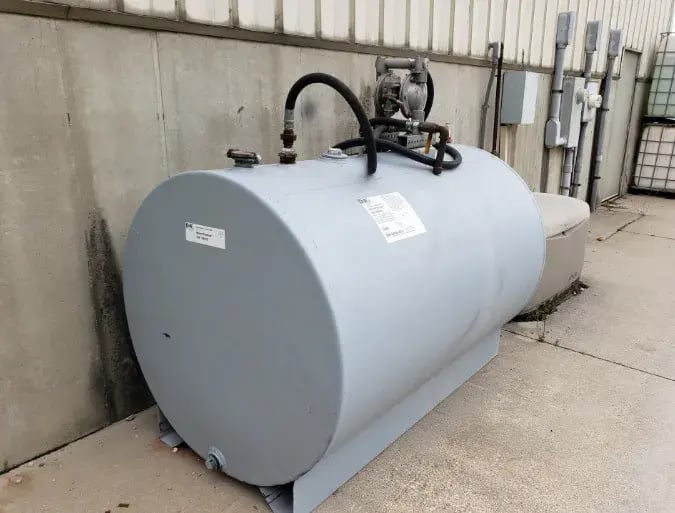
Generators store fuel in a few ways: a sub-base (belly) tank built into the frame, a small day tank beside the unit, or a day tank paired with a large bulk tank somewhere else on the property. Every container of 55 gallons or more counts at its full shell capacity, so a 500-gallon sub-base tank adds 500 gallons whether it's full or nearly empty. On larger engines the oil sump or a separate lube oil tank can also reach 55 gallons, so check the spec sheet. At a data center, our data center SPCC guide covers the setups we see most.
The federal rule applies to a facility that stores more than 1,320 gallons of oil aboveground in total, or more than 42,000 gallons completely buried, and could reasonably be expected to discharge oil to navigable waters or adjoining shorelines. A storm drain or ditch that eventually reaches a stream usually meets that test. Tanks in basements count as aboveground tanks. In New Jersey, EPA Region 2 enforces the rule.
How Do You Recount Your Oil Storage Before Installing a Generator?
Count the whole site, not just the generator. SPCC treats the facility as one unit, so the new tank gets added to everything else that already holds oil.
| What's on your site |
Counts toward the 1,320 gallons? |
| Generator sub-base, day, and bulk fuel tanks of 55 gallons or more |
Yes, at full shell capacity |
| Existing aboveground diesel, gasoline, and used oil tanks |
Yes |
| Drums, totes, and vegetable or cooking oil containers of 55 gallons or more, full or empty |
Yes |
| Oil-filled transformers, hydraulic systems, and lube systems of 55 gallons or more |
Yes |
| Any container under 55 gallons |
No |
| Fuel tanks on vehicles that power the vehicle itself |
No |
| Propane |
No, it isn't oil |
Drums are the item people miss most, and our article on 55-gallon drums and SPCC plans shows how they count. Underground tanks are a separate question, covered in the New Jersey section below.
Here's a quick example. A site with a 500-gallon diesel tank, three 55-gallon drums of oil, and a 330-gallon oil-filled transformer totals 995 gallons. That's under the line, so no SPCC plan is required. Add a generator with a 1,000-gallon sub-base tank and the total is 1,995 gallons. One purchase order changed the site's status.
Do this recount during design, not after the order. Tank sizes shift between proposal and purchase, and a swap from a 900-gallon base tank to an 1,100-gallon one can decide which side of a threshold you land on. Write the math down and keep it with the project files, even if you come in under, because the next tank anyone adds will start from that number.
What Happens If a Generator Pushes You Over the 1,320-Gallon SPCC Threshold?
If the recount puts you over 1,320 gallons for the first time, your facility is subject to SPCC and needs a written plan. EPA expects a facility that starts storing oil to have its plan prepared and implemented before operations begin. For an existing site about to cross the line, we recommend the same approach: have the plan in place before the new tank holds fuel, with the facility diagram, tank inventory, containment evaluation, inspection routine, spill response steps, and training ready at commissioning.
Federal civil penalties for SPCC violations are adjusted for inflation every year under 40 CFR Part 19, and they can reach tens of thousands of dollars per day per violation. Our article on top SPCC plan violations and fines covers what inspectors tend to cite.
If the generator leaves you under the line, you don't need a federal SPCC plan, but New Jersey's Spill Act reporting and cleanup duties still apply to you. Keep your capacity math on file so you can spot the day a later tank or drum tips you over.
How Does a New Generator Affect Your SPCC Plan Tier and PE Certification?
SPCC plans come in three types, and which one you need depends on your total aboveground storage, your largest container, and your spill history. A new generator can move you up a tier.
| Plan type |
Who it fits |
Who certifies it |
| Tier I qualified facility |
10,000 gallons or less aboveground, no single container over 5,000 gallons, and no significant spill history in the past three years |
You self-certify using EPA's template |
| Tier II qualified facility |
10,000 gallons or less aboveground, with at least one container over 5,000 gallons |
You may self-certify a full plan that doesn't deviate from the rule |
| PE-certified plan |
Over 10,000 gallons aboveground, a facility that doesn't meet the qualified criteria, or any plan that deviates from rule requirements |
A licensed Professional Engineer |
Generators bump sites up a tier all the time. One 6,000-gallon bulk tank takes you out of Tier I even if your total is modest, because no single container can exceed 5,000 gallons. A site with 9,000 gallons that adds a 2,000-gallon generator tank crosses 10,000 and needs a PE-certified plan. Our articles on the different types of SPCC plans and professional engineer requirements for SPCC plans go deeper.
Even if you qualify to self-certify, you can choose PE certification instead, and some facilities prefer it for a complex generator system. Some consulting firms have a PE on staff and others work with a trusted outside PE. Either way, you want a licensed PE who visits the site, reviews the plan, and stands behind it.
How Should You Plan SPCC Secondary Containment for a Generator Fuel Tank?
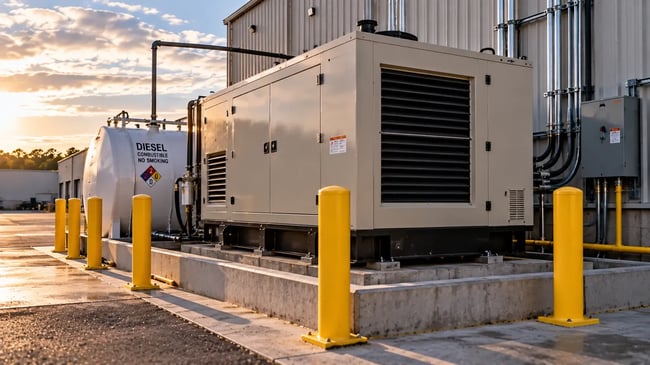
Bulk storage containers need sized secondary containment: enough to hold the full capacity of the largest container in the area, plus freeboard for rain if the containment is open to the weather. With generators, some of that is often built in. Many sub-base tanks are double-walled, and many indoor day tanks sit in a rupture basin. Whether that satisfies the rule depends on how the tank is built and how your plan documents it.
Ask these questions before the tank is ordered, while changes are cheap. How is the tank built? How will rainwater drain from outdoor containment without carrying oil with it? Where does the fuel truck park, and what keeps a failed hose or an overfill from reaching a storm drain? How is the piping between the bulk tank and the day tank protected and inspected? Your vendor can answer the first one, but the delivery area and the piping are usually site decisions that nobody on the vendor side is thinking about.
A plan also covers inspections, tank integrity checks, security, and annual spill prevention training. Our guide to sizing SPCC oil spill containment covers the math, and the online training library handles the training piece.
When Do You Have to Amend Your SPCC Plan After Adding a Generator?
If you already have an SPCC plan, a new generator tank is a textbook reason to amend it. The rule requires an amendment whenever a change in facility design, construction, operation, or maintenance materially affects the potential for a discharge. EPA calls this a technical amendment. It has to be prepared within six months of the change and implemented as soon as possible, no later than six months after it's prepared.
Six months is the outer limit, not the goal. Wait, and you've got a tank in service that your plan doesn't describe. We recommend finishing the amendment around installation so containment, inspections, and delivery procedures are in place from the first fill.
A PE-certified plan needs a PE to certify its technical amendments. A Tier I owner recertifies their own template, and if the generator takes you out of Tier I, you move up to a Tier II or PE-certified plan on that same six-month clock. Non-technical changes, like a new phone number, don't need a PE. The five-year review runs separately, and our articles on updating an SPCC plan and five-year SPCC plan reviews explain how the two fit together.
What Do New Jersey's Spill Act, DPCC Plans, and UST Rules Add for Generators?
New Jersey layers its own rules on top of the federal ones, and they reach further than SPCC. Our overview of SPCC plans in New Jersey covers the broader picture. For a generator project, three pieces matter.
Spill Act Reporting and Liability for Generator Fuel Spills
The Spill Compensation and Control Act, known as the Spill Act, covers petroleum and other hazardous substances and applies at your facility whether or not you need an SPCC plan. Anyone responsible for a discharge who knows or should know about it must notify NJDEP immediately through its 24-hour hotline, 1-877-WARNDEP (1-877-927-6337). A generator tank overfilled during a delivery is a typical case. Liability under the Act is broad and can reach more than one party, so after a real discharge, talk with an environmental attorney about your exposure. Cleanup generally has to be overseen by a Licensed Site Remediation Professional (LSRP), with limited exceptions. Our guide to reporting an oil spill covers the sheen rule and the federal side.
Major Facilities and DPCC and DCR Plans
For larger sites, NJDEP runs a program that works as SPCC's state counterpart. A "major facility" under N.J.A.C. 7:1E has a combined storage capacity of 200,000 gallons or more of all hazardous substances, petroleum included, or 20,000 gallons or more of hazardous substances other than petroleum. Major facilities must prepare a Discharge Prevention, Containment, and Countermeasure (DPCC) plan and a Discharge Cleanup and Removal (DCR) plan and submit them to NJDEP as a single document.
A generator rarely makes a site major on its own, but it can tip a large industrial site or data center that's already close, and the count includes all hazardous substances, not just fuel. A site that adds enough storage to become major is treated as major. If you're already major, a new generator tank is a change to the site your approved plans describe, so those plans need amending too. NJDEP has revised these rules recently, so check the current N.J.A.C. 7:1E and the timing requirements in your approved plan before you set an installation schedule.
Underground Generator Tanks and the New Jersey UST Rules
N.J.A.C. 7:14B covers underground storage tank systems holding hazardous substances, petroleum included, and governs registration, design, installation, leak detection, and closure. The exemptions are specific, such as certain small heating oil tanks and tanks sitting on a basement floor, so don't assume a generator tank qualifies for one. Installation generally requires NJDEP approval or notification, and the work has to be done by NJDEP-certified individuals and firms. That's construction-side work we don't handle, but we can help you understand how a buried tank affects your SPCC count and reporting duties. Whether a buried tank is left out of your SPCC totals depends on which tank program covers it, so confirm that before you finalize your recount.
Which Other Permits and Approvals Come With a New Generator Installation?
The tank and the engine come with approvals of their own, and most of them happen before the generator runs. Installing a fuel tank typically involves construction, building, and electrical permits and a fire code review. In New Jersey, the Uniform Fire Code is set by the Department of Community Affairs' Division of Fire Safety and enforced by local fire officials, who will have views on tank location, spacing, and protection. We don't prepare construction-phase permits or approvals, including anything tied to the tank installation. Your engineer, contractor, and local officials handle that. If you're unsure what the construction phase requires, we can help you work out the right questions and point you to the right people.
The engine raises air permitting questions, and our article on emergency backup generators and environmental permits walks through them. You've got operational obligations once the generator runs, and we help with those: the SPCC plan or amendment, DPCC and DCR changes if you're a major facility, spill reporting procedures, inspections, annual training, and often Community Right to Know reporting when fuel, batteries, and other chemicals cross reporting thresholds. Our guide on annual SPCC training explains the training piece.
What Does It Cost to Create or Update an SPCC Plan for a New Generator?
Cost depends on whether you're writing a new plan or amending one, and on how complex the site is. These are the ranges we've published.
| Situation |
Typical RMA range |
| New SPCC plan, from a simple site to a complex one |
$2,500 to $15,000 |
| Simple Tier I plan update |
About $1,500 |
| PE-certified, complex plan update |
$7,500 and up |
Total storage capacity, the number and type of containers, whether PE certification is needed, and whether containment has to be evaluated drive most of the difference. A generator with a double-walled sub-base tank on a simple site sits at the low end. A multi-tank system with a bulk tank, day tanks, long piping runs, and a delivery area that needs rethinking sits higher. A DPCC and DCR plan for a New Jersey major facility is a separate, larger job whose cost depends on total storage capacity and which hazardous substances you store, so we'd quote it after talking with you.
Our SPCC pricing calculator is below, and it estimates what our help would cost for your site. The cheapest plan is usually a template with your name on it that nobody checked against the actual tanks, and it tends to cost more later, when an inspector or an insurer finds the tank isn't where the diagram says it is.
How Can RMA Help With Your Generator and SPCC Plan?
We help facilities work through exactly this question: recounting your oil storage before you order the generator, telling you which plan tier you'll land in, evaluating containment and delivery areas, amending an existing plan, and walking you through whether your plan needs PE certification and what that involves. We're based in New Jersey and work with NJDEP's rules regularly, so we can also help you sort out where the state requirements apply to your site.
We'll also tell you when you don't need us. If you have a small Tier I site and a simple addition, you may be able to update your plan yourself with EPA's template, and we'll say so. Either way, there's no pressure and no obligation. You can call us, email us, or fill out the form on our website, and if you'd like to talk through your generator project, contact RMA and we'll point you in the right direction.