A General Guide to Safety, Stopping the Source, Containment, Spill Reporting, and Cleanup When Oil Gets Into a Pennsylvania Waterway
If oil is heading toward a creek or already in one, the first thing to settle is whether anyone is in danger. If there's a fire, an explosion risk, strong fuel vapors, an injured person, or anyone in or near the water, call 911 right now and get people away from the area. Everything else in this article can wait until people are safe. Once they are, the sequence is nearly always the same: stop the source, contain what you can, make the required phone calls, bring in a cleanup contractor if you need one, and write everything down.
Below we walk through each of those steps in order, including who you have to call in Pennsylvania, how fast, and what paperwork tends to follow. We're a family-run environmental consulting firm. We're not safety consultants or environmental attorneys, so please treat this as a general guide and not an exact roadmap for every emergency. Every spill is different, and your facility's own spill plan, your emergency responders, and the agencies you call will tell you what applies to your situation. If you'd like help getting your oil spill plan and response procedures in order before something like this happens, you can reach out to RMA.
Table of Contents
TL;DR
Call 911 first if anyone is in danger or there's a fire risk. If it's safe, stop the source and put absorbent material or boom between the oil and the water. Then call the National Response Center at 1-800-424-8802 and Pennsylvania DEP's 24-hour emergency line at 1-800-541-2050 right away. Bring in a qualified cleanup contractor, write down everything you do, and expect written follow-up to the agencies. This is a general guide, not safety or legal advice.
What Should I Do First When Oil Reaches a Pennsylvania Creek?
People come before property. Nobody should wade into the water, climb a steep or slick bank, or walk into an area with heavy vapors to save product or protect equipment. Fuel and oil vapors can ignite, and a sheen on moving water can spread quickly. Keep ignition sources away from the spill: shut off engines that aren't needed, no smoking, no power tools, and nothing that sparks. If you're unsure whether the situation is safe, back away and call 911. The fire department can hold a hazard until trained people arrive.
Once everyone is accounted for and safe, take a quick look at what's happening. Where is the oil coming from, and is it still flowing? How far has it traveled? Is anyone downstream, such as a neighbor, a farm, a business, or a drinking water intake? You don't need exact numbers before you pick up the phone. A rough sense of the source, the material, and how far it has gone is enough to get the right people moving, and you can refine it as you learn more. Send someone to meet responders at the entrance so they aren't searching for you.
How Do I Stop the Source of an Oil Spill Safely?
If it's safe to do so, stopping the flow comes before everything else except safety, because every gallon you keep in the tank is a gallon you don't have to chase down a creek. That usually means closing a valve, shutting off a pump, stopping a fuel delivery or transfer, or shutting down the piece of equipment that's leaking. Common sources include a tank valve left open, an overfilled tank during a delivery, a failed hose or fitting, a leaking transformer or hydraulic line, a damaged drum, or a vehicle that's been punctured. If a delivery driver is on site, they can often shut off their own equipment faster than anyone else.
Don't take risks to do this. If the valve is underwater, under a leaking pressurized line, or in a vapor-filled space, leave it and tell the responders and agencies exactly what you couldn't reach. Trained staff with the right materials can sometimes plug or patch a small hole, but improvised repairs on a pressurized or fuel-soaked system are how people get hurt. While you work on the source, cover or block any storm drain inlets between the spill and the creek if you can do it safely, because a storm drain is just another path to the water.
How Do I Contain an Oil Spill Before It Spreads Down the Creek?
The goal is to keep oil on the ground and out of the water, and to keep what's already in the water from traveling any farther. On land, that means absorbent socks and pads, drain covers, and temporary berms built from soil, sand, or a spill kit's dike material placed between the oil and the creek. If your facility has secondary containment such as a dike or a containment curb, check right away whether it held or whether the oil got past it, because that tells you where the real escape route is.
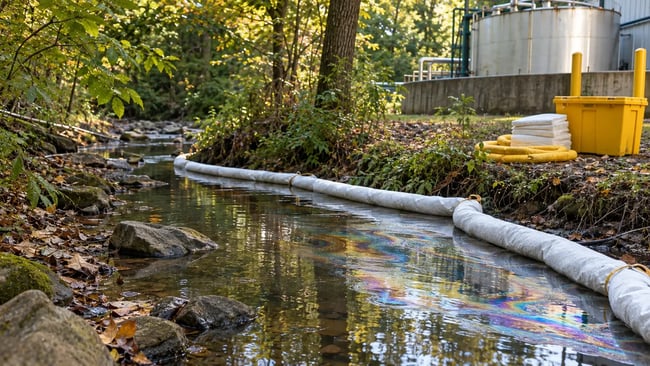
On the water, boom and absorbent pads can slow a sheen in calm or slow-moving water, and that work is best done from the bank by people who've been trained to do it. Fast water, steep banks, and large volumes are a job for a professional contractor, and nobody should enter the water to place boom. Don't wash oil down with a hose, and don't use soap or dispersants to make a sheen disappear. Washing pushes the oil farther into the creek or into storm drains, and the agencies you'll be calling may have their own instructions about what's acceptable. Collect used absorbents in sealed containers or heavy bags, since they're waste that needs proper disposal and not something to toss in the dumpster.
Who Do I Have to Call? Oil Spill Reporting in Pennsylvania
A spill that reaches a creek usually triggers more than one call, because federal and Pennsylvania rules each have their own notification requirements. The numbers and timing below come from EPA, Pennsylvania DEP, and the regulations themselves. Which of these apply to you depends on what spilled, where it went, and what kind of facility you run, so use this as a starting point and confirm against your own situation.
| Who to Call |
Number |
When |
| Local emergency services |
911 |
Right away for fire, explosion risk, injuries, or anyone in danger. PA tank rules also require immediate notice to the local fire authority when a release creates fire, explosion, or safety hazards. |
| National Response Center (NRC) |
1-800-424-8802 |
Immediately after you know oil has reached, or may have reached, a creek, river, or other waters of the United States. |
| PA DEP Emergency Response (24-hour hotline) |
1-800-541-2050 |
Immediately for a spill that pollutes or threatens state waters. Storage tank releases have their own timing, covered below. |
| County emergency management agency, Pennsylvania Emergency Management Agency (PEMA), and DEP |
Check your facility's spill plan for current contacts |
Immediately, if you operate an aboveground storage tank facility with more than 21,000 gallons of total capacity. |
What Does the National Response Center Need to Hear From Me?
The NRC is the federal government's central reporting point for oil and chemical spills, and the U.S. Coast Guard staffs it around the clock. Under federal rules, a discharge of oil that reaches waters of the United States and creates a film or sheen, discoloration of the surface, or sludge or emulsion on the water or the shoreline has to be reported immediately after you know about it. A sheen counts even when the amount of oil is small, and our article on when you have to report an oil spill under the sheen rule goes into the details. Be ready to give your name and phone number, your company, the party responsible, the date and time, the location, what spilled, and about how much. If you don't know a number yet, say so and give your best estimate. A report to the NRC also reaches the federal response network, and EPA Region 3 handles SPCC enforcement in Pennsylvania, so it's worth reading our overview of who enforces SPCC plans if you want to know who may follow up.
What Does Pennsylvania Require on Top of the Federal Call?
Pennsylvania's Clean Streams rules, at 25 Pa. Code Section 91.33, require the person in charge of the substance or the premises to notify DEP immediately by telephone when a harmful substance is discharged into state waters or placed where it could reach them. The same rule says to notify known downstream users if it's reasonably possible, to take immediate steps to prevent injury to property and downstream users, and to remove residual material from the ground and affected waters within 15 days, to the extent the regulations require. DEP's emergency line connects to Duty Officers on call in each of its six regional offices. DEP's own spill guidance tells responsible parties to err on the side of notifying when there's any doubt.
If the oil came from a tank that's regulated under DEP's storage tank program, Chapter 245 adds timing and paperwork. Whether a particular tank is regulated depends on its size, type, and use, so check yours against DEP's storage tank program pages. The owner or operator has to notify the DEP regional office as soon as practicable, and no later than 24 hours after confirming a release, with a follow-up written notice on a DEP form within 15 days to DEP and to each municipality where the release occurred or had an impact. For aboveground tank facilities over 21,000 gallons, the county emergency management agency, PEMA, and DEP get an immediate call, and downstream water companies, municipalities, and industrial users within 20 miles who could be affected must be notified within 2 hours if the release enters or threatens a water supply. There's a narrow exception for small, fully contained releases of under 25 gallons of petroleum that are recovered within 24 hours, but that exception doesn't help once oil is in a creek. Our advice is simple: don't wait for the 24-hour mark. Make the call as soon as you can safely do it.
Do I Need to Hire an Oil Spill Cleanup Contractor?
For a small spill on pavement that never touched water, your own trained staff may handle the cleanup with absorbents and a spill kit. Oil in a creek is a different situation. Recovering oil from moving water, removing soil along the bank, and disposing of everything correctly usually takes boom, vacuum trucks, trained crews, and waste handling, and DEP and EPA will expect the cleanup to be done properly and to be documented. When you call the agencies, tell them whether you already have a contractor on the way. It's a question they'll ask.
When you're choosing one, ask whether they can respond around the clock, whether their crews are trained for emergency response work, whether they've handled spills on waterways, and how they'll handle waste disposal and paperwork. Ask them to document their work as they go. The best time to find a contractor is long before you need one, and their number belongs in your spill plan. Cost depends on the volume spilled, how fast the water is moving, how far the oil traveled, how much soil is affected, the weather, and how long the job takes, so we can't give a reliable range here, and the contractor sets that price. It's also a good idea to call your insurance carrier early, since policies often carry notice requirements and the responsible party generally carries the cost of cleanup.
What Should I Document, and What Follows After an Oil Spill?
Start writing things down while the response is still underway, because memory fades fast and the agencies will ask questions weeks later. Someone should keep a running log with times, and the table below covers what to capture.
| Record |
What to Capture |
| Timeline |
When the spill was discovered, who found it, and when each action was taken. |
| Source and cause |
What leaked, from which tank, container, or equipment, and what you think caused it. |
| Volume estimate |
How much spilled, and how you arrived at the number, such as gauge readings or delivery tickets. |
| Photos and video |
The source, the path the oil took, the creek upstream and downstream, any sheen, and any affected wildlife, all with timestamps. |
| Notifications |
Who you called, when, what you said, who you spoke with, and any report number you were given. |
| Response and cleanup |
Containment steps, materials used, contractor details, waste volumes, and disposal records. |
| Agency contact |
Names of inspectors or responders, instructions they gave, and any samples they took. |
After the emergency is over, some written follow-up may be required. For storage tank releases, that's the 15-day written notice described above. Separately, under federal SPCC rules, a facility that has a single discharge of more than 1,000 gallons of oil into navigable waters or onto adjoining shorelines, or two discharges of more than 42 gallons each within any twelve-month period, has to send the EPA Regional Administrator a written submission within 60 days. It covers the facility details, the cause of the discharge, the corrective actions taken, and the steps planned to keep it from happening again, and a copy goes to the state agency. Most spills won't hit those numbers, but you should know the threshold exists.
A creek spill can also lead to inspections, information requests, penalties, and liability questions, and that's the territory where an environmental attorney may be appropriate. If an agency asks for a written statement or a formal response, consider having an attorney look at it before you send it. Our article on top SPCC plan violations and fines shows what enforcement can look like.
Finally, think about how the spill connects to your oil spill plan. A Spill Prevention, Control, and Countermeasure (SPCC) Plan is the written plan federal rules require from facilities that store more than 1,320 gallons of oil aboveground in containers of 55 gallons or more, or more than 42,000 gallons buried. It lays out how you prevent spills and how you respond if one happens. If you already have one, pull it out, check that the response steps and contact list worked in real life, and update it if the spill showed a gap. Our overview of when to update your SPCC plan covers what triggers a change. If you don't have a plan and your oil storage is over the threshold, a spill like this is a strong sign you need one. Our guide to SPCC plan requirements, costs, and timelines is a good place to start.
How Can RMA Help With Oil Spill Planning and SPCC Compliance?
We're not an emergency response or cleanup company, and we're not safety consultants or environmental attorneys, so we can't be the one on the creek bank in the middle of a spill. Your emergency responders, a spill cleanup contractor, DEP, and an attorney if you need one are the right people for that moment. Where we help is before and after. We write SPCC Plans for facilities across Pennsylvania, we help facilities work out whether their oil storage crosses the threshold at all, and we help update a plan after an incident so the response steps and contacts match what your site really needs. Initial SPCC training is free with a new RMA plan, and our online environmental training library is available for staff who need refreshers.
If you'd like to talk through your situation, there's no pressure and no obligation. You can call us, email us, or fill out the form on our website, and you're welcome to reach out to RMA whenever it's convenient. If we're not the right fit, we'll tell you.


