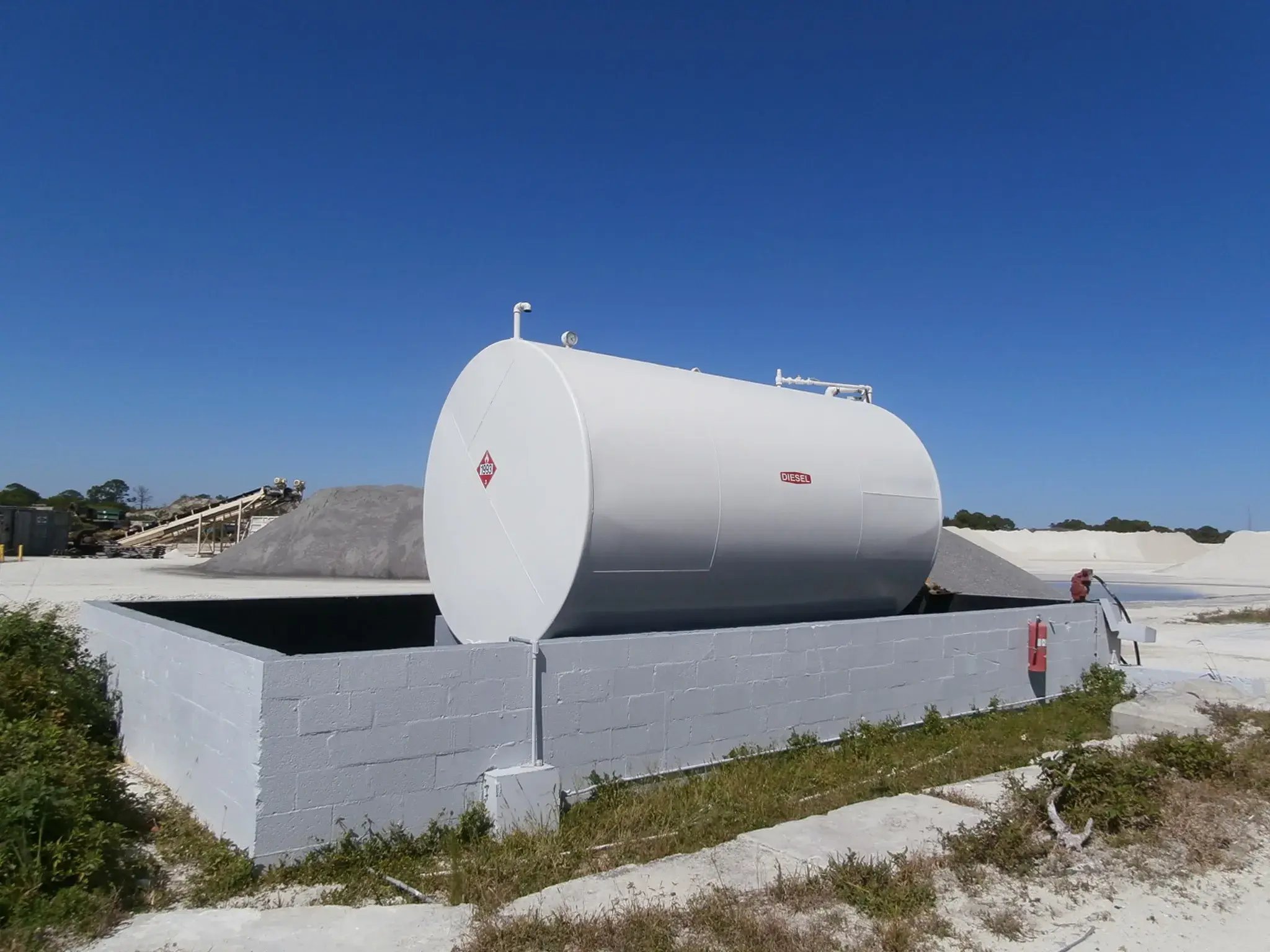
How API 653 Inspections, SPCC Integrity Testing, and DEP's Certified Inspector Rules Fit Together for Large Aboveground Oil Tanks
If your facility has a big steel tank holding diesel, fuel oil, or another oil, someone has probably mentioned API 653 to you. It might have been an insurance carrier, a DEP inspector, an EPA inspector reviewing your oil spill plan, or a tank contractor quoting a cleaning job. API 653 is the American Petroleum Institute's inspection standard for large steel tanks built in the field. For a Pennsylvania facility with a steel tank over 21,000 gallons that was built on site, the short answer is yes, you'll need inspections that follow it. DEP requires large tanks to be inspected by a certified inspector following nationally recognized practice such as API 653, and the federal oil spill rule, known as SPCC (Spill Prevention, Control, and Countermeasure), expects you to test tank integrity under an industry standard that your written plan names.
This article covers what an API 653 inspection looks at, how often each type comes due, who's allowed to perform them in Pennsylvania, and how DEP's rules for large aboveground tanks line up with SPCC integrity testing. We also cover what to do before and after an inspection so the paperwork holds together. If you'd rather talk through your own tanks, you can reach out to RMA and we'll help you figure out where you stand.
Table of Contents
TL;DR
For large steel oil tanks built in the field, API 653 is the standard that tells an inspector what to check and how often. In Pennsylvania, a tank over 21,000 gallons needs an outside (in-service) inspection no more than 5 years apart and an inside (out-of-service) inspection no more than 20 years apart, with the first inside look due within 10 years of installation or of a new tank bottom. For field-built tanks, a DEP-certified inspector who also holds API 653 certification has to do the work, and that same inspection program is how most facilities meet the federal requirement to test tank integrity. Your written oil spill plan should name the standard and spell out the schedule.
What Is an API 653 Tank Inspection and Which Oil Tanks Does It Cover?
API 653 is the American Petroleum Institute's standard for inspecting, repairing, altering, and rebuilding large steel tanks that sit above ground. It was written for tanks built on site from welded steel plates to API's companion construction standard, API 650, the tall cylinders with flat bottoms you see at fuel terminals, power plants, large manufacturers, and bulk fueling yards. The standard tells an inspector what to look at, how to measure it, how to calculate how much life the steel has left, and how long the tank can go before the next inspection. It also gets used for tanks holding chemicals and other liquids, but this article sticks to oil and fuel.
It doesn't cover every oil tank. A diesel tank welded together in a factory usually follows a different standard, the Steel Tank Institute's SP001, and EPA's fact sheet on bulk storage container testing names API 653 and SP001 as the two most commonly used for aboveground oil containers. There's no hard gallon line between them. Pennsylvania adds its own: DEP treats a single aboveground tank over 21,000 gallons as a large tank, and it requires certified inspections of field-constructed tanks of any size when they're installed, rebuilt, or modified. If you have a tank over 21,000 gallons or one built on site, the rest of this article applies to you. Smaller shop-built tanks follow a different schedule, and a DEP-certified inspector can tell you which category each of your tanks falls into.
What Does an API 653 Inspection Look at on a Large Oil Tank?
The standard sets up four layers of checking. The first is a routine walkaround by your own trained staff, at least monthly, looking for leaks, stains, damaged coatings, a settling foundation, and weeping valves. Our guide to the top 10 things to do during SPCC monthly inspections covers what a good one looks like. The second is the formal external inspection by an API 653 authorized inspector while the tank stays in service. Pennsylvania's version evaluates the containment area, foundation, shell, roof, connected piping, leak detection, and cathodic protection if there is any, and the inspector judges whether the tank is suitable for continued service.
The third layer is shell thickness measurement. Steel loses thickness over the years, and an inspector uses ultrasonic readings to see how much is left. The difference between today's thickness and the minimum the tank needs is the corrosion allowance, and dividing that allowance by the rate of loss gives the remaining life. For example, a shell plate with 0.100 inch of steel above its minimum that loses 0.005 inch a year has 20 years of remaining life. That math drives most of the intervals in the next section. The fourth layer is the internal inspection. The tank is emptied, cleaned, and made safe to enter, and the inspector examines the floor from the inside, because tank bottoms are where corrosion hides and the soil side of the plate can't be seen from outside. Pennsylvania requires a metal tank bottom evaluation to rely on ultrasonic testing and visual examination plus at least one other nondestructive method, such as magnetic flux testing or vacuum testing of the bottom lap welds. An internal lining gets inspected too.
How Often Do API 653 Inspections Have to Happen?
API 653 doesn't hand you one calendar date. It sets maximum intervals and shortens them based on what the measurements show, so a tank that's corroding faster gets inspected sooner. The table below shows the standard's default ceilings for the main inspection types.
| Inspection Type |
Who Does It |
Maximum Interval Under API 653 |
| Routine in-service walkaround |
Trained owner personnel |
No more than one month apart |
| Formal external inspection |
API 653 authorized inspector |
5 years, or one quarter of the shell's remaining corrosion life, whichever is shorter |
| External ultrasonic shell thickness readings |
Inspector |
5 years while the corrosion rate is unknown. Once it's known, half the remaining shell life or 15 years, whichever is shorter |
| Internal (out-of-service) inspection |
Inspector |
Set by bottom corrosion rate and remaining thickness. 10 years at most while the rate is unknown, and generally capped at 20 years |
New tank owners tend to get caught by the unknown corrosion rate rows. A new tank, or one with a newly replaced bottom, has no history, so the standard makes you measure early, and Pennsylvania's rule does the same: when the bottom's corrosion rate is unknown, actual bottom thickness has to be checked within 10 years of installation. API 653 can credit safeguards such as a release prevention barrier under the tank to stretch that first internal interval, but Pennsylvania's rule reads as a 10-year first look, so plan around the shorter one and confirm it with your DEP-certified inspector. API also revises 653 through new editions and addenda, so ask which edition your inspector uses.
What Does Pennsylvania Require for Large Aboveground Oil Tank Inspections?
On January 2, 1988, a four-million-gallon diesel tank at a terminal in Floreffe, south of Pittsburgh, split apart as it was being filled to capacity for the first time after being dismantled, moved from Ohio, and reassembled. About a million gallons reached the Monongahela River and moved on into the Ohio River, temporarily affecting drinking water supplies for an estimated one million people. Investigators traced the failure to brittle fracture starting at a flaw that predated the rebuild. It was a field-erected steel tank of the kind API 653 now covers.
Today DEP regulates these tanks under the Storage Tank and Spill Prevention Act and its regulations at 25 Pa. Code Chapter 245. The in-service and out-of-service inspection sections tell inspectors to follow guidelines of a nationally recognized association such as API 653. DEP's aboveground storage tank inspections page summarizes the maximum intervals for tanks over 21,000 gallons like this:
| Pennsylvania Inspection |
First One Due |
After That |
| In-service (outside) inspection |
Within 5 years after installation |
No more than 5 years apart, sooner if the corrosion math calls for it (one quarter of the corrosion rate life) |
| Out-of-service (inside) inspection |
Within 10 years after installation of a new tank or a new tank bottom |
No more than 20 years apart, based on the API 653 calculated service life or half the corrosion rate life |
| Internal lining inspection |
Within 10 years after the lining is installed |
No more than 10 years apart |
| Installation and major modification inspection |
At installation, reconstruction, or relocation |
Each time a major modification is performed |
An out-of-service inspection can stand in for an in-service one, which helps when you're already taking the tank down. A tank that can be completely examined from the outside, which describes many elevated tanks, is excluded from out-of-service inspections unless it's internally lined. Tanks between 5,000 and 21,000 gallons have their own in-service schedule, which we're leaving out to keep this focused on large tanks.
Who Can Perform Large Tank Inspections in Pennsylvania?
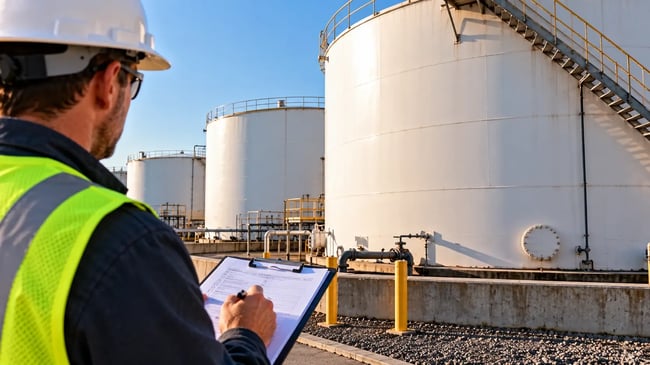
Inspections that satisfy DEP have to be done by a DEP-certified aboveground storage tank inspector, and for field-constructed tanks that means the IAF certification category. An IAF inspector has to hold API 653 certification, have four years of experience (or a qualifying degree and two years), and show a record of documented inspection or construction work from the previous three years. DEP also has its own exam and training that inspectors renew on a three-year cycle, so the person you need holds both credentials. A large factory-built tank falls under the IAM category instead, where STI inspector certification is an accepted alternative to API 653. There's also a conflict of interest rule. According to DEP's inspector training materials, a certified inspector can't be an employee of the tank owner, so your own API 653 inspector on staff can't be the one who signs off for DEP. DEP publishes a searchable list of certified storage tank companies on its inspections page that you can filter by region, county, and certification category.
How Does API 653 Relate to SPCC Integrity Testing?
An SPCC Plan is the written oil spill prevention plan the federal rule requires for facilities that store more than 1,320 gallons of oil in aboveground containers of 55 gallons or larger and could reasonably be expected to discharge oil to waters of the United States or adjoining shorelines. Our guide to everything you need to know about SPCC plans covers the basics. A single tank over 21,000 gallons is far past that capacity threshold, so if you have one and no SPCC Plan, you're very likely covered by the rule, and building the plan comes ahead of the inspection schedule. EPA Region 3 enforces SPCC in Pennsylvania, and our article on who enforces SPCC plans explains how that works alongside DEP.
The rule at 40 CFR 112.8(c)(6) requires you to test or inspect each aboveground container for integrity on a regular schedule and whenever you make material repairs. You determine the qualifications of the people doing the work and the frequency and type of testing in accordance with industry standards. The rule doesn't name API 653, but for large field-built tanks it's what most plans name. Once your plan says it'll follow a standard, EPA expects you to implement the relevant parts of it, and if you deviate, the plan has to explain why and provide equivalent environmental protection, which a professional engineer certifies. Plans that don't name a standard show up in EPA deficiency reviews, and our breakdown of top SPCC plan violations and fines shows what else inspectors cite. A separate provision covers field-built tanks specifically: when one undergoes a repair, alteration, reconstruction, or change in service that might affect its risk of discharge or failure from brittle fracture or another catastrophe, the rule calls for an evaluation. SPCC also requires you to keep inspection and testing records for at least three years, though industry standards like API 653 often expect them held longer, so keep inspection reports for the life of the tank.
Self-certification under SPCC is limited to facilities with 10,000 gallons or less of total aboveground oil storage, so a facility with a tank over 21,000 gallons needs a plan certified by a licensed professional engineer. RMA works with an outside professional engineer in your state for that certification, and our articles on professional engineers and SPCC plan requirements and the different types of SPCC plans explain how that works. The table below shows how the three sets of requirements fit together.
| Source |
What It Asks For |
Who Does the Inspecting |
| API 653 (industry standard) |
Inspection types, methods, and maximum intervals for field-built steel tanks |
API 653 authorized inspector |
| PA DEP, 25 Pa. Code Chapter 245 |
In-service inspections no more than 5 years apart and out-of-service inspections no more than 20 years apart for tanks over 21,000 gallons, reported to DEP |
DEP-certified inspector (IAF for field-built tanks), not an employee of the tank owner |
| Federal SPCC rule (EPA Region 3 in Pennsylvania) |
Integrity testing on a regular schedule under an industry standard named in your SPCC Plan, plus records |
Personnel qualified under the standard your plan names |
In practice, one inspection can feed all three. A DEP-certified IAF inspector who also holds API 653 certification does the work following API 653, files the report with DEP, and the same report becomes your SPCC integrity testing record, as long as your SPCC Plan describes the program: the standard, who performs the inspections, and the schedule. Pennsylvania also requires facilities with large aboveground storage tanks to have a Spill Prevention Response Plan (SPRP) submitted to DEP, so the inspection program and your plans should tell the same story. Because SPCC Plans get reviewed every five years, our guide to SPCC plan 5-year reviews is a good place to check that your schedule still matches what's on the ground.
What Should You Do Before and After an API 653 Inspection?
Start by finding a certified inspector early, because internal inspections take planning. The tank has to be emptied, cleaned, and made safe to enter, and the schedule often depends on where the product goes in the meantime. Anything you bring in to hold product temporarily, like a tank trailer, needs containment and belongs in your SPCC Plan, and our article on how big SPCC oil spill containment needs to be explains how to size it. Gather your previous inspection reports, repair history, and the integrity testing section of your SPCC Plan so the inspector starts from what's already known. Pricing comes from the inspection firm and swings with tank diameter and height, how much cleaning the tank needs, how much of the floor gets scanned, whether there's a lining, and what the inspector finds, so compare scope along with price. A bid that skips floor scanning or DEP reporting is cheaper for a reason.
The certified inspector reports the findings to DEP on its inspection summary form, and DEP's inspector training materials give 60 days for that report. You keep a copy too: in-service reports stay at the facility until the next out-of-service inspection is complete, and out-of-service reports go with your facility records. Anything the inspector flags has to be fixed before the tank returns to service after an out-of-service inspection. Repairs and modifications have to follow the manufacturer's specifications or an engineer's design, and DEP requires major modifications to be inspected by a certified aboveground storage tank inspector and reported. Building, repairing, or rebuilding a tank, and any building or fire permits that go with that work, sit with your tank contractor, a DEP-certified installer, and your engineer. RMA doesn't handle that side, though we can point you toward the right people. Once the tank is running again, the operational paperwork is where we come in: an SPCC Plan or amendment that reflects the changes, tank registration records, inspection scheduling, and staff training. If your team handles the monthly walkarounds and needs training to go with them, our online training library is a good place to start.
How Can RMA Help With API 653 and SPCC Compliance for Pennsylvania Tanks?
The inspection itself is a certified inspector's job. What we help with is everything around it. We can build or rebuild your SPCC Plan so it names API 653 as the standard, lays out a schedule that matches DEP's intervals, and describes who performs the inspections and where the records live. If you have a tank this size and no plan yet, we can build one, working with an outside professional engineer for the certification. If you're not sure which of your tanks fall under which rules, we'll walk through them with you.
There's no pressure and no obligation in any of this. You can call us, send an email, or fill out the form on our website, and we'll give you a straight read on what your tanks require and whether you need our help at all. Sometimes the answer is that your plan and schedule are fine and you just need to book your inspector. If you'd like to talk it through, contact us whenever it's convenient.