A Plain-Language Walkthrough of the PA DEP No Exposure Certification Checklist, One Question at a Time
If your plant runs almost entirely indoors, someone may have told you that you don't need a full PAG-03 stormwater permit and can file a No Exposure Certification with the Pennsylvania Department of Environmental Protection (DEP) instead. That's true for plenty of facilities, but the bar is high. To qualify, every industrial material and activity on the whole site has to be sheltered from rain, snow, and runoff, your stormwater can't flow to waters DEP classifies as High Quality or Exceptional Value, and you have to be able to keep it that way for the next five years. One rack of scrap or one leaky forklift parked behind the building can knock you out.
Below, we walk through the same questions DEP asks on its No Exposure application, one category at a time: outdoor storage, equipment, loading and fueling, drums and spills, dumpsters, and roof vents. For each one, we explain what usually passes and what usually doesn't, then pull it all into a yes/no self-check table. We also cover the PPC Plan and sampling parts of the application, what to do if you're borderline, and how to keep the certification once you have it. If you'd rather have someone walk your site and give you a straight answer, reach out to RMA and we'll help you figure out where you stand.
Table of Contents
TL;DR
Your facility can qualify for a Pennsylvania No Exposure Certification only if every industrial material and activity across the whole site is sheltered from rain and snow, you don't discharge to High Quality or Exceptional Value waters, and you can truthfully answer no to every exposure question on DEP's application, now and for the next five years. Sealed and undamaged containers, well-maintained vehicles, and finished products that won't wash pollutants into runoff are the main exceptions. If even one item is a yes, you'll need to fix it or get PAG-03 coverage instead. DEP's current form and instructions are the final word, and DEP has to approve the certification before it counts.
What Is a Pennsylvania No Exposure Certification Under PAG-03?
NPDES, the National Pollutant Discharge Elimination System, is the Clean Water Act program that requires permits for pollutants discharged to streams and rivers. In Pennsylvania, DEP runs it. Certain industries, identified mostly by SIC code, need NPDES coverage for rain and snowmelt that runs off their industrial areas, which is called stormwater associated with industrial activity. PAG-03 is Pennsylvania's general permit for that stormwater, and it's how most industrial facilities in the state get covered.
A No Exposure Certification is the alternative for facilities where none of that industrial activity touches the rain. Federal rules at 40 CFR 122.26(g), which Pennsylvania adopts through 25 Pa. Code Chapter 92a, say that if everything industrial sits inside a storm resistant shelter, your runoff isn't industrial stormwater at all. You're excluded from the permit as long as you certify it and keep it true. Our guide to general, individual, and No Exposure permits compares the three paths.
Two details catch people off guard. In Pennsylvania, you file the No Exposure application with DEP along with the PAG-03 Notice of Intent (NOI) paperwork, and DEP has to approve it. And an indoor-only facility in a covered industry usually still needs to file. If your SIC code is on the list and everything happens inside, the answer is almost always "file a No Exposure Certification," not "do nothing." Facilities outside the covered categories are a different story, and many need nothing from the stormwater program.
Basic PA No Exposure Eligibility Rules to Check First
A few threshold rules come before the item-by-item questions. The biggest is that No Exposure applies facility-wide. DEP won't approve it for one part of a site while another part has exposed activity, so you can't certify the north lot and permit the south lot under PAG-03. Next, check where your water goes. If any stormwater discharges to a stream classified as High Quality (HQ) or Exceptional Value (EV) under 25 Pa. Code Chapter 93, No Exposure isn't available, no matter how clean the site is. Non-stormwater discharges matter too. Anything leaving the site that isn't rain has to be one of the limited discharges PAG-03 allows. Our article on stormwater versus process water explains where that line usually falls.
The certification also looks forward. DEP's form asks whether each item is exposed now or will be within the next five years, so a planned outdoor storage yard next spring is a problem today. Local rules can change the picture as well. In older cities with combined sewers, such as parts of Philadelphia and Pittsburgh, site runoff may go to a treatment plant and fall under the local sewer authority instead. Rules vary by municipality, so confirm your own situation.
No Exposure Checklist: Materials and Products Stored Outdoors
The first group of questions asks whether raw materials, intermediate products, byproducts, or final products are stored outdoors, and whether materials from past industrial activity are still exposed. That second one trips people up. An old pile of off-spec product, rusted parts from a line you shut down years ago, or a corner where something sat for a decade all count, even if nobody's touched them since.
Final products meant for outdoor use, like new cars on a lot, can stay outside as long as rain doesn't wash pollutants off them. That exception doesn't cover products that dissolve or wash away. DEP's instructions call out rock salt specifically, and the same thinking applies to anything that sheds dust, rust, or coatings. What usually passes is everything inside a building or under a roofed structure built to keep weather out. What usually fails is metal stock or scrap racks in the yard, material piles, pallets of raw material waiting to go inside, and tarped piles. Tarps tear, blow off, and let runoff flow underneath, so they rarely meet DEP's storm resistant shelter standard.
No Exposure Checklist: Industrial Machinery and Material Handling Equipment
The equipment questions ask whether you use, store, or clean industrial machinery outdoors, whether residue from that work remains where rain can reach it, and whether material handling equipment is exposed, with an exception for adequately maintained vehicles. A related question asks whether materials are handled or stored on roads or railways you own or maintain.
The vehicle exception is where most judgment calls happen. A forklift or loader in good shape, not leaking and not caked in product, can usually park outside. One with a weeping hydraulic line or a crust of material isn't "adequately maintained." Look at the pavement where equipment parks overnight. If it's stained, an inspector will notice too. Cleaning is the other common problem. Pressure washing equipment or trucks outside, or doing quick oil changes in the yard, puts residue straight into runoff. For trucking and similar transportation operations, this item decides a lot, since their stormwater coverage applies only to maintenance, equipment cleaning, and fueling areas. If all of that happens inside a shop, No Exposure is often realistic. Our article on what no exposure means under an NPDES permit covers how regulators read these situations.
No Exposure Checklist: Loading, Unloading, and Fueling Areas
DEP asks whether materials or products are exposed during loading, unloading, or transport. This knocks out a lot of facilities that otherwise look like good candidates. Everything may be stored inside, but if forklifts carry open bags across the yard or bulk deliveries get dumped at an uncovered dock, that's exposure, even if it only lasts a few minutes per delivery.
Enclosed or canopied docks, sealed containers, and finished goods in closed packaging usually pass. Open-air bulk transfers, spilled material on a dock apron, hoppers filled outdoors, and uncovered conveyors usually fail. Fueling isn't its own line on the form, but outdoor fueling falls here because it's a liquid transfer in an exposed area. An uncovered fuel island will almost always be a yes. A canopy helps, but if runoff from surrounding pavement crosses the fueling pad, the area can still be exposed.
No Exposure Checklist: Drums, Tanks, Spills, and Leaks
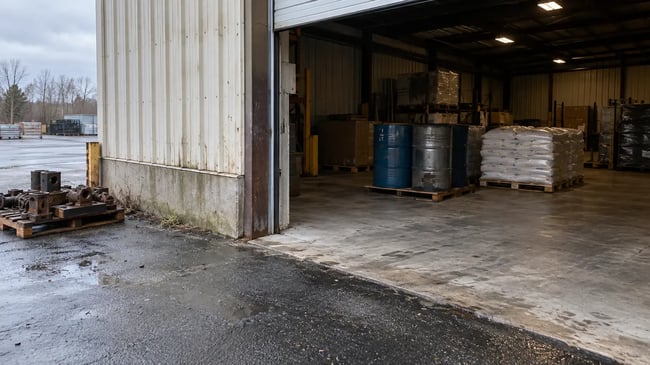
DEP asks whether materials are held in open, deteriorated, or leaking drums, barrels, or tanks, whether there's residue on the ground or in storm inlets from spills or leaks, and whether process wastewater is applied or disposed of on site without a permit. Containers have a specific exception. They don't need shelter if they're tightly sealed, not deteriorated, and not leaking. DEP defines "sealed" as banded or otherwise secured and without operational taps or valves. A row of sealed, undamaged drums of new product can sit outside. A drum with a pump in it, an open-top drum, a rusty drum, or a tank with a working valve doesn't qualify.
For spills, walk the site after a rain and look for stains, sheens in puddles, residue in catch basins, and discolored gravel. Old, cleaned-up stains are less of a concern than active ones, but residue in a storm inlet shows that something has reached the drainage system. The wastewater question catches facilities that spray rinse water onto a lawn or let washdown flow out a door. Unless that discharge is separately permitted, it's a yes.
No Exposure Checklist: Dumpsters, Waste, and Roof Vents
DEP asks whether waste is exposed, with an exception for covered, non-leaking containers like dumpsters with lids. It's one of the most common failures we see. The exception only works if the lids stay closed, the drain plugs are in, and nothing leaks. An open roll-off of scrap or a compactor leaking onto the pavement is exposed waste. If your hauler provides the containers, ask for lidded ones and make closing them part of the routine.
The last question looks up. It asks whether particulate or visible deposits from roof stacks or vents, not otherwise regulated under an air quality permit, show up in the stormwater. Dust collectors, exhaust fans, and process vents can coat a roof with material that washes into gutters every storm. Emissions already covered by an air permit are carved out of this question, but a residue-covered roof will still draw attention. Get up there and check around each vent and at the bottom of the downspouts.
A Yes/No No Exposure Self-Check Table for Pennsylvania Facilities
Here's the checklist in one place. For each row, ask whether the item is exposed to precipitation today or will be within five years. A single yes means you aren't eligible until it's fixed. The pass and fail columns reflect common patterns, not DEP rulings, so use them as a guide for your walkthrough.
| Checklist Item |
Usually Passes |
Usually Fails |
| Machinery used, stored, or cleaned outdoors |
All equipment work done inside |
Yard repairs, outdoor pressure washing |
| Spill or leak residue |
Clean pavement and catch basins |
Active stains, sheens, residue in inlets |
| Materials from past activity |
Legacy material removed |
Old piles, abandoned parts or drums |
| Material handling equipment |
Well-maintained, non-leaking vehicles |
Leaking or product-caked loaders |
| Loading, unloading, and transport |
Covered docks, sealed containers |
Open bulk transfers, uncovered fueling |
| Outdoor storage |
Clean outdoor-use final products |
Material piles, scrap racks, tarps |
| Open, deteriorated, or leaking containers |
Sealed, banded, undamaged drums |
Drums with pumps, open tops, rust |
| Materials on owned roads or railways |
Nothing handled on site roads |
Product spilled along haul roads |
| Exposed waste |
Lidded, closed, non-leaking dumpsters |
Open roll-offs, leaking compactors |
| Process wastewater |
None, or separately permitted |
Washdown flowing outside |
| Roof stack and vent deposits |
Clean roof, or air-permitted emissions |
Residue washing into gutters |
If you answered no to every row and passed the threshold rules, you're a reasonable candidate. If you hit a yes or two, keep reading, because those are often fixable.
PPC Plans and Stormwater Sampling for a PA No Exposure Application
Passing the checklist isn't the end of the application. DEP also asks whether you need a PPC Plan, a Preparedness, Prevention and Contingency Plan for preventing and responding to spills. A yes to any of three questions means one has to be attached: whether you store any materials or equipment outside (including sealed drums, covered stockpiles, or well-maintained vehicles), whether you store final products outside that rain could pull pollutants from, and whether you handle liquids containing toxic or hazardous pollutants under the Clean Water Act, indoors or out. So the exceptions that let you pass the checklist can still mean a written plan. Our comparison of SWPPPs versus PPC Plans in Pennsylvania explains what goes into one.
Existing facilities also have to show their runoff looks like no-exposure runoff, typically with at least one grab sample from a representative outfall, taken early in a qualifying storm and analyzed for common parameters like oil and grease, suspended solids, COD, pH, and iron. One high result doesn't automatically sink an application, but it will prompt questions. New facilities without an existing discharge generally skip this part. DEP revises its forms, so download the current version rather than reusing an old copy. A bad sample can make a clean site look dirty, so read our guides to PAG-03 stormwater sampling and taking a good stormwater sample first.
What to Do If Your Facility Is Borderline for No Exposure
Many exposure problems are housekeeping. Close the dumpster lids. Haul off the legacy pile. Fix the leaking forklift. Move equipment washing into the shop. Swap drums with pumps for sealed containers or bring them inside. These changes are cheap and can turn a no into a yes within weeks.
Bigger fixes, like roofing a storage area or enclosing a dock, can bring construction-phase approvals such as building permits, township stormwater review, or Chapter 102 erosion and sediment control requirements. We don't handle construction permits, and your engineer or contractor typically manages that piece. A No Exposure Certification doesn't authorize construction you'd need to qualify, so sort that out before you file.
Sometimes No Exposure just isn't a good fit. If your operations change often, have outdoor activity that's hard to eliminate, or have a history of spills, PAG-03 coverage with a solid PPC Plan may be less risky than certifying a condition you'll struggle to maintain. DEP charges a $500 application fee and a $500 annual fee for PAG-03, but most of the cost is the site evaluation, plan, sampling, and reporting. Our articles on what a PAG-03 permit costs and how long PAG-03 coverage takes break that down. Whatever you decide, don't certify a guess, since the certification is signed under penalty of law. For a rough idea of what RMA's help would cost, whether that's a No Exposure review or a full PAG-03 application, use the pricing calculator below.
Keeping Your Pennsylvania No Exposure Certification Valid
No exposure is a condition you maintain every day across the whole site. If something changes so you can no longer certify it, like a new outdoor storage area or a tank with a valve, you'll need PAG-03 coverage or an individual permit. That doesn't wait for your renewal date, so make sure nobody adds an outdoor operation without checking the stormwater impact first.
By certifying, you also agree to let DEP inspect the facility and make those reports public on request, and if you discharge to a municipal storm sewer system, the municipality can ask for a copy and inspect too. Our article on what happens during a PA DEP stormwater inspection shows what an inspector looks at. A quick monthly walkthrough using the table above is a good habit. Approval lasts up to five years, and DEP's approval letter tells you when to renew. Put that date somewhere it won't get lost, and plan for the certification during any sale of the facility.
How RMA Helps Pennsylvania Facilities With No Exposure Certifications
We're based in New Jersey and work with facilities across Pennsylvania on stormwater questions. For No Exposure, we look at your site the way DEP will, go through each checklist item and threshold rule, and tell you plainly whether certification looks realistic. If it does, we can help prepare the application, put together a PPC Plan if you need one, and guide you through sampling. If it doesn't, we'll explain what it would take to get there or help you move forward with PAG-03 coverage. We'll also tell you if you don't need anything from the stormwater program at all.
There's no pressure and no obligation. Call us, email us, or fill out the form on our website, and we'll talk through your facility. If you're trying to figure out whether No Exposure fits, contact RMA and we'll help you find the right path.


