A Realistic Timeline for PADEP Review, Application Prep, Stormwater Sampling, and Renewals
How long it takes to get PAG-03 stormwater permit coverage in Pennsylvania depends on which clock you're asking about. One is the time PADEP takes to review your application. The other is the time it takes to prepare everything that goes into that application, and that second clock starts running months before the first one does. Most facilities plan for the review and get caught off guard by the prep.
In this post we'll walk through both timelines, show what a typical project looks like from start to finish, and cover the renewal deadline that trips up facilities that already hold coverage. We'll also say plainly when preparing the application yourself makes sense. If you'd rather have a hand with yours, you can reach out to RMA at any point, whether you're just getting started or you're partway through and stuck.
Table of Contents
TL;DR
DEP's review of a PAG-03 application usually takes about 2 to 6 months, and that clock only starts once DEP receives your application. Preparing the application takes a consultant roughly 4 to 12 weeks, or six months to a year or more if you're doing it in-house for the first time, so a typical project with a consultant runs about 3 to 9 months from kickoff to a decision. A complete, well-organized application is the best way to avoid months of back and forth, and renewals generally need to be in at least 180 days before your coverage expires.
How Long Does PAG-03 Coverage Take in Pennsylvania From Start to Finish?
For a typical facility working with a consultant, the full path from kickoff to a decision from DEP runs roughly 3 to 9 months. That breaks down into about 1 to 3 months to prepare the application and about 2 to 6 months for DEP to review it. Those are ranges for a reason. Rain, lab turnaround, how fast your site information comes together, and DEP's own workload all move the numbers around.
If your team is preparing everything internally for the first time, the range gets wider. It depends on how much you already know and how quickly you can work through the process, but if this isn't anyone's day job, we'd plan on six months to a year or more for the whole thing, prep and review together. We'll get into why further down.
A quick note on location. Everything here is about PAG-03, Pennsylvania's general permit for stormwater discharges from industrial activity. Facilities in New Jersey are working with a different permit program, and we cover that one in our post on how long it takes to get a New Jersey stormwater permit. If you want the Pennsylvania basics first, our guide to Pennsylvania's PAG-03 stormwater permit and how to take stormwater samples is a good place to start.
How Long Does PADEP Take to Review a PAG-03 Application?
In our experience, DEP's review of a PAG-03 application usually takes about 2 to 6 months. Getting approved faster than that is possible, but it isn't likely, and the review can absolutely run longer. If you're building a schedule, plan around the long end of that range instead of the short end.
You may come across an older guidance document online saying that DEP's Permit Decision Guarantee for the PAG-03 is 57 business days. It's a weirdly specific number, and we haven't seen it carry any real weight in practice. We'd caution you against relying on it. If a deadline depends on this permit, budget 2 to 6 months for the review and treat anything faster as a bonus.
The review clock also doesn't start when you begin working on the application. It starts when DEP actually receives it. Every week you spend gathering information, waiting on a lab, or fixing a map is a week that passes before the review has even begun, so your prep time counts against you before DEP sees a single page.
For planning, work backward from the date you need coverage. If a lease, a customer contract, or a facility opening depends on it, add the prep time and the full review window together, then add a cushion on top. A schedule built on the best case tends to fall apart the first time DEP has a question.
What Has to Happen Before You Can Submit a PAG-03 NOI?
Preparing a PAG-03 application is not just filling out a form and sending it in. The Notice of Intent, or NOI, runs several pages by itself, and it sits on top of a stack of work that has to be finished first. A complete package includes:
- Confirming that PAG-03 applies to your facility
- Identifying your pollutants and assessing your drainage and outfalls
- Preparing site maps that show everything DEP expects to see
- Writing a detailed PPC Plan that explains how you prevent pollution
- Collecting stormwater samples and having a lab analyze them
- Completing the multi-page NOI
- Assembling all of it into a complete application package
Applicability comes first because it decides everything after it. Not every facility needs the same kind of coverage, so confirm where you land before you spend weeks on maps. Our guide to which NPDES permit you need walks through the general, individual, and no-exposure options, and our explanation of stormwater associated with industrial activity covers the definition that usually triggers the requirement.
The drainage and outfall work is where site-specific details start to pile up. You need to know where stormwater leaves your property, what it touches on the way, and which materials and activities could end up in it. That information feeds the maps, the PPC Plan, and the sampling plan, so a gap here shows up in every other piece.
The PPC Plan is its own piece of writing. It has to describe your facility, not a generic one, and it has to explain how you prevent pollution day to day. If you're not sure how it differs from a SWPPP you may have seen in other states, we break it down in Pennsylvania stormwater plans: SWPPPs vs. PPC Plans for PAG-03.
How Long Does PAG-03 Stormwater Sampling Take Before You Can Apply?
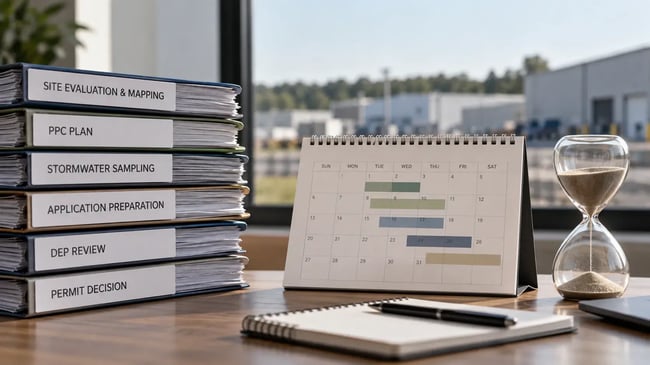
Sampling is the one piece of the application with its own schedule, and you don't control it. First you figure out what you're required to sample for. Then you wait for an actual rain event. Then you collect the samples, get them to a lab, and wait for the lab to analyze them. Only after that can you work the results into the application.
Rain is the obvious variable. A dry stretch can stall the whole project, and a storm that shows up when nobody's on site can mean waiting for the next one. Lab turnaround is the other. Labs vary in how quickly they return results, so ask about turnaround before the storm arrives instead of after, and have your bottles and a plan for getting them to the lab ready to go. Our guide on how to pick a water testing lab covers what to ask.
A sample that's collected the wrong way can mean waiting for another storm and sending another round to the lab, so it pays to get the technique right the first time. We explain our reasoning in why you need to take your own stormwater samples, and our 9 tips for taking good stormwater samples cover the mechanics.
How Long Does It Take to Prepare a PAG-03 Application Yourself?
Nothing says you have to hire a consultant. You can prepare a PAG-03 application yourself, and for some facilities that's the right call. The question is how long it'll take you, and that depends on what you already know.
Take the maps. If you've never used mapping software or worked in something like Adobe Illustrator, the mapping piece alone is a steep learning curve. Those programs are complicated and expensive, so you're paying for the software and spending weeks learning it before a single map is ready for DEP. That's before you start on the PPC Plan, the sampling, or anything else that goes into the package.
If this is your first time doing this kind of work, a lot of your time goes to learning how to do it instead of doing it. When it isn't your day job, we'd say the whole process, prep and review together, can run six months to a year or more.
That said, DIY can make sense. A simple facility with good records and someone internally who has the time to learn the requirements can handle it. If that sounds like you, our post on whether you can get a PAG-03 permit yourself compares doing it in-house with hiring a consultant. Most businesses skip the learning curve and hire an expert to prepare the package.
How Long Does a Consultant Take to Prepare a PAG-03 Application Package?
A typical application package from an environmental consultant takes around 4 to 12 weeks to prepare, which works out to 1 to 3 months. That can sound like a long time until you see what has to happen first.
It starts with a site visit. We come out, walk the site, learn what you do, and document your operations. We take pictures and measurements and inventory the potential pollutant sources. None of that can be done from a desk, and everything else in the package gets built from what we gather on that visit.
Then we turn it into the application itself. That means building the site maps and writing a PPC Plan specific to your facility. Meanwhile the sampling runs on its own track: figuring out what you need to sample for, waiting on rain, collecting samples, getting them to the lab, and folding the results into the package. We can't control when it rains or how quickly a lab turns results around, so that piece can set the pace for everything else.
There's a lot packed into those weeks, but it's not a year-long project. Realistically, getting everything together so DEP will accept and hopefully approve your application takes one to three months. Add DEP's review and you land at the 3 to 9 months we mentioned earlier. If you're weighing that timeline against budget, our breakdown of what an NPDES permit costs in 2026 has real numbers.
What Happens If DEP Sends Back a Deficient PAG-03 Application?
A bad application can cost you more time than a slow review. If DEP gets an application that's incomplete or poorly organized, it can send it back, ask for more information, or deny it altogether. Then you're fixing things, resubmitting, and waiting again, and that back and forth can add months to the process.
So the goal is to get it right the first time. Hiring a consultant doesn't buy you a fast lane with DEP, and nobody should tell you it does. What changes is the quality of what lands on the reviewer's desk. When DEP gets a complete, well-organized application that looks like the PAG-03 applications it's used to approving, there's a better chance it can get through the package without spending time on questions.
How Does Professional Help Save Time on a PAG-03 Application?
Professional help can save time in three places. We can usually prepare the application faster because we've done it before. We can hand DEP a package that's easier to review. And there's a much lower chance that a significant deficiency sends you backward and forces you to fix things or submit again. If you'd like to see the mistakes we run into most often on NPDES permits, we walk through them in common NPDES permit problems and how we fix them.
When Should You Submit a PAG-03 Renewal Application?
If you already have PAG-03 coverage and you're renewing it, don't wait until the permit is about to expire. Pennsylvania generally requires your renewal application at least 180 days before the expiration date. That's roughly six months of lead time, and it's easy to lose track of an expiration date that's still a year or two out.
Treat renewal like a small project of its own. If it's been a few years, the facility has probably changed since the last application, so the maps may need updating and the PPC Plan should reflect how you operate now. If new sampling is needed, you're back to waiting on rain and a lab. Starting well before the 180 day mark leaves room for all of it.
Renewal is also a natural time to check how your ongoing reporting is going. Our guide to Pennsylvania's electronic DMR (eDMR) reporting covers the monitoring side once you have coverage. Whether you're applying for the first time or renewing, this isn't something to start at the last minute.
How Does RMA Help With PAG-03 Permit Applications in Pennsylvania?
We help businesses in Pennsylvania apply for PAG-03 coverage all the time. We handle the applicability review, the site evaluation, the drainage and outfall work, the PPC Plan, the maps, and the application package, so you can get a complete NOI submitted and start DEP's review clock. Senior staff do that work, and we're upfront about timelines like the ones in this post.
We're also glad to tell you when you don't need us. If you have a simple facility, good records, and someone on your team with the time to learn the requirements, preparing the application yourself can make sense, and we'll say so. If you'd rather not spend months figuring it all out, you can reach out to RMA by phone, by email, or through the form on our website. There's no obligation, and we're happy to talk through where your facility stands and what a realistic schedule looks like.