Updating Your SPCC Plan and Pennsylvania Tank Registrations After a Name Change, Sale, or Acquisition
When a company gets renamed, sold, or acquired, the name on the door changes faster than the name on the paperwork. If you store oil above certain amounts, you may have a Spill Prevention, Control, and Countermeasure (SPCC) Plan, which is the written federal oil spill prevention plan facilities need once their aboveground oil storage passes 1,320 gallons (see what an SPCC Plan is if you're not sure whether that's you). If you have one, it names the old company as owner and operator. If your tanks are registered with Pennsylvania DEP, those records name the old company too.
The good news is that most of this is administrative. Swapping names, contacts, and signatures doesn't need an engineer, but a handful of deadlines and forms still apply, and the new owner's changes to how oil is handled can turn a paperwork update into a real plan amendment. We'll walk through which changes are which, and how to update DEP's records. If you'd rather hand it off, you're welcome to reach out to RMA at any point.
Table of Contents
TL;DR
Yes, you need to update both, but a name or ownership change on its own is administrative. Owner and operator names, contacts, and the management approval signature in your SPCC Plan can be changed without a professional engineer. If the new owner changes tanks, containment, or how oil is handled, that's a technical amendment, which has a six-month clock and usually needs a PE for certified plans. For Pennsylvania DEP tank registrations, a change of owner, operator, or contact information has to be submitted within 30 days.
What SPCC Plan Changes Are Non-Technical After a Name or Ownership Change?
EPA's position is that if a facility changes hands and nothing about how it operates changes, the new owner may be able to keep operating under the existing plan once the plan is updated to show the new owner and company names. Changes that don't require good engineering practice are non-technical, and non-technical changes don't need a professional engineer. Naming a new company is paperwork. Deciding where a tank's containment should sit is engineering.
| Change |
What happens to the SPCC Plan |
PE needed? |
| Company name change, same facility and same operations |
Update owner, operator, and facility names and addresses wherever they appear |
No |
| New owner or operator, no change to oil storage or handling |
Update owner and operator information and get new management approval |
No |
| New designated person, phone numbers, emergency contacts, or spill response contractors |
Update the contact pages and notification procedures |
No |
| New or removed tanks, moved containers, changed containment, or changed fueling and transfer practices |
Technical amendment (next section) |
Yes, for PE-certified plans |
Management approval is the piece people forget. An SPCC Plan has to carry the full approval of management at a level with the authority to commit the money and people needed to carry it out. When a new company takes over, the old signer's approval doesn't carry over, so someone with that authority at the new company needs to sign. Log every change in the plan's review and amendment record, and if your five-year review is coming due, a transition is a convenient time to do it. Our article on SPCC Plan five-year reviews explains what that review involves.
When Does an Ownership Change Become a Technical SPCC Plan Amendment?
New owners rarely leave a site exactly as they found it. They add a generator, swap a diesel tank for a bigger one, change where trucks fuel up, or consolidate drum storage. Any change in facility design, construction, operation, or maintenance that materially affects the potential for an oil discharge is a technical amendment under 40 CFR 112.5(a). The amendment has to be prepared within six months of the change and put into practice no later than six months after that. Under the rule, a PE has to certify technical amendments to a full PE-certified plan. Smaller facilities that qualify for the self-certified Tier I or Tier II formats can certify their own amendments, as long as they still qualify after the change.
RMA doesn't have a professional engineer on staff. When a plan needs PE certification, we work with an outside engineer in the state where the plan applies. Our team typically does the site visit and builds the plan, and the PE reviews, stamps, and seals it, which adds some time and a separate review cost. Our article on professional engineers and SPCC requirements covers when certification is required.
Two situations come up often in acquisitions. If the plan was written by another firm and now needs technical changes, we typically rebuild it from scratch rather than update someone else's work. And if you bought a facility and can't find a plan at all, you'll want to confirm whether your oil storage puts you over the threshold. If it does, you'll need to get an SPCC Plan in place, since EPA Region 3 enforces the rule in Pennsylvania. Our guide on when to update an SPCC Plan goes through the triggers in more detail.
How Do You Update PA DEP Storage Tank Registrations After an Ownership Change?
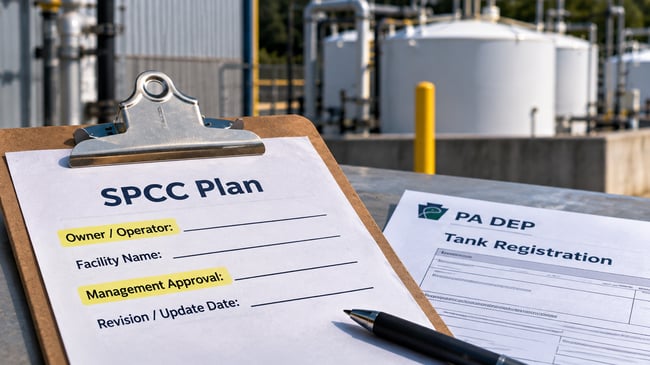
Pennsylvania's storage tank rules sit in 25 Pa. Code Chapter 245. Whether a particular tank has to be registered with DEP depends on its size, type, and use, so confirm yours against DEP's storage tank program. For tanks that are registered, the owner has to submit a registration form to amend the information on file within 30 days of a change. That list of changes includes a change of ownership or operator and a change of contact, mailing address, or telephone number. A new owner also has to register tanks it acquires within 30 days of acquiring an ownership interest.
| Situation |
Timing |
DEP form to look at |
| New owner acquires registered tanks |
Within 30 days of acquiring the ownership interest |
Registration/Permitting of Storage Tanks package (2630-PM-BECB0514), which has a change of ownership option |
| Change of operator, contact, mailing address, or phone number |
Within 30 days of the change |
Registration Amendment Form (2630-FM-BECB0607) |
| Name change only, same legal entity |
Within 30 days of the change |
Usually the amendment form, but confirm with DEP |
DEP's instructions for the full registration package say you may be able to use the amendment form to change information you've already submitted, and the full form includes a change of ownership option, so which one applies depends on how your transaction is structured. A phone call to your DEP regional office before you file is cheap insurance. Both forms can be submitted through DEP's storage tank ePermitting system. If any of the tanks are underground, a change of ownership also requires the underground storage tank operator training documentation form and copies of the Class A and B operator certificates.
The registration form doubles as the operating permit application. Unless DEP agrees otherwise, a regulated substance shouldn't go into a tank until it's properly registered and DEP has approved the operating permit, which is a reason to start the paperwork before closing rather than after. Sellers have their own obligation too: a person who sells a regulated tank, or a property that contains one, has to give the buyer written notice of the owner's registration obligations.
What Should Go on the Closing Checklist for SPCC Plans and Tank Registrations?
The way a deal is structured changes which updates apply. An asset purchase typically means a new owner of the tanks, which points to the ownership change route with DEP. A name change or a stock sale may leave the owner the same legal entity, which can mean a simpler amendment. Your attorney knows how the transaction is structured, and DEP can tell you how it treats it, so it's worth asking both before you pick a form.
A workable order of operations looks like this: confirm which tanks are DEP-registered and which are covered by an SPCC Plan, gather the existing plan and registration certificates, decide before closing whether the new owner plans any changes to tanks or oil handling, submit the DEP paperwork within 30 days, and update and re-sign the plan. If you're not sure which of your tanks count toward the SPCC threshold, remember that capacity is what counts, not how full the tank is, and only containers of 55 gallons or more are counted.
How RMA Helps With SPCC Plan and Tank Registration Updates
If your change is purely administrative, you can often handle the plan edits and the DEP amendment yourself, and we'll tell you that up front. We step in when the new owner is changing how oil is stored or handled, when the existing plan needs a technical amendment, or when nobody can tell which tanks are covered by what. We're a family-run firm, and the senior staff you talk to are the ones who do the work. A new RMA SPCC Plan includes free initial SPCC training. There's no pressure and no obligation, so call, email, or fill out the form on our website, and you can also contact RMA to talk through your situation. You can also browse our SPCC resource library for more.