How Pennsylvania Facilities Lose Qualified Facility Status, What Triggers It, and What Changes Once a Professional Engineer Has to Certify Your Oil Spill Plan
If your facility stores oil in tanks, drums, totes, or oil-filled equipment, the federal Spill Prevention, Control, and Countermeasure (SPCC) rule may require a written oil spill plan, called an SPCC Plan. Smaller facilities with a clean spill history get a break: with 10,000 gallons or less of aboveground oil storage, you can write the plan yourself and sign it, with no Professional Engineer (PE) involved. That break ends once your total aboveground capacity goes over 10,000 gallons, and a large enough spill to a waterway can end it too. If you already have a self-certified plan, you'll need a PE-certified one, and the rule gives you six months from the change to get it done. If you don't have a plan yet but you're growing toward the line, the same math applies to you.
Below, we walk through what counts toward 10,000 gallons, which spills take away self-certification, how the six-month clock works, what changes once a PE signs your plan, and how Pennsylvania's tank rules fit around the federal rule. If you'd rather run your numbers past someone, you can reach out to RMA and we'll look at them with you.
Table of Contents
TL;DR
A facility with 10,000 gallons or less of aboveground oil storage and no qualifying spills in the last three years can write and sign its own SPCC Plan. Once total capacity goes over 10,000 gallons, a licensed Professional Engineer has to certify the plan, and the rule gives you six months after the change to get it in place. A spill that reaches a waterway in large enough amounts, more than 1,000 gallons once or more than 42 gallons twice in 12 months, also stops you from self-certifying for the following three years. The easiest fix is to count your capacity before you buy the next tank, not after.
What Is an SPCC Qualified Facility, and Why Does the 10,000 Gallon Line Matter?
A qualified facility is one that's small enough and clean enough that EPA lets the owner or operator certify the SPCC Plan personally, instead of paying a PE to review and stamp it. The test is in 40 CFR 112.3(g), and it has two parts. The first is size: 10,000 gallons or less of aggregate aboveground oil storage capacity. The second is spill history: in the three years before you certify the plan, no single discharge over 1,000 gallons, and no two discharges each over 42 gallons within any 12-month period. Discharges caused by natural disasters, acts of war, or terrorism don't count against you.
Qualified facilities come in two tiers. A Tier I facility also has no single aboveground container over 5,000 gallons, which lets it complete EPA's short plan template. A Tier II facility has at least one container over 5,000 gallons, so it writes a full plan but still signs it without a PE. Our article on the different types of SPCC Plans compares them in more depth.
| Plan type |
Aggregate aboveground capacity |
Largest single container |
Who certifies |
| Tier I qualified facility |
10,000 gallons or less |
5,000 gallons or less |
Owner or operator, using EPA's template |
| Tier II qualified facility |
10,000 gallons or less |
Over 5,000 gallons |
Owner or operator, with a full plan |
| PE-certified plan |
Over 10,000 gallons, or a disqualifying spill in the last three years |
Any size |
Licensed Professional Engineer |
Moving from Tier I to Tier II costs you the template, not self-certification. If a single container goes over 5,000 gallons but your total stays at or under 10,000, you need a full plan, but you can still sign it yourself. The PE requirement starts at the 10,000 gallon line or with a disqualifying spill.
How Do You Count Aggregate Aboveground Oil Storage Capacity Toward 10,000 Gallons?
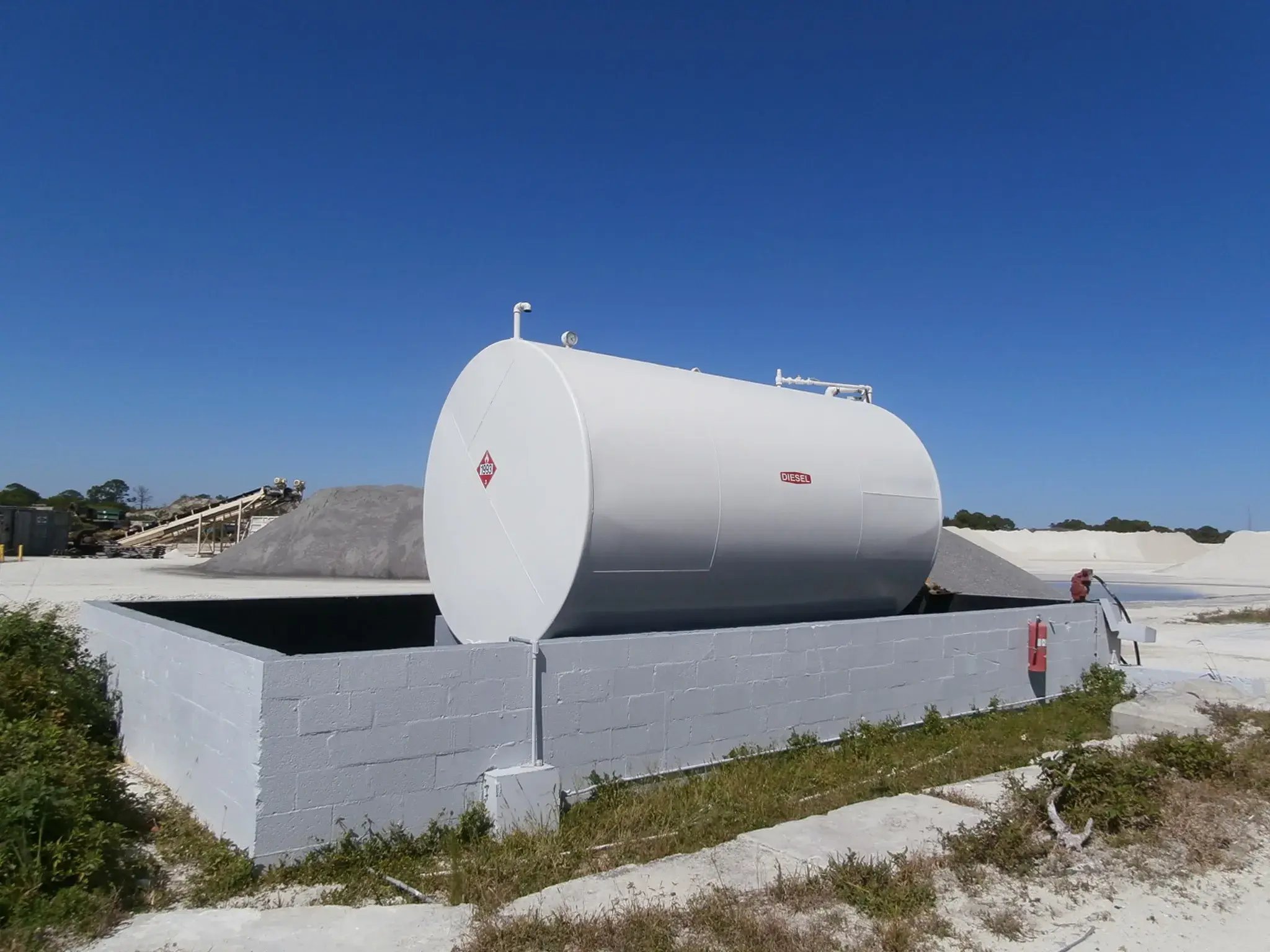
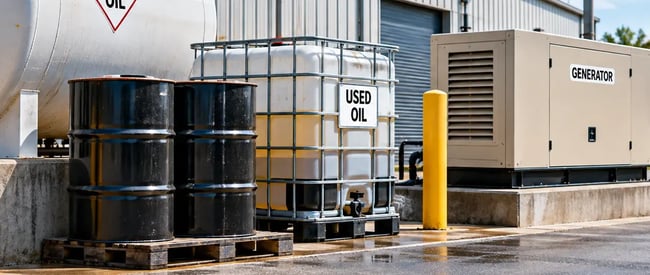
The SPCC rule generally applies once your total aboveground oil storage capacity is over 1,320 gallons, counting only containers of 55 gallons or more, or your buried capacity is over 42,000 gallons. The 10,000 gallon test uses the same counting method. Capacity is what counts, not what's in the tank today. A 6,000 gallon diesel tank that's half full counts as 6,000 gallons, and an empty tank counts too.
| Counts toward your total |
Doesn't count |
| Tanks, drums, and totes of 55 gallons or more, at full capacity, whether full or empty |
Containers under 55 gallons |
| Oil-filled equipment such as transformers and hydraulic systems |
Permanently closed containers |
| Fuel trailers and skid tanks |
Motive power containers, meaning the fuel tank that runs a vehicle's own engine |
| Diesel, gasoline, hydraulic oil, lube oil, and used oil |
Propane and diesel exhaust fluid (DEF) |
| Animal fats and vegetable oils, including cooking oil storage |
Milk and milk product containers |
Facilities seldom cross 10,000 gallons by buying one enormous tank. A generator gets a larger base tank, a second diesel tank goes in for the fleet, a used oil tank appears next to the shop, and more totes of hydraulic oil arrive. Each addition looks small by itself, and nobody adds up the column. Sites adding backup power run into this often, and our article on backup generators and environmental permits covers that side. If you're unsure whether your drums belong in the total, we answer that in our guide on 55-gallon drums and SPCC Plans.
Can an Oil Spill Cost a Facility Its Qualified Facility Status?
The second half of the test looks backward. When you certify a plan as a qualified facility, you're stating that in the prior three years the facility had no single discharge over 1,000 gallons and no two discharges each over 42 gallons within a 12-month period. EPA clarifies that those gallon amounts mean the oil that reaches navigable waters or adjoining shorelines, not the total amount spilled. A 2,000 gallon release that stays inside a dike isn't the same event as a 200 gallon release that runs down a storm drain to a creek. In a state with as many streams and rivers as Pennsylvania, ask whether your tank yard has a path to water.
A discharge that large also starts a separate clock. Under 40 CFR 112.4, if your facility has a single discharge over 1,000 gallons, or two discharges each over 42 gallons within 12 months, you have to send EPA's Regional Administrator (Region 3 for Pennsylvania) a package within 60 days. It covers the facility's location and storage capacity, the cause of the discharge including a failure analysis, the corrective action you took, and the added preventive measures you've taken or plan to take. You also send a complete copy to the state agency in charge of oil pollution control. After reviewing it, EPA can require you to amend your plan, and EPA's rule fact sheet states that a facility required to amend its plan is no longer eligible for self-certification.
Here's what that does to self-certification. The Tier I and Tier II certification statements both include a line saying the facility meets the qualification criteria, and the spill history test looks back three years from the date you certify. So a facility with a disqualifying spill can't truthfully self-certify a new plan or a technical amendment while that spill sits inside the three-year window. In practice, a PE signs the plan until the window clears. If you've had a spill like this, talk to us and to an environmental attorney before you certify anything. Reporting duties, penalties, and liability are separate questions, and the Clean Water Act allows civil penalties of more than $59,000 per day for failing to carry out an SPCC plan, adjusted for inflation under 40 CFR Part 19. We cover common findings in our article on SPCC violations and fines, and spill reporting in our sheen rule explainer. If a spill is happening right now, stop the source if it's safe, call emergency services if anyone is at risk, and make your required reports before anything else on this page.
How Long Do You Have to Get a PE-Certified SPCC Plan After Crossing 10,000 Gallons?
When a change pushes you over 10,000 gallons, the rule gives you six months, and the wording differs slightly by tier. For a Tier II facility, 40 CFR 112.6(b)(2) says that within six months following the change, you must prepare and implement a PE-certified plan that meets the general requirements of 112.7. For a Tier I facility, 112.6(a)(2) runs the six months from the preparation of the amendment, and 112.5(a) separately gives you six months after the change to prepare that amendment. A Tier I facility may have more runway on paper, but we'd treat six months from the change as the working deadline.
| What changes at your facility |
What it does to your plan |
Clock in the rule |
| One container grows past 5,000 gallons, total stays at or under 10,000 |
Tier I template no longer fits. You move to a full self-certified Tier II plan. |
Six months following preparation of the amendment (112.6(a)(2)) |
| Total aboveground capacity goes over 10,000 gallons |
Self-certification ends. A licensed PE has to certify the plan. |
Tier II: six months following the change (112.6(b)(2)). Tier I: six months following preparation of the amendment (112.6(a)(2)). |
| Discharge over 1,000 gallons, or two over 42 gallons in 12 months, reaching a waterway |
Report to EPA. You can't self-certify while the spill sits inside the three-year look-back. |
60 days for the report (112.4). If EPA requires an amendment, EPA sets the schedule (112.4(e)). |
| New facility that will be over 10,000 gallons |
PE-certified plan needed from the start |
Before operations begin (112.3(a)(1)) |
"Prepare and implement" means more than a finished document. The containment, inspection routines, testing procedures, and training the plan describes need to be in place within the window, and the PE's review is a step in the schedule too. If you can't make the deadline for reasons outside your control, such as unavailable qualified personnel or delayed construction or equipment deliveries, 112.3(f) lets the EPA Regional Administrator extend the time on a written request. Filing a request doesn't excuse you from the requirements in the meantime, and extensions aren't automatic, so treat it as a last resort.
What Changes When Your SPCC Plan Needs Professional Engineer Certification?
Under 40 CFR 112.3(d), the PE attests that they're familiar with the SPCC rule, that they or their agent visited and examined the facility, that the plan follows good engineering practice and the rule's requirements, that inspection and testing procedures are established, and that the plan is adequate for the facility. The certification doesn't relieve you of your duty to carry out the plan. You still do the inspections, keep the records, and maintain the containment.
Here's how that works with us. We don't have a PE on staff. When a plan needs PE certification, we work with an outside licensed PE. Our team typically handles the site visit and develops the plan, and the PE then reviews it, stamps it, and seals it. The PE is paid for that review, and it adds time to the project. Our article on professional engineers and SPCC Plan requirements goes further, and the PE-certified plan overview covers how these plans are structured.
| |
Tier I |
Tier II |
PE-certified |
| Plan format |
EPA's short template |
Full plan under 112.7 and the applicable subparts |
Full plan under 112.7 and the applicable subparts |
| Alternative measures (environmental equivalence, impracticability of containment) |
Not allowed |
Only with written PE certification of each one |
Allowed, certified by the PE |
| Technical amendments |
Owner or operator certifies |
Owner or operator certifies, unless the change touches a PE-certified portion |
PE certifies (112.5(c)) |
Once you're PE-certified, every technical amendment, meaning any change in design, construction, operation, or maintenance that affects your potential for a discharge, goes back through the PE. Add a tank, move a tank, or change how a loading area drains, and the plan needs a new certification. The five-year review applies at every level, and our article on SPCC Plan five-year reviews explains how to handle it. Containment still has to hold the largest single container plus room for rain, and our guide on SPCC containment sizing walks through the math, which is one place a growing facility often finds a gap.
What Does a PE-Certified SPCC Plan Cost?
Cost depends on the facility, so here are the ranges and what moves them. Our Tier I plans typically run about $1,500 to $4,000, and across all SPCC plans our pricing runs about $1,500 to $15,000. A plan that needs PE certification costs more than a Tier I plan because the PE is paid for the review and a full plan takes more documentation than the short template. The number goes up with more containers and equipment, storage spread across several areas, containment that has to be evaluated or sized, and tanks that need a PE determination because standard containment isn't practical. It goes down when your capacity list, inspection logs, and spill history are organized and containment is already in place. If another firm wrote your current plan, we typically don't update it and usually rebuild from scratch. Our article on whether you can get your SPCC Plan updated explains when updating makes sense, and how much an SPCC Plan costs goes deeper on pricing. The pricing calculator below gives you a ballpark for RMA's help with your facility, based on the details you enter.
How Do Pennsylvania's Storage Tank Rules Fit In When Your Oil Storage Grows?
In Pennsylvania, the federal SPCC rule and the state's tank program run side by side. EPA Region 3 enforces the SPCC rule here, and our piece on who enforces SPCC Plans explains how inspections work. Separately, the Pennsylvania Department of Environmental Protection (DEP) regulates storage tanks under the Storage Tank and Spill Prevention Act and 25 Pa. Code Chapter 245. Whether a particular tank falls under DEP's program depends on its size, type, and what it holds, so confirm yours against DEP's storage tank program before you assume either way. Where a tank is regulated, DEP's rules can bring requirements like DEP-certified installers and inspectors on top of your SPCC Plan.
The state layer has its own size line, and it isn't 10,000 gallons. A facility with total aboveground capacity over 21,000 gallons of regulated substances has to prepare a Spill Prevention Response Plan (SPRP) and submit it to DEP, with its own required elements, including notice to downstream water users. Crossing 10,000 gallons doesn't trigger that, but a fast-growing facility should know where the next line sits. A full SPCC plan also has to address applicable state requirements, so your SPCC Plan and your DEP obligations should agree. Local fire codes govern tank installations too and vary by municipality, so check with your local fire official early. EPA's own guidance also notes that some states don't allow self-certification at all, which is worth confirming for your state before you rely on it.
How Can You Plan Ahead Before Your Facility Crosses 10,000 Gallons?
The easiest time to deal with the 10,000 gallon line is before the purchase order goes out. A short routine works better than a long policy:
- Keep a running capacity total of every container of 55 gallons or more, every piece of oil-filled equipment, and anything portable, updated whenever something is added, moved, or removed.
- Run the new total before you approve a purchase. If the new tank, generator, or skid takes you over 10,000 gallons, you've started a six-month clock, or for a new site, a plan-before-operations requirement.
- Keep a spill log covering the last three years, including small releases, with an estimate of how much reached water or a shoreline.
- Decide on purpose whether you'd rather stay under the line, for instance by permanently closing an old tank that no longer serves a purpose, or cross it with a PE-certified plan ready to go.
If you already have a self-certified plan, its five-year review is a natural time to recheck your capacity and spill history together. If you don't have a plan yet and you expect to grow past 10,000 gallons within a few years, it often makes sense to start with the PE-certified version so you're not writing the plan twice.
What About the Construction Side of Adding Tanks?
Adding or expanding tank storage usually involves construction-side work: building or fire permits, containment construction, sometimes erosion and sediment control if the site is disturbed, and the installation itself, which in Pennsylvania may require DEP-certified installers for regulated tanks. We don't prepare construction-phase permits or approvals, and we don't install tanks. Your engineer, contractor, and local officials handle that piece. Once the tank is running, the operational side starts: writing or amending your SPCC Plan, inspections and integrity testing, training, and often Tier II reporting. That's where we help, and we can also help you figure out what the construction phase needs and point you toward the right professionals.
How Can RMA Help With an SPCC Plan When Your Oil Storage Is Growing?
If you're getting close to 10,000 gallons, or you've already crossed it, we can help you work out where you stand and what your plan needs to look like. We start by counting your capacity the way the rule counts it, reviewing your spill history, and telling you whether you're still a qualified facility. If you need a PE-certified plan, our team does the site visit and develops the plan, and an outside PE we work with reviews, stamps, and seals it. Initial SPCC training is free with a new RMA plan, and our online training library has courses for your team after that.
There's no obligation and no pressure. You can call us, email us, or fill out the form on our website, and if what you need is a contractor or an attorney, we'll tell you that. When you're ready, contact RMA and we'll talk through your facility.