How Rental Yards Count Fuel, Hydraulic Oil, and Used Oil Toward New Jersey and Federal Spill Plan Rules
If your company rents out excavators, skid steers, generators, light towers, and portable fuel tanks from a yard in New Jersey, you almost certainly have more oil on site than you realize. Diesel in a rental tank, hydraulic oil in drums, lube in totes, used oil waiting for pickup, and the reservoirs on equipment parked in rows all add up, and most rental managers have never been asked to total them. So, do you need an oil spill plan? In most cases, yes. Once your yard stores more than 1,320 gallons of oil in containers of 55 gallons or larger, and a spill could reasonably reach a stream or storm drain, federal law requires a written Spill Prevention, Control, and Countermeasure (SPCC) Plan.
In this article we walk through how a rental yard adds up its oil storage, whether the fuel tanks you rent out count while they sit on your property, what containment drums and fuel tanks need, how to handle equipment coming back from a job, and what New Jersey adds on top of the federal rule. If you'd rather have someone look at your yard with you, you can always reach out to RMA.
Table of Contents
TL;DR
Most equipment rental yards in New Jersey need a federal SPCC oil spill plan once they store more than 1,320 gallons of oil in containers of 55 gallons or larger and a spill could reach a waterway or storm drain. Capacity is counted by container size, not by how full it is, and rental fuel tanks, drums, totes, and used oil tanks stored on your property all count. Drums and tanks need secondary containment, and returned equipment needs a written check-in routine. New Jersey adds its own spill reporting duties under the Spill Act, and larger facilities may need state discharge prevention plans too.
Does an Equipment Rental Yard Need an SPCC Oil Spill Plan?
The federal oil spill rule is 40 CFR Part 112, known as the SPCC rule, and in New Jersey it's enforced by EPA Region 2. A facility needs an SPCC Plan when it meets two tests. The first is capacity: more than 1,320 gallons of oil stored aboveground in containers of 55 gallons or larger, added together across the whole property. The second is what EPA calls a reasonable expectation of a discharge to navigable waters. In plain terms, if oil that got loose in your yard could travel over the ground, into a storm drain, or through a ditch to a stream, the second test is met. Under the rule you can't count on your own berms, curbs, or catch basins when you answer that question, so most yards with a nearby storm sewer or drainage swale meet it.
Rental yards sit in an odd spot because they look like equipment lots rather than oil storage sites. They don't think of themselves as fuel handlers, yet many have a diesel tank for fueling the fleet, drums of hydraulic and engine oil for the shop, a used oil tank, and a row of rental generators and light towers with fuel tanks of their own. The rule doesn't care what the business calls itself. It cares how many gallons of oil can be sitting on the property. For a deeper look at who the rule covers, see our guide to SPCC plans in New Jersey.
If your total comes in under 1,320 gallons, you don't need an SPCC Plan, but you're not off the hook. New Jersey's spill reporting and cleanup duties apply to any discharge no matter how small the yard, and we cover that later in this article.
How Does a Rental Yard Count Its Oil Storage Capacity?
Two rules drive the math. First, you count the capacity of each container, not what's in it. A 500-gallon tank holding 50 gallons counts as 500. Second, only containers of 55 gallons or more are counted, so a shelf of 5-gallon pails and 30-gallon drums doesn't add to the total, though a standard 55-gallon drum does. The oil also isn't limited to petroleum fuels. Hydraulic oil, motor oil, transmission fluid, lube, used oil, and vegetable oils all count, as do oil-filled pieces of operating equipment.
Here's how the common items in a rental yard usually shake out:
| What's in the yard |
Counts toward 1,320 gallons? |
Notes |
| Aboveground diesel or gasoline tank for fueling the fleet |
Yes |
Full shell capacity, whatever the fill level |
| 55-gallon drums of engine or hydraulic oil |
Yes |
55 gallons each, full or empty |
| 5-gallon pails and 30-gallon drums |
No |
Under 55 gallons, so not counted individually |
| Bulk lube or hydraulic oil totes |
Yes |
Tote capacity, commonly 275 or 330 gallons |
| Used oil tank or used oil drums |
Yes |
Used oil is oil for SPCC purposes |
| Portable skid or trailer fuel tanks stored in the yard |
Yes |
Counted whether they're rentals or yours |
| Fuel tanks on generators, light towers, and compressors |
Generally yes |
While they're stored on your property |
| Onboard fuel tank that powers a truck or loader's movement |
No |
Exempt as a motive power container |
| Propane cylinders and tanks |
No |
Propane isn't oil under the rule |
The equipment rows are the ones that cause arguments, because a rented machine can have both a motive power tank and other oil-filled parts, and how each one is treated depends on the machine and how it's used. Get a second opinion on those from someone who does SPCC plans every week. For the drum question specifically, we have a separate piece on whether 55-gallon drums are included in SPCC plans.
Do Rental Fuel Tanks Count Toward SPCC Capacity While They Sit in Your Yard?
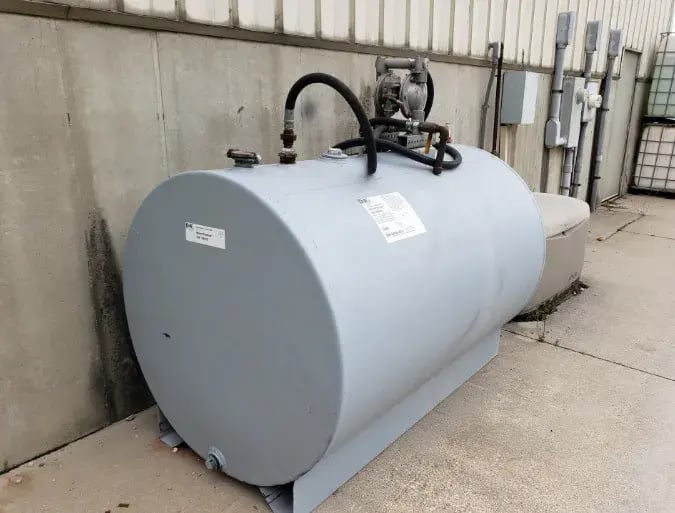
Yes. A portable fuel tank is a container of oil, and when it's parked on your property between rentals, it counts toward your total at its full capacity. Four 500-gallon skid tanks waiting for the next job add 2,000 gallons to your yard's count before you've even looked at your own fueling tank. A rental fleet with a handful of those can push a yard over the 1,320-gallon line on its own, even if the shop and fueling area would have stayed well under it.
The wrinkle is that rental inventory moves. Tanks go out on Monday and come back on Friday, so the number on your property changes all the time. The safest approach is to plan around the highest quantity you'd reasonably expect to have on site at once, rather than the amount you have on a quiet day. A plan written to your typical inventory can be out of date the first week after a big return, and an SPCC Plan has to be amended when a change materially affects your potential for a discharge, such as adding or relocating tanks. Writing the plan to peak capacity avoids a lot of those amendments.
Tanks that are out on rent are a different story. While a tank sits at a customer's job site, it isn't part of your yard's total. It may well be part of your customer's, though, so don't be surprised when customers ask you for the tank's size and containment details. If you want the broader picture of who inspects and enforces all this, read who enforces SPCC plans.
What Secondary Containment Do Drums, Totes, and Fuel Tanks Need?
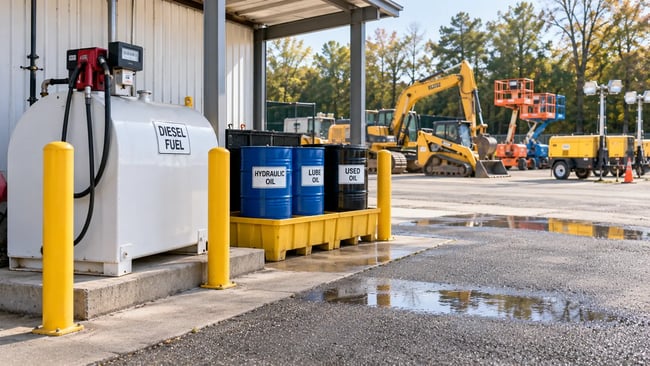
Every SPCC Plan has to describe how a spill from each container would be stopped before it leaves the property. For bulk storage containers, that generally means secondary containment sized to hold the largest single container plus enough extra room (called freeboard) for rainfall. For mobile and portable containers, the rule asks that they be positioned so a discharge is prevented, with containment sized to hold the largest container plus freeboard. Many people use 110 percent of the largest container as a rule of thumb, but the rule itself asks for enough room for precipitation, so an outdoor area with no roof needs a closer look.
Drums and Totes
Drums and totes are the easy win. Spill pallets, containment berms, and covered storage cabinets keep drum leaks off the pavement, and the cover keeps rain from filling the containment with water you then have to deal with. Keep drums off bare ground, keep bungs and lids closed, and don't let a stack of empties sit without a tray under it, because empty drums keep residue that can still run out. Used oil needs the same treatment, and the handling rules for it are covered in our used oil regulations guide.
Fuel Tanks and Fueling Areas
A fixed diesel tank typically needs a dike or a double-walled design, and the area where trucks and equipment get fueled needs a way to catch drips and small spills. Portable tanks on skids are often double-walled, which can satisfy the requirement when it's documented properly, but a single-wall tank sitting on gravel is a problem. Rental fuel tanks that get parked on a slab with a floor drain leading outside are another common finding. If you're unsure how large your containment has to be for the biggest container on site, our guide on how big your SPCC oil spill containment needs to be shows how the sizing works.
How Should a Rental Yard Handle Returned Equipment to Prevent Oil Spills?
Returns are where most yard spills start, because a machine comes back from a job with a weeping hose, a cracked fuel line, or a full tank that nobody checked. A written check-in routine is the cheapest spill prevention a rental yard can buy, and it fits naturally into the inspection paperwork you probably already have. The plan should say who walks each unit when it arrives, what they look for, and where a leaking unit goes. A drip pan or absorbent mat under any unit with a visible leak, a tag that takes it out of the rental rotation, and a designated parking spot with containment give the shop time to repair it without oil reaching the ground.
Fuel handling at return needs a plan too. If you top off tanks or pump fuel out of returned equipment, do it in a fueling area that has containment, with someone watching the nozzle, and with a spill kit within reach. Equipment washing creates its own problem. Washwater from a unit coated in hydraulic oil and mud shouldn't run to a storm drain, and in New Jersey wastewater and stormwater discharges are handled under NJPDES permitting, so a wash pad needs to be set up with that in mind. Absorbent pads and soaked rags from cleanups are waste, and whether they're regulated as hazardous depends on what they picked up, so keep them in a closed container and have them managed properly.
Staff training closes the loop. Under the SPCC rule, employees who handle oil need a discharge prevention briefing at least once a year, and the plan has to include inspection records. A written monthly walk-through is a common way to meet the inspection side, and we put together a list of what to check during SPCC monthly inspections. For the training side, our online training library has courses your team can take on their own schedule.
What Does New Jersey Add to the Federal Oil Spill Plan Rules?
New Jersey's state rules apply whether or not you need a federal SPCC Plan. The Spill Compensation and Control Act, usually called the Spill Act, covers discharges of petroleum and other hazardous substances, and it requires reporting a discharge to NJDEP. It also makes the party responsible for a discharge liable for cleanup costs, and that liability is generally strict, meaning fault isn't the test, and can be joint and several. The reporting details and the exceptions are specific, so confirm them on the NJDEP website, including the current hotline number, rather than relying on a number from memory. Separately from the state rules, the federal Clean Water Act requires reporting an oil discharge that creates a sheen on water, and we explain how that works in our article on the sheen rule.
The state's bigger program for oil storage sits in N.J.A.C. 7:1E. Facilities that qualify as a "major facility" under that rule have to prepare and submit a Discharge Prevention, Containment and Countermeasure (DPCC) Plan and a Discharge Cleanup and Removal (DCR) Plan to NJDEP, and the rules cover hazardous substances beyond petroleum. Whether a rental yard counts as a major facility depends on its total storage capacity and what it stores, so check the rule against your own inventory. Most small and midsize rental yards won't be major facilities, but a large yard with bulk fuel and chemical storage might be.
Two other pieces can touch a rental yard. Underground fuel tanks fall under New Jersey's UST rules in N.J.A.C. 7:14B and are installed, tested, and closed by NJDEP-certified contractors. Aboveground fuel storage and dispensing also fall under the Uniform Fire Code, which is enforced by your local fire official, so keep fire code specifics in a conversation with them. If a spill does reach soil or groundwater, cleanup generally involves a Licensed Site Remediation Professional (LSRP), and if the situation involves enforcement or liability questions, an environmental attorney may be the right call. For a significant release, call emergency responders and NJDEP first and sort out paperwork afterward.
What Does an SPCC Plan Cost for an Equipment Rental Company?
For SPCC work, we publish ranges because we think you should know what to expect. A new SPCC Plan runs roughly $2,500 to $15,000, which is a wide range because facilities differ so much. A simple Tier I update for a small yard with a clean, current plan can run about $1,500, while a more complex plan that needs Professional Engineer certification can run $7,500 or more. You can read more about what moves the number in our SPCC plan cost guide.
For a rental yard, the cost drivers are the total storage capacity, the number and type of containers, how many portable tanks you keep on hand, whether the plan needs PE certification, and whether your secondary containment needs evaluating or upgrading. A yard with several rental fuel tanks and a mix of drums and totes is usually more involved than one with a single fueling tank. If you want to see where your yard falls, our pricing calculator is below, and it's a good first step before you talk to anyone.
How Can RMA Help With Your Rental Yard's Oil Spill Plan?
We're a family-run firm based in New Jersey, and senior staff do the work on every plan. For a rental company, that usually means helping you total up your oil storage, including the rental tanks that come and go, deciding whether a plan is required, and writing one that matches how your yard really runs. We can also review your containment, walk through your return and check-in routine with you, and train your team. If you're thinking about expanding the yard or adding equipment, we can help you work out what operational plans you'd need once you're running. We don't handle construction-phase permits or approvals, like construction stormwater or soil erosion certification, and for that part you'll want your engineer or contractor.
If you already have a plan, we'll tell you if it's good enough, and if it is, we'll say so. If you'd like to talk it through, you can call us, email us, or fill out the form on our website, with no obligation, and contact RMA whenever you're ready.