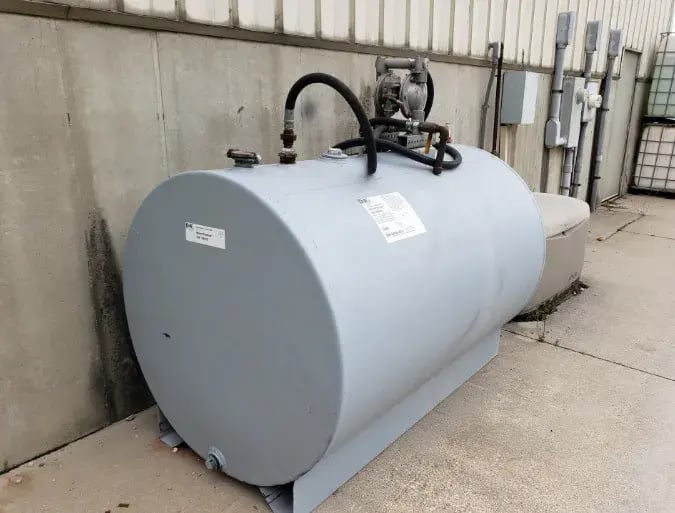
Hot-Mix Asphalt Is Exempt From SPCC Rules, but the Liquid Asphalt Cement, Burner Fuel, Diesel, and Hydraulic Oil at Your Plant Usually Aren't
If you run a hot-mix asphalt plant in New Jersey, you've probably heard that asphalt is exempt from the oil spill rules. That's true for exactly one thing, finished hot-mix asphalt, and it trips up a lot of plant managers. The federal Spill Prevention, Control, and Countermeasure (SPCC) rule is the oil spill plan requirement for facilities that store oil above ground, and an SPCC plan is required once a site stores more than 1,320 gallons in containers of 55 gallons or larger. The hot-mix exemption doesn't reach the liquid asphalt cement tanks, the burner fuel, the diesel, or the hydraulic oil on the same property, and those usually put a plant well over the line. So for most New Jersey asphalt plants, the short answer is yes, you need an oil spill plan.
This article walks through what the exemption really covers, why heated asphalt cement tanks are treated differently, how secondary containment and inspections work for tanks that run hot, and what New Jersey adds on top of the federal rule. If you'd rather talk through your own plant, you can reach out to RMA, and we'll tell you where you stand.
Table of Contents
TL;DR
Yes, most New Jersey asphalt plants need an SPCC oil spill plan. The federal exemption covers finished hot-mix asphalt and the silos and bins that hold it, but it doesn't cover liquid asphalt cement tanks, burner fuel, diesel, hydraulic oil, or other oil containers of 55 gallons or more. If those add up to more than 1,320 gallons and a spill could reasonably reach a waterway or shoreline, you need a plan. Heated tanks bring their own questions about secondary containment, inspections, and heating coils, and New Jersey adds discharge reporting rules and, for the largest facilities, state discharge prevention plans.
What Does the SPCC Hot-Mix Asphalt Exemption Cover?
EPA added the hot-mix asphalt exemption to the SPCC rule in a December 2008 amendment that took effect in February 2009. Under 40 CFR 112.1(d)(8), the rule doesn't apply to hot-mix asphalt or any hot-mix asphalt container, and a companion change keeps the capacity of those containers out of the oil storage total you use to decide whether the rule covers your plant at all.
EPA's reasoning was straightforward. Hot-mix asphalt is a blend of asphalt cement and aggregate such as stone, sand, or gravel, formed into paving products. Once the cement is coated onto the aggregate, the mix doesn't flow like a liquid oil does, so EPA concluded there would be very few situations where a release of finished mix could reach a navigable waterway or shoreline. The silos, surge bins, and other containers that hold finished mix sit on the exempt side of that line.
The exemption is narrow, though, and it follows the material rather than the facility. Your plant isn't exempt because it makes asphalt. Only the finished mix and the containers holding it are exempt, and everything else on the property gets measured against the rule on its own terms.
Why Aren't Asphalt Cement Storage Tanks Exempt From SPCC?
EPA considered exempting asphalt cement along with hot-mix and decided against it, and the agency's reasoning is the same one an inspector will give you. Asphalt cement is solid or semi-solid at ambient temperature, but plants store it hot. At storage temperatures it flows much like other heavy oils, including paraffin wax and heavy bunker fuels, and EPA regulates all of those to keep releases out of waterways. The preamble also describes every type of asphalt, hot-mix included, as a petroleum oil product, and the rule's definition of oil covers oil of any kind and in any form.
Asphalt emulsions and cutbacks stay regulated for the same reason, since they aren't mixed with aggregate. That means the exemption's wording does what you'd hope on one side and what you'd fear on the other. It covers hot-mix asphalt and hot-mix asphalt containers. It doesn't cover the asphalt cement tanks feeding your mixer, and it doesn't cover emulsion or cutback tanks at plants that keep them on site.
What Counts Toward the 1,320-Gallon SPCC Threshold at an Asphalt Plant?
The SPCC rule applies to a facility that stores more than 1,320 gallons of oil in aboveground containers, counting only containers of 55 gallons or more. The count goes by the capacity of each container, not how full it is, so a 30,000-gallon asphalt cement tank that's half empty still counts as 30,000 gallons. Oil in this context is broad: petroleum products, fuel oil, diesel, lubricating and hydraulic oils, used oil, and, as covered above, asphalt cement. Here's how the usual asphalt plant inventory sorts out.
| Item at the Plant |
Counts Toward the 1,320 Gallons? |
Why |
| Silos, surge bins, and containers of finished hot-mix asphalt |
No |
Specifically exempt under 40 CFR 112.1(d)(8) |
| Liquid asphalt cement storage tanks |
Yes |
Stored hot and able to flow, so EPA kept it in the rule |
| Asphalt emulsion and cutback tanks |
Yes |
Not mixed with aggregate, so not hot-mix asphalt |
| Burner fuel and diesel tanks |
Yes |
Petroleum oil in containers of 55 gallons or more |
| Hydraulic, lube, and used oil in drums, totes, or tanks of 55 gallons or more |
Yes |
Oil is counted by container capacity |
| Oil-based release agents or additives in containers of 55 gallons or more |
Yes, if they contain oil |
Check the product's makeup, not just the label |
| Onboard fuel tanks on loaders and trucks |
No |
Motive power containers are exempt |
Asphalt cement tanks at production plants are generally sized in the thousands of gallons, so a single one can pass the threshold by itself, and the fuel and oil containers only add to the total. Hot oil heaters and their expansion tanks are worth a look too, since they're oil-filled equipment and can hold a meaningful volume. Our article on whether 55-gallon drums count toward SPCC covers the drum and tote side of the count in more detail, and plants that also batch concrete will recognize a similar tank mix from our guide on concrete plants and SPCC.
Does an Asphalt Plant Have to Be Near Water to Need an SPCC Plan?
Crossing the 1,320-gallon line isn't the only test. The SPCC rule applies only to facilities that, because of their location, could reasonably be expected to discharge oil to navigable waters or adjoining shorelines. EPA has said an owner can consider the flow properties of the oils on site when making that call, which matters for a heavy product like asphalt cement. But if any single container at the plant meets the test, including a container of oil tied to hot-mix production, then every oil container at the facility is subject to the rule, except the ones that are specifically exempt.
In practice, that means following the ground from your tanks and loading area to the nearest storm drain, ditch, swale, wetland, or stream and asking whether the path leads to a navigable water. Manmade structures like curbs, walls, and berms can't be counted on to rule out a discharge under this test. Claiming your plant falls outside the rule is a judgment you'd have to defend to EPA, so it needs a documented and honest look at the drainage. Given how close New Jersey sites tend to be to streams, ditches, and wetlands, a plan is usually the safer reading, but that call belongs to a real site review.
How Does SPCC Secondary Containment Work for Heated Asphalt Cement Tanks?
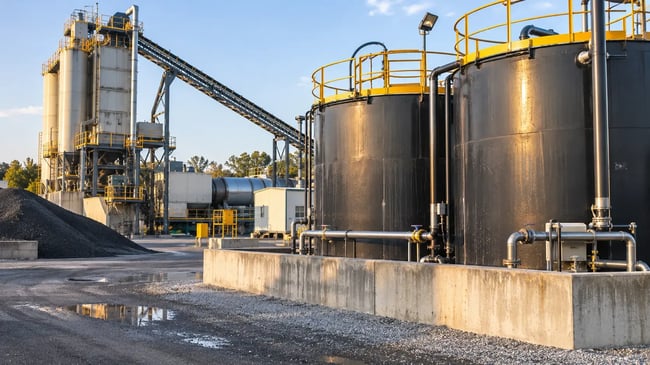
The general rule for bulk storage tanks is secondary containment for the entire capacity of the largest single container, plus enough freeboard to hold rainfall, and the diked area has to be impervious enough to hold the oil. That's in 40 CFR 112.8(c)(2). For a plant with a 30,000-gallon asphalt cement tank, a dike or containment area sized for 30,000 gallons plus precipitation is the baseline, and our guide on how big SPCC containment needs to be walks through the sizing math.
Heated asphalt does give you a little flexibility that other oils don't. EPA has said the flow properties of a heavy oil can be considered when designing containment, and if the oil stays put once it cools, an earthen berm that holds it until it solidifies can be an effective design. That doesn't mean any berm works. Whatever you rely on has to be capable of containing the oil and built so a release from the tank can't escape before cleanup happens.
Several practical issues come with hot product. Asphalt that spills into a dike and hardens is slow, messy work to remove, and a dike partly filled with solidified material has less room for the next release. Insulated, heat-traced piping can hide weeping flanges and valve packing, so aboveground lines need real attention during inspections. Dike drains need to be manual, open-and-closed valves rather than flapper-type valves, and any rainwater you drain has to be checked first so you don't release oil along with it. Truck loading and unloading of asphalt cement also needs containment appropriate to the area, whether or not you have a formal loading rack.
What Inspections Do Heated Asphalt Cement Tanks Need Under SPCC?
Under 40 CFR 112.8(c)(6), each aboveground container has to be tested or inspected for integrity on a regular schedule and after any material repair. You decide the inspector qualifications, the frequency, and the type of testing based on industry standards that fit the tank's size, design, and configuration. You also have to keep comparison records, inspect the tank's supports and foundation, and frequently look over the outside of the tank for deterioration, leaks, and oil accumulating in the dike. The National Asphalt Pavement Association has published guidance specifically on inspecting aboveground tanks that hold asphalt cement at production plants, and it's a good reference to bring to the conversation with whoever writes your plan.
Insulated Tanks and What an Inspector Can See
Most asphalt cement tanks are insulated to hold temperature, and insulation hides the steel. A visual walk-around that works for a bare diesel tank tells you very little about shell condition under cladding. Your plan should spell out how the tank gets inspected despite the insulation, who does it, and how often, and your records should show the results over time. Monthly walk-through inspections still matter for catching leaks, stained ground, and dike problems, and our list of the top 10 things to check during monthly SPCC inspections gives you a practical starting point.
Heating Coils and Hot Oil Systems
The rule also has a requirement written for exactly this kind of tank. Section 112.8(c)(7) calls for controlling leakage through defective internal heating coils by monitoring the steam return and exhaust lines for contamination, or by running those lines through a settling tank, skimmer, or other separation system. Many asphalt plants heat with hot oil rather than steam, so how this requirement applies depends on your heating system, and the plan should address it explicitly rather than skip it. EPA's guidance lists heating coil monitoring among the requirements where a Professional Engineer can document an equivalent alternative, but the plan has to explain what you're doing instead and why it protects the environment just as well. Overfill prevention, compatibility of the tank with the storage temperature, and prompt repair of visible leaks round out the tank requirements in 112.8(c).
What Does New Jersey Add to SPCC for Asphalt Plants?
The federal SPCC rule is the center of the picture, and EPA Region 2 is the office that enforces it in New Jersey. Our article on who enforces SPCC plans explains how that works. New Jersey then layers its own discharge rules on top, and they're stricter than what many states require. Our overview of SPCC plans in New Jersey covers the big picture, and a few pieces matter specifically for asphalt plants.
Spill Reporting and Liability
New Jersey's Spill Compensation and Control Act, usually called the Spill Act, requires discharges of petroleum and other hazardous substances to be reported to NJDEP, and it generally holds the party responsible for a discharge liable for cleanup and removal costs. That liability can be strict and joint and several, which means fault isn't the question and more than one party can be on the hook for the same cleanup. Federal and state reporting rules both apply to oil discharges, so our piece on when you have to report an oil spill is worth reading, and NJDEP's website has the state's current requirements and hotline number. Cleanup of a significant discharge typically involves a Licensed Site Remediation Professional (LSRP). If your plant has had a discharge or you're facing an enforcement question, an environmental attorney may be the right first call.
DPCC and DCR Plans for Major Facilities
Under N.J.A.C. 7:1E, a facility that meets the definition of a "major facility" has to prepare a Discharge Prevention, Containment and Countermeasure (DPCC) plan and a Discharge Cleanup and Removal (DCR) plan and submit them to NJDEP for approval. Whether a plant qualifies depends on its total aggregate storage capacity of hazardous substances, and that count covers all the hazardous substances stored on site, not just oil. NJDEP's guidance notes that petroleum products have to meet the rule's definition of a liquid to count, so whether and how heated asphalt cement is counted at your plant is something to check against N.J.A.C. 7:1E and NJDEP's storage capacity guidance for your actual inventory. If you have underground fuel tanks, New Jersey's UST rules at N.J.A.C. 7:14B and NJDEP-certified UST contractors come into play as well, and local fire officials enforce the Uniform Fire Code for tank installations and storage in their towns.
What Does an SPCC Plan Cost for an Asphalt Plant?
RMA's published range for SPCC plans is $2,500 to $15,000, and where an asphalt plant lands in that range depends on a handful of things. The big ones are total storage capacity, the number and type of containers, whether the plan needs a Professional Engineer's certification, and how much work the secondary containment needs. Facilities with 10,000 gallons or less of total aboveground storage and a clean discharge history can sometimes self-certify, but asphalt cement tanks alone are often larger than that, so a PE-certified plan is common for this industry. What matters is that the PE reviews and approves the plan based on your real site conditions. Some firms have a PE on staff and others work with a trusted outside PE, and either way you should ask how the review works. Our breakdown of SPCC plan costs goes through the pricing factors, and our article on Professional Engineers and SPCC plans explains when certification is required.
Plans don't last forever either. They need a review at least every five years, and a plan that no longer matches your tanks or your site generally has to be rebuilt rather than patched, which our article on SPCC five-year reviews explains. Our SPCC pricing calculator below gives you a ballpark for your own facility, and it's a good way to see how your tank count and capacity move the number before you talk to anyone.
How Can RMA Help Your Asphalt Plant With SPCC?
We're a family-run environmental consulting firm based in New Jersey, and we've been helping industrial clients with SPCC plans since 1992. For an asphalt plant, that means sorting out which containers count, working through the reasonable expectation question, looking hard at your containment and inspection setup for the heated tanks, and building a plan your team can follow. We'll also tell you straight if your plant sits below the threshold and doesn't need us. Your people will need oil-handling training as well, and our online environmental training library is an easy place to start. If you'd like to talk it over, there's no pressure and no obligation. You can call us, send an email, or fill out the form on our website, or just contact RMA to get a conversation started.