How Your Farm's Fuel Storage, Spill History, and New Jersey's Own Tank Rules Decide Whether You Need a Spill Plan
Almost every working farm in New Jersey keeps fuel on site. There's a diesel tank by the equipment shed, a gasoline tank for the trucks, a few drums of hydraulic and engine oil, maybe a used oil tank in the shop and a heating oil tank for the greenhouses. Farmers searching "do farms need an SPCC plan" often get conflicting answers, partly because the federal farm rules changed in 2014 and older advice never caught up. Under federal law, a farm with less than 2,500 gallons of aboveground oil storage capacity doesn't need an oil spill plan, and a farm with more than 2,500 but less than 6,000 gallons doesn't need one either as long as it has no history of reportable spills. Above that, a plan is required, though most farms under 20,000 gallons can write and certify it themselves. New Jersey then adds its own layer, with spill reporting that applies to every farm and state tank rules that carry their own farm exemptions.
In this article we'll walk through how the federal farm tiers work, which tanks and containers count toward your total (and which don't), how spill history changes the picture, and when a farm can prepare its own plan instead of paying an engineer. We'll also cover the New Jersey rules that sit on top of the federal ones and what to do if fuel does hit the ground. If you'd like someone to look at your farm's numbers with you, feel free to reach out to RMA, and we'll tell you plainly whether you need a plan at all.
Table of Contents
TL;DR
Some New Jersey farms need a federal oil spill plan and many don't. If your farm has less than 2,500 gallons of aboveground oil storage capacity, or less than 6,000 gallons with no history of reportable spills, you don't need one. Farms between 6,000 and 20,000 gallons with no tank over 10,000 gallons and a clean spill record can write their own plan, while bigger farms or farms with a spill history need an engineer to certify it. Separately, New Jersey requires every farm to report spills to the state, and its underground tank rules exempt small farm fuel tanks and residential heating oil tanks.
What Counts as a Farm Under the Federal Oil Spill Plan Rule?
The federal oil spill plan rule is called SPCC, short for Spill Prevention, Control, and Countermeasure. It lives in 40 CFR Part 112, and in New Jersey it's enforced by EPA Region 2. An SPCC Plan is a written plan that describes where you store oil, how you keep it from leaking or spilling, how you'd contain it if it did, and who does what when something goes wrong. If you've never seen one, our simple overview of what an SPCC Plan is is a good place to start.
EPA defines a farm as a facility on a tract of land devoted to producing crops or raising animals, including fish, that produced and sold, or normally would have produced and sold, $1,000 or more of agricultural products during a year. That low bar takes in vegetable and grain operations, orchards, dairies, poultry, nurseries and greenhouses, sod farms, and aquaculture, and all of them get the farm thresholds below instead of the general ones.
Two other conditions have to be true before the rule reaches you. First, you have to store or use oil, and the rule's definition of oil covers a lot of ground. Diesel, gasoline, lube oil, hydraulic oil, crop and adjuvant oils, vegetable oil, and animal fats all count. Propane doesn't. Second, your farm has to be in a spot where a spill could reasonably be expected to reach a waterway, and when you make that call you aren't allowed to count manmade features like berms or dikes that might hold it back. In New Jersey, between the drainage ditches, irrigation ponds, creeks, and the dense network of streams feeding the Delaware, the Raritan, and the Pinelands rivers, very few farms can honestly say a spill would never get to water.
How the Federal Farm Tiers for Oil Spill Plans Work
For most businesses, the SPCC trigger is more than 1,320 gallons of aboveground oil storage capacity. Farms got a different deal. In 2014, Congress passed the Water Resources Reform and Development Act (WRRDA), and Section 1049 of that law raised the threshold for farms and loosened the rules about who can certify a farm's plan. The result is a set of tiers based on two things: your total aboveground storage capacity and whether you've had reportable spills.
| Total Aboveground Oil Storage Capacity |
Reportable Spill History? |
What the Farm Needs |
| Less than 2,500 gallons |
Doesn't matter |
No SPCC Plan required |
| More than 2,500 and less than 6,000 gallons |
No |
No SPCC Plan required |
| More than 6,000 and less than 20,000 gallons, with no single tank over 10,000 gallons |
No |
SPCC Plan required, and the farmer can self-certify it |
| 20,000 gallons or more, or any single tank over 10,000 gallons |
Doesn't matter |
SPCC Plan required, certified by a Professional Engineer (PE) |
| More than 2,500 gallons |
Yes |
SPCC Plan required, certified by a PE |
There's one wrinkle in the middle tier. Congress treated 6,000 gallons as an interim number and told EPA to study, with USDA, whether it should come down to somewhere between 6,000 and 2,500 gallons. EPA finished that study in June 2015 and concluded the threshold should be 2,500 gallons, which would effectively erase the spill-free exemption between 2,500 and 6,000. The law expects EPA to make that change through a formal rulemaking, and until the SPCC rule itself is amended, the WRRDA provisions stay in effect. If your farm sits between 2,500 and 6,000 gallons, check EPA's current farm guidance before counting on that exemption, since it could change.
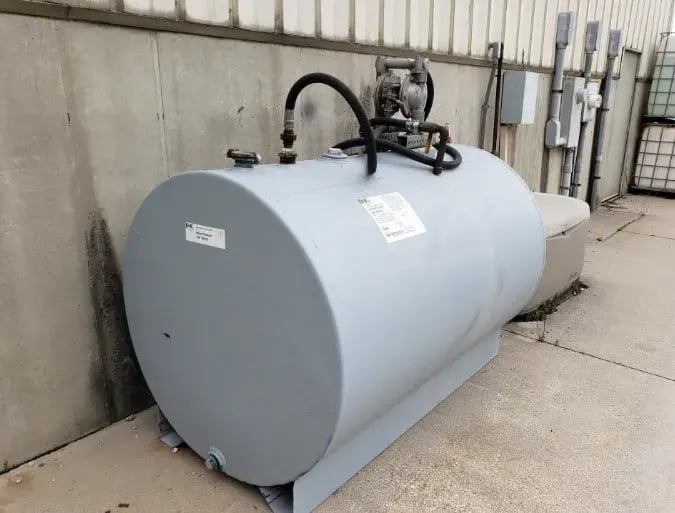
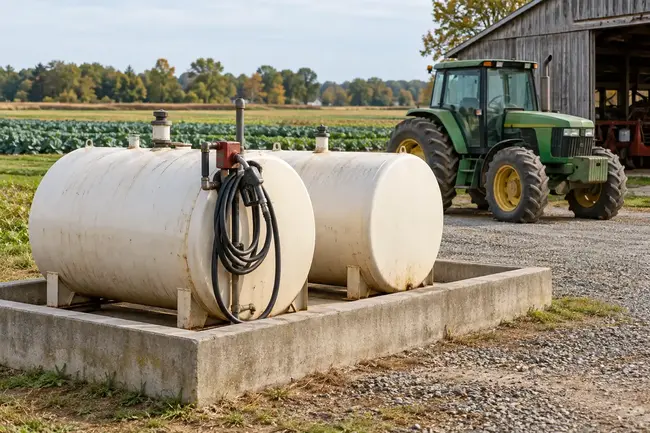
Keep in mind that every number in the table is capacity, not how much fuel happens to be in the tanks. A 1,000-gallon diesel tank you only ever fill halfway still counts as 1,000 gallons. A couple of fuel tanks, a skid tank, and a rack of drums can add up to several thousand gallons quickly.
Which Farm Fuel Tanks and Oil Containers Count Toward the Spill Plan Total?
The general SPCC rule only counts containers of 55 gallons or more, so a shelf of 5-gallon pails of hydraulic fluid doesn't add to your total, but every 55-gallon drum does. Our article on whether 55-gallon drums are included in SPCC plans covers that counting rule in more detail. Farms also get a handful of exclusions that other businesses don't, and they matter because they can drop a farm below a threshold.
| Usually Counts Toward the Total |
Doesn't Count Toward the Total |
| Aboveground diesel and gasoline tanks for farm equipment and trucks |
Fuel tanks built into tractors, combines, trucks, and other equipment (motive power containers) |
| Skid tanks and nurse tanks used to fuel equipment in the field |
Heating oil tanks used solely at a single-family residence, like the farmhouse |
| Drums and totes of 55 gallons or more holding lube oil, hydraulic oil, or crop oil |
Pesticide application equipment and related mix containers |
| Used oil tanks and drums in the shop |
Milk and milk product containers and their piping |
| Heating oil tanks for barns, shops, and greenhouses |
Containers holding FDA-approved animal feed ingredients |
| Generator fuel tanks and other oil-filled equipment of 55 gallons or more |
Containers of 1,000 gallons or less sitting on separate parcels of the farm |
| Vegetable oil and animal fat storage |
Completely buried tanks that meet all of EPA's underground storage tank technical rules (40 CFR Part 280 or 281) |
The heating oil exclusion only covers the house where the farm family lives. Heating oil that warms greenhouses, a farm store, or an equipment shop counts, and for New Jersey nurseries and greenhouse growers, that's often the single biggest number on the list. The separate parcel exclusion helps farms that work scattered fields: a 500-gallon tank sitting on a leased field across the road doesn't get added to the tanks at the home farm. Nurse tanks that move fuel out to equipment in the field are treated as mobile refuelers under the rule, and they still count toward capacity.
Used oil is the one farms forget most often. Crankcase oil drained from equipment and stored in a tank or drums is still oil under the rule, and it carries its own handling requirements too. Our list of the top things to know about used oil regulations is worth a read if you keep a waste oil tank in the shop.
How Spill History Changes a Farm's Oil Spill Plan Requirements
Spill history is the second half of the farm tier test, and it can move a farm from "no plan needed" to "PE-certified plan required" without a single new tank. WRRDA defines a reportable oil discharge history as a single oil discharge of more than 1,000 gallons, or two oil discharges that each exceed 42 gallons within any 12-month period. The look-back window is the three years before your plan is certified, or the time since you became subject to the rule if you've been operating less than three years.
The discharges that count here are the kind the SPCC rule is built around, meaning oil that reaches or threatens a waterway or shoreline in a harmful quantity. A few drips on the shop floor that get wiped up aren't what this definition is about. A tank overfill that runs into the drainage ditch behind the shed is. If you aren't sure whether a past spill qualifies, our explainer on when you have to report an oil spill and how the sheen rule works walks through the federal reporting trigger.
A farm with 4,000 gallons of capacity and a clean record doesn't need a plan at all. The same farm with two qualifying spills last year needs a full plan certified by a Professional Engineer. That's one more reason good fueling habits, like not walking away from a tank while it's filling and checking hoses and fittings before planting season, pay off beyond just saving fuel.
Can a New Jersey Farm Write Its Own Oil Spill Plan?
Often, yes. If your farm has more than 6,000 but less than 20,000 gallons of aboveground capacity, no single tank over 10,000 gallons, and no reportable spill history, the farmer can prepare and self-certify the plan without hiring an engineer. EPA has estimated that about 99 percent of farms have 20,000 gallons of oil storage capacity or less, so most farms that need a plan land in that self-certification range. For facilities with smaller containers, EPA also publishes a fill-in template for a simplified plan. We cover how that works in what a Tier I self-certified SPCC Plan is, and our guide to the different types of SPCC Plans compares the self-certified and PE-certified options side by side.
We'll be straight with you here. Plenty of farmers write their own plans and do it well, and if you have a simple setup and some time over the winter, you may not need a consultant. Farms tend to get stuck on containment: how big it has to be, whether a double-walled tank covers you, and what to do with tanks sitting in the open. Our article on how big SPCC oil spill containment needs to be covers the sizing math. Once you have a plan, you're on the hook for regular tank inspections, training anyone who handles fuel, and reviewing the plan at least every five years. RMA's online environmental training library is one way to handle the training piece without pulling people off the farm for a day.
If you'd rather hand it off, our published range for SPCC Plans runs from $2,500 to $15,000. Where a farm lands depends on total capacity, the number of tanks, whether the plan needs PE certification, whether containment has to be evaluated, and how many fueling areas or parcels the plan covers. For a quick estimate of what RMA's help would cost for your farm, try the calculator below. Our article on what an SPCC Plan costs goes deeper on the pricing factors.
New Jersey's Own Rules for Farm Fuel Tanks and Spills
The federal tiers only decide whether you need an SPCC Plan. New Jersey's main law is the Spill Compensation and Control Act, usually called the Spill Act. It makes discharges of hazardous substances illegal, requires them to be reported, and makes the people responsible for a discharge liable for the cleanup. The Spill Act covers petroleum and a long list of other hazardous substances too, so it can reach some farm chemicals as well as fuel. A farm that's exempt from the federal SPCC rule still has to follow it.
New Jersey also has its own discharge prevention planning program under N.J.A.C. 7:1E. Facilities that qualify as a "major facility" have to prepare Discharge Prevention, Containment, and Countermeasure (DPCC) and Discharge Cleanup and Removal (DCR) plans, which are the state's more demanding version of a spill plan. The major facility thresholds are 200,000 gallons or more of total hazardous substance storage capacity, or 20,000 gallons or more of non-petroleum hazardous substances, so almost no farms reach them. Our article on SPCC Plans in New Jersey explains how these state plans relate to the federal one.
Underground tanks are where New Jersey's farm exemptions show up most clearly. The state's underground storage tank rules at N.J.A.C. 7:14B exempt farm and residential underground tanks of 1,100 gallons or less that store motor fuel for noncommercial purposes. They also exempt underground tanks storing heating oil for use in a residential building, and underground heating oil tanks of 2,000 gallons or less that heat a nonresidential building on site. Larger or commercial buried tanks fall back under the state program's registration, monitoring, and closure rules.
| New Jersey Rule |
What It Means for a Typical Farm |
| Spill Act discharge reporting |
Applies to every farm, regardless of tank size or federal SPCC status |
| DPCC and DCR plans (N.J.A.C. 7:1E) |
Only for major facilities, which almost no farms are |
| Underground storage tank rules (N.J.A.C. 7:14B) |
Small noncommercial farm motor fuel tanks and residential heating oil tanks are exempt; larger or commercial buried tanks are regulated |
| Uniform Fire Code |
Statewide fire safety rules for flammable and combustible liquid storage, enforced by your local fire official |
An exemption from the underground tank program isn't an exemption from the Spill Act. If an old buried farm tank or farmhouse heating oil tank leaks, the cleanup obligations still apply. Installing, repairing, or removing a buried tank is also work for an NJDEP-certified tank contractor and usually needs a construction permit from your town. RMA doesn't install or remove tanks or pull those construction permits, so that piece goes to your tank contractor. Aboveground tanks also have to meet the Uniform Fire Code, enforced by your local fire official, so check with that office before adding or moving a fuel tank.
What a New Jersey Farm Should Do After a Fuel Spill
Safety comes first. If there's a fire, a risk of fire, or anyone's hurt, call 911 before anything else. Once it's safe, stop the flow if you can, shut off the pump or close the valve, and use absorbents, soil, or a quick berm to keep fuel out of ditches, drains, and streams. Then make the calls. New Jersey requires discharges to be reported to NJDEP right away through its 24-hour hotline at 1-877-WARNDEP (1-877-927-6337). If oil reaches a waterway or leaves a sheen on the water, the federal rules also require a report to the National Response Center at 1-800-424-8802. When in doubt, report. Failing to report a spill can bring penalties of its own on top of the cleanup, while an unnecessary call costs you a few minutes.
Small spills on a farm are often handled by digging out the stained soil and disposing of it properly. Bigger releases, or ones that reach groundwater or a stream, can turn into a formal cleanup under New Jersey's site remediation program, which typically means hiring a Licensed Site Remediation Professional (LSRP) to oversee the work. Because the Spill Act's liability rules are strict, a farm facing a significant release, a neighbor's complaint, or an enforcement letter should also think about talking with an environmental attorney. And remember that larger spills feed directly into the federal spill history test. Two qualifying spills in a year can change what kind of SPCC Plan your farm needs, and a spill can also bring an inspector to the farm. Our article on who enforces SPCC Plans explains how those inspections work.
How RMA Helps New Jersey Farms With Oil Spill Plans
We're a family-run firm based in New Jersey, and we've spent more than 30 years helping facilities sort out oil storage rules, including the state rules that sit on top of the federal ones. For farms, that usually starts with tallying your tanks, drums, and parcels to see which tier you're in. Sometimes the answer is that you don't need a plan, and we'll tell you that. Sometimes you need one but can easily write it yourself, and we'll point you to the right template. When a farm needs a PE-certified plan, containment evaluated, or help getting its people trained on fueling and spill response, that's where our senior staff dig in and do the work.
There's no pressure and no obligation. You can call us, send an email, or fill out the form on our website, and someone who knows these rules will get back to you. If you'd like a straight answer about whether your farm needs an oil spill plan, get in touch with RMA and we'll help you figure out your next step.