Vegetable Oil, Animal Fat, and Frying Oil Storage Count as Oil Under the Federal SPCC Rule, and Most Food Plants Have More of It Than They Realize
If your New Jersey plant fries, bakes, blends, or packs with oil, you probably have an oil spill planning question you haven't looked at yet. Most food manufacturers think of oil spills as a petroleum problem, something for gas stations and fuel depots. The federal rule behind oil spill planning doesn't draw that line, and neither does New Jersey. Soybean oil, shortening, tallow, and used frying oil count right alongside generator diesel and hydraulic fluid, so a plant with one bulk tank and a handful of totes can cross the threshold without anyone noticing.
The federal oil spill plan is called a Spill Prevention, Control, and Countermeasure plan, or SPCC plan, and it comes from 40 CFR Part 112 under the Clean Water Act. The short answer for food plants is yes, you need one if your total aboveground oil storage capacity is over 1,320 gallons and a spill could reasonably reach a stream, ditch, or storm drain. Below we walk through how to inventory your oil, what tanks and totes need for containment, how to handle oil deliveries, and what New Jersey adds on top. If you'd rather talk it through with someone, you can reach out to RMA at any time.
Table of Contents
TL;DR
Yes, if your plant stores more than 1,320 gallons of oil above ground, counting every container of 55 gallons or more and measuring by capacity, not by how full it is. Vegetable oil, shortening, tallow, and used frying oil count the same as diesel and hydraulic oil, and the plan only applies if a spill could reasonably reach water, which a floor drain tied to a storm sewer usually does. A plan means an accurate oil inventory, containment sized for your largest container, written delivery procedures, inspections, and training. New Jersey adds its own spill reporting rules, and larger facilities may face extra state planning requirements.
Does Vegetable Oil, Animal Fat, and Frying Oil Count Under an SPCC Plan?
EPA defines oil broadly: oil of any kind or in any form, including fats, oils, and greases of animal, fish, or marine mammal origin, and vegetable oils from seeds, nuts, fruits, and kernels. There's no food-grade exemption. The rule has its own section for animal fats and vegetable oils (Subpart C of Part 112), with requirements that track the petroleum ones closely, because spilled vegetable oil and animal fat coat wildlife and use up the oxygen in the water much the way petroleum does.
That means a plant whose only oil is cooking oil can still need a plan, and a plant that also runs a generator, a fire pump, hydraulic packaging lines, and refrigeration compressors adds up quickly. We cover the basics of cooking oil and used cooking oil in a separate article, and if the term itself is new to you, our overview of what an SPCC plan is covers the fundamentals.
The rule has two conditions, and both have to be true. First, the facility has to store over 1,320 gallons of oil in aboveground containers (or over 42,000 gallons completely buried). Second, a discharge has to be reasonably expected to reach navigable waters or adjoining shorelines. Navigable waters is a wide term that includes streams, tidal waters, and many ditches and wetlands, and EPA's guidance says you can't count man-made structures, such as a berm or a closed valve, when deciding whether a spill could get there. A New Jersey food plant with floor drains tied into a storm sewer, a loading dock that slopes toward a catch basin, or a ditch along the back lot will usually meet the second condition without much debate.
How Do You Build an Oil Inventory for a Food Processing Plant?
Start with a walk of the whole property, not just the production floor. Oil hides in maintenance shops, boiler rooms, mechanical rooms, outdoor pads, rooftops, trailers, and the corner of the warehouse where someone parked four totes of shortening. For every container that holds 55 gallons or more, write down what's in it, where it sits, and its full shell capacity. The inventory is a list of containers, so you'll want a row for each one rather than a single number for each oil type.
Here's how the usual food plant oil sources sort out:
| Oil source |
Typical container |
Counts toward 1,320 gallons? |
| Bulk vegetable oil, shortening, or tallow |
Aboveground tank |
Yes, at full capacity |
| Oil delivered in totes or drums |
275 or 330 gallon totes, 55 gallon drums |
Yes, each container of 55 gallons or more |
| Used frying oil and grease |
Waste oil tanks, totes, or drums |
Yes, it's still oil |
| Generator and fire pump diesel |
Day tanks and base tanks |
Yes |
| Boiler fuel oil |
Aboveground tank |
Yes |
| Hydraulic, lube, and gear oil |
Drums, totes, equipment reservoirs |
Yes, when the container is 55 gallons or more |
| Refrigeration compressor oil |
Compressor and oil pot reservoirs |
Typically, when the reservoir is 55 gallons or more |
| Transformers |
Pad or pole mounted |
Yes, mineral oil counts |
| Fryers, cookers, and kettles |
Process equipment |
Needs a case by case look |
| Milk and milk product containers |
Tanks, silos, piping |
No, EPA exempts them |
| Propane |
Cylinders and tanks |
No, propane isn't oil |
| Containers under 55 gallons |
Pails, small drums, jugs |
No, not counted individually |
Fryers, continuous cookers, and kettles are where food plant inventories get debated. Equipment that holds oil as part of the product process is treated differently from equipment that holds oil only to keep it running, like hydraulic oil, so the right answer depends on how each piece uses the oil. Have whoever writes your plan evaluate each unit instead of assuming it's in or out. The same goes for dairy and mixed-product plants, where the milk exemption covers milk and milk product containers but not the diesel tank sitting next to them. Our 55-gallon drums count article goes deeper on how drums and totes figure in.
How Do You Calculate Whether You Cross the 1,320 Gallon SPCC Threshold?
Count capacity, not contents. A 10,000 gallon soybean oil tank that's a third full still counts as 10,000 gallons, because the rule is built around what could be released, and nobody can promise the tank will stay low. Add up the shell capacity of every container of 55 gallons or more, leave out the exempt items, and compare the total to 1,320 gallons. A single 2,000 gallon tank of vegetable oil crosses the line on its own. A plant with a 1,000 gallon oil tank, a 500 gallon generator tank, and two 275 gallon totes of hydraulic oil lands at 2,050 gallons, which also crosses it.
Once you're over the threshold, the kind of plan depends on your size. A facility with total aboveground capacity of 10,000 gallons or less, no single container over 5,000 gallons, and a clean enough spill history can usually qualify for a Tier I self-certified plan using EPA's template. Larger or more complicated facilities need a full plan, and some elements of a full plan, such as deciding that a containment measure isn't practicable, have to be certified by a Professional Engineer. Our guide to the different types of SPCC plans walks through how the tiers differ. A plant that stays under the threshold doesn't need an SPCC plan, and we'll say so if that's what your inventory shows.
What Secondary Containment Do Oil Tanks and Totes Need?
Secondary containment is the backup system that holds oil if the primary container fails. The SPCC rule asks for two levels of it, and a food plant usually needs both.
Containment for Bulk Oil Tanks
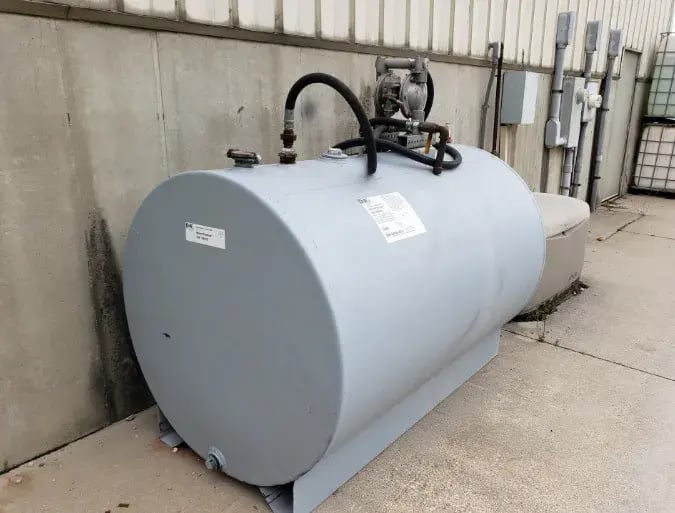
Every area with a realistic chance of a discharge needs general containment, meaning dikes, curbs, berms, drainage to a holding area, or another way to keep a spill from leaving the site, sized to the most likely failure. Bulk tanks have a firmer standard. For animal fat and vegetable oil tanks, the containment has to hold the entire capacity of the largest single container in the installation plus sufficient freeboard for precipitation. The rule doesn't define sufficient freeboard, so engineers typically work it out from local rainfall data and document the reasoning in the plan. If your tank sits outdoors, rain is part of the calculation. Drain valves on the containment should stay closed, and any stormwater collected inside needs to be checked for sheen before it's released. We cover the sizing math in how big your containment needs to be.
Containment for Totes and Drums
Totes and drums are portable, but the rule doesn't let you off the hook because they can be moved. When a tote or drum sits stationary and unattended, the sized containment standard applies: enough capacity for the largest single container plus freeboard if it's outdoors. When it's being moved or staged for use under the direct control of your people, general containment is the standard. In practice that means spill pallets or a curbed, sealed area for storage, drip pans and absorbents at transfer points, and a rule that nobody parks a full tote on bare pavement near a drain. Overfill prevention for bulk tanks, usually a high level alarm or a similar device, also belongs in the plan, along with who checks it.
If you're adding a tank, building a containment pad, or expanding the plant, the installation side involves construction and fire permits and engineering work that RMA doesn't handle. Your engineer or contractor takes that piece, and we can help you work out what the construction phase needs and point you toward the right people. Once the new equipment is running, it needs an SPCC plan or a plan amendment, inspections, training, and spill procedures, and that's the part we do.
What Should Oil Delivery and Loading Procedures Cover at a Food Plant?
Deliveries and pickups are where most oil releases at food plants start. A driver connects to the wrong fitting, a tank is higher than anyone thought, or a hose is disconnected with oil still in it. The rule treats transfer areas seriously, and a good plan writes the routine down so the third shift follows the same steps as the day shift.
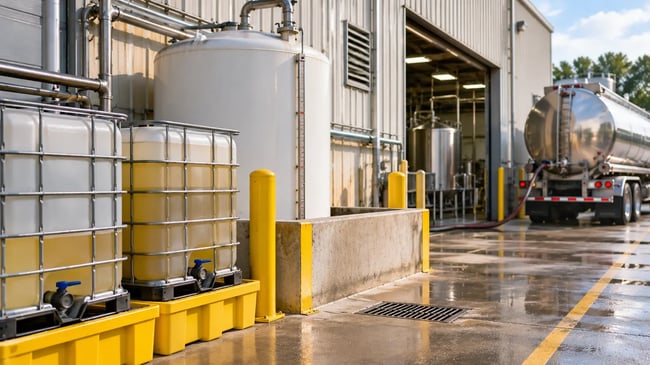
If your plant has a loading or unloading rack where tank trucks connect, the rule asks for containment that holds at least the largest single compartment of the trucks you handle, unless drainage goes to a catchment basin or treatment facility. It also calls for an interlocked warning light or physical barrier, warning signs, and wheel chocks or a brake interlock so a truck can't pull away with the hose still attached. Before filling and before departure, the driver and your staff are supposed to inspect the lowermost drain and all outlets of the vehicle for leaks. Plants with a simple connection on a tote station or a fill line at an outdoor tank fall under general containment for those transfers, and the plan should say how the area is protected.
The procedures we usually see in a food plant plan are written in plain steps. A trained employee checks tank capacity against the delivery quantity before the truck connects, and stays at the transfer from start to finish. Storm drains near the fill area get covered or blocked, and a spill kit is staged within reach. The driver and employee agree on who can stop the pump and how, wheels are chocked, and hoses and fittings are inspected before use. After the transfer, lines are drained into the tank, connections are closed, and the area is checked before the truck leaves. The same steps apply to used oil, grease, and tallow pickups, where a hauler's truck is the one taking oil away. Your own people should know they have the authority to stop a delivery that isn't following the steps.
What Does New Jersey Add to the Federal Oil Spill Plan Rules?
In New Jersey, EPA Region 2 enforces the federal SPCC rule, and the New Jersey Department of Environmental Protection (NJDEP) runs a separate state program built on the Spill Compensation and Control Act, usually called the Spill Act. The two sit side by side. Having an SPCC plan doesn't take the place of your state reporting duties, and our article on who enforces SPCC plans explains how the agencies divide the work.
The state rule people forget is reporting. NJDEP says a discharge should be reported immediately to its hotline at 1-877-WARNDEP (1-877-927-6337), and the agency's own guidance describes immediately as within 15 minutes of the discharge for any contaminant released to the environment. The federal side has its own reporting triggers when oil reaches navigable waters or leaves a sheen, which we explain in our sheen rule article. Whether a particular food-grade oil is on the state's hazardous substance list is something to check against N.J.A.C. 7:1E, but a plant with oil running toward a drain shouldn't spend time on that question before making the call. If anyone is hurt, there's a fire, or the release is large, call 911 first, and keep people out of the area until the release is stopped.
Spill Act liability is also strict and can be shared among the parties connected to a release, which is a good reason to prevent spills instead of paying for them. Larger releases that reach soil or water may need cleanup overseen by a Licensed Site Remediation Professional (LSRP), and RMA doesn't provide LSRP services. If a discharge, an enforcement action, or a liability question is already in play, bring in an environmental attorney.
The other state layer is for what New Jersey calls major facilities under N.J.A.C. 7:1E. These facilities have to prepare a Discharge Prevention, Containment and Countermeasure (DPCC) plan and a Discharge Cleanup and Removal (DCR) plan and submit them to NJDEP. Whether a plant counts as a major facility depends on its total storage capacity and on what it stores, including whether a substance is on the state's hazardous substance list, so check the rule against your own inventory before assuming you're in or out. Most food plants fall well short, but a plant with large fuel storage or large quantities of other listed substances should look at it. Plants with ammonia refrigeration, sanitizing chemicals, and fuel on site may also have Community Right to Know reporting duties, and RMA can help sort those out alongside the oil plan. Our SPCC plans in New Jersey article covers the state picture in more detail.
How Much Does an SPCC Plan Cost for a Food Processing Plant?
RMA's published range for an SPCC plan is $2,500 to $15,000, which is wide because food plants vary so much. A Tier I update for a simple site runs about $1,500, and a complex update that needs Professional Engineer certification starts around $7,500. A plant with one oil tank, two totes, and a generator sits at the low end, and a multi-building plant with a loading rack and containment that needs engineering sits near the top.
What pushes the cost up or down is mostly the same short list: total storage capacity, how many containers and what types, whether a Professional Engineer has to certify the plan, whether existing containment needs to be evaluated or sized, and how many separate areas and buildings need a site visit. A plant that already has a clean inventory and good records is faster to document than one where nobody knows what's in the back lot. We break the numbers down further in what SPCC plans cost and why. The calculator below gives you a quick estimate of what RMA's help would run for your facility, and we're open about what drives the number.
What Inspections, Training, and Reviews Does an SPCC Plan Require?
The plan itself is only the start. Written inspection and testing procedures have to be followed, and the signed records are kept with the plan for three years. Most food plants do this on a monthly rhythm for tanks, containment, valves, and transfer areas, and our monthly inspection checklist lays out what to look at. Records kept as part of your normal maintenance system can count, as long as they're signed and tied to the plan's procedures.
The rule also requires training for oil-handling employees on how the equipment works, how to respond to a discharge, the pollution laws that apply, and what's in the plan. One person at the facility has to be accountable for discharge prevention, and the plan calls for a discharge prevention briefing at least once a year to cover past spills, failures, and new precautions. Our article on annual SPCC training explains what the regulations say, and our online training library is there if you'd rather have staff take a course on their own schedule.
Finally, the plan has to stay current. It gets a five-year review at least every five years, and it needs to be amended when you add or remove tanks, change oil types, move the loading area, or otherwise change the odds of a discharge. Skipping these steps is how plants end up on the list of most common SPCC violations and fines, so the plan you wrote three years ago probably doesn't match the plant you run today unless someone has kept it up.
How Can RMA Help a New Jersey Food Plant With an Oil Spill Plan?
We're a family-run New Jersey firm, and senior staff do the work on your plan, not a junior person working from a template. We start with the oil inventory and tell you plainly whether you need an SPCC plan at all. If your total capacity is under the threshold, we'll say so and you won't pay for a plan you don't need. If you're over it, we write the plan, evaluate your containment and delivery areas, explain what the state side means for your site, and set up inspection and training routines your team can keep up. We don't use AI to produce client deliverables, and we publish our pricing and timelines so you know what to expect.
There's no pressure and no obligation. You can call us, email us, or fill out the form on our website, and we'll talk through what you have on site and what the plan would involve. When you're ready to start the conversation, you can send us a message, and we'll go from there. Our full overview of SPCC plans is also a good place to start if you'd like more background first. If your plant is also looking at generator permits, our article on emergency backup generators covers that piece.