How Hydraulic Presses, Lube Drums, Used Oil, and a Backup Generator Add Up Toward an SPCC Plan, and What Your Indoor Containment Options Are
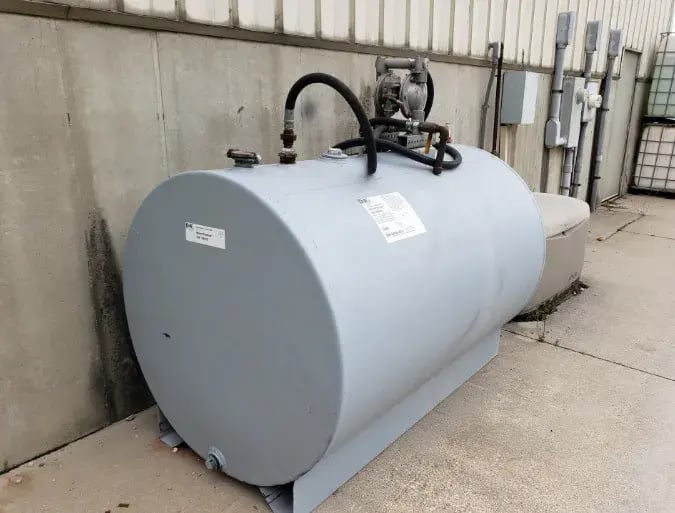
If you run a manufacturing plant in New Jersey, there's probably more oil on site than anyone has added up in one place. There's hydraulic oil in the presses and molding machines, lube oil in drums and totes along the line, cutting oil at the machining centers, a couple of drums of used oil waiting for pickup, and a generator outside with its own fuel tank. Each one feels like a normal part of running the shop, but together they can cross the line that requires a written oil spill plan, which EPA calls an SPCC plan (Spill Prevention, Control, and Countermeasure). The short answer is that many New Jersey manufacturers do need one.
This article covers how oil-filled equipment and drums add up, what containment works for oil stored indoors, and an option that can replace containment around hydraulic presses. If you'd rather have someone run the numbers on your plant, you can reach out to RMA at any point.
Table of Contents
TL;DR
Yes, many New Jersey manufacturers need an oil spill plan. If the capacity of your oil containers and oil-filled equipment, counting every unit of 55 gallons or more, adds up to more than 1,320 gallons, and a spill could reasonably reach a stream, storm drain, or other waterway, the federal SPCC rule applies. Hydraulic systems, lube reservoirs, drums, totes, used oil containers, and generator fuel tanks all count by capacity, not by how full they are. Storing oil indoors doesn't automatically exempt you, but it opens up simple containment options like pallets and curbed areas, and qualifying oil-filled equipment can use an inspection-based alternative instead of containment around every machine.
Does a Manufacturing Plant Need an SPCC Oil Spill Plan?
The federal rule behind an oil spill plan is 40 CFR Part 112, known as the SPCC rule, and in New Jersey it's enforced by EPA Region 2. A facility needs a written SPCC plan when three things are true. It's a non-transportation facility that stores, uses, or handles oil. The total aboveground oil storage capacity is more than 1,320 gallons, or the buried capacity is more than 42,000 gallons. And a spill there could reasonably be expected to reach navigable waters or adjoining shorelines.
That last test reads wider than it sounds. Navigable waters include streams, ditches, wetlands, and the storm drains and sewers that lead to them, so a plant that sits a few hundred feet from the nearest creek can still qualify if the parking lot drains toward a catch basin. In New Jersey, where storm sewers and small waterways are everywhere, most plants have some pathway. The rule also defines oil broadly. It covers petroleum, synthetic and mineral oils, and vegetable oils, which is why hydraulic fluid, lube oil, cutting oil, and used oil all land in the same pile.
How Do Hydraulic Oil, Lube Oil, and Drums Add Up Toward 1,320 Gallons?
Two counting rules do most of the work. First, EPA counts a container's capacity, not what's in it, so a 150-gallon hydraulic reservoir counts as 150 gallons whether it's full or running low. Second, only containers and equipment that hold 55 gallons or more get counted at all. A bucket of grease or a 5-gallon pail of lube doesn't go in the total, but a 55-gallon drum does, and so do totes, tanks, and the oil sitting inside machines. Our article on whether 55-gallon drums count in an SPCC plan goes through the drum question in more detail.
Here's what the math looks like at a plant that doesn't think of itself as an oil storage site. No single line on this list looks alarming, which is how plants end up over the threshold without anyone noticing. The numbers below are an example, so add up your own reservoirs, drums, and tanks the same way.
| Item at the plant |
Capacity |
Counts toward 1,320? |
| Hydraulic reservoirs in four presses (4 x 150 gallons) |
600 gallons |
Yes, each is over 55 gallons |
| Machining center lube and coolant reservoirs (3 x 40 gallons) |
0 gallons |
No, each is under 55 gallons |
| Lube oil drums (6 x 55 gallons) |
330 gallons |
Yes |
| Lube oil tote (1 x 275 gallons) |
275 gallons |
Yes |
| Used oil drums (2 x 55 gallons) |
110 gallons |
Yes |
| Generator diesel fuel tank (1 x 500 gallons) |
500 gallons |
Yes |
| Five-gallon pails and grease tubes |
0 gallons |
No, each is under 55 gallons |
| Total |
1,815 gallons |
Over the 1,320 threshold |
Oil-filled equipment trips people up the most. EPA's guidance is that the oil in a hydraulic press or similar equipment gets factored into facility storage capacity even though the oil is only there to make the machine run. If a plant has a dozen presses, molding machines, and hydraulic power units, those reservoirs can add up to more than the drum and tote storage combined.
Do Oil-Filled Equipment, Generators, Cutting Oil, and Used Oil Count?
Hydraulic systems, lubricating systems, gear boxes, and machining coolant systems fall under the rule's term oil-filled operational equipment. That's equipment where oil is present only so the device can function. Operational equipment isn't treated like a storage tank, but its capacity still counts toward the 1,320-gallon threshold when each unit holds 55 gallons or more.
A backup generator is split into two parts. The engine's lube oil system is operational equipment, while the fuel tank feeding it is a regular bulk storage container that counts toward capacity and needs its own containment. Used oil counts as oil too, whether it's in drums, a tank, or a parts washer waste container of 55 gallons or more, and used oil has its own rules on top of the SPCC rules. Neat cutting oil in drums or totes counts. Water-soluble coolant mixes are less clear cut, because how much of a diluted coolant counts depends on what's in the mix and how it's stored. Raise that one with whoever writes your plan so the answer is documented rather than assumed.
Two exclusions help manufacturers. Motive power containers, such as the fuel tanks on forklifts and trucks, don't count. Oil-filled manufacturing equipment, meaning equipment that oil flows through as part of making a product, isn't treated as operational equipment, and it still falls under the rule, including containment. The rule does allow alternative measures when sized containment is impracticable for that kind of equipment.
Does Oil Stored Indoors Still Count Toward SPCC?
Yes, for the capacity count. A drum counts the same whether it sits in a warehouse bay or in the yard. Indoor storage comes into play on the third test, whether a spill could reasonably reach navigable waters. That question looks at pathways, and in a plant the pathways are floor drains, trench drains, loading dock doors, overhead doors, and whatever those connect to. A floor drain that runs to a storm sewer is a direct route to a waterway, and a drain tied to the sanitary sewer or an oil water separator raises its own questions.
The test also has a rule built into it. When you decide whether a discharge could reach water, you can't take credit for man-made structures such as berms, dikes, or retaining walls. So "we have a berm" doesn't settle the question. A plant that keeps all of its oil indoors with no path to the outside may have a reasonable case that it isn't covered, but that conclusion has to come from walking the building and tracing the drains, and most plants also have oil outside somewhere, like a generator, a used oil area, or a drum staging spot at the dock. Those spots are usually where the plan ends up focused.
What Secondary Containment Options Work for Indoor Drums and Totes?
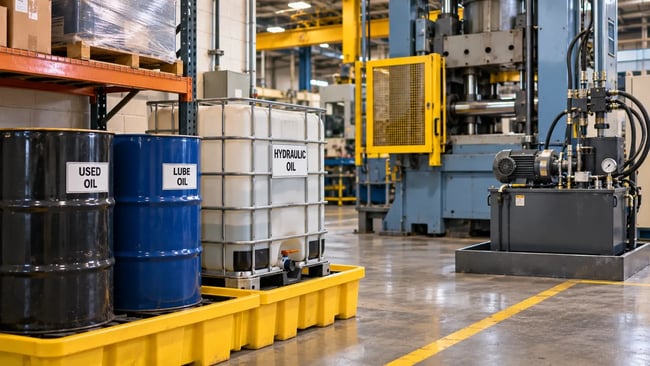
The rule asks for containment that can hold oil, with walls and floor that won't let a discharge from the primary container escape before cleanup. It lists dikes, berms, curbing, drip pans, sumps, and sorbent materials among the acceptable methods, and containment may be passive, like a pallet, or active, like a drain cover and a trained crew. Design is based on the typical failure and the most likely discharge. For bulk storage containers, the sizing standard is the largest single container plus room for rain, and since indoor storage doesn't take rain, the working number is the largest container. Our article on how big your containment needs to be walks through that math.
| Containment option |
Best suited for |
What to know |
| Spill containment pallets |
Drums and small totes in production areas or storage bays |
Easy to move and add. Size the sump to hold the largest container on the pallet. |
| Curbed or bermed storage area |
Rows of drums, large totes, and dedicated lube storage rooms |
Needs a sealed floor and no open floor drains inside the curbed area. Ramps let forklifts through. |
| Drip pans and drain pans |
Under equipment, dispensing points, and transfer stations |
Good for the small, frequent drips. Pans have to be emptied on a schedule. |
| Containment cabinets |
Pails, drums, and cutting oil near machines |
Keeps oil in one spot and often meets fire code storage needs at the same time. |
| Double-walled tanks and totes |
Tanks and larger containers |
Built-in containment. Confirm the design suits the container and how it will be used. |
| Drain covers, sumps, and sorbents |
Floor drains, doorways, and areas that can't be curbed |
These are active measures, so staff need to be trained and the materials kept close by. |
Indoor storage also sits under the Uniform Fire Code, which the DCA Division of Fire Safety writes and local fire officials enforce. Before you rebuild a storage area or add a curb, check with your fire official on how much flammable or combustible liquid can be kept where. Containment that meets SPCC but blocks an exit, or goes in the wrong place, creates a new problem.
What Is the Oil-Filled Operational Equipment Alternative for Hydraulic Presses?
Building curbs around every press and machine isn't realistic on a crowded floor, and the rule recognizes that. It includes an option for qualified oil-filled operational equipment that replaces the general secondary containment requirement for that equipment. To qualify, the equipment's discharge history has to be clean. In the three years before the plan is certified, there can be no single discharge over 1,000 gallons and no two discharges over 42 gallons each in any twelve-month period. Discharges caused by natural disasters, acts of war, or terrorism don't count against you.
The alternative swaps containment for procedures. You need documented inspection or monitoring procedures to catch equipment failures and leaks, plus an oil spill contingency plan that follows 40 CFR Part 109, unless you've submitted a facility response plan. You also need a written commitment of manpower, equipment, and materials to control and remove a discharge. In practice that looks like a documented walk-through of presses and hydraulic units, a leak log, spill kits placed near the equipment, and named people who respond. Staff who handle oil need the right training, and our pages on annual SPCC training and the online training library cover that.
The alternative has limits. It covers operational equipment only, so drums, totes, used oil containers, and the generator fuel tank still need their own containment. It doesn't cover manufacturing flow-through equipment, and the oil in qualifying equipment still counts toward the 1,320-gallon threshold and still gets described in the plan. Eligibility is decided equipment by equipment based on its own discharge history, so one problem press doesn't disqualify the others.
What Does New Jersey Add on Top of the Federal SPCC Rule?
New Jersey's Spill Compensation and Control Act, usually called the Spill Act, sits alongside the federal rule and covers hazardous substances beyond oil. It generally holds the party responsible for a discharge answerable for cleanup and removal costs, and the liability provisions are broad, so a spill that reaches soil or water can get expensive quickly. Discharges are reportable to NJDEP through its hotline, and the current number is on NJDEP's website. Our sheen rule article covers when a spill has to be reported. If you've had a discharge and aren't sure what you owe, an environmental attorney is worth a call.
The state also has "major facility" rules under N.J.A.C. 7:1E, which require a Discharge Prevention, Containment and Countermeasure (DPCC) plan and a Discharge Cleanup and Removal (DCR) plan. Major facility status turns on total storage capacity of hazardous substances, which includes petroleum and chemicals, and the threshold is lower when the substances aren't petroleum. A plant with oil only may sit well under it, but a plant that also stores solvents, acids, or other chemicals should check its combined inventory against N.J.A.C. 7:1E-1.6. Our overview of SPCC plans in New Jersey covers the state side in more detail, and our article on who enforces SPCC plans explains how EPA Region 2 and NJDEP divide the work. Failing to have a required plan is among the common SPCC violations.
How Much Does an SPCC Plan Cost for a Manufacturer?
SPCC plans at RMA generally run from $2,500 to $15,000, and where a manufacturer lands in that range depends on a handful of things. Total oil capacity and the number of containers drive the work, along with the number of buildings and outdoor areas, whether secondary containment has to be evaluated, and whether the plan needs to be reviewed and certified by a Professional Engineer. Smaller facilities with 10,000 gallons or less of oil and a clean spill history may be able to self-certify, which keeps the cost down. Our guides to the different types of SPCC plans and professional engineer certification explain who needs what.
If you already have a plan from someone else and it's more than five years old, or the plant has changed since it was written, we usually rebuild it rather than patch it, so we can stand behind every page. Our SPCC plan costs article goes into the pricing factors, and the calculator below gives you a ballpark for RMA's help with your own plant.
How Can RMA Help a New Jersey Manufacturer With an Oil Spill Plan?
We're based in New Jersey and we know how NJDEP and EPA Region 2 look at manufacturing plants. We can add up your hydraulic, lube, and used oil with you, tell you whether the 1,320-gallon threshold applies, and if it does, write a plan built around how your plant runs, including the oil-filled equipment option where your presses qualify. If you don't need a plan, we'll tell you that too.
There's no pressure and no obligation in a first conversation. You can call us, email us, or fill out the form on our contact page and tell us what's on your floor. Having your drum counts, equipment list, and a rough site layout handy makes the first call faster, but it isn't required.