How Federal Oil Spill Rules and Pennsylvania's Storage Tank Program Treat Farm Diesel, Heating Oil, and Used Oil Tanks
Most people picture oil spill rules as something for refineries and gas stations, not a dairy barn or a grain farm. But a typical Pennsylvania farm keeps a lot of oil on site: a bulk diesel tank by the machine shed, a drum or two of hydraulic oil, a tote of used motor oil, and often a heating oil tank for the shop. Federal law has a farm-specific version of what's called an SPCC plan (Spill Prevention, Control, and Countermeasure), which is simply a written oil spill prevention plan, and Pennsylvania layers its own farm tank rules on top.
The short answer is that many Pennsylvania farms don't need a federal oil spill plan, but some do, and the line depends on how much oil your containers can hold, not how much is in them today. A farm with less than 2,500 gallons of total aboveground oil storage is exempt, a farm between 2,500 and 20,000 gallons can usually write and self-certify its own plan, and larger farms, or farms with a bigger spill history, need an engineer to certify it. Pennsylvania's storage tank program runs on different numbers, so a farm can be exempt from one set of rules and regulated by the other. This article covers what counts, how the federal tiers work, where Pennsylvania's tank rules differ, and what a plan involves, and if you'd like a second set of eyes on your own tanks you can reach out to RMA at any point.
Table of Contents
TL;DR
Under federal rules, a Pennsylvania farm with less than 2,500 gallons of total aboveground oil storage capacity doesn't need an oil spill plan. From 2,500 up to 20,000 gallons, a farm with no tank over 10,000 gallons and no reportable spill history can write and self-certify its own plan, and anything bigger needs a licensed engineer. Pennsylvania's storage tank program is separate, and farm fuel tanks over 1,100 gallons generally have to be registered with DEP even when no federal plan is required. Check both sets of numbers against your own tank inventory.
What Counts Toward a Farm's Oil Storage Capacity Under SPCC?
The federal count is the place to start. For SPCC, a farm adds up the shell capacity of every aboveground container that holds 55 gallons or more of oil. Shell capacity means the full size of the container, so a 1,000 gallon tank that's usually half empty still counts as 1,000. The word oil is broad in this rule. It covers diesel, gasoline, hydraulic oil, motor oil, lubricants, and used oil, and it also covers vegetable oils and animal fats.
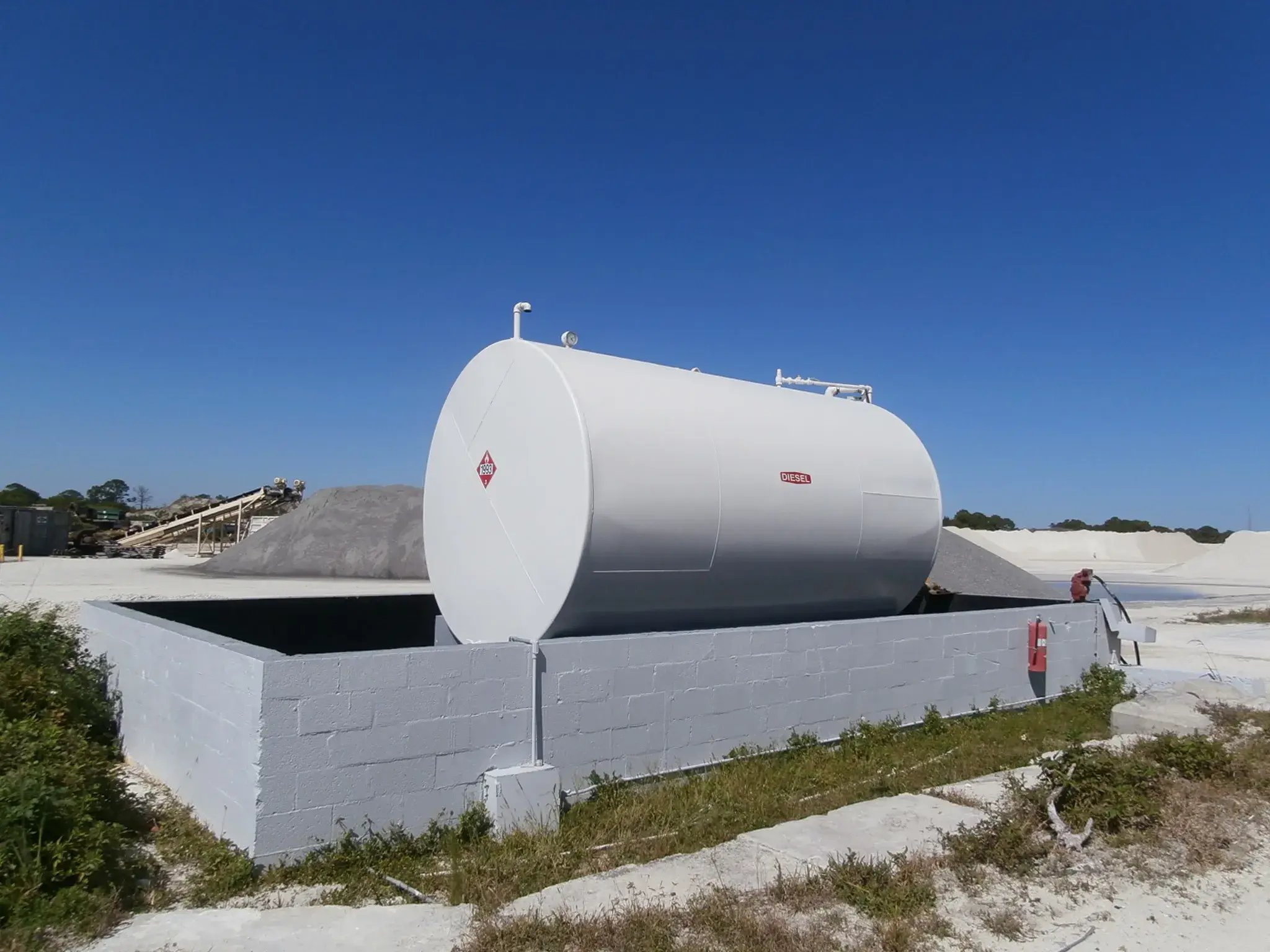
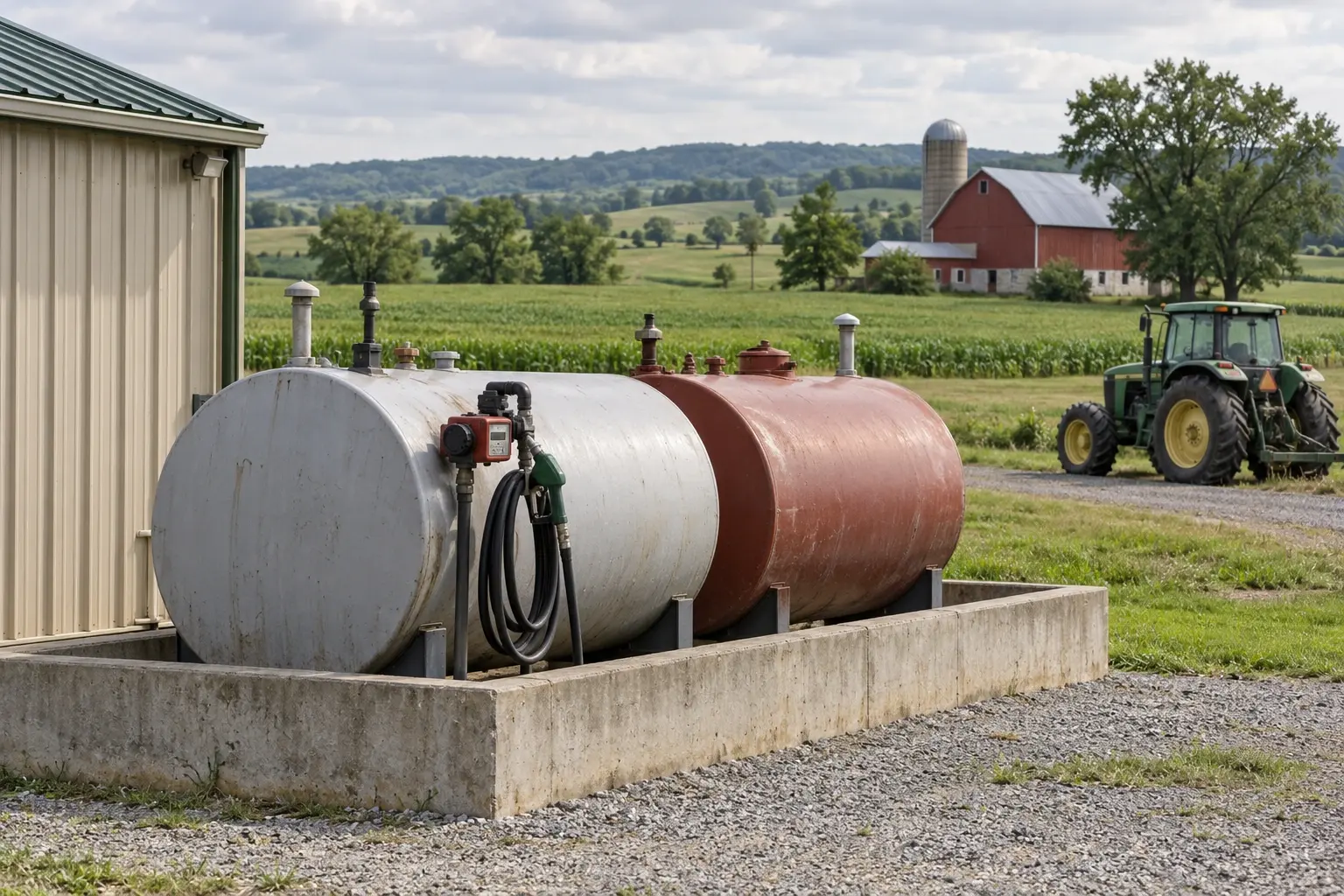
On a farm, that means the bulk diesel and gasoline tanks, a fuel trailer or skid tank you use to fill equipment, the heating oil tank that feeds a shop, barn, or grain dryer, a used oil tank, and any drums or totes of hydraulic and lubricating oil. Our article on whether 55-gallon drums are included in SPCC plans goes deeper on how drums add up. Used oil from the shop counts while it sits in a tank or drum, and it has its own handling rules, which our guide to used oil regulations covers.
Several things stay out of the count: containers under 55 gallons, the fuel tank built into a tractor or truck (the rule calls these motive power containers, and a fuel trailer you use to fill other equipment doesn't qualify), heating oil used solely at a single-family residence such as the farmhouse, pesticide application equipment and its mix containers, milk containers, and containers that have been permanently closed as the rule defines it. A heating oil tank that also feeds a shop or barn doesn't meet the word "solely," so it generally gets counted. Buried tanks follow a separate threshold, so a farm with an underground tank should have that looked at on its own.
It also helps to know what the rule treats as a farm. For SPCC, a farm is a facility on land used to produce crops or raise animals that sold, or normally would have sold, $1,000 or more of agricultural products in a year. A property below that line gets treated like any other facility, with the general 1,320 gallon threshold. Separately, the rule only applies to facilities that could reasonably be expected to discharge oil to navigable waters or adjoining shorelines, and that call can't rely on dikes or other manmade features. Most Pennsylvania farms sit near a stream, ditch, or drainage path, so we'd treat the rule as applying unless the geography clearly says otherwise.
How Do Federal SPCC Rules Treat Farms of Different Sizes?
Congress changed the SPCC rule for farms in the Water Resources Reform and Development Act of 2014, known as WRRDA. The law gave EPA room to set the exemption threshold anywhere from 2,500 to 6,000 gallons, and EPA's June 2015 study settled on 2,500. Here's how the farm tiers break down by total aboveground capacity.
| Farm's Situation |
What the Federal Rule Requires |
| Less than 2,500 gallons total aboveground capacity |
No SPCC plan required |
| 2,500 gallons up to 20,000 gallons, no single tank over 10,000 gallons, and no reportable discharge history |
SPCC plan that the owner can write and self-certify |
| 20,000 gallons or more, any single tank over 10,000 gallons, or a reportable discharge history |
SPCC plan reviewed and certified by a licensed Professional Engineer |
The 20,000 gallon self-certification line is double the 10,000 gallon line that applies to most non-farm facilities, which is a real break for farms. EPA has estimated that about 99 percent of farms store 20,000 gallons or less, so most farms that need a plan at all can write it themselves. Our articles on self-certified plans and engineer-certified plans explain how those two paths differ in practice.
Smaller containers can get special treatment too. A 2016 law known as WIIN says the SPCC rules don't apply to farm containers on separate parcels with an individual capacity of 1,000 gallons or less and an aggregate capacity of 2,500 gallons or less. Whether your tanks qualify depends on how your parcels are laid out and who operates them, so run your own inventory against the rule before leaning on it.
EPA Region 3 enforces SPCC in Pennsylvania, and our overview of who enforces SPCC plans explains what inspections look like. A farm that needs a plan also has to review it at least every five years, and a farm that starts operating and could reasonably discharge oil to water needs its plan in place before it begins.
What Are Pennsylvania's Farm Fuel Tank Rules Under the Storage Tank Program?
Pennsylvania's Department of Environmental Protection (DEP) runs its own storage tank program under the Storage Tank and Spill Prevention Act, with the rules in 25 Pa. Code Chapter 245. It doesn't use the federal numbers. A regulated aboveground tank in Pennsylvania is a stationary tank over 250 gallons holding a regulated substance, and then a list of exclusions carves out much of what farms keep. For farms, the state definition of a farm is land used to produce crops, livestock, and livestock products for commercial purposes, including processing or retail marketing if more than half of those products come from the farm operator. A tank at a business that mostly resells other producers' products isn't a farm tank.
| Farm Tank |
How DEP's Storage Tank Program Treats It |
| Diesel, dyed diesel, gasoline, or biodiesel for farm use |
Regulated above 1,100 gallons. At or under 1,100 gallons, generally excluded when the fuel isn't for resale |
| Motor oil, lubricating oil, or hydraulic fluid |
Regulated above 1,100 gallons |
| Fertilizer, herbicide, or pesticide tanks |
Many tanks over 1,100 gallons are regulated, depending on what's stored |
| Motor fuel over 250 gallons used for other business activities, like fueling trucks or school buses |
Regulated, because the farm exclusion no longer fits |
| Heating oil burned on the premises where it's stored |
Excluded |
| Propane, and equipment tanks like hydraulic lifts |
Excluded |
Farm tanks that fall under the program come with the full set of tank obligations: registering the tank with DEP and paying the annual registration fee, using DEP-certified installers to install, modify, or close it, meeting the technical standards for tank construction and operation, and reporting any confirmed release to the right DEP regional office. DEP-certified inspectors handle the required tank inspections. A farm whose regulated aboveground tanks total more than 21,000 gallons becomes a large aboveground storage tank facility, which adds a Spill Prevention Response Plan on top. Fee amounts change, so ask DEP for the current figure. DEP's Storage Tank Program answers questions at 717-772-5599, or 1-800-42-TANKS from inside Pennsylvania.
Local rules apply as well. Fire code requirements for fuel tanks are set and enforced by municipalities, and they vary a lot from township to township, so confirm yours with the local fire marshal or code office. Your insurance carrier may also have its own storage requirements.
One note on construction. If you're putting in a new or larger fuel tank, DEP's rules call for certified installers, and building, fire, and land disturbance approvals may apply on top of that. RMA doesn't prepare construction-phase permits or approvals, and we don't install tanks, so that work belongs with your contractor, your engineer, and a soil erosion specialist where needed. Once the tank is in and the farm is running, the operational pieces are where we help: the SPCC plan or an update to it, DEP tank registration questions, inspections, and training. We can also help you work out what the construction phase will need and point you toward the right professionals.
What Do These Rules Look Like on Real Pennsylvania Farms?
The federal and state numbers don't line up, so the easiest way to see the difference is a few example farms. These assume the farm meets the federal definition, has no reportable discharge history, and uses its fuel for its own operations. Your own facts could change the answer.
| Farm Setup |
Federal SPCC |
Pennsylvania DEP Tank Program |
| A 1,000 gallon diesel tank, a 1,000 gallon gasoline tank, and two 55 gallon drums of oil (2,110 gallons total) |
Under 2,500 gallons, so no plan |
Both fuel tanks are under 1,100 gallons, so generally excluded |
| One 2,000 gallon dyed diesel tank and six 55 gallon drums (2,330 gallons total) |
Under 2,500 gallons, so no plan |
The diesel tank is over 1,100 gallons, so it's regulated and needs registration |
| A 3,000 gallon diesel tank, a 1,000 gallon gasoline tank, and a 500 gallon heating oil tank for the shop (4,500 gallons total) |
Over 2,500 gallons, so a self-certified plan |
The diesel tank is regulated, while the gasoline tank and on-site heating oil are generally excluded |
| A 12,000 gallon diesel tank plus 3,000 gallons elsewhere (15,000 gallons total) |
One tank is over 10,000 gallons, so the plan needs engineer certification |
The large tank is regulated, and regulated capacity stays under the 21,000 gallon large facility line |
The second row is the one that catches people. That farm can honestly say it doesn't need a federal oil spill plan, and it still has a DEP-regulated tank that needs to be registered, inspected, and installed or modified by certified people. An unregistered regulated tank is a compliance problem on its own, and under DEP's definitions a person who fills an unregistered regulated tank can be named a responsible party if it releases, so confirm your tanks before the next delivery.
Can a Pennsylvania Farm Write Its Own Oil Spill Plan?
If your farm lands in the middle tier, yes, and we're not going to talk you out of it. The rule lets owners self-certify, and EPA publishes a free Tier I qualified facility template designed for smaller facilities. Whether the template fits your farm depends on your largest tank and your total capacity, so read EPA's eligibility criteria before using it. Our guide to Tier I self-certified plans covers who qualifies. A farm with a tank over 5,000 gallons generally needs to write a fuller plan than the template provides.
A plan covers real site details, not just paperwork. It includes a site diagram, an inventory of every container, the spill prevention measures for each one, how you handle containment, who inspects what and how often, and how you respond to a release. Containment is where farms often have the most to fix, and our article on sizing SPCC oil spill containment explains how the math works. The people who handle oil also need a briefing at least once a year, and our online training library is one way to cover that. Keep the plan available on the farm, and walk the tanks on a regular schedule using something like our list of monthly inspection items.
The usual reasons to bring in help are an engineer certification requirement, a farm with several parcels and a muddy tank inventory, a spill history, or a lender, insurer, or buyer asking for a plan you'd rather have done right. Our article on SPCC plan costs shows what drives the price. RMA's SPCC plans run from $2,500 to $15,000 across all the facility types we work with, and the figure for a given farm depends on how many tanks it has, how they're laid out, whether containment needs evaluating, and whether an engineer has to certify the plan. A farm that can self-certify skips the engineer's fee, which is one of the larger line items. The pricing calculator below gives you a number based on your own setup, so you can compare it against doing the work yourself.
How Does a Spill History Change a Farm's SPCC Requirements?
A farm's spill record affects which tier it lands in. Under the farm rules, a reportable discharge history pushes a farm to engineer certification no matter how small its storage is. The rule looks back three years from the date you certify the plan. It counts a single discharge to water of more than 1,000 gallons, or two discharges to water of more than 42 gallons each within any 12 month period. A farm that has had neither can stay on the self-certification path.
Oil that reaches a creek, ditch, or other waterway generally has to be reported when it leaves a sheen, even if the amount is small. Our guide to the sheen rule explains when a spill has to be reported. If a spill is happening now, stop the source if you can do it safely, keep people away, and make the required calls first. If a spill has already reached water, or you've received a notice or information request from EPA or DEP, talk to an environmental attorney early, since what you say and document can affect penalties. Our article on common SPCC violations and fines shows what inspectors tend to cite.
How Can RMA Help With Farm Oil Storage Compliance in Pennsylvania?
RMA is based in New Jersey and works with facilities across Pennsylvania and the rest of the country. For farms, we start by counting your containers against both the federal rule and DEP's storage tank program, and we tell you plainly which ones apply. If you're under the threshold, or you're comfortable writing a self-certified plan, we'll say so rather than sell you something you don't need. If you do want help, we prepare SPCC plans and updates, work through containment questions, train your people, and help you sort out what your tanks mean for DEP registration.
There's no pressure and no obligation. You can call us, email, or fill out the form on our website, and a senior member of our team will talk through your tanks with you. When you're ready, you can contact RMA and we'll take it from there.