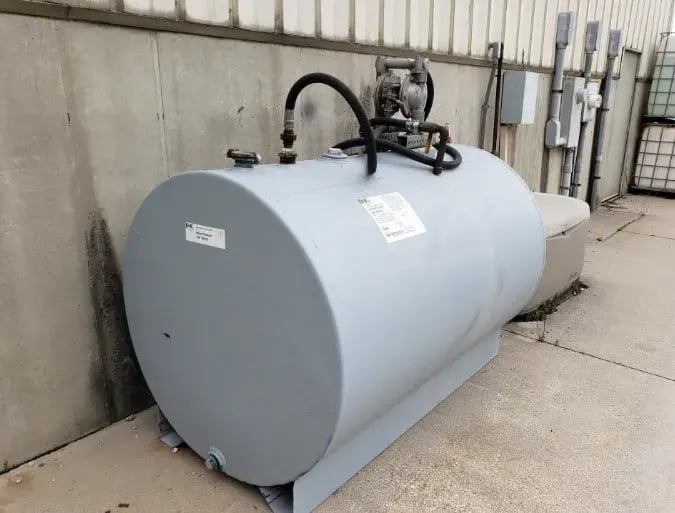
How Diesel Belly Tanks and Day Tanks Push New Jersey Offices, Hospitals, Schools, Data Centers, and Warehouses Into SPCC Oil Spill Plan Requirements
Most businesses buy a backup generator to keep the lights on, the servers running, or the freezers cold during a storm. Very few of them think of it as an oil storage tank. But a diesel generator carries its fuel with it, usually in a tank built into the base of the unit, and that fuel counts toward the federal oil spill plan rule. If the aboveground oil storage at your site adds up to more than 1,320 gallons, and a spill could reasonably reach a stream, river, wetland, or storm drain, you need a written oil spill plan called an SPCC Plan. A single large generator can put you over that line on its own, with no other oil on site.
In this article we'll walk through how generator tanks are counted, why double-walled belly tanks help with spill containment but don't make the plan go away, and which kinds of New Jersey buildings tend to get caught off guard. We'll also cover the New Jersey spill reporting and tank rules that can apply on top of the federal rule, the other permits a generator often needs in this state, and what a plan typically costs. If you'd rather have someone look at your generator setup with you, feel free to reach out to RMA and we'll tell you plainly whether you need a plan.
Table of Contents
TL;DR
Yes, a backup generator can mean you need an oil spill plan. The diesel tank under or beside a generator counts toward the federal 1,320 gallon aboveground oil storage threshold, based on the tank's full capacity rather than how much fuel is in it, and many large generators cross that line by themselves. A double-walled belly tank can satisfy the spill containment requirement, but it doesn't exempt you from having the plan. In New Jersey you also have to report any fuel spill to the state right away, and underground generator tanks, air permits, and fire code rules may apply too.
How Does a Backup Generator Push a New Jersey Business Over the SPCC Threshold?
The federal oil spill plan rule is called the Spill Prevention, Control, and Countermeasure rule, or SPCC. It lives in 40 CFR Part 112, and EPA enforces it. In New Jersey, that's EPA Region 2. The rule says a facility needs an SPCC Plan if it has more than 1,320 gallons of total aboveground oil storage capacity and could reasonably be expected to spill oil into waters of the United States or onto their shorelines. Diesel fuel is oil under this rule, and so is lube oil, hydraulic oil, and even vegetable oil.
Two counting rules catch people. First, only containers of 55 gallons or more count, so the quart bottles of engine oil on the shelf don't matter, but drums, totes, and tanks do. Second, the rule counts capacity, not contents. A 2,000 gallon generator tank that you keep half full is still a 2,000 gallon tank. Facility managers often tell us they "only keep about 800 gallons in there," and the regulation doesn't care.
That's why generators are one of the most common ways a business ends up needing a plan without knowing it. Generator fuel tanks are sized for runtime. A building owner or engineer decides the generator needs to run for 24, 48, or 72 hours without a fuel delivery, and the tank gets sized to match. A mid-sized diesel generator burning a few dozen gallons an hour at full load needs well over 1,000 gallons to run for two days, and bigger units burn far more. Add one more generator, a few drums of lube oil, or an elevator hydraulic reservoir, and you're over. If you want a fuller walkthrough of who needs a plan and why, our guide to everything you need to know about SPCC Plans covers the basics.
How Are Generator Belly Tanks, Day Tanks, and Fuel Tanks Counted for SPCC?
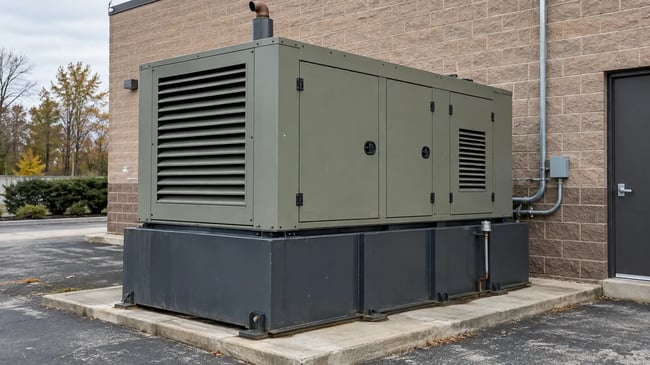
EPA treats a generator set as two different things for SPCC purposes. The engine's lubrication system is considered oil-filled operational equipment, meaning the oil is there only to make the machine run. The fuel tank, on the other hand, is a bulk storage container. That difference matters because bulk storage containers have stricter containment requirements, which we'll get into below. Both still count toward your total capacity if they're 55 gallons or larger.
Generators store fuel in a few common ways, and each one is counted a little differently.
| Fuel Storage Setup |
What It Is |
How It Counts Toward 1,320 Gallons |
| Belly tank (sub-base tank) |
A fuel tank built into the base the generator sits on |
Full shell capacity counts, whether it's single or double-walled |
| Day tank |
A smaller tank near the engine, often indoors, fed from a larger main tank |
Counts separately if 55 gallons or more, in addition to the main tank |
| Remote aboveground tank |
A standalone tank outside that pipes fuel to one or more generators |
Full capacity counts |
| Underground tank |
A completely buried tank feeding the generator |
Usually excluded from the SPCC count if it's fully regulated under the UST rules, but it still goes on the facility diagram |
| Engine lube oil sump |
Oil inside the engine itself |
Counts only if the reservoir is 55 gallons or more, which is common on very large engines |
The capacity you add up is facility-wide. That means every generator, every day tank, every drum of oil, and any other oil-filled equipment of 55 gallons or more on the property gets totaled. Transformers on the site count too if you own them. If the utility owns the pad-mount transformer out front, it's generally theirs to worry about. People also forget about portable or trailer-mounted generators that stay parked on site. If one is sitting there with fuel in it and isn't used to move a vehicle, it's a container you need to count. And if you keep spare fuel in drums for refueling, our article on whether 55-gallon drums are included in SPCC Plans explains how those add up.
Which New Jersey Buildings Get Caught by SPCC Because of Generators?
The businesses that get surprised by SPCC usually aren't industrial. Manufacturers and fuel distributors tend to know they store oil. The surprise lands on facilities whose real business has nothing to do with oil, where the generator was handled by the architect, the electrical contractor, or a facilities team years ago. Here's how it tends to play out across the building types we see most often.
| Building Type |
Why Generators Are There |
Why They Cross 1,320 Gallons |
| Office buildings |
Life safety, elevators, IT rooms, tenant requirements |
One large rooftop or ground unit, plus elevator hydraulic oil and building heating oil |
| Hospitals and medical campuses |
Code-required emergency power for patient care |
Multiple generators sized for long runtimes, plus boiler fuel |
| Schools and universities |
Emergency lighting, shelters, kitchens, dorms |
Generators spread across a campus, plus bus fueling and maintenance shops |
| Data centers |
Uptime for servers and cooling |
Many multi-megawatt units, each often holding thousands of gallons |
| Warehouses and cold storage |
Refrigeration, sprinkler pumps, operations |
Generator plus diesel fire pump tank, forklift fluids, and drummed oils |
Data centers are the extreme case. A single campus can hold tens of thousands of gallons of diesel across rows of generators, and the SPCC Plan becomes a real engineering document rather than a formality. We wrote a full data center guide to SPCC Plans for that situation. For offices and schools, the more common story is a facility with one generator that's just over the line, nobody who knew the rule existed, and a property that's been out of compliance since the day the generator was commissioned.
Ownership can also get murky. In a leased building, the generator might belong to the landlord, a tenant, or a third-party power provider. EPA looks to the owner or operator of the facility, and a lease that's silent on SPCC doesn't settle who's responsible. It's worth sorting out in writing before anything spills.
Could Oil From Your Generator Reach Water? The SPCC Discharge Test
The second half of the SPCC test asks whether a spill from your facility could reasonably be expected to reach navigable waters or their shorelines. Many building owners assume they pass this test because there's no river nearby. In New Jersey, that assumption rarely holds up. Storm drains in parking lots and streets typically empty into a stream, a lake, or the bay, and drainage ditches and wetlands count as pathways too. A fuel spill on the pad outside an office park in Bergen County or a school in Ocean County can easily reach a storm inlet a few hundred feet away.
The rule also says you have to make this call based on geography and location without giving yourself credit for manmade structures that might stop the oil. So you can't say a spill won't reach water because there's a curb, a berm, or a containment basin in the way. You have to imagine the oil traveling as if those weren't there. Once you look at it that way, very few sites in a state as developed and wet as New Jersey can honestly say a generator spill could never reach water. If you're still unsure, our four steps to figure out if you need an SPCC Plan lay out the test in order.
Do Double-Walled Generator Belly Tanks Meet SPCC Secondary Containment?
Secondary containment is a backup barrier that catches oil if the tank leaks. For bulk storage containers like generator fuel tanks, SPCC requires containment that can hold the full capacity of the largest container, plus extra room for rain if the containment is open to the weather. With a large freestanding tank, that usually means a concrete dike or a containment basin. If you're working through the math for a single-walled tank, our article on how big SPCC oil spill containment needs to be walks through it.
Most modern generator belly tanks are double-walled, with a tank inside a tank. EPA has said in guidance memos that shop-built double-walled aboveground tanks can satisfy the secondary containment requirement, because the outer wall catches anything that leaks from the inner wall. That's good news, but it comes with conditions. EPA's guidance generally expects the tank to be built to recognized industry standards, to have overfill protection such as a high-level alarm and an automatic shutoff or flow restrictor, and to have every fuel delivery watched the whole time. The space between the walls, called the interstice, also needs to be checked regularly for fuel or water.
Double walls also don't cover everything around the tank. Piping that runs outside the tank, the fill port, and the spot where the delivery truck parks still need what the rule calls general containment, which means something to stop a spill from spreading, like spill kits, drain covers, berms, or curbing. Fuel deliveries are one of the most likely times for a generator spill to happen, so this is where many plans for generator sites spend most of their attention.
The key point is that a double-walled tank solves the containment requirement, not the plan requirement. We regularly meet facility managers who were told by a vendor that a double-walled belly tank means they're "exempt from SPCC." It doesn't. The tank's capacity still counts, and if you're over 1,320 gallons, you still need the written plan, the inspections, and the training.
What Goes Into an SPCC Plan for a Backup Generator?
An SPCC Plan is a written document that describes your oil storage, how you prevent spills, and what you'll do if one happens. For a site whose main oil storage is a generator or two, the plan is usually straightforward. It includes a facility diagram showing every container, a list of tank capacities and contents, a description of containment for each one, fuel delivery procedures, an inspection schedule, spill response steps, contact information, and a record of employee training.
Many generator-only sites qualify for a simpler, self-certified plan. If your total aboveground capacity is 10,000 gallons or less and you haven't had a reportable spill in the last three years, you're likely a "qualified facility." If no single container is over 5,000 gallons, you may be able to use EPA's Tier I template and certify the plan yourself. Larger sites, or sites with a single tank over 5,000 gallons, may still self-certify under Tier II or may need a Professional Engineer to certify the plan. Our breakdown of the different types of SPCC Plans explains which one fits, and if you're a small site that can use the template, our article on Tier I self-certified SPCC Plans may be all you need. That's a case where you might not need a consultant at all.
The plan isn't a one-time project. You have to inspect the tanks on the schedule your plan sets, keep records, give oil-handling employees a discharge prevention briefing at least once a year, and review the plan at least every five years. Adding a generator, swapping one for a bigger unit, or changing the tank usually means an amendment. Training is often the piece that slips at office buildings and schools, where the "oil handler" is a maintenance tech who also handles HVAC, plumbing, and snow removal. Our article on whether you need to do annual SPCC training covers what's expected, and our online environmental training library is an easy way to get those staff covered.
Which New Jersey Spill and Tank Rules Apply to Generator Fuel Tanks?
The federal SPCC rule is only part of the picture in New Jersey. The state has its own law, the Spill Compensation and Control Act, usually called the Spill Act. It covers discharges of petroleum and a long list of other hazardous substances, not just oil, and it's stricter than federal law in a few ways that matter to generator owners.
The first is spill reporting. Under federal rules, you generally report an oil spill when it reaches water or causes a sheen. New Jersey's approach is broader. NJDEP expects discharges of hazardous substances, including diesel, to be reported to its 24-hour hotline, 1-877-WARNDEP (1-877-927-6337), right away, and its compliance guidance points to a 15-minute window. The exceptions are narrow, so a fuel spill on the ground from an overfilled belly tank can be reportable in New Jersey even if it never gets near a storm drain. Our article on when you have to report an oil spill covers the federal side. Your SPCC Plan's spill response section should include the state hotline alongside the National Response Center.
The Spill Act also makes people who are responsible for a discharge liable for cleanup costs. That liability is strict, meaning it doesn't depend on fault, and it can be joint and several, meaning more than one party can be on the hook for the whole cost. A cleanup in New Jersey is generally overseen by a Licensed Site Remediation Professional, or LSRP. If a generator spill has already happened, or you've found contamination around an old tank, that's a good time to talk with an environmental attorney and an LSRP before deciding how to proceed.
Discharge Prevention Plans for New Jersey Major Facilities
New Jersey has a second planning rule, N.J.A.C. 7:1E, that applies to "major facilities." A major facility generally has 200,000 gallons or more of combined storage capacity for petroleum and other hazardous substances, or 20,000 gallons or more of hazardous substances other than petroleum. Those sites need a Discharge Prevention, Containment, and Countermeasure (DPCC) Plan and a Discharge Cleanup and Removal (DCR) Plan, which go further than SPCC. A typical office building or school with a generator won't come close. A large data center campus, a hospital system with big fuel oil reserves, or an industrial site where generators are one piece of a larger tank farm might, so it's worth adding up the whole site if you're anywhere near those numbers.
New Jersey Rules for Underground Generator Tanks
If your generator is fed by a fully buried tank, New Jersey's underground storage tank rules at N.J.A.C. 7:14B come into play. New Jersey exempts certain heating oil tanks, but those exemptions are written for tanks that feed a heating system. A tank that fuels a generator usually doesn't fit them. Underground generator tanks are generally subject to registration, leak detection, and other operating requirements, and installation, repair, and closure work has to be done by NJDEP-certified UST contractors. Since the details depend on the tank's age, size, and use, confirm the status of your specific tank with NJDEP or a certified UST professional.
What Other New Jersey Rules Apply to Backup Generators?
Spill prevention is the focus of this article, but a generator in New Jersey usually brings a few other requirements with it. They're handled by different programs, so it's common for a facility to have one of them covered and not know about the others.
| Requirement |
Who Oversees It |
How It Relates to Generators |
| Air permit |
NJDEP Air Quality Permitting |
Emergency generators rated at 37 kW or more generally need air permit coverage, often through general permit GP-005A for diesel units, with limits on testing hours and recordkeeping |
| Community Right to Know and Tier II reporting |
NJDEP and federal EPCRA |
Diesel at or above 10,000 pounds on site, roughly 1,400 gallons, can trigger annual chemical inventory reporting |
| Uniform Fire Code |
DCA Division of Fire Safety, enforced by local fire officials |
Covers fuel tank installation, location, and fire safety, with permits and inspections handled locally |
| Underground tank rules |
NJDEP UST program |
Applies to buried generator tanks, as described above |
Notice that the diesel weight that triggers Tier II reporting is in the same neighborhood as the SPCC threshold. A site that just crossed 1,320 gallons for SPCC may be close to chemical inventory reporting too. For a broader look at the permits that come with generators, see our article on environmental permits for emergency backup generators.
Installing a New Generator in New Jersey
If you're planning a new generator or replacing one with a larger unit, the installation phase has its own approvals, like construction and fire permits for the tank, and certified contractors for any underground tank. RMA doesn't prepare construction-phase permits or approvals. Your engineer, electrical contractor, or generator vendor typically handles that piece, and we're happy to help you figure out who you need. Where we come in is what happens once the generator is running. A new or bigger generator almost always means a new SPCC Plan or an amendment, updated spill reporting procedures, inspections, training, and often chemical inventory reporting. It's much easier to plan for those during the project than to discover them a year later.
How Much Does an SPCC Plan for a Generator Cost in New Jersey?
SPCC Plans generally run from about $2,500 to $15,000. A site with one or two generators and little else usually lands near the low end of that range. A data center or hospital campus with many generators, remote tanks, and complex containment sits toward the high end. Updates are less. A simple Tier I update is often around $1,500, while an update to a complex, PE-certified plan can be $7,500 or more.
The biggest cost drivers are the number of containers, whether a Professional Engineer has to certify the plan, how much containment analysis is needed, and how much work it takes to reconstruct missing information like tank specs and site drainage. If your site qualifies for a Tier I template and you have someone on staff who's comfortable with it, you may not need to pay anyone. We'll tell you that if it's true. For a fuller picture of what goes into pricing, read our breakdown of how much an SPCC Plan costs. If you'd like a quick estimate for having RMA help with your generator site, you can use the SPCC pricing calculator below.
What Happens If a New Jersey Generator Site Skips the SPCC Plan?
EPA Region 2 inspects SPCC facilities in New Jersey, and inspections can come from routine targeting, a spill, a complaint, or a referral from another agency. Federal civil penalties for SPCC violations are adjusted for inflation every year under 40 CFR Part 19, and they can run into the tens of thousands of dollars per day of violation. In practice, settlements depend on how long the facility has been out of compliance, how much oil is involved, and how quickly the problem gets fixed. Our article on who enforces SPCC Plans explains the federal and state roles, and our rundown of the top SPCC Plan violations and fines shows where inspectors usually find problems.
The penalty is often the smaller risk. If a generator tank fails at a site with no plan and no spill procedures, the cleanup falls under New Jersey's Spill Act, and the costs of remediation, LSRP oversight, and possible third-party claims can dwarf any EPA fine. Insurers and lenders also ask about SPCC more often than they used to. If you're dealing with an enforcement letter or a spill that's already happened, bring in an environmental attorney early. For a broader look at New Jersey's approach, our article on SPCC Plans in New Jersey covers more of the state picture.
How RMA Helps New Jersey Businesses With Generator SPCC Plans
We're based in New Jersey and have been writing SPCC Plans since the 1990s, for everything from a single office generator to sites with dozens of tanks. Our senior staff does the work. We'll help you add up your oil storage correctly, check whether your belly tanks meet EPA's double-wall conditions, look at the delivery area and drainage, and figure out which type of plan you need. If you need a plan, we'll write one that fits how your facility runs. If you can use a Tier I template yourself, we'll tell you that too.
There's no pressure and no obligation. Give us a call, send us an email, or fill out the form on our website, and we'll talk through your generator setup and what makes sense for your site. When you're ready, just contact RMA and we'll take it from there.