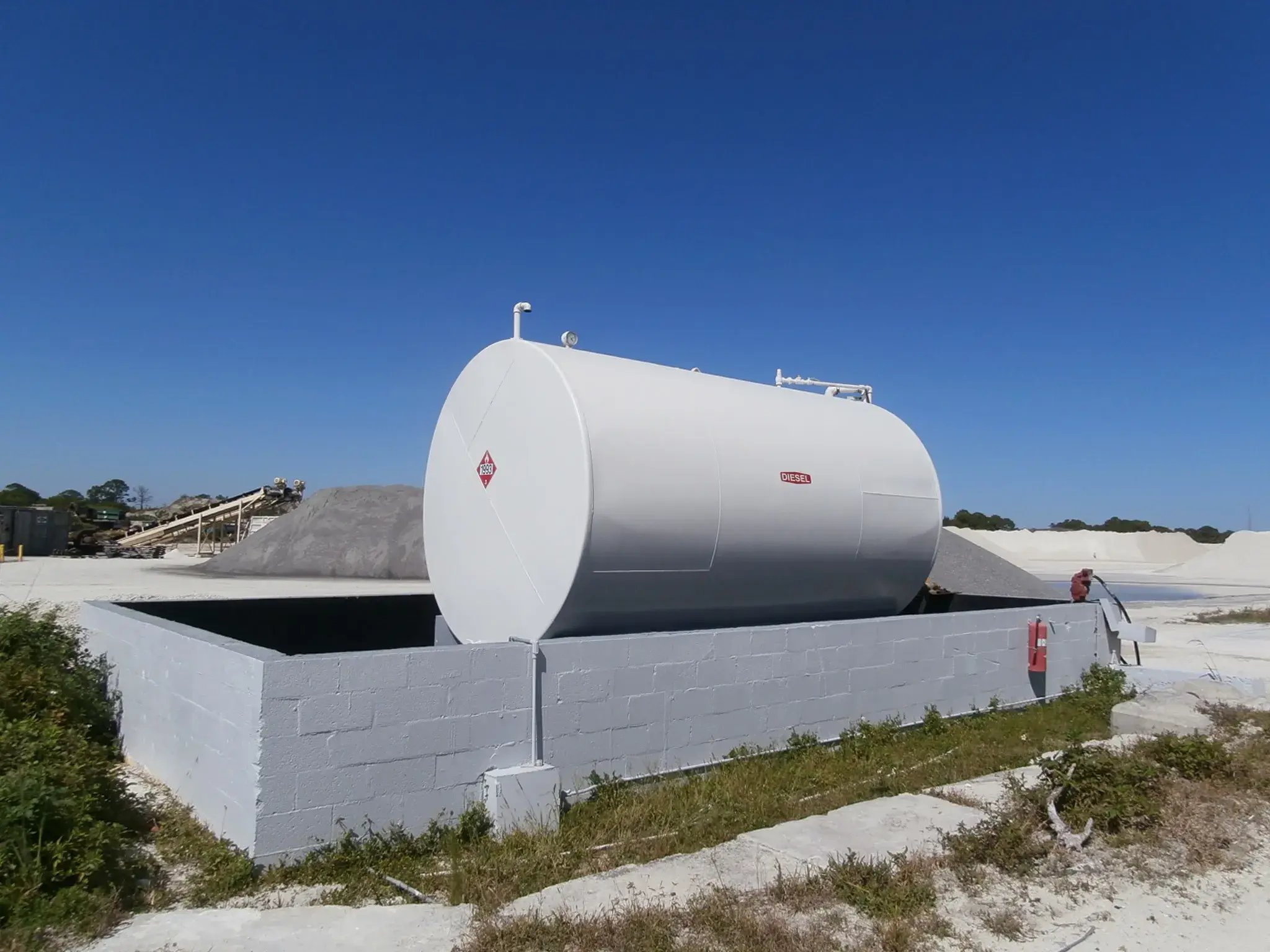
How Diesel Generator Tanks Push Pennsylvania Offices, Hospitals, Schools, Data Centers, and Warehouses Into Federal SPCC Rules
Most businesses buy a backup generator to keep the lights on, not to sign up for an environmental program. But a standby diesel generator usually comes with its own fuel tank, and that tank can be big. Once the total aboveground oil storage at a site tops 1,320 gallons, counting only containers that hold 55 gallons or more, federal oil spill rules kick in. So the short answer is often yes. If your generator's fuel tank, together with the other oil containers on your property, adds up to more than 1,320 gallons, and a spill could reasonably reach a creek, river, or storm sewer, your Pennsylvania facility probably needs a written oil spill plan, known as an SPCC Plan.
Many facility managers learn this during an EPA inspection or a property sale, years after the generator went in. Below, we cover how generator tanks are counted, how double-walled belly tanks fit the containment rules, which buildings get caught most often, where Pennsylvania's tank program comes in, and what else applies to a standby generator. If you'd rather talk it through with someone who handles this every day, reach out to RMA and we'll help you figure out whether your site is in or out.
Table of Contents
TL;DR
A diesel backup generator can put a Pennsylvania business under the federal oil spill prevention rule if the site's total aboveground oil storage capacity is more than 1,320 gallons, counting containers of 55 gallons or more, and a spill could reach water. Generator belly tanks and day tanks count at their full capacity, even when they're half empty. Shop-built double-walled tanks can often meet the containment requirements, but you still need the written plan, and Pennsylvania's own storage tank rules may also apply depending on the tank's size and use. Many smaller sites qualify to write their own plan using EPA's free template.
What Is an Oil Spill Plan, and Why Would a Backup Generator Trigger One?
An oil spill plan, formally called a Spill Prevention, Control, and Countermeasure Plan (SPCC Plan), is a written document that explains how a facility stores oil, how it keeps that oil from escaping, and what staff do if it does. The requirement comes from the federal Oil Pollution Prevention regulation at 40 CFR Part 112. In Pennsylvania it's enforced by EPA Region 3 out of Philadelphia, not by DEP. We explain that split in who enforces SPCC plans.
The rule applies when three things are true. First, the facility isn't transportation-related, and an office, hospital, school, warehouse, or data center isn't. Second, it has more than 1,320 gallons of aboveground oil storage capacity, or more than 42,000 gallons in completely buried tanks. Third, a spill could reasonably be expected to reach navigable waters or their shorelines. In Pennsylvania that's easy to meet, since a storm drain that empties into a tributary of the Schuylkill, the Susquehanna, or the Monongahela is enough. You also can't count walls, curbs, or other manmade structures when deciding whether oil could get out.
The rule's definition of oil goes well past fuel. Diesel is oil. So are lubricating oil, hydraulic fluid, transformer oil, and even vegetable oil. Propane isn't, and neither is diesel exhaust fluid. Our guide on the best four steps to figure out if you need an SPCC plan walks through the full check.
How Much Diesel Does a Backup Generator Tank Hold?
Generator fuel tanks are sized by how long the unit needs to run without a fuel delivery. A common rule of thumb is that a diesel generator burns roughly 7 gallons per hour for every 100 kW of output at full load. A 1,000 kW unit goes through about 71 gallons an hour. Here's what that looks like across a few common sizes.
| Generator Size |
Approx. Full-Load Fuel Use |
24 Hours of Fuel |
48 Hours of Fuel |
72 Hours of Fuel |
| 250 kW |
18 gal/hr |
About 430 gallons |
About 860 gallons |
About 1,300 gallons |
| 500 kW |
36 gal/hr |
About 860 gallons |
About 1,710 gallons |
About 2,570 gallons |
| 1,000 kW |
71 gal/hr |
About 1,710 gallons |
About 3,410 gallons |
About 5,120 gallons |
| 2,000 kW |
142 gal/hr |
About 3,410 gallons |
About 6,810 gallons |
About 10,220 gallons |
These numbers come from generic fuel consumption charts, and real tanks come in standard sizes that won't match them exactly. The pattern is what counts. A 1,000 kW generator with a single day of runtime clears 1,320 gallons by itself, and a 500 kW unit only needs about a day and a half of fuel to get there. Since the rule looks at tank capacity, check the tank's data plate or your installer's submittal package instead of estimating from the kW rating.
How Are Generator Belly Tanks and Day Tanks Counted Toward the SPCC Threshold?
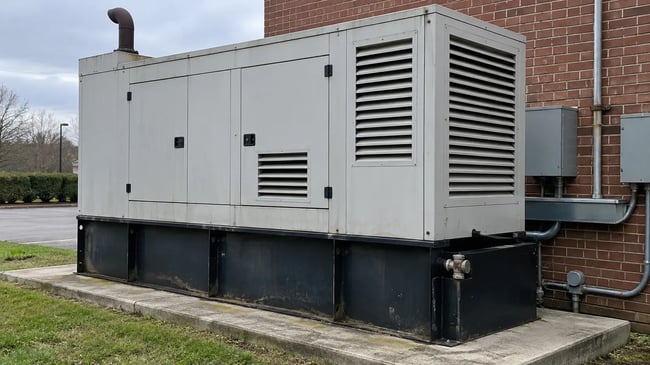
Generators store fuel in a few common ways. A belly tank, also called a sub-base tank, sits under the generator and forms its base. A day tank is a smaller tank near the engine that gets refilled from a larger supply tank somewhere else on the property. Some sites have both. EPA treats a generator's fuel tank as a bulk storage container and its engine lubrication system as oil-filled operational equipment. Both count toward your total if they hold 55 gallons or more.
| Item at the Site |
Counts Toward 1,320 Gallons? |
Notes |
| Generator belly (sub-base) tank |
Yes |
Counted at full shell capacity as a bulk storage container |
| Day tank and its separate supply tank |
Yes, each one 55 gallons or larger |
Both tanks are added to the total |
| Engine lube oil system |
Yes, if 55 gallons or larger |
Oil-filled operational equipment, common on very large units |
| Tank that's empty but still in service |
Yes |
Capacity counts, not contents |
| Permanently closed tank |
No |
Must meet EPA's definition of permanently closed |
| Rental or towable generator tank |
Yes |
The motive power exemption covers vehicle fuel tanks, not generator tanks or fuel trailers |
| Completely buried tank under federal UST rules |
No |
Excluded from SPCC, but underground tank rules apply instead |
| Containers under 55 gallons, propane tanks |
No |
Below the size minimum, or not oil |
A 2,000-gallon belly tank you keep half full is still a 2,000-gallon tank, and a rental generator's tank isn't exempt just because it has wheels. Then add everything else on the property that holds oil in a container of 55 gallons or more: transformers you own, hydraulic elevator reservoirs, a diesel fire pump tank, and drums in the maintenance room. Our post on whether 55-gallon drums are included in SPCC plans covers it. The threshold applies to the facility as a whole, not to the generator alone.
Do Double-Walled Generator Belly Tanks Meet SPCC Secondary Containment Rules?
Secondary containment is the backup barrier that catches oil if the tank itself fails. For bulk storage containers, the SPCC rule calls for containment that can hold the entire capacity of the largest container, plus enough room for rainwater if it's outdoors. A concrete dike around an outdoor generator is expensive, so most modern units sit on double-walled belly tanks. For the general sizing math, see how big your SPCC oil spill containment needs to be.
EPA has said that shop-built double-walled aboveground tanks can satisfy both the general containment requirement and the sized containment requirement for bulk storage, as long as certain safeguards are in place. The inner tank should be a UL-listed steel tank. The outer wall should be built to a recognized industry standard. The tank needs overfill prevention that includes an overfill alarm and an automatic flow restrictor or shutoff, and every fuel delivery should be watched the whole time. Most factory-built sub-base tanks are designed for this, but the overfill and delivery pieces depend on how your site handles refueling, which is where inspectors find gaps.
A double wall also doesn't cover everything around the tank. Fuel piping, fill ports, vents, and anything outside the double-walled shell still fall under the general containment rule, and the spot where the fuel truck parks during a delivery needs attention too. The space between the two walls has to be checked during your routine inspections, and the tank needs periodic integrity testing based on an industry standard such as STI SP001. Our list of the top things to check during SPCC monthly inspections is a good starting point.
What About Indoor Generators?
A generator in a basement or mechanical room still counts toward your capacity. The building can help hold a spill, but floor drains, doorways, and loading docks are common escape routes, and a floor drain tied to the storm sewer can carry diesel off the property in minutes. Your plan has to account for those pathways.
Why Offices, Hospitals, Schools, Data Centers, and Warehouses Get Caught by Generator SPCC Rules
None of these buildings think of themselves as oil storage sites. The generator usually goes in as part of an electrical or life safety project, the installer focuses on getting power to the building, and nobody on the job brings up oil spill rules. The table below shows the usual pattern.
| Facility Type |
Other Oil Often on Site |
Why It Gets Missed |
| Office buildings |
Hydraulic elevator reservoirs, owned transformers, fire pump fuel tank |
The generator is managed as an electrical asset, not an oil tank |
| Hospitals |
Multiple large generators, boiler fuel oil tanks, fire pump tanks |
Long runtime needs drive big tanks, and staff focus on healthcare codes |
| Schools and colleges |
Heating oil tanks, maintenance shop oils, bus garage tanks |
Generators get added for emergency shelter use without a look at oil totals |
| Data centers |
Many generators, bulk fuel tanks, transformers |
Capacity can run into tens of thousands of gallons as sites expand in phases |
| Warehouses and distribution centers |
Diesel fire pump tank, hydraulic oil, equipment fluids |
Often leased, and tenant and landlord each assume the other handles it |
Data centers grow fast, and each new phase changes the plan. We've written a data center's guide to SPCC plans for operators in that position.
Leased buildings are the other common blind spot. SPCC duties fall on the owner or operator of the facility, and a lease that says nothing about who handles the plan leaves both sides exposed. The gap usually comes to light during an EPA inspection, an insurer's questionnaire, or due diligence when the property is sold. Our post on why insurance companies ask about SPCC plans explains that last scenario.
Does Pennsylvania's Storage Tank Program Cover Generator Fuel Tanks?
Pennsylvania has its own tank rules on top of the federal oil spill plan. In 1988, a large diesel storage tank collapsed at Floreffe, near Pittsburgh, and a large share of the fuel reached the Monongahela River. The legislature passed the Storage Tank and Spill Prevention Act the next year, and DEP runs the program under 25 Pa. Code Chapter 245.
Under Chapter 245, a regulated aboveground storage tank is generally a stationary tank larger than 250 gallons that holds a regulated substance such as diesel. That's a much lower bar than the federal 1,320-gallon threshold. The definition also comes with a long list of exclusions, and several matter for generators:
- Tanks of 1,100 gallons or less that store motor fuel for noncommercial purposes. The state definition of motor fuel includes No. 2 diesel, and noncommercial means the fuel isn't for resale.
- Equipment or machinery that holds a regulated substance for operational purposes, such as hydraulic lift tanks and electrical equipment.
- Tanks storing heating oil that's used on the premises. That rarely fits a generator, but it does cover many boiler tanks at schools and hospitals.
- Tanks that aren't stationary. A tank counts as stationary when it's permanently affixed to the property or connected to it by piping or another structure.
How those exclusions apply to a specific generator tank isn't always obvious. A belly tank built into the frame, a stand-alone tank piped to a day tank, and a rental unit on a pad can land in different places. If a generator tank is regulated, it has to be registered with DEP, installation and major modifications have to be done by a DEP-certified installer, and the tank has to meet Chapter 245's operating and inspection standards. For any generator tank over 1,100 gallons, we recommend confirming its status with your DEP regional office or a qualified professional instead of assuming either way.
Bigger sites have one more state layer. A facility with more than 21,000 gallons of regulated aboveground storage capacity, or a single tank that size, has to file a Spill Prevention Response Plan (SPRP) with DEP. That mostly affects data centers, hospitals, and campuses with large fuel farms. The SPRP is a separate state requirement, and an SPCC Plan doesn't satisfy it on its own.
What Other Pennsylvania Rules Apply to a Backup Generator?
The oil spill plan isn't the only rule a generator brings. Stationary diesel engines fall under federal air emission standards, including limits on how many hours an emergency generator can run for testing and maintenance. Depending on the engine size, DEP may require a plan approval or general permit, or the unit may qualify for an exemption. Allegheny County and Philadelphia run their own air programs, so confirm the local requirements there. We cover the air side in our post on emergency backup generators and environmental permits.
Diesel can also trigger annual Tier II chemical inventory reporting. Diesel is an OSHA hazardous chemical, and the reporting threshold is 10,000 pounds on site at any one time, which works out to roughly 1,400 gallons. That report is due every March 1. Local fire code adds its own rules for tank placement, venting, and indoor fuel limits, and those vary by municipality, so check with your local fire official.
If you're installing a new generator, the construction side runs through your engineer and contractor. That includes building and electrical permits, fire marshal review, and tank installation that may need a DEP-certified installer. RMA doesn't prepare construction permits or approvals. Where we come in is what the site needs once the generator is running: the SPCC Plan or plan amendment, questions about DEP tank registration, inspection and testing schedules, training, and Tier II reporting. We're also glad to help you sort out what the construction phase needs and point you toward the right people for it.
Can You Write Your Own SPCC Plan for a Backup Generator?
Often, yes. EPA lets smaller facilities self-certify their own plans instead of hiring a Professional Engineer. A Tier I qualified facility has 10,000 gallons or less of total aboveground oil storage, no single container larger than 5,000 gallons, and no reportable spills in the past three years. That means no single discharge of more than 1,000 gallons, and no two discharges of more than 42 gallons each within a 12-month period. Tier I facilities can use EPA's free plan template, found in Appendix G of 40 CFR Part 112. A Tier II qualified facility meets the same total and spill history limits but has at least one container over 5,000 gallons, so it can self-certify but can't use the template. Above 10,000 gallons, or with a recent spill history, a PE has to certify the plan.
Many offices, schools, and warehouses with one or two generators fit Tier I. If that's you, you may not need a consultant at all. A capable facilities manager can fill out the template with tank data and a careful site walk. Our post on what a Tier I self-certified SPCC plan is explains the details. Where people get stuck is everything after the plan is signed. You need monthly inspections, training and annual briefings for staff who handle oil, a review at least every five years, and an amendment within six months of a change like adding a second generator or a bigger tank. Our online environmental training library covers the training piece for teams that want to handle it themselves.
How Much Does an SPCC Plan for a Generator Site Cost?
SPCC Plans prepared by a consultant typically run from $2,500 to $15,000. A building with one generator and a few other small containers sits near the low end, especially if it qualifies for Tier I. A hospital or data center with multiple generators, bulk fuel tanks, and transformers that needs a PE-certified plan sits near the high end. A simple Tier I update runs about $1,500, while a complex PE-certified update starts around $7,500. We break down the factors that move the price in how much an SPCC plan costs. Keep in mind that a plan price covers the plan. Containment upgrades, overfill alarms, and tank integrity testing are separate costs if your site needs them.
Compare that with the penalty side. Under 40 CFR Part 19, EPA can seek civil penalties of up to $59,114 per day for each violation of the oil spill prevention regulations in federal court, and administrative penalties of up to $23,647 per day, capped at $295,564 per case. A missing plan is one of the most common findings when EPA inspects. Our rundown of the top SPCC plan violations and fines shows what inspectors usually cite. If you've already received an EPA information request or inspection report, it's smart to talk with an environmental attorney before you respond. To get a ballpark for RMA's help with your site, use the SPCC pricing calculator below.
How RMA Helps Pennsylvania Facilities With Generator Oil Spill Plans
We've been helping facilities with oil spill plans since 1992. We're based in New Jersey and work with offices, hospitals, schools, data centers, warehouses, and industrial sites across Pennsylvania. For generator sites, we start by confirming whether you're over the threshold at all, and we'll tell you if you're not. If you are, we'll tell you whether EPA's template fits or you need a PE-certified plan. Senior staff do the work, and we write our plans ourselves without using AI to produce them.
We also help with what comes after the plan: inspection checklists your team will use, training, five-year reviews, amendments when you add equipment, and the Tier II reporting that often comes along with a large diesel tank. There's no pressure and no obligation to talk it through. Call us, email us, or fill out the form on our website, or simply contact RMA and tell us what's on your site.