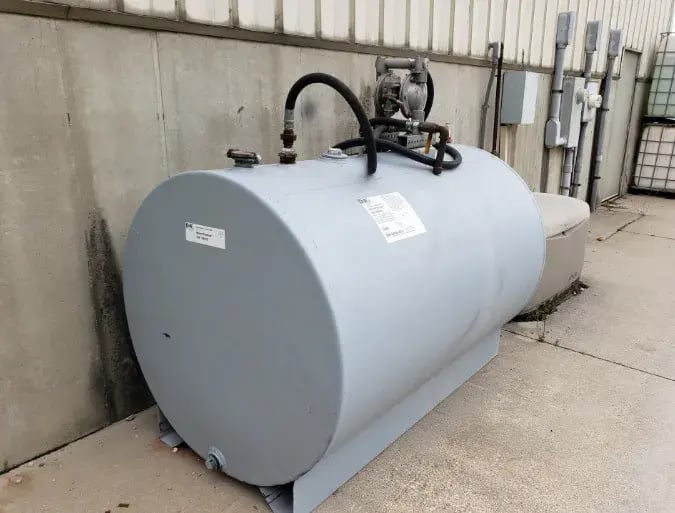
How Generator Fuel Tanks, Belly Tanks, and New Jersey's Spill Rules Add Up for Data Center Operators
If you run a data center in New Jersey, you probably think of your diesel generators as insurance, not as an environmental issue. They sit idle most of the year, they run through a scheduled test, and nobody gives the fuel much thought until a lender, an insurer, or an inspector asks to see your oil spill plan. The short answer is yes, you almost certainly need one. A federal fuel storage rule called SPCC covers nearly every facility with a standby generator fleet, and New Jersey layers its own fuel tank and spill rules on top.
This article walks through how the 1,320-gallon threshold adds up across a generator fleet, how belly tanks, day tanks, and fuel piping are treated, what inspections and testing look like, and where New Jersey's rules go further, including the state's "major facility" plans for larger campuses. If you'd rather talk it through with people who've worked through this for data centers, you can reach out to RMA at any point.
Table of Contents
TL;DR
Yes. A New Jersey data center with standby generators almost always needs a federal SPCC oil spill plan, because generator fuel tanks, day tanks, and transformer oil add up past the 1,320-gallon threshold quickly. Larger sites usually need a plan certified by a Professional Engineer, and very large campuses may also trigger New Jersey's "major facility" plans or even a federal response plan. New Jersey adds its own spill reporting, underground tank, and cleanup rules, so the safest approach is to count your total fuel and oil capacity first and work outward from there.
Does a Data Center Need an SPCC Plan?
In almost every case, yes. The federal Spill Prevention, Control, and Countermeasure rule, known as SPCC and found at 40 CFR Part 112, applies to a facility that stores more than 1,320 gallons of oil in aboveground containers, counting only containers of 55 gallons or more, or more than 42,000 gallons in completely buried tanks. The facility also has to be one that could reasonably be expected to discharge oil to navigable waters or their adjoining shorelines. EPA enforces the rule, and for New Jersey that's EPA Region 2. "Oil" covers diesel fuel, lube oil, and the mineral oil inside transformers, so a generator fleet qualifies as oil storage without much debate.
The "reasonable expectation" part is where facilities sometimes hope to find a way out. EPA wants you to judge it by geography and drainage: where would spilled oil travel across the ground, through storm sewers, and into ditches, streams, or wetlands. You can't count your own dikes, containment, or other manmade features as the reason a spill wouldn't reach water. With the number of streams, tidal waterways, and storm drain systems in New Jersey, most sites have a pathway of some kind. If you believe yours doesn't, that conclusion deserves a documented review, not an assumption. Our guide to SPCC plans for data centers covers the basics, and the quick version is there if you only need the short answer.
Backup generators carry air permit questions too, but that's a separate track from oil spill planning. We cover it in our article on environmental permits for emergency backup generators.
How Is Generator Fuel Storage Counted Toward the SPCC Threshold?
EPA counts the shell capacity of each container, meaning how much it can hold, not how much fuel is in it today. A 3,000-gallon belly tank kept half full still counts as 3,000 gallons. You add up every aboveground container of 55 gallons or more across the whole facility, and the total includes more than fuel tanks. The table below shows how the common data center items fall.
| Item at a data center |
Counts toward the 1,320 gallons? |
Notes |
| Generator sub-base (belly) fuel tank |
Yes |
Counted at full shell capacity, not current fill level. |
| Day tank |
Yes, if 55 gallons or more |
Its piping belongs in the plan as well. |
| Central bulk diesel tank |
Yes |
Often the largest single container on site, which drives containment sizing. |
| Generator engine lube oil system |
Yes, if the container is 55 gallons or more |
EPA treats this part as oil-filled operational equipment, which has lighter requirements. |
| Transformers and other oil-filled electrical equipment |
Yes, if 55 gallons or more |
Mineral oil counts, and it's easy to overlook on the electrical side. |
| Used oil drums, totes, or fuel polishing tanks |
Yes, if 55 gallons or more |
Drums stored on site count like any other container. |
| Completely buried fuel tanks |
Tracked separately |
Generally handled under the federal underground tank rules, but they still count toward New Jersey's major facility storage total. |
| Containers under 55 gallons, battery systems, natural gas |
No |
Small containers and non-oil systems don't add to the SPCC total. |
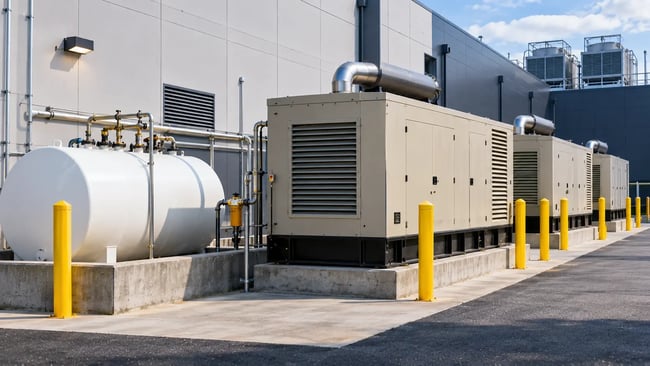
Here's how fast it adds up. A campus with twelve generators, each sitting on a 2,000-gallon sub-base tank, has 24,000 gallons of fuel capacity before anyone counts day tanks, bulk storage, or transformer oil. Even a small installation with two or three generators and a couple of day tanks usually clears 1,320 gallons without trouble. EPA treats a generator set as two things in one: the fuel tank is a bulk storage container, and the engine's lubrication system is oil-filled operational equipment. Both count toward your total, but they're held to different standards.
What Does SPCC Require for Belly Tank and Day Tank Containment?
The rule's general approach is that every place oil could escape needs a way to catch it. For bulk storage containers, that means secondary containment large enough to hold the full capacity of the largest single container, plus extra room, called freeboard, for rainfall when the area is open to weather. If you're not sure how to size it for your layout, our article on how big SPCC oil spill containment needs to be walks through the math.
Belly tanks make this easier than most setups. Most sub-base tanks are double-walled, and many data centers rely on the outer shell as the containment for the tank itself. Your plan has to show that the design really does that, and the shell isn't the whole story. A spill is far more likely to start at a fill port, a vent, a day tank, a fuel line, a flexible connector, or a hose during a delivery than through the wall of the tank. Each of those release points needs containment or a documented procedure that deals with it. Day tanks and the fuel piping that feeds them belong in the plan too, especially when a central bulk tank sits some distance from the generators.
Fuel deliveries deserve their own look. The rule expects containment or equivalent measures where tank trucks unload, sized for the largest compartment of the truck, along with overfill prevention on the tank, such as a high-level alarm or an automatic shutoff. Spill buckets at the fill ports, a written delivery procedure, and a person watching every transfer cover most of what an inspector will look for. If your containment areas are open to rain, the rule also governs how you drain stormwater out of them and what records you keep when you do.
How Should Generator Fuel Systems Be Inspected and Tested for SPCC?
People use "testing" to mean two different things, and the SPCC rule cares about both. The first is the regular run test of the generators, which shows the equipment starts and carries load. The second is inspection and integrity testing of the fuel system itself, which shows it holds fuel. A clean monthly run doesn't cover the second one, although the run is a handy moment to look for drips at the tank, piping, and fittings.
Under 40 CFR 112.8(c)(6), each aboveground bulk container is tested or inspected for integrity on a regular schedule and whenever you make material repairs, using methods suited to the tank's size and design. For shop-built tanks, industry standards such as STI SP001 are what plans typically point to when setting inspection categories and frequencies. Your plan states the schedule, and then you have to follow it. The rule also calls for written inspection procedures, and the inspection records have to be signed and kept for three years. For a data center, a practical program covers the belly tanks, day tanks, fill boxes, vents, alarms, interstitial monitors if you have them, valves, flexible connectors, and containment, and it tests alarms and level gauges rather than assuming they work. Our list of the top 10 things to check during monthly SPCC inspections is a good place to start building that checklist.
The people side counts as much as the hardware. Anyone who handles oil, from the technicians who run the generators to the staff who supervise deliveries, needs discharge prevention briefings at least once a year, and the plan names a person who's accountable for spill prevention. We cover what that looks like in practice in our article on SPCC training for data centers, and RMA's online training library has courses available if you'd rather not build your own.
Which SPCC Plan Type Fits a Data Center, and When Does an FRP Apply?
The type of plan you need depends mostly on your total aboveground storage and the size of your largest container. The table below lays out the common categories. The two "qualified facility" options also require a clean spill history, so a site with a past significant discharge may not be able to use them.
| Facility profile |
Plan type |
What it means |
| More than 1,320 and up to 10,000 gallons total, no single container over 5,000 gallons |
Tier I qualified facility |
Self-certified plan using EPA's template. |
| Up to 10,000 gallons total, with at least one container over 5,000 gallons |
Tier II qualified facility |
Self-certified plan written to the full rule. A Professional Engineer is still needed for certain alternatives to the rule's requirements. |
| More than 10,000 gallons total |
PE-certified plan |
A licensed Professional Engineer certifies the plan after visiting the site. |
| 1 million gallons or more total, or large oil transfers over water |
Possible Facility Response Plan (FRP) on top of SPCC |
Depends on EPA's substantial harm criteria, covered below. |
Many multi-generator campuses, and any site with central bulk storage, end up above 10,000 gallons and need a PE-certified plan. Our articles on the different types of SPCC plans and how Professional Engineers fit into SPCC plans explain what each path involves.
A Facility Response Plan is a heavier requirement than SPCC. It applies to a facility that stores 1 million gallons or more of oil and meets at least one condition from EPA's substantial harm criteria: not enough secondary containment in a storage area, a location where a discharge could injure fish, wildlife, and sensitive environments, a location where a discharge could shut down a public drinking water intake, or a reportable discharge of 10,000 gallons or more in the past five years. Facilities that transfer oil over water and store more than 42,000 gallons also fall in. Most data centers sit well below those numbers, but a large campus with a central fuel farm should run the math instead of assuming.
Is Your New Jersey Data Center a Major Facility Under DPCC and DCR Rules?
New Jersey runs its own oil and chemical spill program alongside the federal one. It rests on the Spill Compensation and Control Act, usually called the Spill Act, and the NJDEP rules that carry it out at N.J.A.C. 7:1E. The part that matters for storage is the "major facility" definition. A facility is major when its total combined storage capacity, aboveground or buried, reaches 200,000 gallons or more of hazardous substances of all kinds (petroleum counts as a hazardous substance here), or 20,000 gallons or more of hazardous substances other than petroleum. NJDEP looks at contiguous or adjacent properties owned or operated by the same person together, and its guidance leaves out out-of-service tanks and containers of five gallons or less.
Many data centers fall below 200,000 gallons of diesel, but a large campus with central bulk storage can get there, and the second number deserves a look too. Some coolants, treatment chemicals, and battery electrolytes can be on NJDEP's hazardous substance list, and whether they count depends on the specific substance and how it's stored. Check N.J.A.C. 7:1E, including its Appendix A, against your own inventory instead of guessing.
If you are a major facility, the requirements go well beyond SPCC. You prepare a Discharge Prevention, Containment, and Countermeasure plan (DPCC) and a Discharge Cleanup and Removal plan (DCR), submit them to NJDEP together as one certified document, follow them once approved, and renew them on the schedule the rule sets. The DPCC side covers storage standards, containment, drainage, loading areas, and piping. The DCR side covers who's in charge during a spill, how people are notified, what response equipment you keep on hand, and the drills you run. A facility that adds enough storage to cross the major facility line becomes one, and new major facilities go through NJDEP's plan review, so growth plans matter. NJDEP has also been revising these rules, with changes published in the New Jersey Register in June 2025, so confirm current requirements with NJDEP before relying on any summary, ours included.
Your SPCC plan doesn't replace DPCC and DCR plans, although a lot of the content overlaps. We can help you work out whether your site counts as a major facility and how the state and federal programs fit together. Our article on SPCC plans in New Jersey and our explanation of who enforces SPCC plans give more background on how the agencies divide the work.
How Do New Jersey Spill Reporting and Underground Tank Rules Affect Data Centers?
Start with the plain question of who you call when fuel gets out. New Jersey's discharge notification rules don't set a minimum quantity the way many federal triggers do, and the exceptions are limited. NJDEP's hotline is 1-877-WARNDEP (1-877-927-6337). On the federal side, a discharge that reaches navigable water or leaves a sheen has to be reported to the National Response Center at 800-424-8802, and our article on the sheen rule explains how that trigger works. Your plan should put both numbers and a clear decision path in front of whoever is on shift at 2 a.m.
Liability under the Spill Act is generally described as strict, joint and several. In plain terms, a person who is in any way responsible for a discharged hazardous substance can be held liable for cleanup costs and damages, and fault isn't the test. We aren't lawyers and can't give legal advice on that, and if you've had a discharge or you're weighing a self-disclosure, an environmental attorney is the right call. Cleanup of a significant discharge also typically involves a Licensed Site Remediation Professional (LSRP), and a major facility has its approved DCR plan to follow as well.
Tanks that are completely buried bring in a separate program. If any of your generator fuel tanks sit underground, New Jersey's underground storage tank rules at N.J.A.C. 7:14B may apply, which can mean registration, release detection, and NJDEP-certified contractors for installation, testing, and closure. The rule has exemptions and special provisions for certain tank types, so check its applicability section against each underground tank you have. Aboveground generator tanks fall outside that program, but local construction and fire officials review tank installations under the building code and the Uniform Fire Code, which is a statewide code enforced locally. Keep any fire code specifics for your own jurisdiction in hand, because local requirements vary.
What Should You Know About Oil Spill Plan Timing for a New Data Center?
If you're building or expanding a facility, the oil spill plan has to be ready before fuel goes into the tanks. The federal rule expects a new facility's SPCC plan to be prepared and implemented before operations begin, and a New Jersey major facility has to go through NJDEP plan review. Design decisions made early change which rules you meet. Putting fuel in sub-base tanks on each generator versus building a central bulk tank, for example, shifts your largest single container, your containment design, your plan type, and how close you come to New Jersey's major facility threshold.
The construction phase has its own set of approvals, and we want to be straightforward about that: RMA doesn't prepare construction-phase permits or approvals. That includes construction stormwater coverage, soil erosion and sediment control certification through the local Soil Conservation District, construction and fire permits for tank installation, and underground tank installation, which requires NJDEP-certified contractors. Most owners work with their engineer, general contractor, or a soil erosion specialist on those, and we can help you figure out what the construction phase is likely to need and point you toward the right people.
Once the building is running, the operational side is where we come in. A new or expanded data center almost always needs an SPCC plan or an amendment, DPCC and DCR plans if it's a major facility, spill reporting procedures, regular inspections, annual training, and often Community Right to Know reporting for diesel storage, which is a separate filing with its own thresholds. Lenders and insurers ask for these documents more often than most owners expect, as we explain in our article on SPCC plans and insurance companies.
How Much Does a Data Center SPCC Plan Cost?
RMA's SPCC plans generally run from $2,500 to $15,000, and our SPCC cost breakdown shows what moves a project around inside that range. A simple update to an existing plan can run about $1,500, while a complex PE-certified update starts around $7,500. For a data center, the main cost drivers are your total storage capacity, the number and type of containers, whether a Professional Engineer needs to certify the plan, and whether your secondary containment needs a real evaluation. Existing plans also come due for review every five years, which we cover in our article on SPCC plan 5-year reviews.
DPCC and DCR plans aren't priced the same way. Their cost depends on whether you're a major facility and which hazardous substances you store, and NJDEP charges its own fees, so we'd rather talk through your site than quote a number here. For the SPCC side, RMA's pricing calculator below can give you a ballpark for our help with your plan, and the cost of skipping it can be steep, which our article on SPCC plan violations and fines goes through.
How Can RMA Help With Data Center Oil Spill Compliance in New Jersey?
We're a family-run firm based in New Jersey, and data centers are one of the industries we work with most. We can count your fuel and oil capacity, tell you which plan type fits, develop or update your SPCC plan, help you work out whether you're a major facility under New Jersey's rules, and train the people who handle your fuel. If a simpler option fits your site, we'll say so, and if we're not the right fit for part of the job, we'll tell you that too.
If you'd like a second set of eyes, there's no pressure and no obligation. You can call us, send an email, or fill out the form on our website, and you can reach out to RMA whenever it suits you. You'll work with senior team members who do the actual work and who'll go through your situation in plain language.