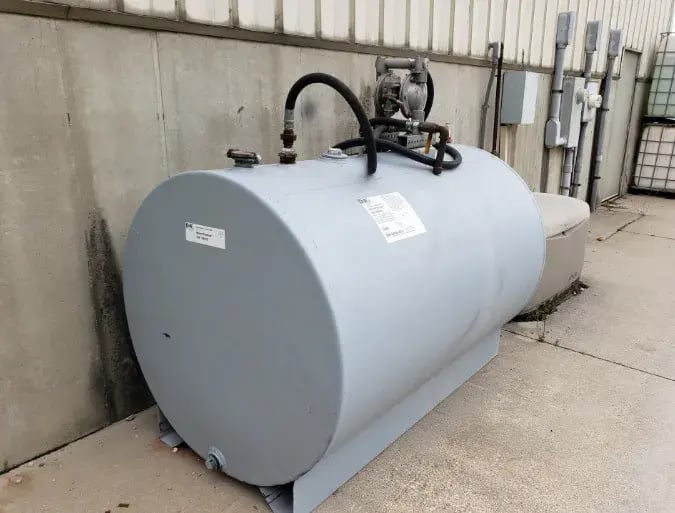
Fleet yards with on-site diesel fueling, used oil, lube storage, and DEF are prime candidates for an SPCC plan. Here's how to count your oil, what your fueling area needs, and where New Jersey's spill, tank, and stormwater rules come in.
If your trucks fuel up from a tank on your own lot, or your shop keeps drums of motor oil, hydraulic fluid, and used oil, you may be required to have a written oil spill plan even if nobody has ever mentioned one. The federal rule behind it is the Spill Prevention, Control, and Countermeasure rule, or SPCC, and EPA Region 2 enforces it in New Jersey. A lot of trucking and fleet operators assume it doesn't apply to them because the trucks themselves, which hold most of a fleet's fuel, get a pass.
In this article we'll walk through what counts toward the SPCC threshold, why vehicle fuel tanks are exempt while your fueling operation isn't, and what containment and procedures a fleet yard needs. We'll also cover how New Jersey's Spill Act, tank rules, and industrial stormwater program overlap with the federal rule. If you'd rather talk it through with a person, you're welcome to reach out to RMA at any point, and we'll tell you straight if you don't need a plan.
Table of Contents
TL;DR
Often, yes. A New Jersey fleet needs an SPCC plan when the combined capacity of its aboveground oil containers of 55 gallons or more is over 1,320 gallons, which on-site diesel tanks, lube drums, and used oil totes can reach quickly. The fuel tanks on the trucks themselves don't count, but the fueling operation does, so fueling areas need containment, written procedures, inspections, and training. New Jersey adds its own spill reporting duties, tank rules, and industrial stormwater requirements, and a yard that stays under the threshold usually doesn't need a plan.
Do New Jersey Fleet Companies Need an SPCC Oil Spill Plan?
It comes down to a number. Under the federal SPCC rule, a facility needs a written plan when it stores more than 1,320 gallons of oil aboveground, counting only containers of 55 gallons or more, or more than 42,000 gallons completely buried, and a spill could reasonably be expected to reach navigable waters or adjoining shorelines. That last condition is rarely a hurdle in New Jersey, since storm drains, ditches, and swales that lead to a creek, river, or the bay all count as pathways. If SPCC is a new term for you, our overview of what an SPCC plan is covers the basics.
"Oil" in this rule covers diesel, gasoline, motor oil, hydraulic fluid, transmission fluid, grease, and used oil, not just crude. A trucking company with a 1,000-gallon diesel tank, a shop stocked with lube drums, and a used oil tote can cross the line without anyone noticing. The rule applies facility by facility, so a company with three yards is looking at three plans. Our guide to SPCC plans in New Jersey covers how the rule plays out in the state, and if your yard sits comfortably under 1,320 gallons, you probably don't need a plan or a consultant.
What Oil at a Fleet Yard Counts Toward the SPCC Threshold?
You add up the shell capacity of every aboveground container that holds 55 gallons or more, whether it's full, half full, or empty. A 1,000-gallon tank holding 300 gallons of diesel counts as 1,000. An empty 55-gallon drum you could fill with oil tomorrow counts too. Containers smaller than 55 gallons don't count individually, no matter how many you have, and our article on 55-gallon drums and SPCC plans covers the edge cases. Here's what the math looks like for a typical mid-sized fleet yard.
| Item at the yard |
Capacity |
Counts toward SPCC? |
| Aboveground diesel fueling tank |
1,000 gallons |
Yes |
| Used oil tote |
275 gallons |
Yes |
| Two drums of new motor oil |
110 gallons |
Yes |
| One drum of hydraulic fluid |
55 gallons |
Yes |
| Fuel tanks on the tractors and trucks |
Hundreds of gallons across the fleet |
No, motive power containers are exempt |
| DEF tote |
275 gallons |
No, DEF isn't an oil |
| Five-gallon grease pails |
Under 55 gallons each |
No |
| Total counted |
1,440 gallons |
Over 1,320, so a plan is needed |
This yard lands at 1,440 gallons without counting a single truck, which is why fleets with on-site fueling tend to be the ones that trip the threshold. Diesel exhaust fluid is a mix of water and urea, not an oil, so a DEF tote doesn't count toward the SPCC total even when it sits right next to the lube room. Underground tanks follow their own rules, and we'll get to those in the New Jersey section.
Why Are Vehicle Fuel Tanks Exempt From SPCC Capacity Counting?
EPA exempts what it calls motive power containers. These are onboard tanks used primarily to power a vehicle's movement, plus onboard hydraulic and lubrication containers that serve the vehicle's ancillary equipment. They're left out of your capacity total entirely, so a tractor with two 150-gallon saddle tanks adds nothing to your count. That exemption is the reason a fleet of fifty trucks doesn't automatically need a plan.
The exemption stops at the vehicle, though. The rule says directly that transferring fuel into a motive power container at an otherwise regulated facility isn't covered, so your bulk diesel tank, the dispenser, and the fueling area are all part of the regulated facility once you're over the threshold. Mobile refuelers don't get the same treatment either. A fuel truck or a trailer-mounted skid tank that hauls fuel to equipment isn't a motive power container, so its capacity counts toward the total. Mobile refuelers are exempt from the sized secondary containment rules that apply to other bulk containers, but the general containment requirements and integrity testing still apply to them. A fleet that fuels only at public stations and keeps a modest amount of lube on site often stays under the threshold.
What Does SPCC Require for Fleet Fueling Areas and Used Oil Storage?
An SPCC plan documents what oil you have, where it sits, how you keep it from reaching the ground or a drain, and what you do if it gets out anyway. For a fleet yard, most of that work happens in two places, the fueling area and the shop.
Fueling Pad and Dispenser Containment
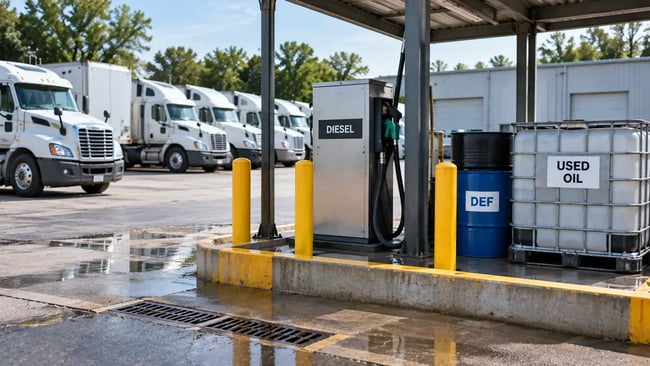
Aboveground fuel tanks need secondary containment sized to hold the largest tank plus extra room for rainfall, and our guide to how big SPCC oil spill containment needs to be shows how that math works. Around the dispenser, the rule asks for containment that fits the most likely spill. In practice that means a curbed pad, drip pans or a catch basin at the nozzle, no direct path to a storm drain, and spill kits within reach. Tanks should have overfill protection such as a high-level alarm, and the plan should spell out delivery procedures, including who's present during a fuel drop and how they confirm the tank has room before the driver starts pumping.
Used Oil, Lube Totes, and Drums
Used oil tanks, lube totes, and drums all count toward your capacity and need containment sized for the largest container, with extra room for rain if they're stored outdoors. Keep containers closed, labeled, and away from floor drains. Used oil has its own handling rules separate from SPCC, which we cover in our article on the top seven things to know about used oil regulations. If your shop has a wash bay or an oil/water separator, bring it up when the plan is written, because floor drains and separators need a deliberate look.
The plan also sets a schedule for inspections, and monthly walkthroughs are a common choice, so our list of the top 10 things to check during monthly SPCC inspections is a useful starting point. Tanks need integrity testing to an industry standard, and employees who handle oil need spill prevention training each year. Our online environmental training library is one way to cover that. Smaller yards with clean spill histories may qualify for a self-certified plan, while larger or more complex yards need a Professional Engineer to review and certify it, and our article on the different types of SPCC plans breaks down the differences. Every plan also needs a review at least every five years.
How Do New Jersey's Spill Act and Tank Rules Apply to a Fleet Yard?
The federal SPCC rule is only one layer. New Jersey adds its own rules for discharges, tanks, and fire safety, and some of them apply to every fleet whether or not it needs an SPCC plan. Here's how the layers stack up.
| Rule |
What it covers |
Who it reaches at a fleet yard |
| Federal SPCC (40 CFR Part 112) |
A written oil spill prevention plan, enforced by EPA Region 2 |
Yards with more than 1,320 gallons of aboveground oil capacity |
| New Jersey Spill Act |
Immediate reporting of discharges and liability for cleanup of petroleum and other hazardous substances |
Every facility, regardless of size |
| DPCC and DCR plans (N.J.A.C. 7:1E) |
State discharge prevention and cleanup plans for "major facilities" |
Facilities with very large storage, generally 200,000 gallons or more of hazardous substances including petroleum |
| NJ underground storage tank rules (N.J.A.C. 7:14B) |
Registration, design, leak detection, and certified contractors for regulated buried tanks |
Yards with underground fuel tanks |
The one that catches people most often is the Spill Act, formally the Spill Compensation and Control Act. It requires anyone responsible for a discharge of petroleum or another hazardous substance to notify NJDEP immediately through its 24 hour hotline at 1-877-WARNDEP (1-877-927-6337). NJDEP draws a line between a leak that stays inside secondary containment and gets cleaned up and a discharge that reaches the land or waters of the state, so containment you maintain keeps a small drip from becoming a reportable event. If oil reaches navigable water or leaves a sheen, there's also a federal report to the National Response Center at 1-800-424-8802, and our article on when you have to report an oil spill explains when that applies. If anyone is hurt or there's a fire risk, call 911 first.
The Spill Act also makes liability strict. In general terms, a party responsible for a discharge can be held for cleanup costs whether or not it was careless, and responsibility can be shared among several parties. An environmental attorney can give you legal advice on that, and what we're sharing here is general information only.
DPCC and DCR plans apply only to what New Jersey calls major facilities, generally 200,000 gallons or more of hazardous substances including petroleum, or 20,000 gallons or more of non-petroleum hazardous substances. Most fleet yards fall far short, but a large terminal should check N.J.A.C. 7:1E against its own inventory, since NJDEP has been revising those rules.
Underground tanks are handled differently. The SPCC rule leaves completely buried tanks that meet the federal underground storage tank requirements out of your aboveground count, but New Jersey regulates them directly under N.J.A.C. 7:14B. Regulated tanks have to be registered with NJDEP, and work on them involves NJDEP-certified contractors. The Uniform Fire Code is enforced by local fire officials and varies by town, so check with yours before changing your fueling setup.
If you're building a new yard or adding fuel storage, the construction side is its own track: construction stormwater coverage, soil erosion and sediment control certification, building and fire permits, and UST installation. We don't prepare those, and most readers work with their engineer, contractor, or a soil erosion specialist. Once the yard is running, it almost always needs an SPCC plan or amendment, spill reporting procedures, inspections, training, and often a stormwater permit or certification, which is the part we help with. If a discharge to soil or groundwater ever needs cleanup, a Licensed Site Remediation Professional (LSRP) typically leads that work.
Why Do Fleet Fueling Areas Matter for NJ Industrial Stormwater Permits?
An SPCC plan and an industrial stormwater permit are separate programs that care about the same patch of pavement. SPCC is about keeping oil from getting out. A stormwater permit is about what leaves your site with the rain. Federal stormwater rules treat transportation facilities with vehicle maintenance, equipment cleaning, or non-retail fueling as industrial activity, so a fleet yard that fuels and services its own trucks can need coverage. NJDEP's industrial stormwater program offers a general permit, an individual permit, or a no exposure certification for facilities whose industrial materials and activities are fully protected from rain.
Fueling areas are where that gets difficult. An uncovered outdoor fueling pad, trucks that drip while they sit, and open drums by the shop door all count as exposure, which makes a no exposure certification hard to claim, while a roofed fueling canopy, indoor maintenance, and covered storage can change the answer. The housekeeping is the same under both programs, including drip pans, drain protection, prompt cleanup, and regular inspections. Whether your yard needs a permit depends on its industrial classification and what you do on site, so confirm that with NJDEP or with us before assuming either way. Our article on the difference between an SPCC plan and a SWPPP explains how the two fit together.
How Much Does an SPCC Plan Cost for a Trucking or Fleet Company?
SPCC plans run from $2,500 to $15,000, and where a fleet lands in that range depends on its yard. A single-location company with one diesel tank, a few drums, and a used oil tote sits toward the lower end. Multi-location fleets, large bulk tanks, complex containment, or a plan that needs Professional Engineer certification push the price up. The main cost drivers are total storage capacity, the number and type of containers, whether secondary containment needs evaluating, whether a PE has to review the plan, and how many yards you operate.
If you already have a plan that's old or was written for a different layout, we typically rebuild it rather than patch it, so we can stand behind the finished document. Our SPCC plan cost breakdown goes deeper on pricing, and the pricing calculator below gives you an estimate for RMA's help with the plan itself, separate from any tanks or containment you may need to buy.
How Can RMA Help a New Jersey Fleet Company With an SPCC Plan?
We're a family-run firm based in New Jersey, and we've been doing this since 1992. For fleet companies, we start by going through your oil inventory with you and telling you straight whether you need a plan at all. If you do, senior staff build it around how your yard runs, with Professional Engineer review where one's required, and we help set up the inspections, training, and spill reporting procedures that go with it.
There's no pressure and no obligation. You can call us, email us, or fill out the form on our website. If you'd like to start with a conversation, contact RMA whenever it suits you.