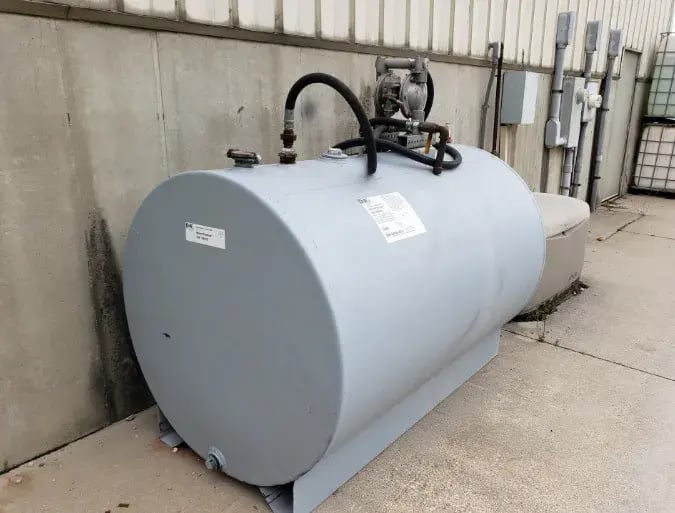
Federal oil spill rules and New Jersey's discharge prevention rules look alike, but they have different triggers, different regulators, and different paperwork.
If you store oil or chemicals at a New Jersey facility, you've probably heard about an oil spill plan from EPA and a separate discharge prevention plan from NJDEP, and you may have wondered whether one covers the other. It doesn't. The federal program is the Spill Prevention, Control, and Countermeasure (SPCC) rule. The state program is New Jersey's requirement for Discharge Prevention, Containment and Countermeasure (DPCC) and Discharge Cleanup and Removal (DCR) plans. Each one has its own definition of who's covered, and plenty of facilities fall under one but not the other.
The short answer is that not every New Jersey facility needs both. Some need only an SPCC Plan, a smaller group needs both, and a few chemical storage sites need only the state DPCC and DCR plans. In this article we walk through how each program decides who's covered, how the two programs count your storage differently, and what to do if you can't tell where you land. If you'd rather talk it through with someone, you can reach out to RMA at any point.
Table of Contents
TL;DR
Not every New Jersey facility needs both plans. A federal SPCC Plan applies when you store more than 1,320 gallons of oil in aboveground containers (counting containers of 55 gallons or more) and could reasonably reach navigable waters. State DPCC and DCR plans apply only if your facility is an NJDEP "major facility," meaning 20,000 gallons or more of non-petroleum hazardous substances or 200,000 gallons or more of all hazardous substances including petroleum. One plan doesn't replace the other, and New Jersey's spill reporting rules apply to you whether or not you need either one.
What Are an SPCC Plan and a DPCC/DCR Plan?
Start with plain words. An SPCC Plan is a written oil spill prevention plan that EPA requires under 40 CFR Part 112, which implements the Clean Water Act. It describes your oil storage, the secondary containment around it, your inspections, your training, and what you'd do if oil got loose. New Jersey sits in EPA Region 2, so that's the EPA office that enforces the rule here. In most cases the plan stays at your facility instead of being filed with EPA, and it has to be reviewed at least every five years. If you want the full background, our article What Is an SPCC Plan? covers it.
A DPCC/DCR plan is the state version, and it reaches further. DPCC stands for Discharge Prevention, Containment and Countermeasure, and it covers how you prevent releases through things like secondary containment, tank integrity testing, high level alarms, and written operating procedures. DCR stands for Discharge Cleanup and Removal, and it covers your response if a release happens anyway. Both come out of New Jersey's Spill Compensation and Control Act, known as the Spill Act, and the rules at N.J.A.C. 7:1E. The two plans are prepared and submitted to NJDEP as a single document, and NJDEP reviews and approves them. Because the Spill Act covers petroleum and a long list of other hazardous substances, a DPCC/DCR plan can apply to a chemical warehouse that stores no oil at all.
Does Your New Jersey Facility Need a Federal SPCC Plan?
An SPCC Plan is required when two things are both true. First, your facility has more than 1,320 gallons of oil in aboveground containers, counting only containers of 55 gallons or more. Second, your facility could reasonably be expected to discharge oil into navigable waters or onto adjoining shorelines, based on its location, land contour, and drainage. That second test looks only at geography. Dikes, walls, and other manmade features can't be used to argue that spilled oil wouldn't get there.
The 1,320 gallon count uses container capacity, not what's in the container today. A 5,000 gallon tank that's usually half full counts as 5,000 gallons. Oil includes diesel, gasoline, lube oil, hydraulic oil, vegetable oil, and the oil inside electrical and hydraulic equipment, while propane doesn't count. Motive power containers, such as the fuel tank on a truck, are exempt, along with a few other categories like milk containers. Completely buried tanks that are fully covered by federal or state underground storage tank rules (in New Jersey, N.J.A.C. 7:14B) also drop out of the SPCC count. Our articles on 55-gallon drums and emergency backup generators cover two of the most common counting questions, and the 4 steps to figure out if you need an SPCC Plan give you a quick way to check your own numbers.
Who signs the plan depends on the facility. Smaller facilities that meet the conditions for self-certification can certify their own plans, while larger or more complex sites need a Professional Engineer to review and certify the plan. Whenever your site calls for a PE, have one review and approve the plan. Our article on Professional Engineers and SPCC Plan requirements explains how to tell which situation you're in.
Does Your Facility Count as an NJDEP Major Facility Requiring DPCC and DCR Plans?
New Jersey's trigger is the "major facility" definition. Under the Spill Act and N.J.A.C. 7:1E, a facility is major if its total aggregate storage capacity is 20,000 gallons or more of hazardous substances other than petroleum products, or 200,000 gallons or more of all hazardous substances including petroleum. Those numbers are much larger than the federal 1,320 gallons, which is why many SPCC facilities never become major facilities. The catch is that non-petroleum hazardous substances count too, and the list is long. NJDEP's amendments to Appendix A, the list of hazardous substances, were adopted in June 2025 and added more than 200 PFAS compounds, so check your chemical inventory against the current list.
NJDEP also counts storage differently than EPA does. It adds up the design capacity of every storage tank, drum, tote, and container, whether it's full or empty, so a 55 gallon drum counts as 55 gallons. Emergency generator tanks count. An empty tank still counts unless it meets the rule's strict "out of service" definition, which requires emptying it, disconnecting and blanking off the piping, locking the valves, and posting signs with the date it was taken out of service. Containers of five gallons or less are left out, and so is an underground tank used only for heating oil burned on site. Other underground tanks count toward the total even though they're regulated under their own rules. NJDEP's Guide to Hazardous Substance Storage Capacity walks through worked examples, including a facility with a 190,000 gallon fuel oil tank and 15,000 gallons of ethylene glycol in drums that crosses the 200,000 gallon line.
If you are a major facility, you submit the DPCC and DCR plans to NJDEP's Bureau of Release Prevention for approval, with a certification, and then follow the approved plans. NJDEP's amendments published on June 16, 2025 moved the renewal period from three years to five, and NJDEP audits and inspects major facilities, so the plans need to match what's really happening on site. The DCR side includes trained personnel, response equipment, and annual drills that are varied and critiqued in writing, and our online environmental training library is a good place to start on the training piece. Consultants who work in this program describe the plan certification as coming from a New Jersey licensed Professional Engineer, so confirm the current certifier requirements in N.J.A.C. 7:1E-4.11 before you plan your timeline.
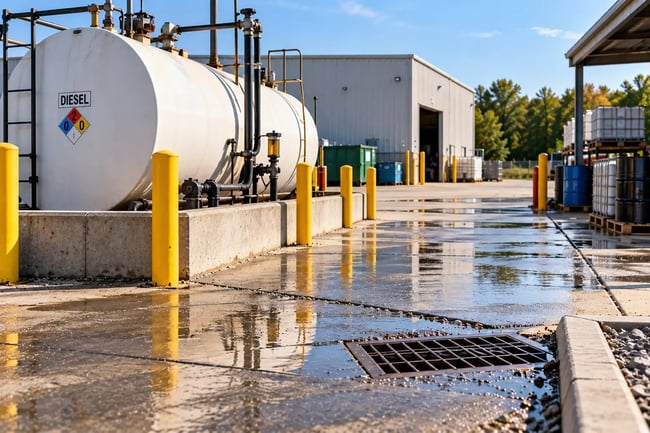
How Do SPCC Plans and DPCC/DCR Plans Compare Side by Side?
The two programs share vocabulary, which is part of why they get lumped together. The table below shows where they split.
| |
Federal SPCC Plan |
NJ DPCC/DCR Plans |
| Rulebook |
40 CFR Part 112 (Clean Water Act) |
N.J.A.C. 7:1E (Spill Act) |
| Enforced by |
EPA Region 2 |
NJDEP Bureau of Release Prevention |
| Substances covered |
Oil only |
Petroleum and other listed hazardous substances |
| Trigger |
More than 1,320 gallons aboveground (containers of 55 gallons or more) and a reasonable expectation of reaching navigable waters |
Major facility: 20,000 gallons or more of non-petroleum hazardous substances, or 200,000 gallons or more of all hazardous substances including petroleum |
| What counts |
Container capacity; regulated underground tanks excluded |
Design capacity of tanks and containers over five gallons; underground tanks count except heating oil used on site |
| Filing |
Usually kept at the facility |
Submitted to NJDEP for review and approval |
| Review cycle |
At least every five years |
Renewal every five years after NJDEP's 2025 amendments |
One plan can't stand in for the other, but the work overlaps a lot. Tank inventories, secondary containment evaluations, inspection routines, and training records feed both programs, so facilities that need both usually build them from one set of site facts. That keeps the documents consistent, which matters because an inspector from either agency will compare your plan to what's sitting in your yard.
Which Combination of Plans Applies to Your Facility?
Here are four common situations and how each tends to come out. Your own answer depends on your actual capacities and location, so treat these as patterns, not rulings.
| Facility example |
SPCC Plan |
DPCC/DCR Plans |
| 6,000 gallons of diesel and lube oil in aboveground tanks, with a storm drain or stream nearby |
Yes, if the site could reasonably reach navigable waters |
No, unless other hazardous substances push the total over the major facility line |
| A warehouse storing up to 1,000 drums of non-petroleum chemicals |
Only if it also holds more than 1,320 gallons of oil |
Yes, since 55,000 gallons of capacity is over the 20,000 gallon line |
| A bulk fuel oil terminal with a 250,000 gallon tank |
Yes |
Yes, since the capacity is over 200,000 gallons |
| 800 gallons of oil in drums and a generator tank |
No, under 1,320 gallons |
No, though spill reporting still applies |
The large terminal row deserves a caution. Large terminals and port facilities can also fall under Facility Response Plan rules and, for marine transfers, Coast Guard jurisdiction, so the layers stack up quickly. If that sounds like your site, expect to sort out more than two programs.
What Changes If You Build, Expand, or Add Storage?
A non-major facility that adds enough storage capacity to cross the threshold is treated as a major facility. A new major facility, or an existing facility planning an expansion that makes it major, must submit its DPCC and DCR plans to NJDEP at least 180 days before it operates as a major facility, and it needs approval and an implemented plan before it starts. Put that timeline in the project schedule from the beginning. Construction-phase approvals, such as soil erosion and sediment control certification, construction stormwater coverage, and building or fire permits for new tanks, are separate, and RMA doesn't prepare them. Most owners work with their engineer or contractor on that piece. Once the facility is running, though, it almost always needs an SPCC Plan or amendment, spill reporting procedures, inspections, training, and, if it's major, DPCC and DCR plans. That's where we help, and we can also help you work out what the construction phase needs and point you toward the right construction professionals.
What Spill Reporting and Liability Rules Apply Even Without a Plan?
If oil or a chemical is spilling right now, handle safety first. Call 911 if there's a fire, an injury, or a threat to people, and report the discharge to NJDEP's hotline at 1-877-WARNDEP (1-877-927-6337).
Reporting doesn't depend on having a plan. New Jersey's Spill Act requires immediate notification to NJDEP when a discharge happens, and the discharge reporting provisions in N.J.A.C. 7:1E reach facilities that aren't major facilities too. There are narrow exceptions for certain small discharges that are cleaned up under an approved plan or under the state's cleanup rules, so don't assume a small spill is exempt until you've checked N.J.A.C. 7:1E-5. Federal rules separately require reporting oil that reaches navigable waters or creates a sheen, which we explain in When Do You Have to Report an Oil Spill?
Cleaning up a discharge frequently involves a Licensed Site Remediation Professional (LSRP), the state-licensed professional who oversees cleanups under New Jersey's site remediation program. The Spill Act is also known for strict liability that can reach more than one party, and how that applies to your situation is a legal question. If a discharge has already happened, or you're dealing with an enforcement notice, an environmental attorney is a reasonable call to make. For the plan side, our article on top SPCC Plan violations and fines covers what inspectors tend to cite.
How Can RMA Help You Sort Out SPCC and DPCC Requirements?
We're based in New Jersey and work with NJDEP's rules alongside EPA's, so this overlap is familiar ground for us. A good first step is a simple inventory. List every tank, drum, tote, and piece of oil-filled equipment with its capacity, and separate the oil from other hazardous substances. With that list, we can tell you whether the SPCC trigger is met, whether you're close to NJDEP's major facility thresholds, and what to do next. If you only need an SPCC Plan, we'll say so. SPCC Plans typically run $2,500 to $15,000 depending on the site, and our SPCC plan cost guide explains what drives the price. Plans that call for a Professional Engineer get PE review and approval before they're final. If DPCC and DCR plans come into play, we'll explain what's involved, how they fit with your SPCC Plan, and who you'll likely need alongside us.
There's no pressure and no obligation. You can call us, email us, or fill out the form on our website, or you can contact RMA directly and tell us a little about your site. We'd rather answer a question now than have you find out about a gap during an inspection.