Propane and Other Fuels That Don't Count as Oil Under New Jersey's Oil Spill Plan Rules
If you run a facility in New Jersey, you've probably heard that anyone with enough fuel tanks needs an oil spill plan, formally called a Spill Prevention, Control, and Countermeasure (SPCC) plan. Then you look out back at the big white propane tank feeding your forklifts or your heating system and wonder whether it counts. It's a fair question, because most of the other tanks on your property probably do.
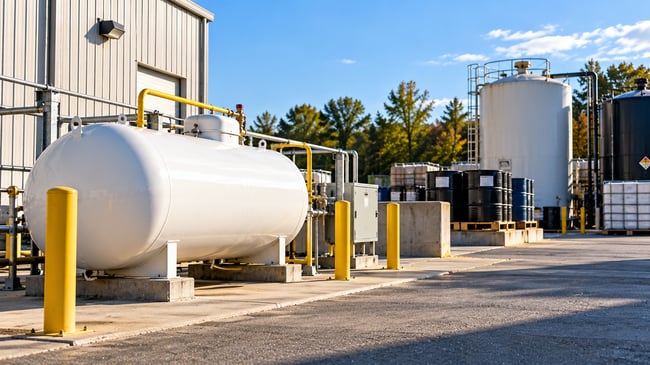
The short answer is no. Propane is a liquefied gas, not oil, so propane tanks don't need an SPCC plan and don't count toward the storage threshold. Below, we'll walk through why that's true, which other materials fall outside the rule, and which materials people wrongly assume are safe to ignore. We'll also cover the rules that do apply to propane in New Jersey, and if you'd rather have someone check your tanks for you, you can always reach out to RMA.
Table of Contents
TL;DR
No, propane doesn't need an SPCC plan. The federal rule only covers oil, and propane is a gas, so your propane tanks aren't counted toward the 1,320-gallon threshold. Vegetable oil, asphalt cement, and transformer oil, on the other hand, are oil, and plenty of facilities get caught by them. Propane still has its own fire code and safety rules in New Jersey, so it isn't a free pass on compliance, just a different set of rules.
Does Propane Count as Oil Under the SPCC Rule?
The SPCC rule is part of the federal oil pollution prevention regulation, 40 CFR Part 112. It defines oil broadly, as oil of any kind or in any form, and then lists examples: petroleum, fuel oil, sludge, synthetic oils, mineral oils, oil refuse, animal fats, and vegetable oils. Propane isn't on that list, and it doesn't fit the definition. It's a liquefied gas that turns back into vapor when it's released, so it doesn't leave a slick on a stream the way diesel or hydraulic oil does. EPA's SPCC training materials say plainly that propane storage tanks aren't covered and that you shouldn't count them when you total up your storage.
Here's how the counting works. A facility needs an SPCC plan when it stores more than 1,320 gallons of oil in aboveground containers of 55 gallons or more, adding up capacity rather than what's actually in the tanks, and when a spill could reasonably reach navigable waters. Propane just doesn't go into that math. If you have a 5,000-gallon propane tank and 500 gallons of diesel, you're nowhere near the threshold. EPA Region 2 enforces the SPCC rule in New Jersey, and its inspectors will ask you to show your oil totals, so it helps to know which tanks belong on the list. Our article on how to figure out if you need an SPCC plan walks through the counting process step by step.
Which Other Fuels and Materials Don't Count as Oil for SPCC?
Propane is the most common question we get, but it isn't the only material that falls outside the rule. The SPCC rule is narrow on purpose. It's about oil, so a lot of the other things you store don't count toward your total, even when they're hazardous in other ways. The table below covers the usual suspects.
| Material |
Counts as oil under SPCC? |
What to know |
| Propane and other LP gas |
No |
Don't count the tanks toward the 1,320-gallon threshold. |
| Natural gas |
No |
It's a gas, not an oil. |
| Many industrial chemicals, such as solvents and acids |
Generally no |
They're not oil, but they can still be regulated as hazardous substances under other programs. |
| Antifreeze (ethylene glycol) |
Generally no |
Used antifreeze mixed with oil is a different story, so look at what's actually in the container. |
| Hot-mix asphalt |
No |
EPA exempts hot-mix asphalt and its containers. Asphalt cement is a different matter (see below). |
A couple of cautions go with this table. First, "not oil" doesn't mean "not regulated." A chemical that stays out of your SPCC totals can still trigger reporting, storage, or discharge rules somewhere else, and New Jersey's Spill Act covers hazardous substances well beyond oil. Second, EPA can decide that a material is oil even when it isn't named in the rule, and mixtures get treated as oil when they contain it. If a product is a blend or you're not sure what's in a tank, check the safety data sheet and then ask someone who works with the rule every day before you leave it off your list.
Which Materials Do People Wrongly Assume Aren't Oil Under SPCC?
The mistakes we see run the other way. Facilities leave tanks off their totals because the material doesn't look or act like motor oil. The SPCC rule doesn't care about that. If it's oil of any kind in any form, it counts, and some of the biggest surprises come from materials that sit in a gray area in people's heads.
| Material |
Why it counts |
| Vegetable oil and animal fats (cooking oil, used fryer oil, tallow) |
The rule specifically names oils from seeds, nuts, fruits, and kernels, plus fats and greases of animal origin. |
| Asphalt cement, binders, cutbacks, and emulsions |
Asphalt is part of the petroleum oil definition. Only hot-mix asphalt and its containers are exempt. |
| Transformer oil and other oil-filled equipment |
Mineral oil is oil, and the oil inside electrical equipment counts toward your capacity. |
| Hydraulic, lubricating, and synthetic oils |
Synthetic oils are named in the definition, and hydraulic reservoirs add up quickly. |
| Used oil and oil mixed with waste |
The definition includes oil mixed with wastes other than dredged spoil. |
Restaurants and food processors are the classic example. A grease tote and a couple of drums of used cooking oil can push a site past 1,320 gallons without anyone noticing, and we cover that situation in our article on SPCC plans for cooking oil. Concrete and asphalt plants get caught by asphalt cement and release agents, and utilities, data centers, and manufacturers add up transformers, generators, and hydraulic systems without thinking about it. Small containers matter too, since the 55-gallon minimum applies per container but every container at or above it goes into the total. Our piece on 55-gallon drums and SPCC plans explains how that works.
What Rules Apply to Propane Tanks in New Jersey Instead?
Staying out of SPCC doesn't put propane outside the rules. In New Jersey, propane storage and installation fall under the state's liquefied petroleum gas rules at N.J.A.C. 5:18, which adopt the national NFPA 58 standard with New Jersey amendments, and under the Uniform Fire Code. The Department of Community Affairs oversees these rules, and your local fire official is usually the person who inspects and enforces them. Tank placement, distances from buildings, cylinder storage, and who can fill and handle containers all come from that side of the house, not from the environmental agencies. Details vary with tank size and location, so your propane supplier and local fire official are the right first calls.
Installing or moving a propane tank also usually involves permits and approvals from the fire official or building department. RMA doesn't handle construction-phase permits or installation approvals, so that piece belongs with your propane supplier, contractor, or engineer. Where we come in is the environmental paperwork that surrounds a running facility. Large propane inventories can trigger Tier II chemical inventory reporting under federal Community Right to Know rules, which generally apply to hazardous chemicals stored at or above 10,000 pounds at any one time, and a few thousand gallons of propane can get you there. New Jersey runs its own Community Right to Know reporting too, so check your total against the current state requirements.
How Can RMA Help You Figure Out If You Need an SPCC Plan?
If your only tank is a propane tank, you probably don't need us, and we'll tell you that. If you've also got a diesel generator, a fuel tank, a grease tote, a transformer, or a few drums, the answer depends on adding up everything that counts, and that's where a second set of eyes helps. We can look at your inventory, tell you whether you're over the threshold, and explain what kind of plan fits if you are. Our overview of SPCC plans in New Jersey covers the state's extra layers, and what an SPCC plan is is a good starting point if the terms are new. We're based in New Jersey and know how NJDEP and EPA Region 2 approach this. There's no pressure and no obligation. You can call us, email us, or fill out the form on our website, and you're welcome to contact RMA whenever you're ready.