How Rain Turns Pallets, Drums, Scrap, and Stockpiles at a Pennsylvania Facility Into a PA DEP Stormwater Issue
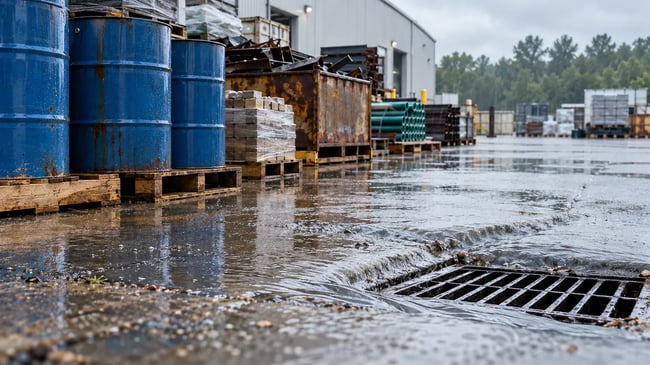
Walk around almost any industrial property and you'll find things sitting outside. Pallets along the fence, drums by the loading dock, a roll-off full of scrap, a pile of stone, a forklift that's been dripping on the same patch of asphalt for months. Most people never think about any of it from an environmental angle. PA DEP does, because every time it rains, water runs over those materials, picks up whatever comes off them, and carries it toward a storm drain or creek. If your facility falls into one of the industrial categories covered by Pennsylvania's industrial stormwater rules, that outdoor storage is usually the biggest factor in whether you need PAG-03 permit coverage or can get by with a much simpler No Exposure Certification. If your business isn't in a covered category, outdoor storage on its own usually won't put you under PAG-03.
Below, we'll walk through how rain turns outdoor storage into a stormwater discharge, which facilities need to care, what counts as "exposed," and practical changes like covering, moving things indoors, or adding containment that can lower your risk or even change your permit status. We'll also cover what each path tends to cost. If you'd rather talk through your own site, feel free to reach out to RMA and we'll help you figure out where you stand.
Table of Contents
TL;DR
Rain washes oil, metals, residue, and sediment off materials stored outside and carries them to storm drains and streams. If your facility's industry code is on the list of covered industrial categories, exposed outdoor storage generally means you need PAG-03 permit coverage, while keeping everything indoors or properly sheltered can let you file a No Exposure Certification instead. Sealed, intact containers and properly covered storage usually don't count as exposure, but open or leaking drums, uncovered scrap bins, open stockpiles, and dripping equipment do. If your business isn't in a covered category, outdoor storage alone usually won't require PAG-03, though local rules may still apply.
How Does Rain Turn Outdoor Storage Into a Pennsylvania Stormwater Issue?
Stormwater is rain and snowmelt that runs off a property instead of soaking into the ground. On a paved industrial yard, almost all of it runs off. As it crosses the site, it dissolves anything soluble, like salts, some metals, and chemical residue, and it picks up loose particles like dust, rust flakes, and fine stone. The first part of a storm usually carries the most, because it's rinsing off everything that built up since the last rain.
That water usually flows to a storm inlet, swale, or ditch, then into a municipal storm sewer or straight into a stream, without passing through a treatment plant. Whatever came off your storage area ends up in the local creek and eventually the Susquehanna, the Delaware, or the Ohio. That's why the Clean Water Act and Pennsylvania's Clean Streams Law treat this runoff as a regulated discharge. Regulators call it stormwater associated with industrial activity, and the definition includes storage areas for materials, products, and waste.
| What's Stored Outside |
What Rain Tends to Carry Off |
| Scrap metal, parts, and steel stock |
Iron, zinc, copper, aluminum, and leftover oils |
| Open, dented, or leaking drums and totes |
Oil, solvents, coolants, and product residue |
| Stone, sand, soil, and aggregate stockpiles |
Sediment and suspended solids |
| Cement, lime, and concrete waste |
High-pH water and fine solids |
| Equipment and material handling gear |
Oil, grease, hydraulic fluid, and metals |
| Used pallets and dunnage |
Spilled product residue and debris |
| Fertilizer, salt, mulch, or compost |
Nitrogen, phosphorus, and chlorides |
Runoff from a scrap pile can look clear and still carry enough dissolved zinc or copper to show up in a lab result. Nutrients get extra attention here because so much of Pennsylvania drains to the Chesapeake Bay, and the current PAG-03 permit added nitrogen and phosphorus monitoring across all of its industry appendices.
Which Pennsylvania Facilities Need to Worry About Outdoor Storage and Stormwater?
The permit question starts with what kind of business you are, not what's in your yard. Federal rules, which DEP follows, list categories of industrial activity mostly by Standard Industrial Classification (SIC) code, the four-digit number describing your primary line of business. Covered categories include most manufacturing, scrap and recycling yards, salvage yards, concrete and asphalt plants, lumber and wood products, and chemical and petroleum facilities. For lighter manufacturing like electronics, furniture, printing, and food processing, permit coverage only kicks in if industrial materials or activities are exposed to stormwater, so outdoor storage is often the whole question. Our article on who needs a stormwater permit goes through the categories in more detail.
Plenty of businesses that store things outside aren't in a covered category, and they usually don't need PAG-03. That's common for warehouses that keep goods indoors, body shops, dealerships, quick-lubes, and most contractors. Steel service centers often handle lots of metal outdoors but are frequently classified as wholesale, which generally isn't covered. A few situations sit in the middle:
- Trucking, bus, rail, and airport operations are covered only for their vehicle maintenance, equipment cleaning, fueling-related, or deicing areas, not the whole lot.
- Some warehousing codes are on the list, so an indoor-only warehouse may still need to file a No Exposure Certification rather than nothing.
- Quarries, landfills and transfer stations, and oil and gas sites fall under their own DEP programs, which overlap with industrial stormwater.
DEP can require a permit from any facility it finds discharging pollutants to waters of the Commonwealth, covered category or not. And where your runoff goes matters. Older cities like Philadelphia and Pittsburgh have combined sewers in parts of town, where storm drains flow to a treatment plant instead of a stream, and the sewer authority may govern your runoff instead of a DEP stormwater permit. Local rules and fees may differ, so confirm how your site drains.
Why Outdoor Storage Decides Between PAG-03 and a No Exposure Certification
NPDES, the National Pollutant Discharge Elimination System, is the federal permit program for discharges to surface water, and DEP runs it in Pennsylvania. PAG-03 is DEP's general NPDES permit for industrial stormwater, meaning one standard set of conditions that facilities apply to be covered under by filing a Notice of Intent. The current PAG-03 took effect March 24, 2023, for a five-year term. Facilities that discharge to High Quality or Exceptional Value waters under 25 Pa. Code Chapter 93 can't use it and need an individual NPDES permit. Our article on general, individual, and No Exposure options compares the paths.
A No Exposure Certification is a formal statement to DEP that none of your industrial materials or activities are exposed to rain, snow, or runoff. If DEP approves it, you don't need permit coverage. So a covered facility with everything indoors may qualify, while the same facility with uncovered scrap bins and open drums by the back door generally needs PAG-03.
| |
PAG-03 Coverage |
No Exposure Certification |
| When it fits |
Industrial materials or activities exposed to stormwater |
Everything industrial indoors or properly sheltered |
| Ongoing work |
PPC Plan, inspections, sampling, eDMR reporting, annual reports, and corrective action |
Keeping the whole site free of exposure and allowing DEP to inspect |
| Renewal |
Follows the general permit's five-year cycle |
Every five years |
| High Quality or Exceptional Value waters |
Not eligible |
Not eligible |
The PPC Plan (Preparedness, Prevention and Contingency Plan) is Pennsylvania's version of a stormwater pollution prevention plan. It maps drainage areas and outfalls, identifies pollutant sources, and spells out the practices you'll use, and outdoor storage areas are usually a big part of it. We compare the two plan types in SWPPPs vs. PPC Plans for PAG-03, and our guide to PAG-03 stormwater sampling covers the monitoring side, where outdoor storage often drives high results.
What Outdoor Storage Counts as Exposure Under Pennsylvania Stormwater Rules?
No exposure means all industrial materials and activities are protected by a storm resistant shelter, like a roof or building, that keeps rain, snow, and runoff off them. The federal rules, which Pennsylvania's No Exposure application follows closely, list what counts as exposure and carve out a few things that can sit outside without a roof. For more background, see our article on what non-exposure means under a stormwater permit.
| Generally Counts as Exposure |
Generally Doesn't Count as Exposure |
| Open, rusted, dented, or leaking drums and totes |
Tightly sealed, intact containers with no taps or open valves |
| Uncovered scrap bins and roll-offs |
Covered, non-leaking waste containers like lidded dumpsters |
| Raw material, product, or waste stockpiles in the open |
Materials indoors or under a permanent roof that keeps runoff off |
| Machinery used, stored, or cleaned outside |
Adequately maintained material handling vehicles |
| Stains, residue, or spills on the ground or in inlets |
Final products built for outdoor use, like new vehicles, that don't shed pollutants |
| Loading and unloading in the open |
Loading and unloading inside or under a canopy |
Gray Areas in Outdoor Storage Exposure
Real yards get messier than the table. Leftovers from past operations count, so an old slag pile or abandoned equipment can create exposure even if nobody has touched it in years. Final products only get a pass when rain doesn't mobilize anything, which is why new cars are fine and a pile of rock salt isn't. Clean new pallets are one thing, but pallets with chemical or oily residue are another. An empty drum stored open-side up collects rainwater and whatever was left inside. Tarps that blow loose or let water run underneath don't do the job of a storm resistant shelter, and handling counts too, so forklifts moving material between buildings in the rain can create exposure even when everything ends up indoors. The person who sees the yard every day tends to stop noticing what's sitting in it, so a walk-through with fresh eyes helps.
No Exposure also has a few catches. It's all or nothing for the whole facility, not one outfall at a time. It only lasts as long as the conditions do, so if materials end up outside, the exclusion no longer applies and any discharge becomes unpermitted. Federal rules expect you to get permit coverage before a change like that happens. And filing doesn't guarantee approval, since DEP reviews the certification and can still require a permit if your runoff causes a water quality problem.
Simple Changes That Reduce Outdoor Storage Stormwater Exposure
A lot of exposure comes from habits, not from how the facility was built. Small changes can cut what rain picks up, lower your sampling results under PAG-03, and sometimes get a covered facility to the point where No Exposure is realistic. These changes are called best management practices, or BMPs, and our article on stormwater BMPs covers the broader toolbox.
The most effective change is moving material inside. Much of what sits outdoors is there out of convenience, and clearing out old equipment and obsolete inventory often frees enough room for drums, parts, and smaller materials. For bulky items, a permanent roof or canopy can serve as storm resistant shelter if it keeps runoff from flowing underneath, so curbing or grading is often part of the fix. A new canopy or storage building may need a building permit or township approval, which your contractor or engineer would handle, since we don't handle construction approvals.
For what has to stay outside, keep it sealed, covered, and contained. Keep drum bungs tight, replace damaged containers, and set drums on spill pallets or in covered containment units. Put lids on scrap bins and dumpsters, store empty containers closed, and keep stockpiles in bays or under secured covers, away from storm inlets. Housekeeping rounds it out. Sweep storage and loading areas instead of hosing them toward a drain, clean up drips right away, keep spill kits handy, fix leaking equipment, and check outdoor storage before forecast storms.
| Change |
Can It Support No Exposure? |
| Moving materials indoors |
Yes |
| Permanent roof or canopy with runoff kept out |
Yes, if it keeps rain and runoff off the material |
| Sealing drums and replacing damaged containers |
Often, for sealed, intact containers |
| Lidded dumpsters and covered scrap bins |
Often, if covered and non-leaking |
| Tarps and temporary covers |
Rarely, because they don't hold up in every storm |
| Spill pallets, berms, and containment |
Helps, but containment alone isn't shelter |
| Sweeping, spill cleanup, and inspections |
Supports it, but doesn't qualify a site on its own |
No Exposure depends on the whole facility staying that way, so the people running the site need to know why things moved inside. One delivery staged in the yard or one uncovered bin can undo it. Outdoor storage is also one of the first things an inspector sees, and our article on what happens during a PA DEP stormwater inspection covers what that visit looks like.
What Does Exposed Outdoor Storage Cost Under PAG-03 Versus Fixing It?
For PAG-03 coverage, PA DEP charges a $500 application fee and a $500 annual fee. The bigger costs come from preparing what the permit requires, like the site evaluation, mapping, PPC Plan, and application, then keeping up with inspections, sampling, lab fees, eDMR reporting, and annual reports. For a fairly straightforward facility, professional help with the full PAG-03 application typically runs around $5,000 to $10,000, and ongoing compliance support may add $3,000 to $6,000 a year. Benchmark exceedances and corrective action can add more. Our article on how much a PAG-03 permit costs in Pennsylvania breaks this down further.
Fixing outdoor storage is usually a one-time cost that varies widely. Drum covers, spill pallets, and lidded bins are relatively inexpensive, reorganizing a building mostly costs time, and a new roofed structure is a real capital project. If some covers and a cleaned-out storage room would let a covered facility qualify for No Exposure, that can be a good trade over a five-year cycle. If you'd need to roof a stockpile you use every day, PAG-03 may simply be the more practical answer, and there's nothing wrong with that.
If you'd like an estimate of what RMA's help would cost for your facility, whether that's a PAG-03 application, ongoing compliance support, or a No Exposure review, you can use the free pricing calculator below. No email required and no sales call attached.
How RMA Helps Pennsylvania Facilities With Outdoor Storage and Stormwater
We're a family-run environmental consulting firm based in New Jersey, and we work with facilities across Pennsylvania on industrial stormwater. When outdoor storage is the question, we start with the basics: whether your SIC code puts you in a covered category, where your runoff goes, and whether you discharge to High Quality or Exceptional Value waters. Then we look at what's stored outside and how it's handled, and give you a straight answer on whether No Exposure looks realistic or PAG-03 is the better fit. If you need a permit, we can help with the PPC Plan, mapping, Notice of Intent, sampling, eDMR reporting, and inspections. If it turns out you don't need anything from DEP, we'll tell you that too.
There's no pressure and no obligation. You can call us at 888-RMA-0230, send us an email, or fill out the form on our website. If you're looking at a yard full of pallets, drums, and scrap and wondering what DEP would think, contact RMA and we'll help you sort it out.


