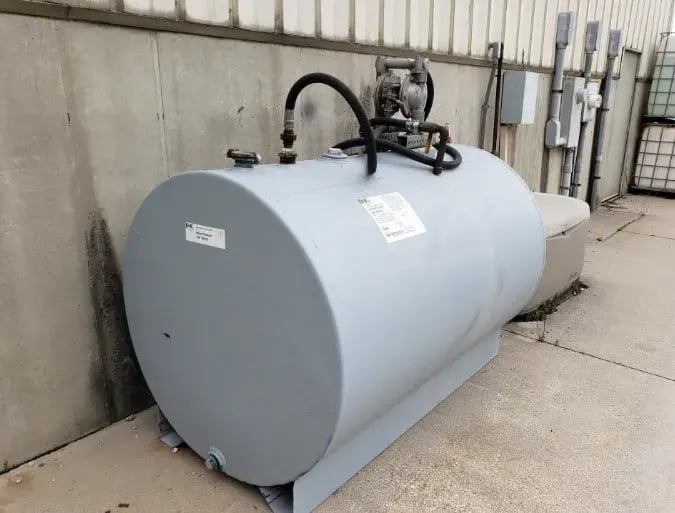
How New Jersey Businesses Can Tell If Their Diesel, Hydraulic Oil, Drums, and Generators Add Up to a Federal Oil Spill Plan Requirement
If your business keeps diesel for a generator, a few drums of hydraulic oil, a tote of used oil waiting for pickup, or a bin of used fryer oil out back, a federal oil spill rule may apply to you, and most business owners have never heard of it. Here's the short answer: if your site can hold more than 1,320 gallons of oil aboveground, counting only containers of 55 gallons or more, or more than 42,000 gallons in buried tanks, and a spill could reasonably flow into a creek, river, wetland, or a storm drain that leads to one, you need a written oil spill plan. Most businesses that cross that line don't know it, because nobody added up the small stuff.
Below, we walk through that test in plain terms: what counts as "oil," how EPA counts your storage, the containers people forget, the "could it reach water" question, and what New Jersey adds on top. There's also a sample tally you can copy for your own site. If you'd rather have someone do the math with you, reach out to RMA, and we'll tell you straight whether you need a plan.
Table of Contents
TL;DR
You need a federal oil spill plan if your site can hold more than 1,320 gallons of oil aboveground or more than 42,000 gallons in buried tanks, and a spill could reasonably reach a waterway or a storm drain that leads to one. You count the full size of every container 55 gallons or bigger, even if it's half empty, and "oil" includes diesel, hydraulic oil, lube oil, used oil, transformer oil, and cooking oil. Generator tanks, drums, totes, and oil-filled equipment are what usually push businesses over the line without them noticing. New Jersey adds its own spill reporting, tank, and discharge prevention rules on top, but the federal count is where to start.
What Is a Federal Oil Spill Plan, or SPCC Plan?
The plan is called a Spill Prevention, Control, and Countermeasure Plan, or SPCC Plan. It comes from the federal Clean Water Act, and the rule lives at 40 CFR Part 112. In plain words, it's a written plan for one site that lays out where you keep oil, how you keep it from leaking, what catches a leak before it leaves the property, who inspects what, and what your people do if something spills. It isn't a permit, and you don't send it in for approval. You keep it on site and follow it.
In New Jersey, the federal agency that inspects and enforces SPCC is EPA Region 2. NJDEP, the state environmental agency, runs New Jersey's own spill and tank programs, which we'll get to later. Our articles on what an SPCC Plan is and who enforces SPCC Plans cover both in more depth.
The rule has two triggers, and a site needs both. One is how much oil the site can store. The other is whether a spill could reasonably reach waterways, which in practice includes the storm drains and ditches that feed them. In a state as wet and built up as New Jersey, the second trigger rarely gets anyone off the hook, so most of this article is about the first.
What Counts as Oil Under the SPCC Rule?
The word "oil" makes people picture a fuel tank. The federal definition is much wider. It covers oil "of any kind or in any form," and the regulation spells out that this includes petroleum and fuel oil, synthetic oils, mineral oils, sludge, oil mixed with waste, and also animal fats and vegetable oils. So diesel counts, gasoline counts, and so do hydraulic fluid, motor oil, gear oil, lube oil, cutting and machining oils, transformer oil, used oil, and the soybean or canola oil in a restaurant or food plant.
That last one surprises a lot of food and beverage businesses. A bakery, a fry operation, or a snack plant can hit the threshold on cooking oil alone. We wrote a separate piece on whether cooking oil and used cooking oil need an SPCC Plan if that's your world. Used oil is the other one that sneaks up on people, because it piles up in drums and totes waiting for a hauler, and every one of those containers counts.
Propane and other liquefied gases aren't oil under this rule, and neither is natural gas. A few products, like some coolants and water-based fluids, are judgment calls worth checking against the safety data sheet. When in doubt, count it.
How the SPCC 1,320-Gallon Oil Storage Threshold Works
The aboveground threshold is "more than 1,320 U.S. gallons" of aggregate aboveground storage capacity. Three words in there do most of the work. "Aggregate" means you add up everything on the site. "Capacity" means the size of the container, not how much is in it today. A 275-gallon tote counts as 275 gallons whether it's full, half full, or down to a puddle. And "aboveground" covers some tanks you might not expect: partially buried tanks, bunkered tanks, and tanks sitting in vaults are all treated as aboveground storage.
The other rule that changes everything is the 55-gallon cutoff. Containers smaller than 55 gallons are left out of the count entirely. A shelf full of 5-gallon pails doesn't count. A 55-gallon drum does, and a site with 25 drums of various oils is already at 1,375 gallons and over the line on drums alone. Our article on whether 55-gallon drums are included in SPCC Plans goes into that in more detail.
Here's how the main counting rules line up:
| Item |
Counts Toward the Threshold? |
| Any aboveground oil container 55 gallons or larger |
Yes, at full shell capacity |
| Containers under 55 gallons (pails, quart bottles, 30-gallon drums) |
No |
| Oil-filled equipment 55 gallons or larger (transformers, hydraulic systems, gearboxes) |
Yes |
| Empty containers that aren't formally "permanently closed" |
Yes |
| Fuel tanks that power a vehicle or forklift (motive power containers) |
No |
| Partially buried, bunkered, or vaulted tanks |
Yes, as aboveground storage |
| Milk and milk product containers |
No |
| Propane and other liquefied gases |
No, not oil |
"Permanently closed" has a specific meaning: the container is emptied of liquid and sludge, its lines are disconnected and blanked off, its valves are closed and locked, and a sign on it states the closure date. That unused tank behind the shop is very likely still part of your total.
The 42,000-Gallon Threshold for Buried Tanks
Completely buried storage has its own threshold of more than 42,000 gallons, and most small and mid-sized businesses never get near it. Buried tanks that already meet all the federal underground tank requirements at 40 CFR Part 280, or an EPA-approved state program, are left out of that count. Either way, an underground tank doesn't settle the question. Your aboveground total still has to be under 1,320 gallons.
How to Run Your Own SPCC Oil Storage Tally
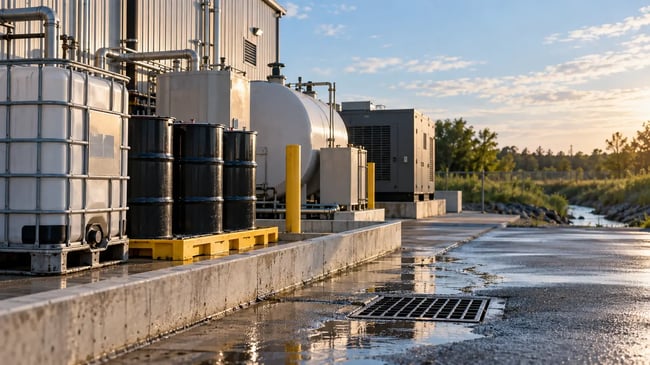
The fastest way to answer the question is to walk your property with a clipboard and write down every container or piece of equipment that holds 55 gallons or more of anything oily. Do each building, then the yard, the roof, and the electrical room, and record the nameplate capacity, not what's inside. A handful of things almost always get missed on the first pass.
Emergency generators are the big one. A generator often sits on a "belly tank" that holds anywhere from a few hundred to a few thousand gallons of diesel, and because it's part of the generator, nobody thinks of it as a tank. Our article on emergency backup generators and environmental permits covers this, and SPCC is usually part of it.
Oil-filled equipment is the second blind spot: transformers you own (not the utility's), hydraulic power units on presses, elevator reservoirs, big gearboxes, and compressors, if they hold 55 gallons or more. Third are "temporary" containers, like drums and totes waiting to be used or waiting for a hauler. Here's a typical tally for a small manufacturing or fleet shop that figured it was nowhere near the line:
| Container or Equipment |
Quantity |
Capacity Each |
Total Counted |
| Emergency generator sub-base diesel tank |
1 |
500 gal |
500 gal |
| Used oil tank in maintenance bay |
1 |
275 gal |
275 gal |
| Hydraulic oil and lube oil drums |
6 |
55 gal |
330 gal |
| Totes of new hydraulic oil |
1 |
275 gal |
275 gal |
| Hydraulic press power unit reservoir |
1 |
120 gal |
120 gal |
| Owner-owned pad-mounted transformer |
1 |
250 gal |
250 gal |
| 5-gallon pails of gear oil |
20 |
5 gal |
0 gal (under 55) |
| Forklift and truck fuel tanks |
8 |
Varies |
0 gal (motive power) |
| Total aboveground capacity |
|
|
1,750 gal |
Nothing on that list is a fuel farm, and the owner would probably say they "don't really store oil." But at 1,750 gallons, the site is well over the threshold, and even without the transformer and press it's at 1,380. If you're close to the line, you may have some control over it. Consolidating drums, permanently closing a tank you don't use, or scheduling used oil pickups more often can sometimes bring a site under 1,320 gallons for good. The change has to be real and lasting, though. Our guide to the four steps to figure out if you need an SPCC Plan walks through this exercise another way.
The SPCC Test for Whether a Spill Could Reach Water
The second half of the test asks whether, because of its location, a site could reasonably be expected to spill oil into navigable waters or onto adjoining shorelines. You make that call in good faith based on the real geography. Is there a stream, pond, wetland, or tidal marsh nearby? Where do your parking lot catch basins discharge? Is there a ditch along the property line? Distance, slope, soil, and rainfall all matter.
One rule catches people off guard. You can't count manmade structures like berms, dikes, curbs, or containment walls when you decide whether oil could reach water. EPA expects you to judge the site as if they weren't there, because the plan is what requires and maintains them. "We have a dike around the tank" isn't a reason to skip the plan.
In New Jersey, this test rarely saves anyone. The state is laced with rivers, tidal creeks, wetlands, and storm sewers that empty into them, and nearly every developed industrial or commercial property has a storm drain within reach of a spill. If you're over the gallon threshold and want to claim a spill couldn't reach water, have someone qualified look at it and keep the reasoning in writing. And if oil ever does reach water, federal reporting rules apply, which we explain in our piece on when you have to report an oil spill.
New Jersey Oil Spill Rules on Top of the Federal SPCC Rule
The SPCC count works the same way in Newark as it does in Nebraska. New Jersey adds its own layer, though, and it's stricter than most states. A site under the federal line can still have state obligations, and a site over it almost always has a few.
The biggest piece is the Spill Compensation and Control Act, or Spill Act. It makes discharges of petroleum and other hazardous substances in New Jersey reportable, and it holds those responsible for a discharge liable for cleanup. That liability is generally described as strict, joint, and several, meaning it doesn't depend on fault and can fall on more than one party. How it applies to a specific situation is a question for an environmental attorney. Discharges are reported to the NJDEP Action Hotline at 1-877-WARNDEP (1-877-927-6337), and New Jersey expects a prompt call, not a report filed weeks later.
Larger sites that meet the state's definition of a "major facility" under N.J.A.C. 7:1E also need a Discharge Prevention, Containment and Countermeasure (DPCC) plan and a Discharge Cleanup and Removal (DCR) plan, New Jersey's own prevention and response plans. The major facility thresholds are set at storage volumes far above the federal SPCC line, so most small and mid-sized businesses aren't major facilities, while bulk fuel terminals and large manufacturers often are.
Underground tanks fall under NJDEP's UST program at N.J.A.C. 7:14B, which covers registration, leak detection, and closure and requires NJDEP-certified contractors for installation and removal. Some tanks, including certain heating oil tanks, are treated differently, so it's worth confirming where yours fit. Aboveground tanks also have to meet the Uniform Fire Code, enforced by your local fire official. Our article on SPCC Plans in New Jersey covers how these pieces fit together.
What to Do If Your Oil Storage Tally Says You Need an SPCC Plan
If your count is over 1,320 gallons and a spill could reach water, you need a written SPCC Plan, and it should have been in place before the site started operating. It has to be implemented, not just written: secondary containment, inspections, employee training, and spill procedures that match the paper. It has to be reviewed at least every five years and amended when container changes affect spill potential.
Not every plan needs a Professional Engineer's stamp. A Tier I qualified facility has 10,000 gallons or less of aboveground capacity, no single aboveground container over 5,000 gallons, and a clean spill history (no single discharge to water over 1,000 gallons and no two over 42 gallons each in any 12-month period in the past three years). A Tier II qualified facility meets the same capacity and spill test but has a container over 5,000 gallons. Both can self-certify. Bigger sites need a PE-certified plan. Our guide to the different types of SPCC Plans breaks this down, and a small Tier I site can often use EPA's template without hiring anyone.
Skipping the plan isn't a cheap option. EPA can assess administrative penalties for SPCC violations of up to $23,647 per violation per day, capped at $295,564 per case, under the inflation-adjusted figures in 40 CFR Part 19, which EPA updates each year, and larger penalties are possible in court. Our breakdown of the top SPCC Plan violations and fines shows what inspectors flag most often.
Having a consultant prepare an SPCC Plan generally runs about $2,500 for a simple site up to $15,000 for a large or complicated one, depending on the number of containers, whether a PE has to certify it, and how much containment work is involved. You can estimate what it would cost for RMA to help with your plan using the pricing calculator below, and our article on SPCC Plan costs explains what drives the number.
How RMA Helps New Jersey Businesses Figure Out Their SPCC Requirements
We're a family-run environmental consulting firm based in New Jersey, and we've helped facilities sort out oil storage questions since 1992. Much of our SPCC work starts where this article does, with someone who isn't sure they're over the line. We'll count your containers the way EPA does, look at where a spill would go, and tell you whether you need a plan. If you don't, we'll say so.
If you do need one, our senior staff write it themselves, without AI. We prepare new plans, update old ones, handle five-year reviews, and help with inspections and training, including our online environmental training library. Being in New Jersey, we also know how the federal rule lines up with the Spill Act and NJDEP's programs.
There's no pressure and no obligation. Call us, send an email, or fill out the form on our website, and we'll talk through your site. Whenever you're ready, reach out to RMA.