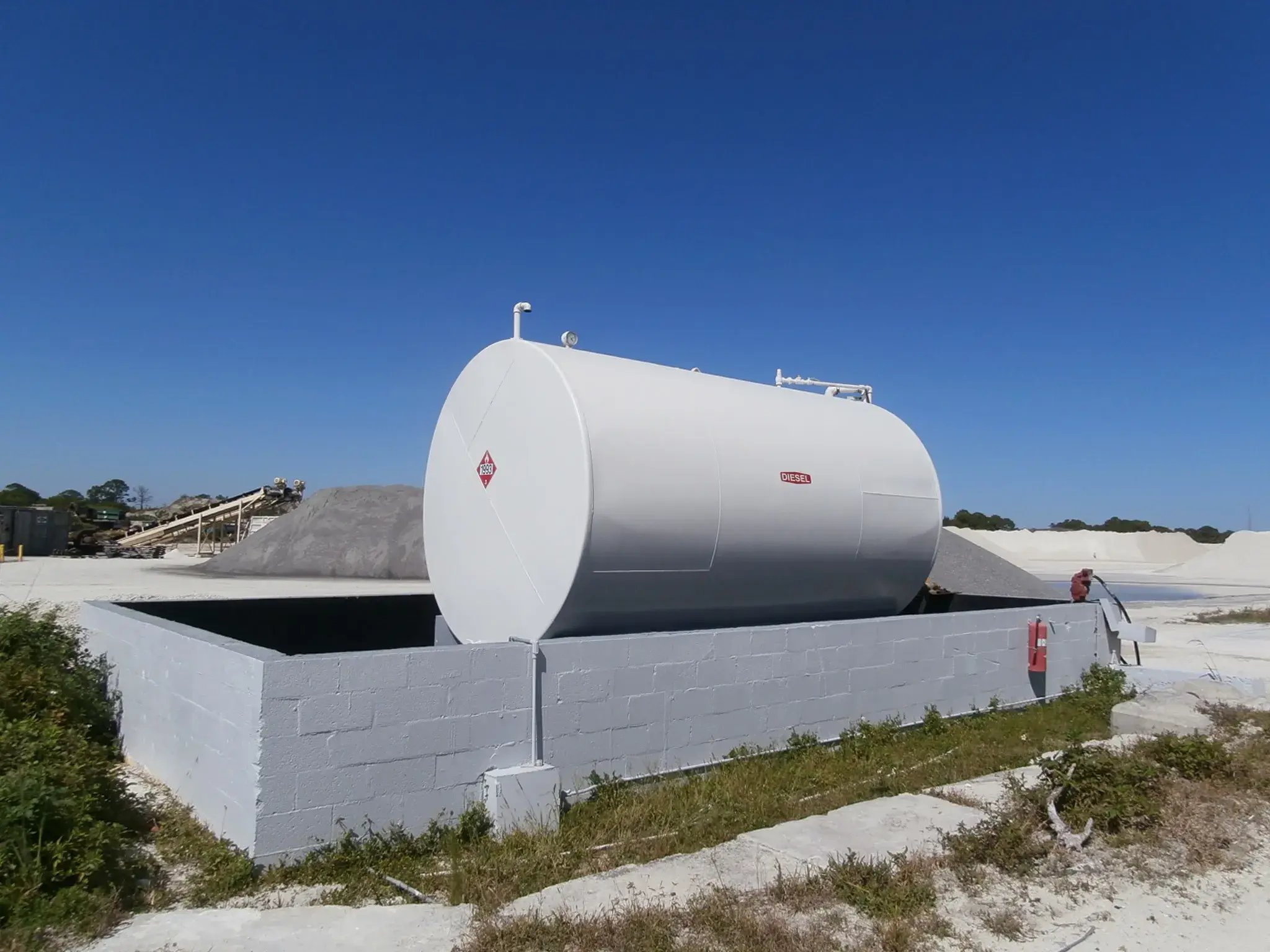
How Pennsylvania Businesses Can Tally Diesel Tanks, Drums, Totes, Transformers, and Cooking Oil Against the Federal 1,320-Gallon SPCC Threshold
If your business keeps a diesel tank for equipment, a few drums of hydraulic oil in the shop, a tote of used oil out back, or a grease bin behind the kitchen, there's a federal rule you may never have heard of that could apply to you. It requires certain businesses to keep a written oil spill plan, and most owners we talk to only find out about it when an inspector, an insurance carrier, or a buyer's due diligence team asks to see one. Here's the short answer to the question: you need a federal oil spill plan if your site has more than 1,320 gallons of aboveground oil storage capacity (counting only containers that hold 55 gallons or more), or more than 42,000 gallons of buried capacity, and a spill could reasonably reach a creek, river, or a storm drain that leads to one.
The details are where people get tripped up. Capacity counts instead of what's in the tank, some oils people don't think of as oil count, and equipment nobody calls a "tank" can push a site over the line. Below, we'll walk through what counts, show a sample tally, and cover how Pennsylvania's own tank rules sit on top of the federal requirement. If you'd rather have someone run the numbers with you, feel free to reach out to RMA and we'll help you figure out where you stand.
Table of Contents
TL;DR
A Pennsylvania business needs a federal oil spill plan if it has more than 1,320 gallons of aboveground oil storage capacity, counting only containers of 55 gallons or more, or more than 42,000 gallons buried, and a spill could reasonably reach a waterway or a storm drain that leads to one. You count the size of every tank, drum, tote, and piece of oil-filled equipment, even if it's empty, and cooking oil counts while propane and DEF don't. Pennsylvania has its own tank rules too, but this federal test is the first one to check.
What Is a Federal Oil Spill Plan, and Who Enforces It in Pennsylvania?
The federal oil spill plan is formally called a Spill Prevention, Control, and Countermeasure Plan, or SPCC Plan for short. It's a written plan that describes the oil your site stores, how you keep it from leaking, how you'd contain a spill, and how you'd clean one up. The requirement comes from the federal Clean Water Act and is written into the regulations at 40 CFR Part 112. If you want a deeper primer on what goes inside the document, our guide on what an SPCC Plan is covers it.
Two things surprise most business owners. First, this isn't a permit. You don't apply for it, you don't file it with anyone, and nobody sends you a reminder. You write it, follow it, and keep it on site. Second, it isn't enforced by Pennsylvania's Department of Environmental Protection (DEP). The U.S. EPA enforces it through its Region 3 office in Philadelphia, and EPA usually finds out a site lacks a plan during an inspection or after a spill. Our article on who enforces SPCC Plans goes into how federal and state roles split.
What Counts as Oil Under the Federal Spill Plan Rule?
The rule's definition of oil covers petroleum products of every kind, plus animal fats and vegetable oils. A restaurant's fryer oil or a food plant's tallow counts the same way diesel does.
| Material |
Counts Toward the Threshold? |
Notes |
| Diesel, gasoline, kerosene, heating oil |
Yes |
The obvious ones, including generator fuel |
| Hydraulic, lube, motor, and gear oil |
Yes |
Both stored product and oil inside equipment |
| Used oil |
Yes |
Used oil tanks and drums count like new oil |
| Transformer (dielectric) oil |
Yes |
Counts if you own the transformer |
| Cooking oil, fryer grease, animal fats |
Yes |
Animal fats and vegetable oils are regulated oils |
| Propane |
No |
Stored as a pressurized gas, not covered |
| Diesel exhaust fluid (DEF) |
No |
It's urea and water, not oil |
| Milk and milk products |
No |
Specifically exempted from the rule |
Cooking oil catches restaurants and food processors off guard most often, and we cover it in Do I Need an SPCC Plan for Cooking Oil or Used Cooking Oil? Used oil also has its own handling rules separate from the spill plan, which we summarize in our top things to know about used oil regulations.
How Does the 1,320-Gallon Oil Storage Threshold Work?
The aboveground threshold is more than 1,320 gallons of total oil storage capacity. The most common mistake we see is adding up how much oil is on hand. You add up the shell capacity of every container, whether it's full, half full, or sitting empty waiting for the next delivery. A 1,000-gallon diesel tank that you only ever fill to 600 gallons is a 1,000-gallon tank for this purpose.
Only containers that hold 55 gallons or more go into the tally. Five-gallon pails and 30-gallon drums don't count, no matter how many you have. A standard drum is 55 gallons, and the common totes hold 275 or 330 gallons. Our article on whether 55-gallon drums are included in SPCC Plans walks through the drum question specifically.
What Comes Off the Oil Storage Tally
A few things are excluded. Containers that are permanently closed don't count, but that has a specific meaning in the rule: the tank has been emptied of liquid and sludge, its lines and valves are disconnected or blanked off and locked, and it carries a sign saying it's permanently closed. A tank that's simply empty and waiting still counts. Fuel tanks that power a vehicle or a piece of mobile equipment (motive power containers, like the saddle tanks on a truck or the fuel tank on an excavator) are also exempt. Fuel trailers, skid tanks, and mobile refuelers aren't motive power, so they count.
The 42,000-Gallon Buried Oil Storage Threshold
The second trigger is more than 42,000 gallons of completely buried capacity. It rarely decides things for a typical business, because buried tanks fully covered by the federal underground storage tank rules (40 CFR Parts 280 and 281) are excluded from the count. Partially buried tanks and tanks in vaults are treated as aboveground.
Which Oil Containers Do Businesses Forget to Count?
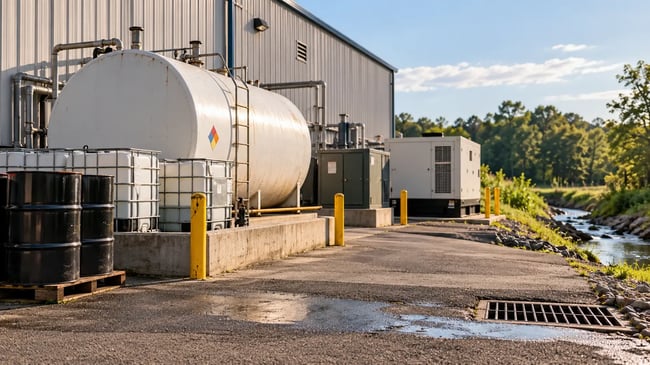
When we walk a site with an owner, the main diesel tank is always on their list. The things that push them over 1,320 gallons usually aren't, because oil-filled equipment counts toward capacity too. These are the items that most often get missed.
| Commonly Missed Item |
Typical Size |
| Emergency generator base (belly) tank |
Varies widely by unit |
| Drums of hydraulic, lube, or motor oil |
55 gallons each |
| Totes (IBCs) |
275 or 330 gallons |
| Owner-owned transformers |
Varies by unit |
| Hydraulic presses, lifts, and elevators |
Reservoirs of 55 gallons or more |
| Used oil tanks and drums |
55 to several hundred gallons |
| Used cooking oil and grease containers |
Often 150 to 300 gallons |
| Fuel trailers and skid tanks |
Often 100 to 1,000 gallons |
The utility's transformer on the pole isn't yours to count, but pad-mounted transformers you own on your side of the meter are. If you're adding backup power, our article on emergency backup generators and environmental permits covers the spill plan question along with the other rules a generator can bring.
What Does an Oil Storage Tally Look Like for a Typical Business?
Picture a small equipment rental and repair yard along the Susquehanna. Nobody there would call it an oil storage facility. Here's its tally.
| Container |
Capacity |
Counted? |
| Aboveground diesel tank (usually half full) |
1,000 gal |
Yes, 1,000 gal |
| Four drums of hydraulic and motor oil |
4 x 55 gal |
Yes, 220 gal |
| Used oil tote |
275 gal |
Yes, 275 gal |
| Backup generator belly tank |
150 gal |
Yes, 150 gal |
| Twelve 5-gallon pails of gear oil |
60 gal total |
No, each is under 55 gal |
| Fuel tanks on service trucks |
Various |
No, motive power |
| Total counted capacity |
|
1,645 gal |
This yard is over the threshold even though its main tank alone is under 1,320 gallons. The drums, tote, and generator made the difference. Now flip it around. A small machine shop with a 500-gallon heating oil tank, three drums of cutting and hydraulic oil (165 gallons), and one 275-gallon used oil tote comes to 940 gallons. That shop is under the line today. If it adds a second tote and a mid-size generator next year, it may not be.
So the tally isn't a one-time exercise. Write it down, date it, and redo it any time you add a tank, a generator, or new hydraulic equipment.
Could an Oil Spill at Your Business Reach a Creek, River, or Storm Drain?
Capacity is only half of the test. The rule applies when a site over the threshold could also reasonably be expected to discharge oil to navigable waters or shorelines. In plain terms, if a tank failed, could the oil end up in a creek, a river, a pond, a wetland, or a drainage ditch, storm sewer, or culvert that carries it to one?
For most Pennsylvania businesses, the answer is yes. The state is laced with streams that feed the Delaware, Susquehanna, Allegheny, Monongahela, and Ohio rivers, and almost every commercial property has a parking lot drain, a swale, or a roadside ditch heading somewhere. A spill doesn't need a creek next door. It just needs a path.
When you decide whether a spill could reach water, you can't give yourself credit for manmade structures like berms, containment walls, curbs, or dikes. Containment is part of what the plan requires, so it can't also be the reason you don't need one. If you conclude a spill couldn't reach water, write down why. Our four steps to figure out if you need an SPCC Plan lays the full decision out in order.
How Do Pennsylvania's Storage Tank Rules Fit With the Federal Oil Spill Plan?
Pennsylvania adds its own layer, and its history explains why. In January 1988, a large diesel tank collapsed at an Ashland Oil terminal in Floreffe, near Pittsburgh, releasing millions of gallons of fuel and sending a large amount of it into the Monongahela River. The state responded with the Storage Tank and Spill Prevention Act, and today DEP runs a storage tank program under 25 Pa. Code Chapter 245.
That program has its own triggers. Depending on tank size and contents, it can require registering aboveground tanks with DEP, using DEP-certified installers and inspectors for certain work, and, at facilities with larger aboveground storage, preparing a state Spill Prevention Response Plan (SPRP). Underground tanks have their own state rules and an insurance fund (the USTIF), and facilities with certain DEP permits may also need a Preparedness, Prevention, and Contingency (PPC) Plan.
The two systems don't substitute for each other. Registering a tank with DEP doesn't satisfy EPA, and an SPCC Plan doesn't register your tanks. Start with the federal tally, then confirm the state pieces with the DEP regional office for your county.
What Happens If Your Business Is Over the Oil Storage Threshold?
If you cross 1,320 gallons and a spill could reach water, you need a written SPCC Plan, and you have to follow it, including secondary containment around tanks and drums, regular inspections, oil spill training for the people who handle oil, and a review of the plan at least once every five years. The type of plan you need depends on how much oil you store and your spill history.
| Plan Type |
Who Qualifies |
Who Certifies It |
| Tier I qualified facility |
10,000 gallons or less aboveground, no single container over 5,000 gallons, and a clean recent spill history |
The owner, using EPA's Tier I template |
| Tier II qualified facility |
10,000 gallons or less aboveground with a clean spill history, but at least one container over 5,000 gallons |
The owner, following the full rule |
| PE-certified plan |
More than 10,000 gallons aboveground, or a recent reportable spill history |
A licensed Professional Engineer |
The "clean spill history" piece means no single discharge over 1,000 gallons, and no two discharges over 42 gallons each within any 12-month period, in the three years before you certify. Our article on the different types of SPCC Plans compares the options side by side, and our guide to SPCC five-year reviews explains what the review involves. For training, our online environmental training library has self-paced courses.
Skipping the plan is expensive. Under the current federal inflation adjustments in 40 CFR Part 19, EPA can seek administrative penalties of up to $23,647 per violation, capped at $59,114 for a smaller (Class I) case, or up to $23,647 per day, capped at $295,564, for a larger (Class II) case. In court, it's up to $59,114 per day. Our breakdown of top SPCC Plan violations and fines shows what inspectors cite most. If you're already dealing with an EPA inspection finding or information request, it's worth talking with an environmental attorney as well.
What Does a Federal Oil Spill Plan Cost a Pennsylvania Business?
If you qualify as a Tier I facility, you may not need a consultant at all, since EPA publishes a fill-in template many small businesses complete themselves. Our article on Tier I self-certified SPCC Plans explains whether that route fits. When outside help does make sense, the plans we prepare generally run from $2,500 to $15,000, depending on the size of the site and whether a Professional Engineer has to certify it. Updates to an existing plan run about $1,500 for a simple Tier I plan and $7,500 or more for a complex PE-certified one. Our article on SPCC Plan costs breaks the pricing factors down further.
Containment, integrity testing for larger tanks, and state tank registration fees often cost more than the plan itself. [RMA TO FILL: typical cost ranges for secondary containment construction, tank integrity testing, and PA tank registration fees, or confirmation to leave these unpriced.] If you'd like a rough number for our help with the plan, you can get a quick estimate with the pricing calculator below.
What If Your Oil Storage Is Under the Federal Threshold?
Then you probably don't need a federal oil spill plan, and we'd tell you that directly. Plenty of small businesses we talk to land at a few hundred gallons and have nothing more to do on the federal side. Keep your dated tally on file so you can show an inspector, insurer, or buyer how you got there, and recount whenever you add backup power, a bigger fuel tank, or more totes and drums, since that's how most businesses cross the line. Pennsylvania's tank rules can still apply on their own, and simple habits like spill pallets and absorbent near your drums cost very little either way.
How RMA Helps Pennsylvania Businesses With Oil Storage and Spill Plans
We're a family-run firm based in New Jersey, helping facilities across the country, including many in Pennsylvania, with oil spill plans since 1992, and our senior staff does the work. We can walk through your tally with you, tell you whether you're over the federal threshold, and point out where Pennsylvania's tank program may apply. If you can handle a Tier I template yourself, we'll say so. If you need a full plan, an update, or training, we'll explain what's involved and what it costs up front.
There's no pressure and no obligation. You can call, email, or fill out the form on our website. If you're not sure where your site stands, get in touch with our team and we'll help you sort it out.