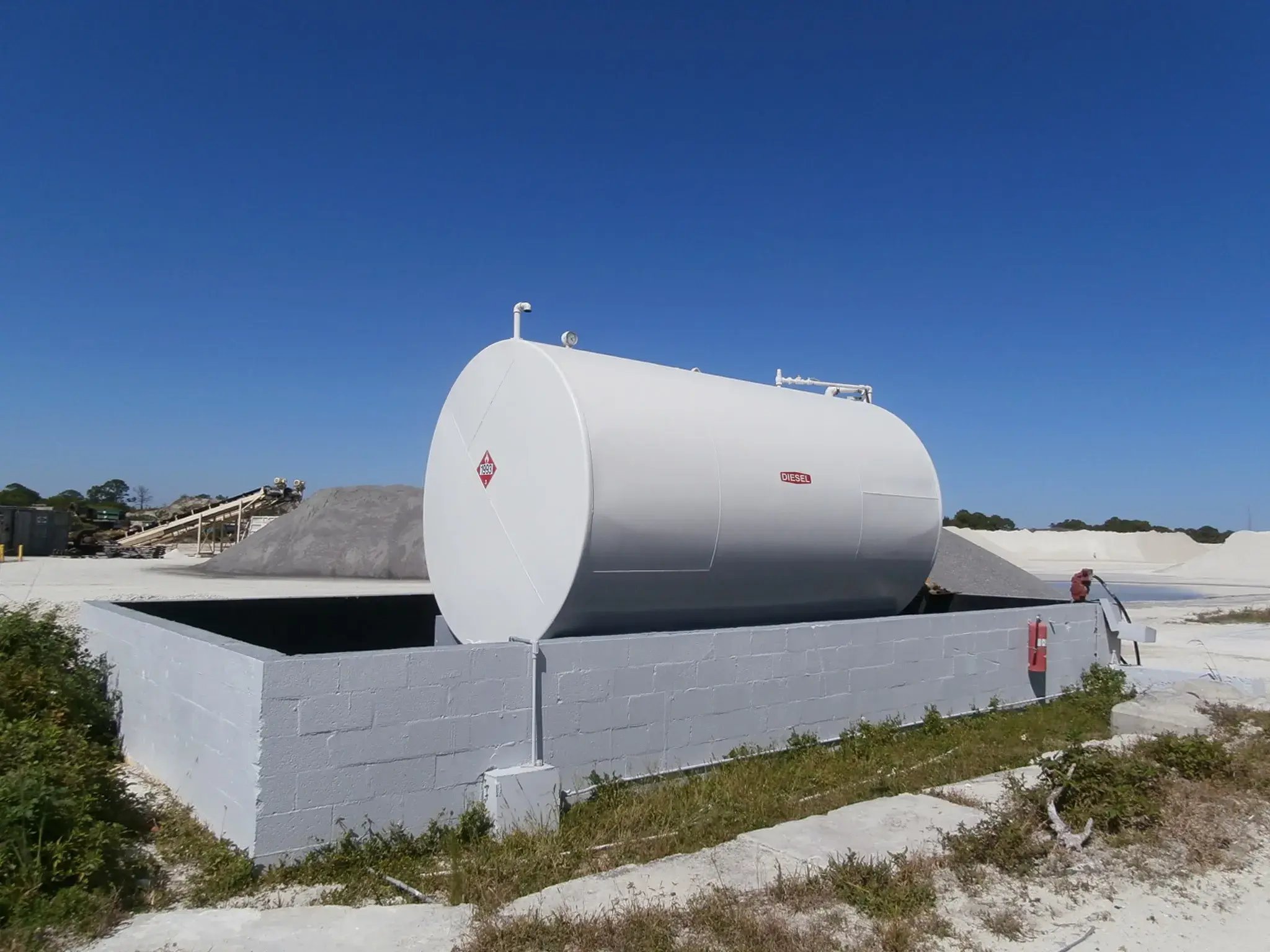
What a Double-Walled Oil Tank Covers Under SPCC and Pennsylvania Tank Rules, and What It Leaves Exposed
A lot of facilities buy a double-walled tank because the salesperson, the installer, or a coworker said it takes care of containment. It's an easy assumption to make. The tank has an outer shell built right in, so there's no dike to build, no concrete to pour, and no rainwater to pump out. If you store enough oil to fall under the federal SPCC rule, which requires a written oil spill plan called an SPCC Plan, the short answer is that a shop-built double-walled tank can satisfy the secondary containment requirement for the tank itself. It doesn't cover the piping, the fill connection, or the area where the delivery truck hooks up, and the space between the two walls needs to be checked and written down.
This article walks through what EPA's guidance says a double-walled tank can and can't do, where the gaps are around the tank, how to monitor the interstitial space, and how Pennsylvania's storage tank rules fit in. We also cover what to check and document so an inspector sees a program and not just a tank. Double-wall containment has enough fine print that it's worth a conversation with someone who has seen how inspectors read it, so if you have a specific tank in mind, feel free to reach out to RMA.
Table of Contents
TL;DR
A shop-built double-walled tank can serve as the secondary containment for the tank itself under the federal SPCC rule, and EPA says it usually doesn't need extra room for rainwater. It doesn't cover the piping, the fill port, the vent, or the delivery area, so those still need their own protection. The space between the walls should be checked on a schedule and the results written down. In Pennsylvania, DEP's tank rules add their own containment and leak monitoring expectations, so confirm how your tank fits before you count on the double wall alone.
Does a Double-Walled Tank Satisfy SPCC Secondary Containment?
The SPCC rule has two layers of containment requirements. The general one, in 40 CFR 112.7(c), says every area with a potential for an oil discharge needs appropriate containment or diversionary structures. The specific one, in 112.8(c)(2), says bulk storage tank installations need secondary containment for the entire capacity of the largest single container, plus enough freeboard to contain precipitation. Dikes, curbs, and pits are the examples the rule names. A double-walled tank isn't on that list, which is why people ask.
EPA addressed it in guidance. A double-walled tank is a tank inside another tank with a gap between them, built to industry standards. The inner tank holds the oil and the outer shell acts as secondary containment. EPA first said so in a 1992 memo limited to tanks under 12,000 gallons, then amended it in 2002 to drop the size cap. Today EPA's inspector guidance says shop-fabricated double-walled aboveground tanks, regardless of size, can generally satisfy both the general requirement and the sized requirement for bulk storage containers. Because the interstitial space isn't exposed to the weather, these tanks typically don't need extra volume for rainfall.
That "generally" comes with conditions. EPA's summary of its memos describes the tank as one that includes these elements:
| Element |
What it means in practice |
| Shop fabricated |
The tank was built in a factory, not constructed in the field. |
| Inner tank is UL-listed steel |
The primary tank carries a recognized listing. |
| Outer tank built to accepted standards |
Examples EPA names include API, STI, and American Concrete Institute standards. |
| Overfill alarm plus automatic flow restrictor or shutoff |
Handles overfills out of the tank vent. EPA also allows active or passive containment for vent overfills instead. |
| Constant monitoring of transfers |
Someone is present and watching every delivery or fill. |
Two more points matter. If the tank has fittings or openings below the liquid level, such as a manway or a bottom connection, it may need additional containment to meet industry standards and local codes. And the Plan itself has to say how the tank complies. A double wall doesn't excuse you from describing it, along with its overfill protection, in the Plan, and a Professional Engineer or the facility owner (for a qualified facility) certifies that those choices follow good engineering practice. For how containment is sized when a dike is the answer instead, our guide on SPCC containment sizing covers the math.
What Does a Double-Walled Tank Not Protect? Piping, Fill Ports, and Transfers
Here's where facilities get caught. The outer wall protects against a failure of the inner tank. Most oil spills at fuel tank installations don't start there. EPA has noted that discharge reports point to valves, piping, and appurtenances as far more common sources than catastrophic tank failure. Transfers are the other big one, because people overfill tanks and hoses come loose. A double wall does nothing for either.
EPA's guidance is direct about this. Any piping, equipment, or device that isn't inside the double-walled tank falls under the general containment requirement in 112.7(c). Transfer areas do too, and so does the loading or unloading rack if you have a rack as the rule defines it. In practice that means walking the tank and listing everything oil touches on its way in and out.
| Part of the system |
Covered by the double wall? |
What to look at |
| Inner tank failure (leak or rupture) |
Yes, if the tank meets the conditions above |
Tank construction, listing, interstitial checks |
| Overfill out of the vent |
No |
Overfill alarm, shutoff or restrictor, or containment under the vent |
| Fill port and delivery hose connection |
No |
Spill bucket or containment at the connection, monitored transfers |
| Piping, valves, and pumps |
No |
Drip pans, curbing, sumps, or other containment, plus regular inspection |
| Truck unloading area |
No |
Containment sized to the most likely failure, drain covers, spill kits |
| Dispenser or fueling point |
No |
Containment at the dispensing area |
For piping and transfer areas, the rule asks for containment that fits the typical failure, not a full tank's worth. That's a more forgiving standard than the one for the tank, and it can be met with active measures like drain covers and spill kits if people can deploy them in time. EPA is cautious about leaning on active measures, though, especially where nobody's on site. We cover the requirements inspectors tend to find missing in our guide to the most overlooked SPCC requirements.
How Should You Monitor the Interstitial Space of a Double-Walled Tank?
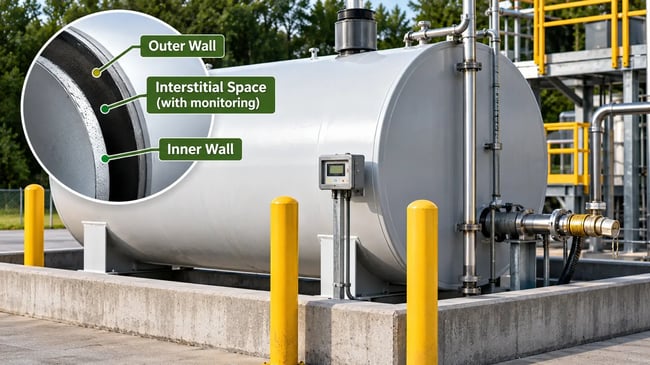
The interstitial space is the gap between the inner tank and the outer shell. If the inner tank leaks, oil collects there first, which is the whole point of the design. It only works as containment if somebody notices.
The federal SPCC rule doesn't spell out a monitoring method for the interstitial space. What it does require, in 112.8(c)(6), is that you test or inspect each aboveground container for integrity on a regular schedule and whenever you make material repairs. You decide the frequency and type of inspection in line with industry standards, taking into account the container's design, and the rule specifically lists double-walled containers as one of the designs to account for. EPA's guidance points to the Steel Tank Institute's SP001 inspection standard as an example of an industry standard, and EPA's guidance ties the exterior inspection duty to the inner tank for double-walled tanks. The practical read is this: check the interstitial space on a set schedule, and follow the manufacturer's instructions for how.
The right method depends on the tank. Some have a gauge or a monitoring port you read by eye. Others have an electronic sensor or an alarm panel that sounds when liquid shows up between the walls. Whichever yours is, write down three things in the Plan: what you check, how often, and who does it. Then keep the records. The rule requires inspection and test records, signed by the supervisor or inspector, to be kept with the Plan for three years, and records you already keep for normal business purposes count. Our list of the top things to do during monthly SPCC inspections is a good starting point for adding the interstitial check to a routine.
If a check finds liquid in the interstitial space, treat it as a possible leak from the inner tank until you know otherwise. Figure out what the liquid is (it may be water that got in through a fitting), stop using the tank if oil is present, and bring in the tank manufacturer or a DEP-certified tank company before you put the tank back into service. Spill reporting is a separate question that depends on whether anything reached the environment, and an environmental attorney can be a sensible call if a release is more than minor.
How Do Pennsylvania Storage Tank Rules Treat Double-Walled Tanks?
Pennsylvania adds a second layer on top of the federal rule. Under the Storage Tank and Spill Prevention Act and 25 Pa. Code Chapter 245, DEP regulates stationary aboveground tanks with a capacity over 250 gallons that store regulated substances, subject to a list of exemptions (heating oil tanks used on the premises where it's stored and certain farm tanks are two examples). Regulated tanks must be registered with DEP and are billed an annual registration fee. Whether your tank is regulated depends on its size, contents, and use, so confirm it against DEP's storage tank program before assuming either way.
For regulated aboveground tanks, the performance standards in Chapter 245 call for a leak monitoring system and a release prevention system. Section 245.542 requires emergency containment structures, like dike fields or curbing, to contain releases from overfills, leaks, and spills. Dike fields have to hold 110% of the capacity of the largest tank in the containment area, and transfers into a tank inside emergency containment have to be watched by designated personnel for the duration of the transfer. The rule also has separate provisions for smaller tanks. How a particular double-walled tank is treated under these sections depends on the tank's design and size, and DEP's views on it, so a double wall that satisfies EPA's SPCC guidance doesn't automatically settle the Pennsylvania question. The two programs ask related but different things.
That's also where DEP-certified installers come in. In Pennsylvania, installing or modifying manufactured aboveground tank systems generally calls for individuals DEP has certified, and a certified company can tell you what your installation has to include. On the federal side, EPA Region 3 enforces SPCC for Pennsylvania facilities, while DEP's regional offices handle the state tank program.
What Should You Check and Document for a Double-Walled Tank?
An inspector looking at a double-walled tank wants to see that you understood what the double wall does and what it doesn't, and that you kept up with it. These are the items worth having in hand, whether your Plan is a self-certified one for a smaller facility or a PE-certified one.
| What to check |
What to document |
| Tank construction: shop built, listing, outer wall standard |
Manufacturer data sheet or nameplate details kept with the Plan, and a description of the tank in the Plan |
| Openings or fittings below the liquid level |
A note on where they are and what extra containment, if any, covers them |
| Overfill protection: alarm and shutoff or restrictor, or containment at the vent |
Which method you use, plus test records for the alarm and any level sensing devices |
| Delivery procedure and constant monitoring of transfers |
A written transfer procedure and the training records for the people who watch deliveries |
| Interstitial space checks |
Method, frequency, who does it, and signed records kept for three years |
| Piping, valves, pumps, fill port, and dispenser |
The containment method for each, and inspection records |
| Integrity testing or inspection of the tank |
The industry standard you follow, the schedule, and the results |
| Pennsylvania registration and DEP requirements, if the tank is regulated |
Registration paperwork, installer certification, and any DEP inspection or testing records |
Training is part of this too. The rule requires oil-handling employees to be trained in operating and maintaining equipment to prevent discharges, and discharge prevention briefings are required at least once a year. The person watching a delivery and the person reading the interstitial gauge both need to know what they're looking for. We keep an online environmental training library for exactly this kind of recurring need, and our piece on annual SPCC training explains what the rule expects.
What Happens to Your SPCC Plan When You Install a Double-Walled Tank?
Adding a tank changes your oil storage, and that can matter even if you've never thought about an SPCC Plan. If the new tank pushes your total aboveground oil storage over the SPCC threshold (more than 1,320 gallons counting only containers of 55 gallons or more), you'll need to prepare an SPCC Plan. If you already have one, the rule says to amend it when a change to your facility's design, construction, operation, or maintenance materially affects the potential for a discharge, and adding or moving a container is one of the examples. The amendment has to be prepared within six months of the change and put into effect no later than six months after that, and a Professional Engineer has to certify technical amendments unless you're a qualified facility that self-certifies. We cover the details in when to update your SPCC Plan, and if a PE is needed, how PE certification works is worth a read. RMA doesn't have a PE on staff. When a plan needs one, we handle the site visit and plan development and work with an outside Professional Engineer who reviews, stamps, and seals it.
The installation itself is construction-phase work, and that's outside what RMA does. Choosing and installing the tank, the foundation, building and fire permits, and any DEP-certified installer requirements are things you'll work out with your engineer, contractor, and the tank company. Local fire code requirements for tanks vary by municipality, so check with your local fire official too. If construction stormwater or erosion and sediment control comes into the project, that's another piece for your engineer or an erosion control specialist. What happens once the tank is running is where we come in: the SPCC Plan or amendment, the inspection and testing program, training, and, when it applies, Tier II reporting for the product you store.
How Can RMA Help With Double-Walled Tank Containment?
If you already have a double-walled tank, or you're about to buy one, we can look at how it fits into your oil spill plan: what the double wall covers, what still needs containment, how the interstitial checks should be written up, and what Pennsylvania adds on top. For facilities that need a new plan, our Tier I SPCC plans typically run about $1,500 to $4,000, and overall SPCC pricing runs from about $1,500 to $15,000 depending on the number and size of containers and whether a PE needs to certify the plan. Initial SPCC training is free with a new RMA plan. We generally don't update another firm's plan and usually rebuild from scratch, which we'd rather say up front.
There's no obligation in a first conversation, and if you only need to ask a question, that's fine. You can call us, email, or fill out the form on our site, and you can contact RMA here to talk through your tank and your Plan.