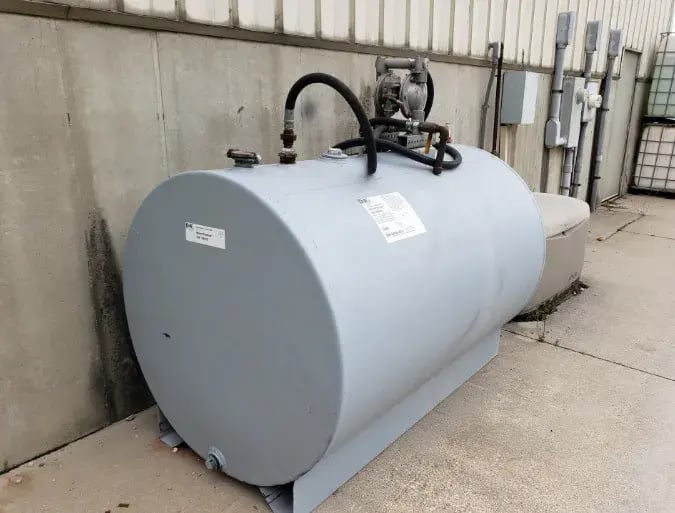
Adding Oil Storage, Equipment, or Transfer Areas? Plan Your SPCC Plan Amendment Before You Build
You're adding a second diesel tank for a new generator, a room full of oil totes, a transformer yard, or a bigger fueling area, and somebody asks whether your Spill Prevention, Control, and Countermeasure (SPCC) Plan needs to change. An SPCC Plan is the federal oil spill prevention plan required for facilities with more than 1,320 gallons of aboveground oil storage, and the answer is almost always yes. Expansions are where plans go stale, because tanks and equipment get added by people who are thinking about production, not oil storage rules.
New Jersey adds its own layer on top of the federal rule, including state discharge prevention plans for larger facilities, underground tank rules, and permits from your local fire official. This article walks through how to count new oil storage capacity, build containment into the project, check your plan tier and facility response plan thresholds, schedule the amendment and engineer certification, and line up the state and local pieces. If you'd rather talk through your own project, you can reach out to RMA at any point.
Table of Contents
TL;DR
Yes, adding tanks, oil-filled equipment, or transfer areas to a New Jersey facility almost always means amending your SPCC Plan, and a licensed Professional Engineer usually has to certify the change. Recount your total oil storage before the design is locked, build secondary containment into the project, and check whether you've crossed a plan tier line, a facility response plan threshold, or New Jersey's major facility threshold. Line up the engineer, the state notice if it applies, and your local fire official early, and don't treat the six-month amendment window as permission to build first.
Does Adding Oil Storage Trigger an SPCC Plan Amendment?
The federal SPCC rule at 40 CFR 112.5(a) requires you to amend your plan whenever there's a change in facility design, construction, operation, or maintenance that materially affects your potential for an oil discharge. You have six months from the change to prepare the amendment, and then up to six months after that to implement it. EPA Region 2 enforces the federal rule in New Jersey, and a plan that doesn't match what's on the ground is exactly the kind of gap an inspector looks for.
Most expansions meet that test. The table below shows how common project changes usually play out.
| Project change |
Likely effect on your SPCC Plan |
| New aboveground tank, tote area, or drum storage |
Technical amendment. Recount total capacity and add containment details. |
| Generator with a base tank or day tank |
Technical amendment. New container, new fuel transfer, new containment. |
| New transformers, hydraulic systems, or other oil-filled equipment |
Counts toward capacity. Amend the plan and the containment analysis. |
| New or relocated truck loading or unloading area |
Technical amendment. Containment and transfer procedures change. |
| Moving, rebuilding, or altering existing containment |
Technical amendment, because the containment calculations change. |
| New contact person or phone number |
Administrative change. Update the plan, but no engineer certification is needed. |
The six-month window covers the paperwork. It doesn't excuse a tank that's filled and running without proper containment, so the practical approach is to treat the amendment as part of the project schedule, not a cleanup task for later. We cover the details of what counts as an update in our article on whether you can get your SPCC Plan updated, and our guide on when to update your SPCC Plan covers the do-it-yourself question.
How Do You Count New Oil Storage Capacity Toward Your SPCC Totals?
SPCC counts capacity, not contents. A 5,000 gallon tank that's usually kept half full counts as 5,000 gallons. The federal threshold is more than 1,320 gallons of aggregate aboveground oil storage, and you add up every container of 55 gallons or more. That includes drums, totes, bulk tanks, used oil tanks, generator base tanks and day tanks, and oil-filled equipment like transformers, hydraulic systems, and compressors. Vegetable oils and animal fats count too. Propane doesn't, and completely buried tanks that are subject to the federal underground tank regulations are left out of the SPCC count.
Take a facility with about 1,000 gallons aboveground that has never needed a plan. Add a 500 gallon generator tank and it's at 1,500 gallons, which means a complete SPCC Plan, not an amendment. Backup generators are a common way small facilities cross the threshold, and our article on emergency backup generators and environmental permits explains the other approvals that often come along with them.
If you already have a plan, run the new total before the design is locked, not after the equipment is on order. For drums specifically, see our answer on whether 55-gallon drums are included in SPCC plans. The new total drives the plan tier, the engineer certification question, the facility response plan screening, and New Jersey's major facility screening.
Will Your Expansion Change Your SPCC Plan Tier or Require PE Certification?
The federal rule gives smaller facilities a way to skip engineer certification. A facility is a qualified facility if it has 10,000 gallons or less of aggregate aboveground oil storage and a clean spill history for the past three years, meaning no single discharge over 1,000 gallons and no two discharges over 42 gallons each within any 12-month period. A qualified facility with no single container over 5,000 gallons is Tier I and can self-certify using EPA's template. A qualified facility with any container over 5,000 gallons is Tier II and can self-certify a fuller plan. Everyone else needs a plan reviewed and certified by a licensed Professional Engineer (PE).
Expansions push facilities across these lines all the time. Add one 6,000 gallon tank to a Tier I facility and, as long as total storage stays at 10,000 gallons or less, you've moved to Tier II. Take total storage past 10,000 gallons and the plan has to be PE-certified, and you have six months to get there. For facilities that already have a PE-certified plan, technical amendments have to be PE-certified too. That means your expansion schedule needs a spot for the engineer's review and, in most cases, a site visit.
Don't Confuse SPCC Tiers With EPCRA Tier II Reporting
The Tier I and Tier II names in SPCC have nothing to do with Tier II chemical inventory reporting under Community Right to Know. They're separate programs with separate thresholds. An expansion that adds oil or chemical storage can change both, so check each one on its own. Our explainers on the different types of SPCC Plans and how Professional Engineers fit into SPCC requirements go deeper on both.
How Should You Design SPCC Secondary Containment Into the Expansion Project?
Secondary containment is cheapest to get right on paper and most expensive to fix after the concrete is poured. For bulk storage tanks, the rule calls for containment that holds the entire capacity of the largest single container plus enough extra room for precipitation. The rule doesn't set a percentage for that extra room, so the number comes from your site conditions and your engineer's judgment,. If several tanks share one containment area, the area is sized for the biggest tank in it, not the total.
Tank trucks and transfer areas have their own requirement. Where trucks load or unload oil, the containment has to handle the largest compartment of the largest truck that uses the area. Generators and other oil-filled equipment need containment or another approved prevention method, and you'll want to settle which one before the equipment is set. Give your design team the SPCC requirements at the start of the project so they can size the dike, pick the tank type, place the overfill protection, and plan how rainwater gets out of the containment without carrying oil with it. Our guide on how big your SPCC oil spill containment needs to be walks through the sizing math.
If your site can't physically fit full containment, the rule allows limited alternatives, but they require a PE's certification and a written explanation in the plan. Raise that early with your engineer, because discovering it during final inspection is expensive.
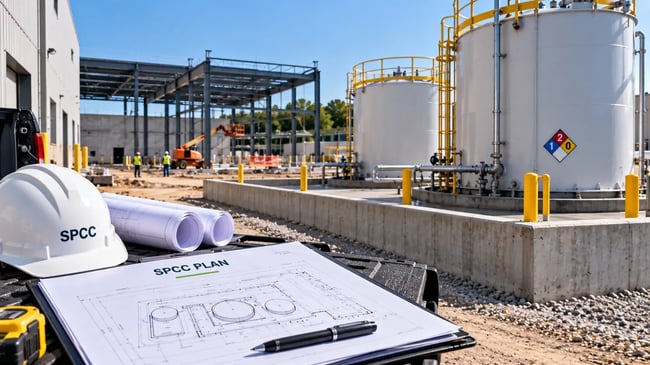
Could Your Expansion Trigger a Facility Response Plan?
A facility response plan (FRP) is a much bigger document than an SPCC Plan. It covers worst-case discharge planning, response equipment, trained response personnel, and drills, and it goes to EPA. Most expansions never get near it, but growth at a terminal, a marine facility, or a large bulk storage site can. A facility is a substantial harm facility, and needs an FRP, if it meets either of these federal criteria:
| Federal screening threshold |
What it triggers |
| Total oil storage of 42,000 gallons or more, with oil transfers over water to or from vessels |
Substantial harm facility. An FRP is required. |
| Total oil storage of 1 million gallons or more, plus any one of several other factors: no adequate secondary containment, a reportable discharge of 10,000 gallons or more in the past five years, or a location where a spill could shut down a public drinking water intake or harm sensitive environments |
Substantial harm facility. An FRP is required. |
Even if you don't meet the criteria, EPA's Regional Administrator can decide a facility poses substantial harm, and facilities that don't meet the criteria are expected to document that conclusion on the federal substantial harm certification form and keep it with the SPCC Plan. Marine transfers can also bring in other agencies, including the Coast Guard. If your expansion touches over-water transfers or takes you toward the larger capacity range, screen it early, because an FRP is a different project with a different timeline.
How Do New Jersey's Major Facility and DPCC/DCR Rules Apply to an Expansion?
New Jersey's Spill Compensation and Control Act (the Spill Act) and its discharge rules at N.J.A.C. 7:1E reach well beyond the federal SPCC rule, and they cover hazardous substances of all kinds, not only oil. A facility is a "major facility" if its total aboveground and buried storage capacity of hazardous substances, counting petroleum and chemicals together, is 200,000 gallons or more, or 20,000 gallons or more of hazardous substances other than petroleum. The capacity is added up across contiguous or adjacent properties owned or operated by the same person. Underground tanks used only for heating oil burned on site are left out of the count.
Major facilities have to prepare and submit two plans to the New Jersey Department of Environmental Protection (NJDEP): a Discharge Prevention, Containment and Countermeasure (DPCC) plan and a Discharge Cleanup and Removal (DCR) plan. The rule specifically covers an existing facility that plans to increase its storage capacity enough to become a major facility, which means you'll want to catch this before the new tanks go in, not after. For facilities that are already major, N.J.A.C. 7:1E-4.8 has required written notice to NJDEP before construction, installation, or modification of certain equipment, and an amended plan within a set number of days after a modification that changes the plan. NJDEP adopted revisions to N.J.A.C. 7:1E in June 2025, so confirm the current notice timelines and renewal requirements in the rule text before you build your schedule around them.
Facilities under the major facility threshold still have Spill Act obligations. Anyone who discharges a hazardous substance, including oil, has to report it to NJDEP, and Spill Act liability for cleanup costs is broad and can reach several parties. If a discharge happens during construction, an environmental attorney may be the right call alongside your consultant. Our article on when you have to report an oil spill covers the federal side, and NJDEP's website has the current hotline number.
What Do New Jersey Tank Rules and Local Fire Officials Require for New Oil Tanks?
Three layers of New Jersey review can touch a new tank, and none of them replace the SPCC amendment. First, underground tanks fall under NJDEP's underground storage tank rules at N.J.A.C. 7:14B, which cover registration, permits, design standards, release detection, and work by NJDEP-certified contractors. Some heating oil tanks are treated differently. For example, non-residential heating oil underground tanks of 2,000 gallons or less fall under NJDEP's Unregulated Heating Oil Tank program, which has its own certification requirements. Whether your tank is regulated depends on its use and size, so check the rule before you assume either way.
Second, New Jersey's Uniform Fire Code is a statewide code enforced by local fire officials. It requires permits for installing, altering, or removing stationary tanks that store flammable or combustible liquids and for storing those liquids above certain quantities. The details vary with the type of liquid, the container, and the location, and some towns restrict aboveground flammable liquid storage through local ordinances and zoning. Talk to your local fire official during design and ask what they'll want to see. Our overview of SPCC Plans in New Jersey puts these state and federal pieces side by side.
The Construction-Phase Permits We Don't Handle
Expansion projects bring construction-phase requirements that sit outside what we do. That includes construction stormwater coverage, soil erosion and sediment control certification through your local Soil Conservation District, building and fire permits for the tank installation itself, and underground tank installation, which requires NJDEP-certified contractors. We don't prepare or manage any of those, and you'll usually work with your engineer, your contractor, or a soil erosion specialist on them. What we can do is help you figure out what the construction phase is likely to need and point you toward the right professionals.
Where we help is the part that starts when the new equipment is running: the SPCC Plan or amendment, DPCC and DCR plans if you're a major facility, spill reporting procedures, inspections, training, and often Community Right to Know reporting. A new or expanded facility almost always needs all of it, and it's easier to build in from the beginning than to add under a deadline.
What Does an SPCC Plan Amendment Timeline and Cost Look Like for an Expansion?
The cleanest way to handle an expansion is to run the compliance steps alongside the construction steps. Before the design is locked, recount total capacity and screen against the plan tier, FRP, and major facility thresholds. During design, put the containment requirements in front of your engineer and contractor, and open the conversation with your fire official. During construction, draft the amended plan to match what's being built, and schedule the PE's review and site visit before oil goes into anything new. Once the equipment is running, implement the amended plan, update your inspection checklists, and train the people who operate it. Our online training library is one way to cover the staff side. The engineer's schedule is the step most likely to slip, so line it up early.
Cost depends on what the expansion does to your plan. A simple Tier I update typically runs about $1,500. A PE-certified update for a complex facility starts at $7,500 and goes up from there. A brand new plan for a facility that just crossed the 1,320 gallon line can run from $2,500 to $15,000. The drivers are total storage capacity, the number and type of containers, whether a PE certification is needed, and how much secondary containment has to be evaluated or designed. DPCC and DCR plans, underground tank work, and construction-phase permits are separate costs we don't quote here. You can get a price for your own situation using RMA's SPCC pricing calculator below, and our breakdowns of SPCC Plan costs and how long an SPCC Plan takes help set expectations.
How Can RMA Help With SPCC Planning for a New Jersey Facility Expansion?
We're based in New Jersey and have been helping facilities with SPCC Plans for more than 30 years, so the state's layers of rules aren't new to us. On an expansion, we can help you recount your oil storage, work out whether you've crossed a tier, FRP, or major facility line, review your containment plans before they're built, and amend the plan and coordinate the engineer's certification. Our senior staff do the work themselves, and we'll tell you plainly if a simple self-certified update is all you need. Some small Tier I updates don't require a consultant at all.
If you're planning an expansion and want a second set of eyes on the oil storage side, you can call us, send an email, or fill out the form on our website. There's no pressure and no obligation, and if we're not the right fit, we'll say so. When you're ready, just contact RMA and tell us what you're building.