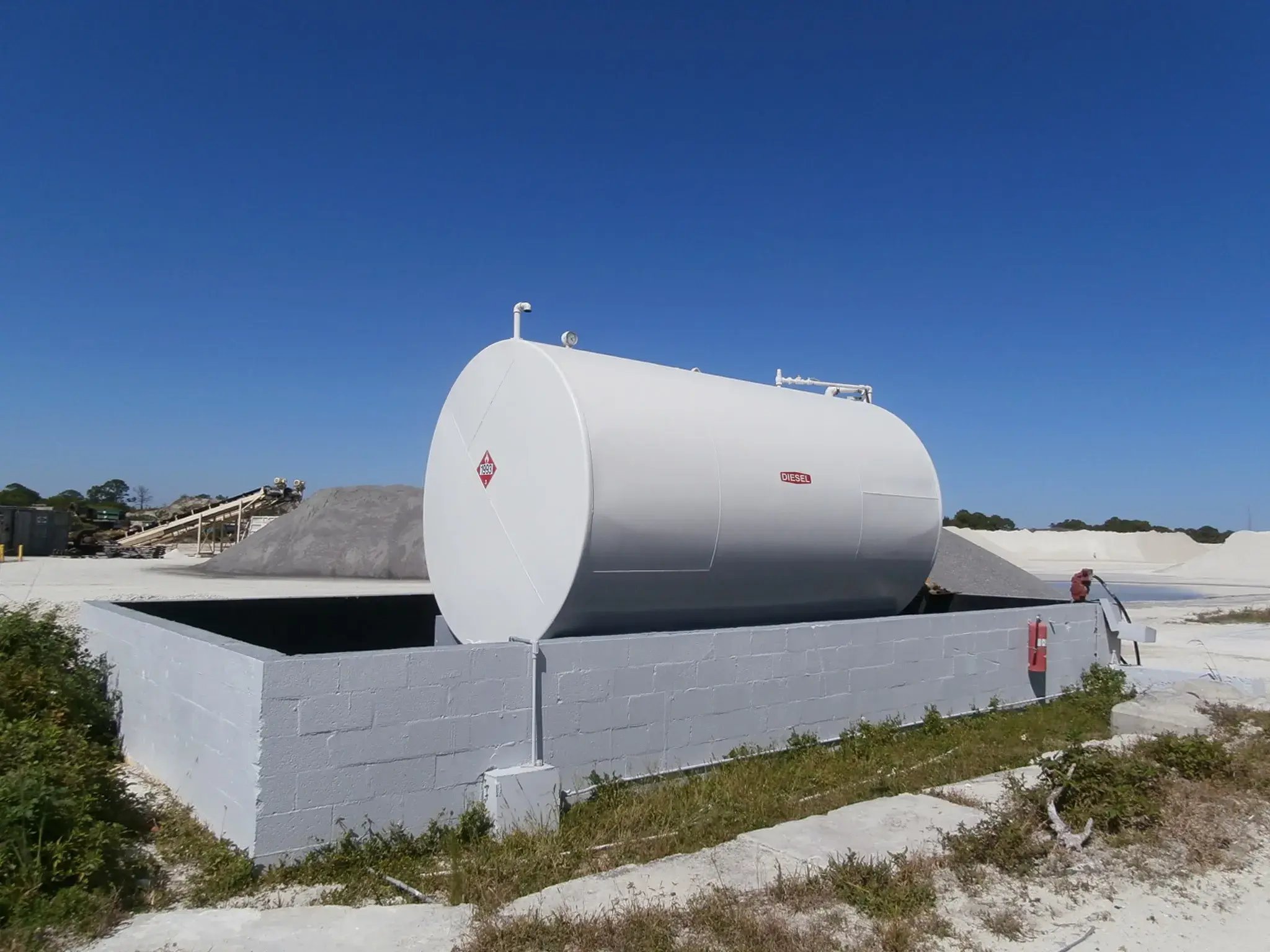
Expanding a Pennsylvania Facility? How New Oil Storage, Equipment, and Transfer Areas Change Your Spill Plan, Your Tank Paperwork, and Your Project Schedule
Expansions rarely start with a conversation about oil. They start with a new production line, a bigger backup generator, a second fuel tank for the fleet, or a new loading area, and somewhere on the equipment list sits a tank, a drum rack, or a transformer full of oil. Federal rules treat that new capacity as a reason to look at your oil spill plan, which EPA calls an SPCC Plan (short for Spill Prevention, Control, and Countermeasure Plan). It's a written plan, required once a facility stores more than 1,320 gallons of oil aboveground, that describes your tanks, your containment, your inspections, and what your people do if oil gets loose. If you already have one, new storage means it has to be amended. If you've never needed one, the expansion might be what puts you over the threshold.
The expensive mistakes tend to come from timing. The tanks get ordered, the pad gets poured, and the plan gets thought about after the first fuel delivery. This article walks through how to plan ahead: counting the new capacity, building containment into the project, checking whether you still qualify for a self-certified plan, scheduling the amendment and any engineer review, and lining up Pennsylvania tank registration and your local fire officials. If you'd rather talk it through for your own site, you're welcome to reach out to RMA at any point.
Table of Contents
TL;DR
Yes. New oil tanks, oil-filled equipment, or transfer areas change your SPCC Plan, and if the expansion pushes you past 1,320 gallons of aboveground capacity, it may be the reason you need a plan at all. Count every new container of 55 gallons or more, design containment into the project, and check the 10,000 gallon and 5,000 gallon limits for a self-certified plan. In Pennsylvania, a new tank over 250 gallons generally needs DEP registration and an operating permit before it holds oil, and anything over 21,000 gallons adds an installation permit and a spill prevention response plan. Build the plan and any engineer review into the schedule so it's ready when the tanks go into service.
Does Adding Oil Storage Change Your SPCC Plan?
If you already have an SPCC Plan, yes, in most expansions it does. The federal rule (40 CFR Part 112) requires you to amend the plan whenever a change in your facility's design, construction, operation, or maintenance materially affects the potential for an oil discharge. EPA's own examples read like a project checklist: commissioning or moving containers, installing or replacing piping, construction that alters secondary containment, and changes of product or service. A new tank, a relocated tank, a generator with a built-in fuel tank, and a new loading area all fit. The rule gives you six months to prepare the amendment and up to six more to implement it, but we wouldn't treat that as permission to run new tanks before the plan catches up. If a new tank sits on a pad that drains toward a storm drain, an amendment sitting on someone's desk won't help on the day of a spill. Inspectors cite failures to amend, and EPA Region 3 handles SPCC enforcement in Pennsylvania. Our guide on who enforces SPCC Plans covers how that works.
If you don't have a plan, the question is whether the expansion makes you subject to the rule. You are if your total aboveground oil storage capacity is greater than 1,320 gallons (counting only containers of 55 gallons or more), or your completely buried capacity is greater than 42,000 gallons, and a discharge could reasonably be expected to reach navigable waters or adjoining shorelines. That last test looks at your location and ignores manmade features like berms, so a site near a storm drain, ditch, or stream often meets it. Facilities that become operational are expected to have their plan in place before operations begin, and we plan expansions the same way: ready when the new tanks go into service, not six months later. Our article on when to update your SPCC Plan and whether you can do it yourself goes deeper on the amendment rules.
How Do You Count New Oil Storage Capacity for SPCC?
Count capacity, not contents. A 2,000 gallon tank counts as 2,000 gallons even if you only keep 500 gallons in it, and an empty tank still counts. Only containers of 55 gallons or more go into the total, but every one of them does, including drums, totes, and the oil sitting inside equipment. That last category is where expansions trip people up. An electrical upgrade brings transformers, a new line brings hydraulic reservoirs and compressors, and a new generator comes with a base tank, and all of that oil counts toward the 1,320 gallon total.
| New item |
Counts toward 1,320 gallons? |
Notes |
| Aboveground diesel, gasoline, or lube oil tank |
Yes, at full capacity |
Half full or empty doesn't change the count |
| 55 gallon drums and larger totes |
Yes, each one |
Containers under 55 gallons aren't counted |
| Generator with a built-in fuel tank |
Yes |
The tank's capacity counts |
| Transformers, hydraulic units, compressors |
Yes |
Count the oil capacity of each unit |
| Fuel trailer or skid tank |
Yes |
Not covered by the motive power exemption |
| Used oil, cooking oil, or other animal fat and vegetable oil tanks |
Yes |
Animal fats and vegetable oils count like petroleum |
| Fuel tank on a truck or forklift |
No |
Motive power containers are exempt |
| Propane and DEF |
No |
Not oil under the SPCC rule |
| Permanently closed container |
No |
Closed means closed, not just empty |
Add the new capacity to what you already have and check the total against the 1,320 gallon line. A facility at 1,000 gallons that adds one 500 gallon tank crosses it. Our article on whether 55-gallon drums count toward SPCC walks through the container rules in more detail.
Will the Expansion Change Your SPCC Plan Tier or Engineer Requirements?
Who certifies your plan depends on how much oil you store. A facility with 10,000 gallons or less of total aboveground oil storage and a clean discharge history is called a qualified facility. Clean means no single discharge over 1,000 gallons, and no two discharges over 42 gallons each within any 12 month period, in the three years before the plan is certified. Qualified facilities can self-certify instead of hiring a professional engineer (PE). If no single container is over 5,000 gallons, you're Tier I and can use EPA's short template. If any container is over 5,000 gallons, you're Tier II and write a full plan, which you still self-certify.
| Facility |
Total aboveground oil |
Largest container |
Plan route |
| Tier I qualified |
10,000 gallons or less |
5,000 gallons or less |
EPA's self-certified template, no PE |
| Tier II qualified |
10,000 gallons or less |
Over 5,000 gallons |
Full self-certified plan, no PE |
| Not qualified |
Over 10,000 gallons, or discharge history |
Any size |
Full plan certified by a PE |
An expansion can change more than the paperwork. Adding one 6,000 gallon tank to a Tier I facility makes it Tier II. Pushing total capacity from 9,000 to 11,000 gallons ends self-certification, and the rule gives you six months to move to a PE-certified plan. When your capacity lands near a line, talk it through before the order goes in. When a PE is needed, we work with an outside professional engineer licensed in the state where the facility sits. Our staff typically visit the site and develop the plan, and the engineer reviews, stamps, and seals it. That review adds time and a separate cost, so it belongs in the schedule early. Our guides to the different types of SPCC Plans and to professional engineers and SPCC requirements cover the options.
Very large facilities face a separate rule, the facility response plan (FRP), submitted to EPA. It generally applies at 42,000 gallons or more with over-water transfers to or from vessels, or at 1 million gallons or more with another factor such as inadequate secondary containment or a past discharge of 10,000 gallons. Most Pennsylvania expansions are nowhere near those numbers, but a terminal loading barges on the Ohio or Delaware should run the check.
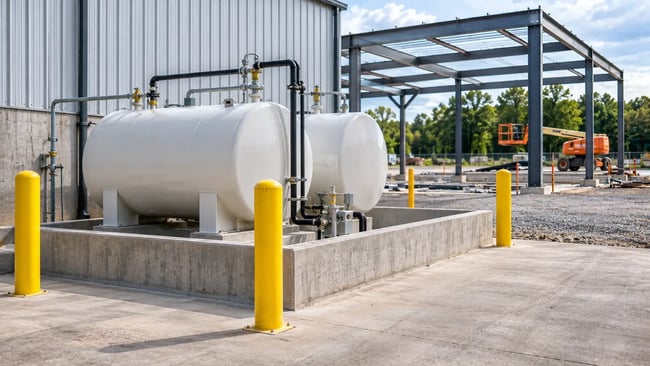
How Do You Design SPCC Secondary Containment Into an Expansion Project?
Containment is the part of an SPCC Plan you can't fix cheaply later. For bulk storage containers, the rule calls for secondary containment sized to hold the entire contents of the largest container in the area plus extra room (freeboard) for rainfall. Loading and unloading areas need containment for the largest compartment of a tank truck. Those rules sound simple until you're laying out a real site with several tanks, a drain, an unloading spot, and a forklift route, and our guide to how big your SPCC oil spill containment needs to be walks through the math.
Settle a few things while it's still a drawing: where the tanks sit, how rainwater leaves the containment, where trucks stop to unload and where a spill there would run, and how inspections and integrity testing will work once the tank is in service. A layout review takes little time on paper and costs a lot once the concrete is poured. DEP's tank standards add design requirements of their own, which your certified installer has to meet, so check the two sets against each other early.
Here's where we draw a line. RMA doesn't prepare construction-phase permits or approvals. That includes erosion and sediment control and construction stormwater permitting under Pennsylvania's Chapter 102 when a project disturbs enough ground, building and fire permits for the tank installation, and the installation itself, which in Pennsylvania has to be done by DEP-certified installers. Your engineer, contractor, or a soil erosion specialist handles those pieces. A new or expanded facility also needs a second set of paperwork once it's running: an SPCC Plan or amendment, DEP tank registration, inspections and integrity testing, and employee training. That's where we help, and we can also help you work out what the construction phase needs and point you toward the right construction professionals. A contractor's temporary fuel storage on a construction site can fall under SPCC as well, and we can help with that plan, though not with the construction permits themselves.
What Pennsylvania Tank Registration and Permits Apply to New Oil Tanks?
SPCC is a federal rule. Pennsylvania adds its own layer through the Storage Tank and Spill Prevention Act and 25 Pa. Code Chapter 245, run by DEP's storage tank program. The law dates to 1989, the year after the Floreffe tank collapse put diesel into the Monongahela River, and a Pennsylvania tank can be regulated even when your total oil storage is far below the SPCC threshold. In general, a stationary aboveground tank holding more than 250 gallons of a regulated substance like petroleum falls under the program, though there are exclusions, such as certain heating oil tanks and oil-filled operational equipment. Whether a particular tank needs DEP registration depends on its size, type, and use, so confirm yours against DEP's storage tank program before assuming either way.
Registration is easy to miss. The registration form doubles as the operating permit application. Tank owners register each regulated aboveground tank within 30 days after installation, and unless DEP approves otherwise, oil can't go into the tank until it's registered and DEP approves the operating permit. When you add a tank to a facility that's already registered, the registration information gets amended within 30 days of the installation. DEP invoices an initial fee and then a yearly fee per tank. Work on a regulated tank system, other than routine maintenance, has to be done by a DEP-certified installer, required inspections by a certified inspector, and DEP publishes a list of certified companies.
Size changes the process. A new tank over 21,000 gallons, or a new facility whose combined aboveground capacity exceeds 21,000 gallons, needs a site-specific installation permit before construction can begin. The application includes a spill prevention response plan (SPRP) covering the proposed tanks, proof that you've notified the municipality and county, and a fee, and the permit expires five years after issuance unless DEP extends it. An SPRP is Pennsylvania's spill plan for aboveground tank facilities over 21,000 gallons, similar in purpose to an SPCC Plan but submitted to DEP. If you already have an approved SPRP, the statute requires a revised plan or addendum when certain changes occur, including substantial changes in emergency equipment or the facility's emergency organization, so an expansion at a large facility should include a look at the SPRP alongside the SPCC amendment. Smaller tanks can follow a simplified program under Chapter 245.
How Should You Schedule the SPCC Amendment, Engineer Review, and Local Approvals?
Work backward from the day oil goes into the new tanks. By then the plan has to be amended and implemented, the DEP registration done and the operating permit approved, the containment built, and your people trained.
| Project stage |
What to line up |
| Early design |
Count new capacity, check the Tier and PE lines, sketch containment and transfer areas, and check the 250 and 21,000 gallon DEP thresholds |
| Before ordering |
SPRP and municipal and county notices if an installation permit applies, a DEP-certified installer, and a conversation with local fire officials |
| During construction |
A site walk once the layout is final so the plan describes what's built, with PE review following the draft when required |
| Before the first fill |
Plan certified, DEP registration submitted and operating permit approved, containment built, staff trained |
| After startup |
Inspections, integrity testing, and the five-year plan review |
Fire code requirements for tanks are enforced locally and vary by municipality, so confirm what yours requires for your tank size and location. Timelines vary with the size of the facility and whether a PE is involved, since the engineer's review has to be scheduled. Our article on how long it takes to get an SPCC Plan covers what drives the calendar. Training belongs on the same schedule. Initial SPCC training is free with a new RMA plan, and our online training library helps with new hires later.
An expansion can touch other programs too. A new generator may need an air permit (Allegheny County and Philadelphia run their own air programs), and a bigger fuel inventory can change your Tier II chemical reporting. Our guide to emergency backup generators and environmental permits covers that ground.
What Does an SPCC Plan Cost When You Expand?
Our SPCC plans run about $1,500 to $15,000 overall, and Tier I plans run about $1,500 to $4,000. Complex PE-certified work, updates included, starts around $7,500. Where you land depends on a few things, and our SPCC cost guide goes through them in detail.
| What drives the price |
Pushes it up |
Keeps it down |
| Capacity and container count |
Many containers, large total capacity |
A few containers under the Tier I limits |
| Certification route |
PE review, which adds engineer time and cost |
Qualified facility that self-certifies |
| Containment and transfer areas |
Multiple diked areas, loading racks, complex drainage |
One simple containment area |
| Who wrote the existing plan |
Another firm's plan, which we usually rebuild from scratch |
No plan yet, or a current plan we wrote |
If another firm wrote your current plan, we typically rebuild it rather than patch it, and our article on getting an SPCC Plan updated explains why. Tank purchase, containment construction, installer and inspector fees, and DEP registration fees are separate from the plan itself. Our SPCC pricing calculator is below. It gives you a ballpark for our help with the plan, not for the tanks, containment, or agency fees.
How Can RMA Help With an Oil Storage Expansion in Pennsylvania?
We're a family-run firm, and the senior people you talk to are the ones doing the work. For an expansion, that means counting your new capacity, reviewing your layout before the concrete goes in, writing the new or amended SPCC Plan (with an outside PE when one is required), helping you work through DEP tank registration, and training your staff. We can also tell you plainly when you don't need us. If you're a Tier I qualified facility with a plan you maintain yourself and you're adding one small tank, you may be able to handle the amendment on your own. We don't prepare construction-phase permits, but we can help you figure out what that phase needs and who to talk to.
If you're planning an expansion and want a second set of eyes on the oil side, there's no pressure and no obligation. You can call or email us, or reach out to RMA through the form on our website, and we'll talk through where your project stands.