What Happens to Your SPCC Obligations When a New Jersey Facility Goes Idle or Closes, and What Your Options Are for the Oil Left Behind
A plant shuts down on a Friday, the lights go off, and the oil stays exactly where it was. The diesel in the generator tank, the drums of hydraulic oil, the transformer out back, and the fuel tank by the loading dock don't know the business closed, and neither does EPA's Spill Prevention, Control, and Countermeasure rule, usually shortened to SPCC. If you own, operate, or lease a closed or idle New Jersey facility and you're wondering whether the oil spill plan, the inspections, and the containment still apply, the short answer is yes, for as long as the oil and containers are still there in a form the rule counts.
This article covers the three realistic paths: keep the plan and inspections going, permanently close the containers, or remove the oil and tanks entirely. We'll also cover New Jersey's tank closure requirements and the other state rules that show up when a facility winds down, including the Spill Act and ISRA. If you'd rather talk through your own site, you're welcome to reach out to RMA, and we'll tell you straight how much help you need, which is sometimes none.
Table of Contents
TL;DR
A closed or idle facility keeps its SPCC obligations while it holds more than 1,320 gallons of aboveground oil storage capacity that hasn't been removed or permanently closed. You can keep the plan, inspections, and security going, permanently close the containers by removing all liquid and sludge, blanking off piping, locking valves, and posting a dated sign, or remove the oil and tanks entirely. New Jersey underground tanks follow NJDEP's separate closure rules, and the Spill Act, DPCC and DCR plans, and ISRA can apply too.
Do SPCC Obligations Continue When a New Jersey Facility Shuts Down?
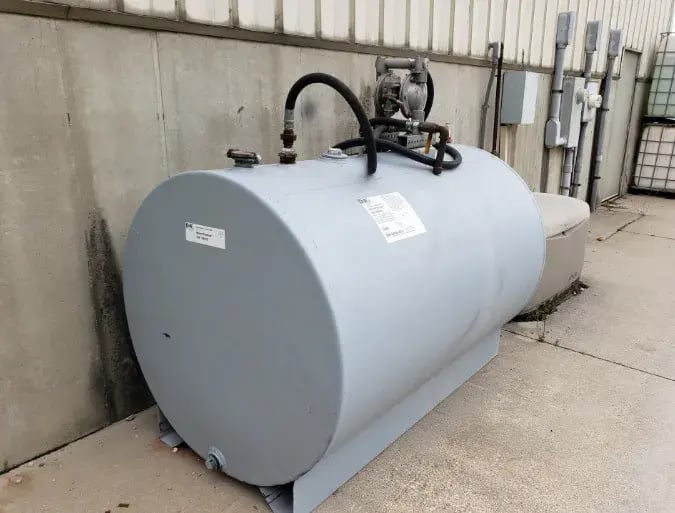
SPCC applies based on how much oil a facility can store, not on whether anyone is working there. The threshold is more than 1,320 gallons of aboveground oil storage capacity, counting every container of 55 gallons or more, and it's the container's capacity that counts, not what's in it today. The rule also covers containers used for standby, seasonal, or temporary storage, and any container that hasn't been permanently closed. A shutdown isn't on that list. In New Jersey, EPA Region 2 enforces the federal rule.
What changes is the practical side. Inspections, training, and walk-throughs usually stop within weeks, along with the person who knew where the drain valve was. A plan that promises monthly inspections at a site nobody visits is a plan the facility isn't following, and that gap is what shows up in enforcement. We cover who enforces SPCC plans and the most common SPCC violations and fines in separate articles. It also helps to take stock of what's on the property. A closed plant often holds more oil than the owner remembers: the generator tank, hydraulic reservoirs, oil-filled equipment, and drums of used oil. Oil-filled equipment and vegetable oils count, and propane doesn't. Our SPCC plan basics guide covers the counting rules.
What Counts as a Permanently Closed Container Under the SPCC Rule?
"Permanently closed" is the only status that takes a container out of the SPCC rule while it's still on your property. The definition in 40 CFR 112.2 has two parts. All liquid and sludge has to be removed from the container and its connecting lines. Then every line has to be disconnected and blanked off, every valve except ventilation valves closed and locked, and a conspicuous sign posted on the container saying it's permanently closed and giving the date of closure.
A tank that's been drained, with open valves, no sign, and a fill line still attached is out of service but not permanently closed. The SPCC rule doesn't define "empty" or "out of service," so that tank is treated like any other container. It stays in the plan, needs secondary containment, and needs inspections and integrity testing. Once a container meets the closed definition, its capacity drops out of your facility total.
| Container status |
What it looks like |
How SPCC treats it |
| Active or idle |
Oil in it, or drained but not closed out to the full definition |
Counts toward capacity, belongs in the plan, needs containment, inspections, and integrity testing |
| Permanently closed |
Liquid and sludge removed, piping blanked off, valves locked, dated sign posted |
Excluded from the capacity total and the plan |
| Removed from the site |
Container and contents are gone |
No longer part of the facility |
We'd photograph the sign, the blanked-off lines, and the locked valves, and keep the waste records showing the oil and sludge left the site. Those are your answer when an inspector asks how you know a tank is closed.
Option One: Keep Your SPCC Plan and Inspections Going
Keeping everything in place is the right call when the shutdown is temporary, you're waiting on a sale, or you plan to restart. Nothing about the plan has to change, but every ongoing duty continues at a site that may have no staff. Containers still need regular inspection, bulk containers still need integrity testing on schedule, secondary containment has to stay in working order, and the security measures in your plan, like locked valves, fencing, and lighting, have to be real. Inspection records are kept for three years, and gaps are easy for an inspector to spot.
The deciding question is who does the work. Someone has to walk the site on your plan's schedule, check the tanks and containment, handle stormwater in the containment properly, and sign the records. That might be a caretaker, a property manager, or a consultant. Our article on monthly SPCC inspections covers what a good walk includes, and the person responsible still needs annual SPCC training, which our online training library can cover. A closed building often still has a diesel tank feeding a generator nobody runs, and that tank counts like any other (see our article on emergency backup generators). The five-year review also keeps running while the building sits empty.
Option Two: Permanently Close the Containers and Update Your SPCC Plan
Permanent closure makes sense when the tanks are staying but you're done using them, for example because the building is being sold with its equipment or removal costs too much right now. A licensed vendor removes the oil and sludge, and the contents have to go to the right place, which depends on whether it's used oil, waste oil, or something else (we explain the difference between used oil, waste oil in a separate article). The lines get disconnected and blanked off, the valves closed and locked, and the signs go up with the closure date.
Then the plan has to match what's on site. Remove the closed containers from the plan and the facility diagram. An amendment generally has to be made within six months of the change and put into practice within six months after that, and a plan certified by a Professional Engineer generally needs the engineer to certify technical amendments. Recalculate your aboveground capacity without the closed containers. If what's left is 1,320 gallons or less, you may no longer need a plan, but forgotten drums, oil-filled equipment, and day tanks can push you back over the line. Closing a container to the SPCC definition doesn't end your duties under New Jersey law, and it doesn't excuse leaks that already happened. See our articles on when an SPCC plan needs an update and whether your plan can be updated.
Option Three: Remove the Oil and Tanks Entirely
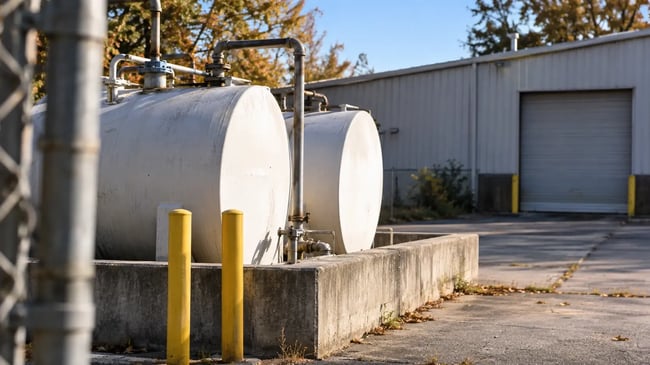
Full removal is the cleanest exit. With the oil, tanks, drums, and oil-filled equipment gone, no oil storage is left for the rule to apply to, so there's no plan to maintain. Buyers, landlords, and lenders usually prefer it because there's nothing to inherit. Walk the property with a checklist, because a shed of 55-gallon drums or a couple of hydraulic units can keep a facility under the rule.
Tanks need to be emptied and cleaned before they're cut up or lifted out, and the residue is a waste that needs a proper determination and disposal paperwork. Work on a tank that held fuel is dangerous and belongs to experienced tank contractors. Depending on the municipality, removal and demolition can require local permits, often involving the fire official, since the Uniform Fire Code is statewide but enforced locally. RMA doesn't prepare those construction-phase permits, so check with your contractor and municipality early.
Look at what's under the tanks. Stained soil or a sheen in the excavation is a discharge and may have to be reported to NJDEP, and our article on when an oil spill has to be reported explains the triggers. Cleanup in New Jersey typically involves a Licensed Site Remediation Professional, or LSRP. Keep the old plan, the closure records, and the disposal manifests, because buyers and agencies ask for them years later.
What Are New Jersey's Tank Closure Requirements for Underground Tanks?
Underground tanks are where New Jersey gets more specific than the federal rule. Regulated underground storage tanks (USTs) fall under NJDEP's rules at N.J.A.C. 7:14B, and closure is its own regulated process. Whether a buried tank falls under those rules, SPCC, or both depends on the tank, what it stores, and how it's used, so confirm which program applies before anyone touches it.
For a regulated UST, the facility and tank have to be registered with NJDEP, and the owner or operator has to notify NJDEP of the intent to close at least 14 calendar days before closure, through NJDEP's online service. The approval from that notice then goes to the municipal and county health departments and the local authority along with the demolition permit application, also at least 14 days ahead. Closure, by removal or abandonment in place, has to be done by NJDEP-certified firms and individuals, so a general contractor with a backhoe won't do. A site investigation follows, and if it finds contamination, the case moves into New Jersey's site remediation process, typically under an LSRP.
A parked tank has a clock too. A regulated UST that's out of service for more than 12 months generally has to be closed, with exceptions for systems that keep up release detection, corrosion protection, and other conditions. Tanks holding hazardous waste follow the hazardous waste closure rules, and unregulated heating oil tanks fall under N.J.A.C. 7:14B-16 and 7:26F, which also call for certified professionals. Fees and forms change, so use NJDEP's UST closure pages and your certified contractor for current ones.
Which Other New Jersey Rules Apply When a Facility Goes Idle or Closes?
SPCC is the federal piece, and our article on SPCC plans in New Jersey covers the wider state picture. The Spill Act makes discharges of hazardous substances, including oil, reportable to NJDEP, and it can make the owner or operator responsible for cleanup and related costs. That doesn't pause when the doors lock. A leak in an unattended building is still a discharge, and it can grow before anyone notices. If you ever have to report one, NJDEP's website lists the current hotline. Spill Act liability is broad and fact-specific, so if a discharge is involved, an environmental attorney is worth a call.
Major Facilities and DPCC and DCR Plans
New Jersey requires "major facilities," defined in N.J.A.C. 7:1E, to have NJDEP-approved Discharge Prevention, Containment and Countermeasure (DPCC) and Discharge Cleanup and Removal (DCR) plans. Whether your site counts depends on its total storage capacity and what it stores, so check the rule against your own inventory. If you have approved plans, the rules call for amending them within 30 days of a modification that necessitates a change, and closing or removing tanks can be one. Contact NJDEP before assuming those duties end with operations.
ISRA and Cessation of Operations
The Industrial Site Recovery Act (ISRA) applies to "industrial establishments" whose NAICS code is listed in the rule, and it's triggered by events such as a sale of the property or business and the cessation of operations. NJDEP's rules count some temporary shutdowns longer than two years as closing operations, so an idle plant can trigger ISRA without anyone declaring it closed. A trigger requires a General Information Notice to NJDEP within five days, and the process that follows generally involves an LSRP, an investigation, and any needed cleanup. ISRA is a legal and financial matter as much as an environmental one, so bring in an environmental attorney and an LSRP early.
If you still hold hazardous substances above reporting thresholds, Community Right to Know reporting may continue until they're gone, and any waste from the cleanout carries generator duties.
How Do You Choose Between Keeping, Closing, or Removing Your SPCC Containers?
The right path usually depends on how long the facility will be idle and what happens to the property next. A short, planned shutdown points toward keeping the plan going. A sale in the next year or two usually points toward full removal. A long-term hold with tanks nobody wants to pay to remove is the classic case for permanent closure.
| Path |
Best fit |
What you keep doing |
| Keep the plan going |
Temporary shutdown, planned restart, standby generators |
Inspections, integrity testing, containment upkeep, security, training, five-year review |
| Permanently close containers |
Long-term idle site, tanks staying in place |
Plan amendment and records, plus plan duties for anything left that still counts |
| Remove everything |
Sale, lease return, redevelopment |
Closeout records, plus New Jersey closure rules for any underground tanks |
Plan updates and amendments are the usual SPCC work in a closure. A simple Tier I update runs about $1,500, and a complex plan that needs Professional Engineer certification starts at $7,500. What moves the price is total storage capacity, the number and type of containers, whether secondary containment has to be re-evaluated, and whether a PE has to certify the change. Tank cleaning, removal, and UST closure are quoted by the contractors who do that work and vary a lot by site, so get written quotes. Our what an SPCC plan costs article covers the factors, and the pricing calculator below shows what RMA's help with the plan side costs.
How Can RMA Help With SPCC Plans for Closed or Idle Facilities?
We're based in New Jersey and we've worked with NJDEP's rules for a long time. We'll start by working out what's on your site and which of the three paths fits your timeline. From there we can update or amend your SPCC plan, confirm when a plan is no longer needed, and set up inspections and training if you're keeping the site going. If you don't need us, we'll say so, since a site cleared of all its oil often needs nothing from a consultant. We don't do tank removal, UST closure, demolition or fire permits, or cleanup oversight, and we'll point you to the right professionals for those.
There's no pressure and no obligation. You can call us, email us, or fill out the form on our website, and a person will reply with straight answers. When you're ready, you can contact RMA whenever it suits you.