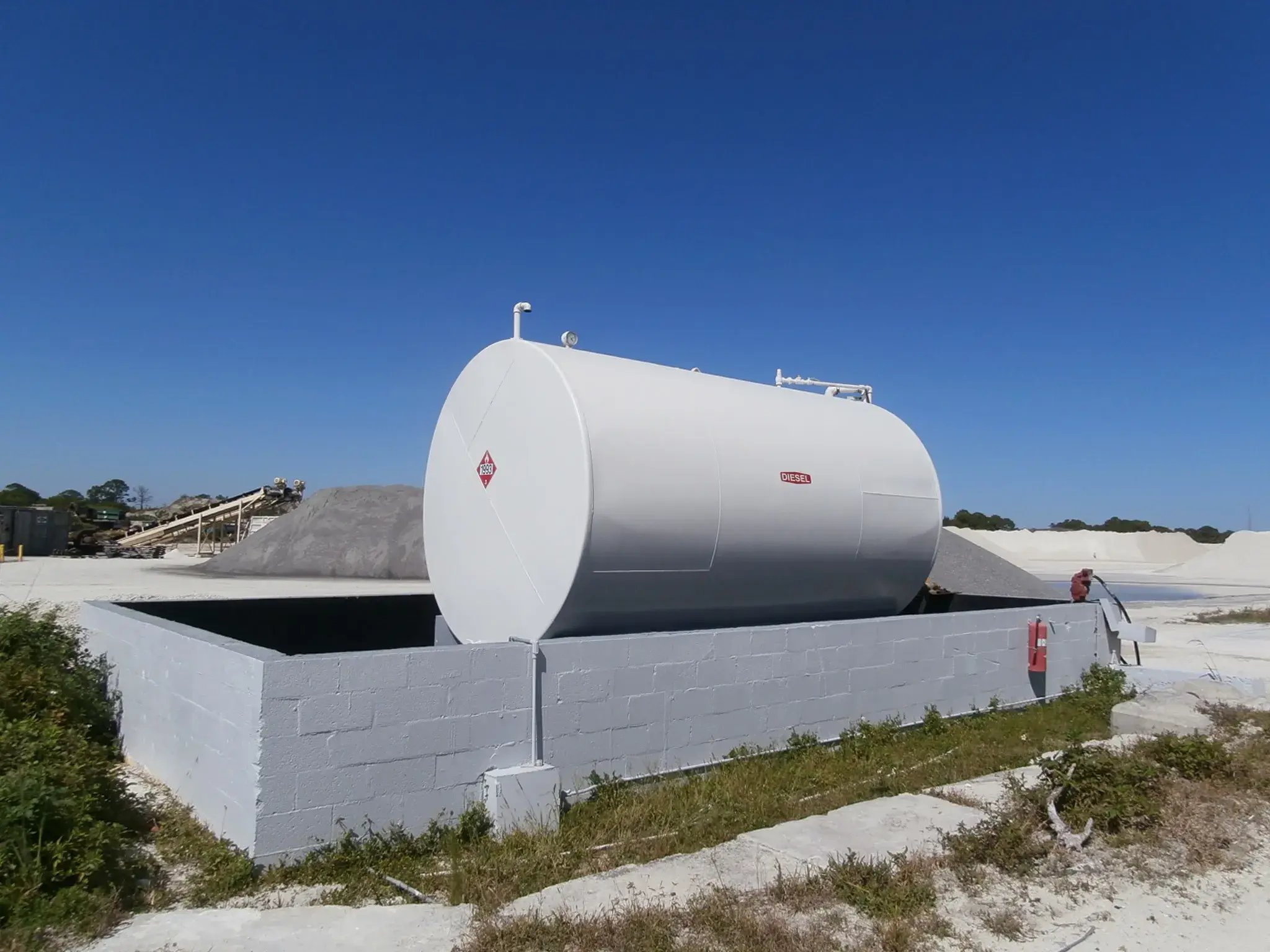
How Heating Oil Tanks at Pennsylvania Businesses, Churches, and Schools Count Toward Federal SPCC Rules, and Where DEP's Storage Tank Program Fits In
Plenty of Pennsylvania buildings still heat with oil. Older churches, schools, shops, offices, and warehouses across the state have a 275-gallon tank in the basement or a larger tank out back, and most owners think of it the way a homeowner does: you call for a delivery when it's low and that's about it. What surprises a lot of them is that the federal exemption for heating oil tanks only covers single-family homes. At a business, church, or school, that heating oil tank counts toward the federal oil spill rules, and when it's paired with an emergency generator or a few drums of hydraulic oil, the building can end up needing a written oil spill plan.
The short answer is yes, a commercial heating oil tank counts, but it only brings the federal rule into play if your total aboveground oil storage in containers of 55 gallons or more tops 1,320 gallons. Heating oil alone often stays under that line. A heating oil tank plus a generator is where many buildings cross it. Pennsylvania's own storage tank program is a separate story: it generally doesn't regulate heating oil tanks of 30,000 gallons or less that heat the property where they sit, but it does regulate larger generator fuel tanks. Below, we'll walk through how the federal rule works, who the residential exemption covers, how to count your capacity, what changes when you add a generator, where DEP's program fits, and what to do if you're over. If you'd rather talk it through with someone, you can reach out to RMA anytime.
Table of Contents
TL;DR
The federal exemption for heating oil tanks only covers single-family homes, so a heating oil tank at a business, church, school, or apartment building counts toward the federal oil spill rules. You need a written oil spill plan if your total aboveground oil storage in containers of 55 gallons or more is over 1,320 gallons, and a heating oil tank plus a backup generator is a common way buildings cross that line. Pennsylvania DEP generally doesn't regulate heating oil tanks of 30,000 gallons or less that heat the same property, but it does regulate generator fuel tanks over 1,100 gallons. Most small buildings that do cross the federal line can write their own plan using EPA's free template.
What Are the Federal Oil Spill Rules for Heating Oil Tanks?
The federal rule is EPA's Spill Prevention, Control, and Countermeasure rule, found at 40 CFR Part 112. The document it requires is called an SPCC Plan, which is simply a written oil spill plan. It lists your oil containers, explains how you keep them from leaking, describes how you'd contain a spill, and spells out who does what if one happens. If you're new to the whole idea, our guide to what an SPCC Plan is covers the basics. In Pennsylvania, the rule is enforced by EPA Region 3 out of Philadelphia, not by DEP, which surprises people who assume every environmental rule runs through Harrisburg.
Heating oil is oil under this rule, the same as diesel, gasoline, hydraulic oil, lubricating oil, and even vegetable oil. A facility is covered when its aboveground oil storage capacity is over 1,320 gallons, counting only containers that hold 55 gallons or more, or when its completely buried storage capacity is over 42,000 gallons. The rule counts the size of the container, not how much oil is in it. A 1,000-gallon tank that's a quarter full counts as 1,000 gallons, and an empty tank that hasn't been formally closed still counts at full size.
There's one more piece. The rule only applies to facilities that could reasonably be expected to spill oil into a creek, river, lake, or a storm drain or ditch that leads to one. The catch is that this judgment can only consider geography, like distance to water, the slope of the land, and how the site drains. It has to ignore manmade features such as walls, dikes, and equipment. So you can't count the boiler room walls or a curb around the tank as the reason a spill wouldn't get out. With Pennsylvania's dense network of streams and storm sewers, most buildings can't rule themselves out on location alone, so we usually tell people to assume the rule applies and focus on the capacity math.
Does the Heating Oil Residential Exemption Cover Businesses, Churches, and Schools?
The exemption is narrow. Under 40 CFR 112.1(d), the rule doesn't apply to a container of heating oil used solely at a single-family residence, and that capacity is left out of the 1,320-gallon count. That's it. The wording is about the building, not the fuel, so it doesn't reach a church, school, office, store, restaurant, warehouse, or shop. A lot of owners assume heating oil is a "residential" product by nature and therefore exempt everywhere, and that assumption is where the trouble usually starts.
The exemption also doesn't stretch to apartment buildings or mixed-use buildings with apartments over a storefront, since those aren't single-family residences. On the other side, a parsonage, rectory, or caretaker's house on a church or school campus that has its own tank heating only that house generally reads as a single-family residence, so that one tank may stay out of the count. The word "solely" does a lot of work here. If one tank feeds both the house and the main building, it doesn't fit the exemption. When you're sorting this out, it helps to write down which building each tank serves before you start adding gallons.
| Building the heating oil tank serves |
Does the tank count toward the federal 1,320-gallon threshold? |
| Single-family home |
No, it's exempt |
| Parsonage, rectory, or caretaker's house with its own tank serving only that house |
Generally no, as long as the tank serves only that single-family house |
| Apartment building or mixed-use building |
Yes |
| Church, school, office, store, restaurant, warehouse, or shop |
Yes |
| One tank serving both a house and a non-residential building |
Yes, because it isn't used solely at a single-family residence |
How Do You Count Heating Oil Tank Capacity Toward the SPCC Threshold?
The easiest way to do this is to walk the building with a notepad and write down every oil container that holds 55 gallons or more, along with its nameplate capacity. Look in the basement, the boiler room, the maintenance shop, the generator enclosure, and the elevator machine room. People tend to remember the heating oil tank and forget everything else, and the "everything else" is often what tips the total. Our article on whether 55-gallon drums count in SPCC plans goes deeper on the smaller containers.
| Item |
Counts toward 1,320 gallons? |
Notes |
| Heating oil tank (275, 330, 550, 1,000 gallons, or larger) |
Yes |
Count the full tank size, not the fuel level |
| Old heating oil tank left in place after switching to natural gas |
Yes, unless permanently closed |
Permanently closed means emptied of oil and sludge, lines disconnected and blanked off, valves locked, and a sign posted with the closure date |
| Generator base tank, belly tank, or day tank |
Yes |
Often the piece that pushes a building over |
| Oil-filled equipment, such as elevator hydraulic reservoirs or transformers you own |
Yes, if 55 gallons or more |
Utility-owned transformers are generally the utility's responsibility |
| 55-gallon drums of hydraulic oil, motor oil, or used oil |
Yes |
Each drum counts as 55 gallons |
| Bulk cooking oil or used cooking oil containers |
Yes, if 55 gallons or more |
Animal fats and vegetable oils are oil under the rule |
| Containers smaller than 55 gallons |
No |
Five-gallon pails and quart bottles stay out |
| Propane tanks |
No |
Propane isn't oil under this rule |
| Fuel tanks on vehicles, buses, and mowers |
No |
These are motive power containers; a fuel trailer or skid tank used for refueling is not |
The converted-building row deserves a second look. Many Pennsylvania churches and schools switched to natural gas years ago and left the old oil tank sitting in the basement. If nobody formally closed it, it still counts at full capacity, even if it hasn't held oil in a decade. Closing it properly, or having it removed, takes it out of the math.
What About Buried Heating Oil Tanks at a Business?
Buried heating oil tanks get treated a little differently. The SPCC rule excludes completely buried tanks that are subject to all of the federal underground storage tank rules in 40 CFR Part 280. But those federal UST rules don't cover tanks storing heating oil used on the premises, which means a buried heating oil tank at a church or business doesn't get that exclusion. It counts toward the 42,000-gallon buried threshold, which very few buildings of this kind ever approach. Where it matters is when your aboveground storage already puts you over 1,320 gallons. At that point the buried heating oil tank belongs in your SPCC Plan too, and the plan has to address how you protect it from corrosion and check it for leaks.
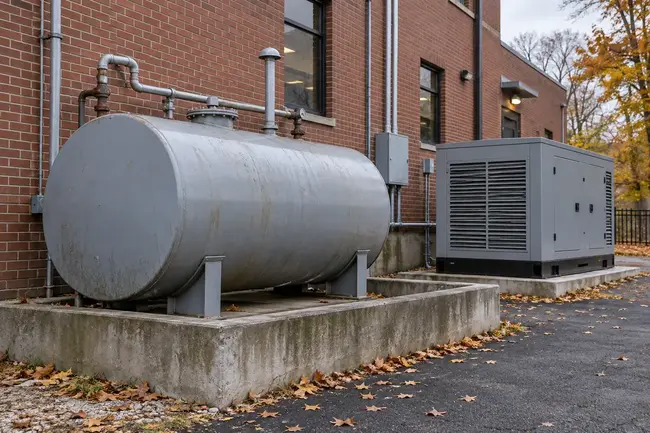
When Does a Heating Oil Tank Plus a Generator Push You Over 1,320 Gallons?
Heating oil on its own often keeps a building under the line. A single 275-gallon basement tank is 275 gallons, and two of them are 550. Even a 1,000-gallon tank leaves room to spare. The picture changes when a backup generator shows up. Generators get added after a bad storm, at an insurer's request, to keep a school open as an emergency shelter, or to protect refrigerated inventory, and their fuel tanks commonly run from a few hundred gallons to a couple thousand. Add that to the heating oil tank and an elevator reservoir, and the total climbs fast.
| Example building |
Oil containers of 55 gallons or more |
Aboveground total |
Over 1,320 gallons? |
| Small church |
One 275-gallon heating oil tank, 150-gallon generator belly tank |
425 gallons |
No |
| Church with a school wing |
Two 275-gallon heating oil tanks, 500-gallon generator base tank |
1,050 gallons |
No, but close |
| Office building |
1,000-gallon heating oil tank, 400-gallon generator base tank |
1,400 gallons |
Yes |
| Private school |
2,000-gallon heating oil tank, 250-gallon generator tank, 120-gallon elevator reservoir |
2,370 gallons |
Yes |
The church with the school wing is the one to watch. It's under today, but two drums of hydraulic oil in the maintenance room, or a slightly bigger generator next time, would put it over. So do the math before you buy a generator, not after. If a smaller base tank gives you the runtime you need, the building may stay under the threshold. If you need a larger tank for longer runtime, that's a perfectly good reason to choose it, but build the oil spill plan into the project so it's ready when the tank is filled. Our article on emergency backup generators and environmental permits covers the other approvals a generator can bring.
Installing a generator or a new tank also involves construction-phase approvals, such as building, electrical, and fire permits, and in Pennsylvania some tank installations have to be done by a DEP-certified installer. RMA doesn't prepare those construction permits or install tanks. Your contractor, electrician, or engineer usually handles that piece. Where we come in is what the building needs once the new equipment is running, which is often an SPCC Plan or an update to an existing one.
How Does Pennsylvania's Storage Tank Program Treat Heating Oil Tanks?
Pennsylvania runs its own storage tank program under the Storage Tank and Spill Prevention Act and 25 Pa. Code Chapter 245, administered by DEP. It's completely separate from the federal SPCC rule, and it uses its own definitions. Under DEP's rules, aboveground storage tanks over 250 gallons that hold regulated substances are generally covered, but tanks storing heating oil for use on the property where they sit are excluded, as long as an aboveground heating oil tank is 30,000 gallons or less. A tank sitting on the floor of a basement is treated as an aboveground tank under DEP's definitions, so the same heating oil exclusion applies to it. DEP's own tank search pages note that home heating oil tanks aren't regulated.
| Tank |
Regulated by DEP's storage tank program? |
Counts toward federal SPCC at a business? |
| Aboveground or basement heating oil tank, 30,000 gallons or less, heating the same property |
No |
Yes |
| Aboveground heating oil tank over 30,000 gallons |
Yes |
Yes |
| Buried heating oil tank heating the same property |
No, unless federal law requires it |
Toward the 42,000-gallon buried threshold, and included in the plan if the facility is covered |
| Aboveground generator diesel tank, including belly tanks, over 1,100 gallons |
Yes |
Yes |
| Aboveground generator diesel tank of 1,100 gallons or less |
No |
Yes |
That last pair comes from DEP's position that aboveground tanks connected to emergency generators, including tanks built into the generator unit, aren't exempt unless they're 1,100 gallons or less. A regulated tank has to be registered with DEP, with an annual registration fee, and tank handling like installation, modification, and removal has to be done by DEP-certified installers. Depending on the tank's size, there can also be inspection requirements by DEP-certified inspectors. If you're unsure whether a tank needs registration, its size, type, and use decide it, so confirm yours with DEP's storage tank program or your DEP regional office.
Two things trip people up here. First, a tank that's invisible to DEP can still count for EPA. The heating oil exclusion in Pennsylvania's rules has no effect on the federal 1,320-gallon count, so a church can owe nothing to DEP and still need an SPCC Plan. Second, DEP's exclusion is for heating oil used for heating on the property where it's stored. If one tank also feeds a generator or supplies fuel somewhere else, it may not fit the heating oil exclusion, and that's worth confirming with DEP before you assume it's exempt. Local fire codes also apply to tank installations, and those are enforced by your municipality and vary from place to place.
If you own a buried heating oil tank, Pennsylvania has some financial help for leaks. DEP's Underground Heating Oil Tank Cleanup Reimbursement Program can reimburse eligible cleanup costs for buried heating oil tanks of 3,000 gallons or less, after a $1,000 deductible and up to a capped amount per tank. Owners of buried heating oil tanks of 3,000 gallons or more can choose to opt in to the Underground Storage Tank Indemnification Fund (USTIF) for cleanup coverage. Aboveground heating oil tanks aren't eligible for either program. If a tank does leak, our article on when you have to report an oil spill explains the federal reporting trigger, and safety and a call to the right agencies always come first.
What Do You Do If Heating Oil Tanks Put You Over the SPCC Threshold?
First, the good news. Most churches, schools, and small commercial buildings that cross the line are what EPA calls Tier I qualified facilities. That means total aboveground oil storage of 10,000 gallons or less, no single aboveground container over 5,000 gallons, and a clean spill record (no single discharge over 1,000 gallons, and no two discharges over 42 gallons each within any 12-month period, in the three years before you certify the plan). A Tier I facility can write and certify its own plan using EPA's template, without hiring a Professional Engineer. We explain how that works in our article on Tier I self-certified SPCC Plans. If you have someone organized on staff and a simple setup, you may not need a consultant at all, and we'd rather tell you that up front.
Whoever writes it, the plan commits you to a few ongoing habits. You'll need secondary containment for your tanks, meaning a way to catch a leak before it leaves the area, and basement heating oil tanks sitting on a bare floor near a floor drain are one of the most common gaps we see. Our article on how big SPCC oil spill containment needs to be walks through the sizing. You'll also do regular visual inspections, which our list of things to check during SPCC monthly inspections makes easier, and give a spill prevention briefing at least once a year to the people who handle oil, such as custodians, maintenance staff, and whoever meets the delivery truck. Our online environmental training library can help with that. The plan itself has to be reviewed at least every five years.
Cost depends on the building. A Tier I plan on EPA's template costs mostly staff time. When a consultant prepares the plan, RMA's published range for SPCC Plans runs from $2,500 to $15,000, and simple buildings with a heating oil tank and a generator usually sit near the lower end. What moves the price is total storage capacity, how many containers there are, whether a Professional Engineer has to certify the plan, and whether existing containment needs to be evaluated. Our SPCC plan cost guide breaks those factors down, and you can get a ballpark for RMA's help with the calculator below.
How RMA Helps Pennsylvania Facilities With Heating Oil Tanks and SPCC Plans
We're based in New Jersey and work with facilities across Pennsylvania, and buildings like these are some of our favorite projects because the answer is often simpler than the owner feared. We can help you count your capacity, figure out which tanks matter to EPA and which matter to DEP, and tell you plainly whether you're under the threshold, a good candidate to self-certify, or better off with a professionally prepared plan. If you do need a plan, our senior staff write it and help you fix the practical gaps, like basement tanks without containment or an old tank that was never properly closed.
There's no pressure and no obligation. If you'd like a second set of eyes on your oil storage, call us, send an email, or fill out the form on our website, and we'll help you figure out where you stand. You can reach out to RMA here whenever you're ready.