Why 25 Drums of Lube or Hydraulic Oil Can Put a Pennsylvania Shop Under Federal Oil Spill Rules, How Drums and Totes Are Counted, and What Containment You'll Need
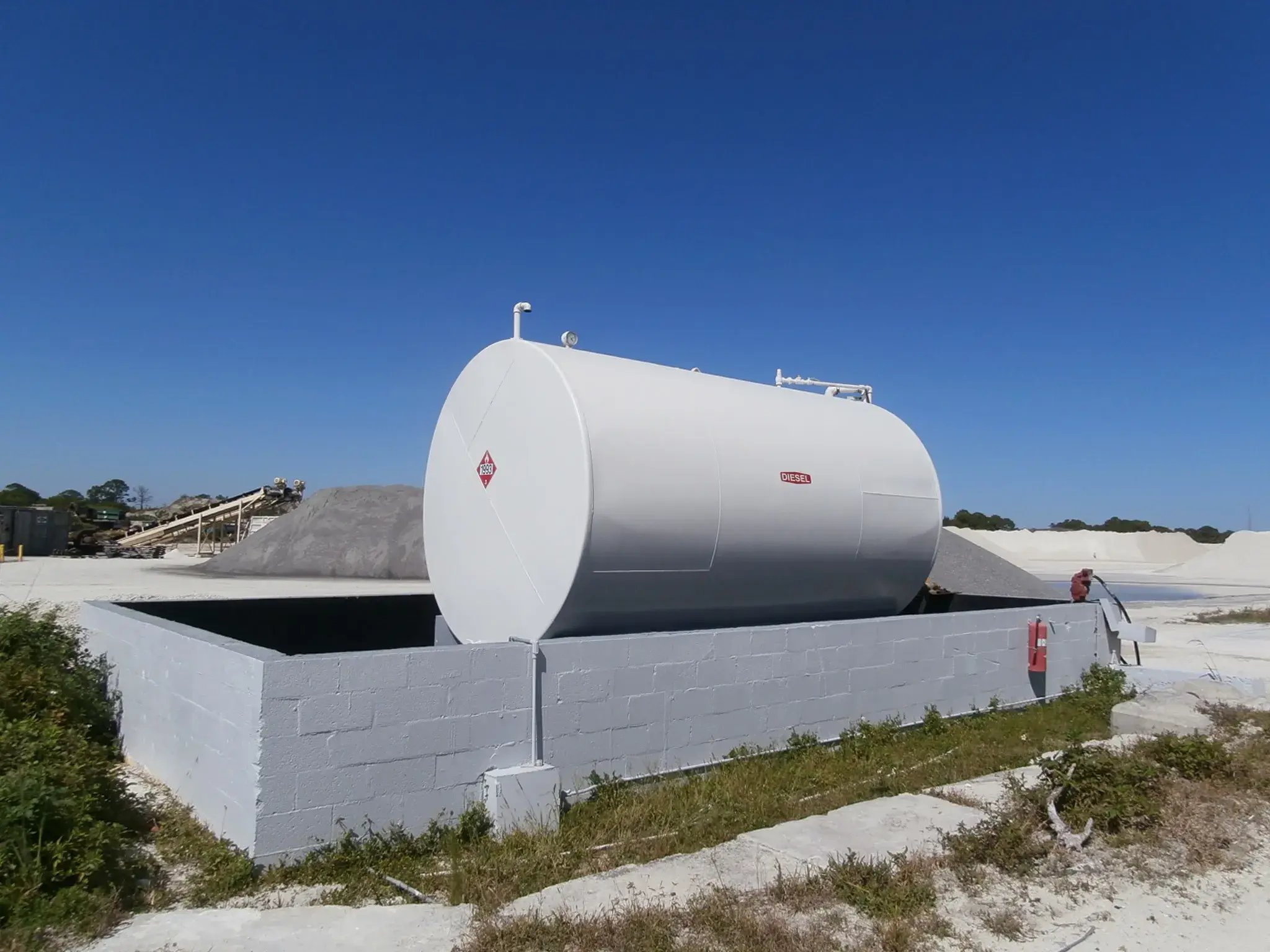
Most shop owners picture oil spill rules as something for fuel terminals and tank farms, not a maintenance bay with a row of drums along the back wall. But the federal rule doesn't care whether your oil sits in one big tank or in fifty small containers. It adds up every container of 55 gallons or more, and once the total goes over 1,320 gallons, you're expected to have a written oil spill plan. That works out to 25 standard drums. A fabrication shop, a machine shop, a fleet garage, or a small manufacturer can cross that line without owning a single tank, and many do without knowing it.
In this article we walk through how drums and totes are counted, a few quick math examples, what changes once you're covered (especially the secondary containment requirement for drum storage areas), practical containment options from spill pallets to containment buildings, where Pennsylvania's own tank program does and doesn't come into play, and what a plan costs for a drum-heavy shop. If you'd rather have someone count your containers with you and tell you where you stand, you can always reach out to RMA and we'll give you a straight answer.
Table of Contents
TL;DR
The federal oil spill rule counts every oil container of 55 gallons or more, by its full capacity, and a facility that totals more than 1,320 gallons aboveground needs a written spill plan. Twenty-four drums is exactly 1,320 gallons, so the 25th drum puts you over, and totes get you there even faster. Once you're covered, your drum storage areas need secondary containment that can hold at least the largest single drum or tote, which usually means spill pallets, containment cabinets, or a curbed or prefabricated containment building. Many drum-only shops qualify for the simplest self-certified plan, and some can stay under the line by cutting inventory.
How Does the Oil Spill Plan Threshold Count 55-Gallon Drums?
The rule we're talking about is the federal Spill Prevention, Control, and Countermeasure regulation, usually shortened to SPCC. An SPCC Plan is a written oil spill prevention plan that describes where your oil is, how you keep it from getting out, and what you'll do if it does. The rule lives at 40 CFR Part 112, and in Pennsylvania it's enforced by EPA Region 3 out of Philadelphia, not by the state. A facility needs a plan when its total aboveground oil storage capacity is more than 1,320 gallons (or its buried capacity is more than 42,000 gallons) and a spill could reasonably reach a creek, river, storm drain, or ditch that leads to one.
Three counting rules trip people up. First, only containers of 55 gallons or more count, so your 5-gallon pails and 30-gallon drums are off the books. Second, it's capacity that counts, not what's inside. A drum that's down to its last few gallons still counts as 55. Third, "oil" is broad. Hydraulic oil, gear oil, motor oil, cutting oil, used oil waiting for pickup, diesel, and even vegetable oil all count. We cover the drum question from a few more angles in our article on whether 55-gallon drums are included in SPCC plans.
The "could it reach water" part is also narrower than most people hope. The rule only lets you consider geography, like distance, slope, and drainage. You can't count your building walls, berms, or containment to argue a spill would never get out. A shop with floor drains or a loading dock that sheds to a storm inlet is almost always in.
| Counts Toward 1,320 Gallons |
Doesn't Count |
| 55-gallon drums of any oil, full, partly full, or nearly empty |
Containers under 55 gallons (pails, 30-gallon drums, quart bottles) |
| Intermediate bulk containers (totes), usually 275 or 330 gallons |
Fuel tanks that power a vehicle or machine (motive power containers) |
| Used oil drums and used oil tanks |
Containers that have been permanently closed under the rule's definition |
| Oil-filled equipment of 55 gallons or more, like hydraulic reservoirs and transformers |
Propane and diesel exhaust fluid (DEF), which aren't oil |
| Vegetable oil and animal fat containers, plus fuel trailers and skid tanks |
Completely buried tanks already regulated under federal UST rules |
Oil Drum and Tote Math: How Fast a Shop Crosses 1,320 Gallons
Twenty-four drums is exactly 1,320 gallons, and the threshold is "more than" 1,320, so 24 drums alone keeps you at the line and the 25th puts you over. Totes move the number much faster. Four 330-gallon totes also equal exactly 1,320 gallons, so a fifth tote, or a single drum added to those four, puts you in. The table below shows a few combinations we run into all the time.
| What's on Site |
Counted Capacity |
Over the Line? |
| 24 drums of hydraulic and lube oil |
1,320 gallons |
No, but one more drum changes that |
| 25 drums |
1,375 gallons |
Yes |
| 12 drums plus two 330-gallon totes |
1,320 gallons |
No, right at the line |
| 10 drums, one 275-gallon used oil tote, and a 500-gallon diesel tank |
1,325 gallons |
Yes |
| 8 drums plus three press hydraulic reservoirs of 150 gallons each and a 275-gallon tote |
1,165 gallons |
No, but there's little room to grow |
That last row is where small manufacturers get surprised. Hydraulic presses, injection molding machines, large compressors, and transformers often hold 55 gallons or more of oil, and they count as oil-filled equipment even though nobody thinks of them as storage. Walk the floor and check nameplates or manuals for reservoir sizes before you assume you're under. Our four-step guide to figuring out if you need an SPCC plan lays out the full inventory process, and if your shop also runs a fryer or handles food-grade oils, the same counting applies under our article on SPCC plans for cooking oil.
Count the high-water mark, too. Plenty of shops sit at 18 drums most of the year and spike to 30 when a bulk order lands or the used oil hauler is late. The rule looks at the capacity on site, so if you regularly go over the line, you're a covered facility.
Why Do Oil Drum Storage Areas Need SPCC Secondary Containment?
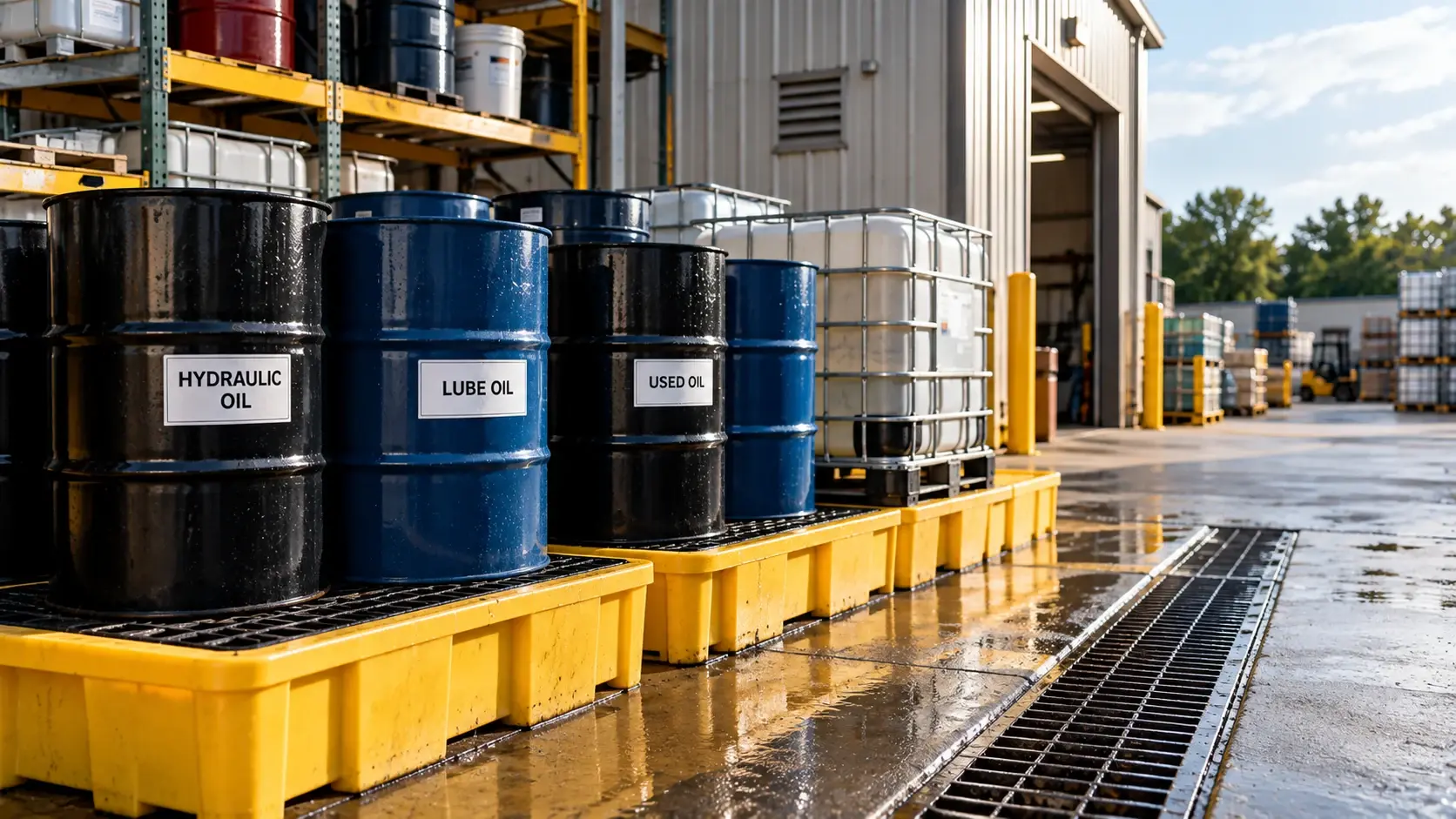
Once you're over the threshold, your drums aren't just a line on an inventory sheet. Under 40 CFR 112.8(c)(11), drums, totes, and other portable oil containers have to be positioned so a leak won't reach a drain or the outdoors, and they need secondary containment that can hold at least the capacity of the largest single container in that area. If the storage is outside, the containment also needs enough extra room (freeboard) to hold rainwater on top of that. For a drum-only area, that usually means room for one full drum plus rain if it's uncovered. Put a 330-gallon tote in the same area and the containment has to handle 330 gallons.
Secondary containment is any barrier that catches oil when the primary container fails: a sump under a pallet, a curb around a room, a sealed floor with no drains, or a prefabricated building with a built-in basin. It's also one of the items EPA inspectors look at first, because missing or undersized containment is visible from across the room. Other common gaps show up in our rundown of top SPCC plan violations and fines.
Don't forget where oil moves. The rule's general containment requirement in 112.7(c) also covers areas where you pump out of drums, fill equipment, or stage used oil for pickup. A drum on a spill pallet with a hand pump dripping onto bare concrete next to a floor drain is still a problem. For sizing math beyond drums, see how big your SPCC oil spill containment needs to be.
Oil Drum Containment Options: Spill Pallets, Cabinets, and Containment Buildings
There's no single right answer here. The best option depends on how many drums you keep, whether they're inside or outside, how often you pull from them, and whether you'd rather buy equipment or modify the building. Most shops end up with a mix.
| Option |
Best For |
Watch Out For |
| Drum spill pallets and decks (1, 2, 4, or 8 drum) |
Indoor drum storage, small to medium counts, flexible layouts |
Check the sump capacity rating covers a full drum, and keep the grate clear of rags and debris |
| Tote (IBC) containment pallets |
275 and 330-gallon totes of new or used oil |
Needs a sump sized for the full tote, which is a much bigger unit than a drum pallet |
| Containment cabinets and lockers |
A few drums near the work area, flammable liquids that also need fire code storage |
Limited capacity, and fire-rated cabinets have their own rules |
| Prefabricated containment buildings |
Outdoor storage of many drums or totes, keeping rain out of the containment |
Higher upfront cost, and placement may need local approvals |
| Curbed room or bermed floor area |
Large, permanent drum rooms where pallets would get in the way |
Floor drains inside the area must be sealed or plugged, and the volume has to be calculated and documented |
Spill pallets are usually the cheapest way to get compliant quickly, and they're easy to rearrange as inventory changes. Outdoor storage is where costs climb, since you need to deal with rainwater either by covering the area or by sizing for it and draining it properly. Whatever you choose, your plan has to describe it, and someone has to inspect it. Our list of things to check during monthly SPCC inspections works well as a starting checklist for drum areas.
Do Pennsylvania DEP Tank Rules Apply to Oil Drums and Totes?
Pennsylvania layers its own storage tank program on top of the federal rule. DEP runs it under the Storage Tank and Spill Prevention Act and 25 Pa. Code Chapter 245, and it's built around stationary tanks. For aboveground tanks, the state definition starts at stationary tanks larger than 250 gallons. Drums and totes that get moved around generally aren't what that program registers, so a shop full of drums usually deals with EPA's SPCC rule rather than DEP tank registration. A stationary used oil tank or diesel tank at the same shop is a different story, and it's worth checking against the state definition and its exemptions.
Two other rules often apply to drum storage. Used oil has its own handling and labeling requirements, which we cover in our top seven things to know about used oil regulations. Local fire code also governs how much flammable and combustible liquid you can keep in a building and how it's stored, and that's enforced by your municipality, so requirements vary from town to town. Check with your local fire marshal before you set up a new drum room.
What Does an SPCC Plan Cost for a Shop With Oil Drums?
The good news for drum-heavy shops is that most of them qualify for the simplest version of the plan. If your total aboveground capacity is 10,000 gallons or less, no single container is over 5,000 gallons, and you haven't had a significant oil spill to water in the last three years, you're a "Tier I qualified facility." That means you can self-certify using EPA's fill-in template without hiring a Professional Engineer. Some shops do that themselves and do it well, and we'll tell you so if that's the right path for you. Our explainer on Tier I self-certified SPCC plans walks through the details.
When shops do bring in help, SPCC Plans generally run from $2,500 to $15,000, and a drum-and-tote shop with no large tanks usually lands toward the bottom of that range. The plan also comes with ongoing work: regular inspections of the drum areas, annual spill prevention briefings for anyone who handles oil, and a review at least every five years. Our online environmental training library is one way to handle the training piece, and our full breakdown of SPCC plan costs covers what drives the price.
Skipping the plan isn't a cheap alternative. EPA can assess administrative penalties of up to $23,647 per day of violation for SPCC failures, with a cap of $295,564 for the larger class of administrative case, under the 2025 inflation figures in 40 CFR Part 19. And if you're sitting at 25 or 26 drums, there may be a legitimate way to stay under the line: trim inventory, move some products into containers smaller than 55 gallons, or get your used oil picked up more often. If you go that route, keep the numbers documented so you can show an inspector how you stay under. If you'd like a ballpark for RMA's help preparing or reviewing a plan, our pricing calculator is below.
How RMA Helps Pennsylvania Shops With Oil Drum Storage and SPCC Plans
We've spent more than 30 years helping facilities sort out exactly this kind of question. We're based in New Jersey and work with shops and manufacturers across Pennsylvania, and we can help you count your containers and oil-filled equipment, figure out whether you're over the threshold, choose containment that fits how your floor runs, and prepare or review a plan that holds up when EPA Region 3 walks in. Senior staff do the work, and if a self-certified template is all you need, we'll say so.
There's no pressure and no obligation. Give us a call, send an email, or fill out the form on our website, and you can contact RMA whenever you're ready. We're happy to talk it through, even if all you need is a second set of eyes on your drum count.