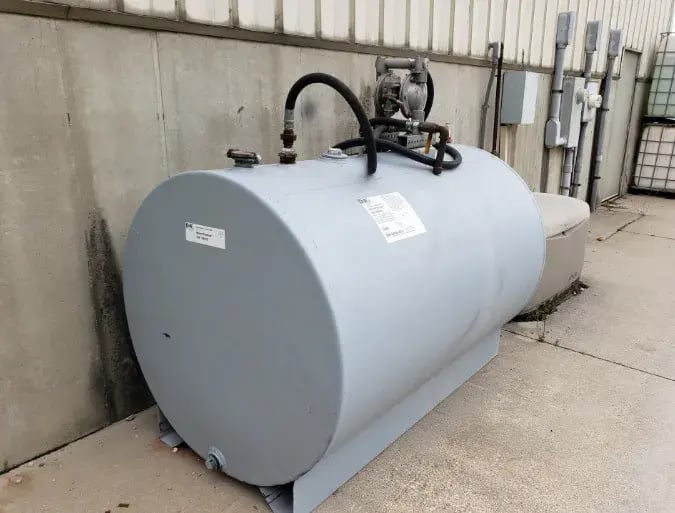
What EPA's Free Template, Your Own Time, Containment Fixes, and Optional Consultant Help Add Up To for a Small Oil Storage Facility
If you run a small shop, garage, maintenance yard, farm, or other site with a few oil tanks, drums, or a generator, you've probably been told you need a Spill Prevention, Control, and Countermeasure (SPCC) plan, and you're wondering what that's going to cost. For the smallest facilities, the federal rule lets the owner write the plan on a short EPA form. That version is called a Tier I plan. The direct price of the paperwork can be close to zero, but close to zero isn't the same as free, and the real total depends on a few things the form doesn't spell out.
This article breaks down where the money and time go for a Tier I plan in New Jersey: the template, your own hours, any containment or equipment fixes the plan turns up, and the optional help of a consultant to fill it out correctly. We use RMA's published ranges where they apply and explain what pushes the total up. If you'd like someone to look at your site and tell you what you're facing, you can reach out to RMA anytime.
Table of Contents
TL;DR
A small facility can write its own Tier I SPCC plan on EPA's free template, and the plan is kept on site instead of being filed with an agency, so the direct cost can be zero. The real costs are your own time, any secondary containment or equipment fixes the plan shows you need, and optional consultant help. For RMA, updating a simple Tier I plan runs about $1,500, and having a new self-certified plan written is roughly $2,500 to $5,000. Costs climb with more containers, containment gaps, travel, rush timelines, and anything that knocks you out of Tier I eligibility.
Which Facilities Qualify for a Tier I SPCC Plan?
Before you can price a Tier I plan, you have to know whether you can use one. The SPCC rule applies to a facility that stores more than 1,320 gallons of oil total in aboveground containers of 55 gallons or more, or more than 42,000 gallons in completely buried storage. Oil here is broader than motor oil. Diesel, gasoline, hydraulic oil, lube oil, transformer oil, and vegetable oils count, and the number is based on what the containers can hold, not how full they are. Drums, totes, tanks, generators with fuel tanks, and oil-filled equipment all go into the count. Our guide on whether 55-gallon drums count toward SPCC is a good check if your total sits near the line.
Once you're covered, a facility can use a Tier I plan only if it meets every condition in the federal definition of a qualified facility, found in 40 CFR 112.3(g). The table below shows the conditions.
| Condition |
Tier I Limit |
| Total aboveground oil storage capacity |
10,000 gallons or less |
| Largest single aboveground container |
5,000 gallons or less |
| Single oil discharge in the past three years |
None over 1,000 gallons |
| Repeat discharges in the past three years |
No two discharges over 42 gallons each within any 12-month period |
Discharges caused by natural disasters, acts of war, or terrorism aren't counted, and a facility that's been operating less than three years looks back to the day it became subject to the rule. A facility with a tank over 5,000 gallons moves up to a self-certified Tier II plan, and one with more than 10,000 gallons in total, or one that needs to deviate from the rule's requirements, needs a plan reviewed and certified by a Professional Engineer. We cover the differences in our articles on Tier I self-certified plans, the different types of SPCC plans, and when a Professional Engineer is involved.
Can You Write a Tier I SPCC Plan With EPA's Free Template?
Yes. EPA publishes the Tier I template as Appendix G to 40 CFR Part 112, and the owner or operator of a qualifying facility can fill it out, sign the self-certification, and use it as the plan. There's no fee to EPA for the template, no Professional Engineer stamp, and no application to file. The plan is kept at the facility and shown to an inspector if one asks. Our New Jersey SPCC guide notes that New Jersey doesn't charge a state fee for an SPCC plan, and that EPA's free template is a workable starting point for many small sites. We tell people that plainly, because if the template does the job, you shouldn't be paying anyone to do it for you.
The template walks you through the facility's information, a list of containers with their capacities, a prediction of where oil would flow if each type of equipment failed, secondary containment for the larger containers, overfill prevention, inspection and testing, training, and spill response contacts. When you sign it, you're certifying that you've visited the facility, that it meets the Tier I conditions, that management approves the plan, and that you'll carry it out. That last part is where the cost hides. A signed template with nothing behind it is worth about what you paid for it.
The common trouble spots are easy to name. Capacities get counted by contents instead of by what the container holds. Secondary containment is sized for the tank but not for rain falling in an open dike. Inspections are written into the plan and never happen. Pieces of the form are marked not applicable when they are. In New Jersey, EPA Region 2 enforces the SPCC rule, and while NJDEP and local inspectors don't usually ask for your plan, a concern spotted on a site visit can be passed along. Our article on the most overlooked SPCC requirements lists the items inspectors tend to find missing.
How Much of Your Own Time Does a Tier I SPCC Plan Take?
Your time is the largest cost of the do-it-yourself route, and it's the one nobody puts in a budget. Start with the inventory. Someone has to walk the site and list every container of 55 gallons or more, write down what each one holds, and note where it sits, what's around it, and where a spill would travel. Then comes a facility diagram, a look at the containment, and a set of written procedures for inspections, fueling, and spill response. For a simple site with a handful of containers, this is a few focused sessions. For a site with several buildings, mobile equipment, and a mix of tanks and drums, it takes longer, and the plan is only as good as the walk-through behind it.
The work doesn't end when the plan is signed. Someone has to carry out the inspections the plan describes and keep the records, and SPCC inspection and test records are generally kept for three years. Staff who handle oil need a discharge prevention briefing at least once a year, which you can handle in-house or through our online environmental training library. Our guides on annual SPCC training and monthly SPCC inspections explain what that looks like in practice.
Finally, the plan has to be reviewed at least every five years and updated when something about the facility changes in a way that affects spill risk, like adding a tank, moving a drum area, or changing how you fuel equipment. A technical amendment to a Tier I plan has to be certified again by the owner. Our article on SPCC plan five-year reviews walks through that cycle. If you're writing the plan yourself, put those review dates on a calendar now so they don't surprise you later.

What Do Containment and Equipment Fixes Add to a Tier I SPCC Plan Budget?
This is the cost people don't see coming. A plan describes what your facility does, and filling out the form is how you find out what it doesn't do yet. The Tier I rule expects containers above the smallest size to have secondary containment large enough to hold the largest single container plus room for rainfall, and it expects overfill protection on tanks, either a device or a documented procedure, that you test. If your drums sit on bare pavement or your outdoor tank has a dike that fills with rainwater, you've just found a line item. Our guide on how big SPCC containment needs to be explains the sizing math, including why 110 percent of the largest tank isn't always enough outdoors.
What these fixes cost swings a lot, and we won't guess at a number for your site. Some are small purchases, like spill pallets for drums, drip pans under fittings, container labels, a spill kit, and a written fueling procedure. Others are real projects, like building a curb or dike, moving a tank, or replacing a container that's corroded. The price tracks how many containers you have, how far you are from compliant, and whether the fix is something your own maintenance staff can handle. One way to keep this from blowing up the budget is to look at the containment before you write the plan, so you know what you're signing up for.
If a fix involves construction, such as pouring a containment pad, installing a new tank, or adding a dike, you may be dealing with local construction and fire code approvals. RMA doesn't prepare construction-phase permits, so that part goes through your engineer, contractor, and local officials. Where we help is the part that comes after, which is making sure the finished setup is accurately described in your SPCC plan and that your inspection and training routine is ready to go.
How Much Does Consultant Help With a Tier I SPCC Plan Cost?
Consultant help is optional for a Tier I plan, and there's a range of ways to use it. Some owners fill out the template and want a second set of eyes before they sign. Others would rather hand over the whole job. A few already have a plan and just need it updated. The table lays out the options and what each one tends to cost, using RMA's published ranges where we have them.
| Option |
What You Do |
Typical Cost |
| EPA template on your own |
Fill it out, self-certify, and carry it out |
No fee for the template, plus your time and any fixes |
| Template plus a consultant review |
Write it yourself and have someone check it before you sign |
Less than writing a plan from scratch, priced by facility |
| Update of an existing simple Tier I plan |
Provide your current plan and what changed |
About $1,500 at RMA |
| New self-certified plan written for you |
Answer questions, share site details, and sign |
Roughly $2,500 to $5,000 at RMA |
| Plan reviewed and certified by a Professional Engineer |
Needed if you no longer qualify for self-certification |
$4,000 to $10,000 or more at RMA |
The simplest sites sit at the bottom of those ranges. A small garage with a few containers can come in around $1,500, while a bigger site with a lot of containers and extensive containment work can climb far past the ranges above. Our SPCC plan cost guide goes through the full range of what we charge and why, and the pricing calculator below gives you an estimate for your own facility based on a few quick answers. It's there to help you get a feel for what our help would cost, not to tell you what the plan itself costs.
A couple of practical notes on shopping for help. Remote development, where a consultant builds the plan from your photos, diagrams, and a call instead of a site visit, can lower the total for a simple facility, and our guide on how remote SPCC development works covers when it's a good fit. And the cheapest quote isn't always the least expensive plan. A plan that gets signed without a site look, or one that can't be defended in an inspection, usually costs more to fix than the first quote saved.
What Drives the Cost of a Tier I SPCC Plan Up?
Two facilities that both qualify for Tier I can end up with very different totals. Most of the difference comes from a short list of factors, and knowing them lets you predict where your site will land.
| Cost Driver |
Why It Raises the Cost |
| Number and type of containers |
Each tank, drum area, generator, and piece of oil-filled equipment needs to be listed, evaluated, and covered by the failure analysis |
| Containment gaps |
Undersized dikes, no rainwater allowance, or drums on bare ground mean fixes before the plan can be honestly signed |
| Losing Tier I eligibility |
A tank over 5,000 gallons, more than 10,000 gallons total, or a qualifying discharge history pushes you to Tier II or a Professional Engineer certified plan |
| Needing to deviate from the rule |
If a requirement can't be met as written, a Professional Engineer has to certify the alternative |
| Multiple sites or buildings |
Each location needs its own plan, though bulk work for several sites can bring the per-plan cost down |
| Travel and site location |
A site visit is valuable for most plans, and distance adds time and expense |
| Rush timelines |
Needing a plan by a lender, insurer, or inspector deadline can carry a premium |
| Starting point |
An existing, well-kept plan is cheap to update, while an outdated or missing one means starting over |
New Jersey adds one more layer to watch. Some facilities that store large quantities of oil or other hazardous substances count as major facilities under N.J.A.C. 7:1E and need a separate state plan, called a Discharge Prevention, Containment and Countermeasure (DPCC) plan. A Tier I facility stores oil in modest amounts, but if you also store hazardous substances, check the rule against your own inventory. Our guide to SPCC plans in New Jersey explains how the federal and state pieces fit together. An existing plan can also be brought up to date for far less than a new one, as we explain in can I get my SPCC plan updated.
How Can RMA Help With a Tier I SPCC Plan in New Jersey?
We're a family-run environmental consulting firm based in New Jersey, and we've been helping facilities with SPCC plans since 1992. For a Tier I facility, that can mean anything from a quick review of a template you've filled out to writing the whole plan, walking your site with you, and getting your inspection and training routine in place. If you're keeping the job in-house, we're glad to point you to the right free resources. A good number of small sites do fine on their own, and we'd rather tell you that than sell you something you don't need.
If you're not sure whether you qualify for Tier I, want someone to check your work, or would just like a number for your site, you can call us at 888-RMA-0230, email info@rmagreen.com, or fill out the form on our website. There's no obligation and no pressure, and we'll tell you if we're not the right fit. You can contact RMA here whenever you're ready.