How Oil Capacity, Covered Containers, Discharge Potential, and Exclusions Decide Whether You Need an SPCC Plan
If an insurer, a lender, or a customer has asked for your "SPCC Plan" and you've never heard the term, you're in good company. SPCC stands for Spill Prevention, Control, and Countermeasure. In plain terms, it's a written oil spill plan that EPA requires from facilities that store enough oil, close enough to water, that a release could reach it. Whether you need one comes down to three questions: what kind of facility you run, how much oil your containers can hold, and whether a spill could reasonably reach a waterway. For most New Jersey facilities with more than 1,320 gallons of oil capacity in containers of 55 gallons or larger, the answer is yes.
In this article we walk through how to add up your capacity, which containers count, which ones are excluded, what the "reasonable expectation" test means in a state where nearly every site drains to something, and how New Jersey's own discharge rules apply whether or not you need the federal plan. If you'd rather have someone check your numbers, you can reach out to RMA and we'll tell you whether you need a plan, including when the answer is no.
Table of Contents
TL;DR
You need an SPCC Plan if your facility isn't transportation-related, stores more than 1,320 gallons of oil in aboveground containers of 55 gallons or larger (or more than 42,000 gallons completely buried), and a spill could reasonably reach navigable waters or adjoining shorelines. Count what your containers can hold, not what's in them, and include oil-filled equipment, vegetable oil, and animal fat. Motive power tanks, milk containers, permanently closed containers, and a few other items are excluded. Because New Jersey has so many streams, storm drains, and wetlands, capacity is usually the number that decides it.
What Is an SPCC Plan and Which New Jersey Facilities Need One?
SPCC is a federal rule, found at 40 CFR Part 112 and issued under the Clean Water Act. It requires certain facilities to write down, and then follow, a plan for preventing oil spills, containing one if it happens, and responding to it. EPA Region 2 enforces the rule in New Jersey, and NJDEP separately enforces the state's own discharge rules, which we cover further down. If you want the full picture of who inspects and who fines, our article on who enforces SPCC plans covers it.
A facility needs an SPCC Plan when all three of these are true. First, it's a non-transportation-related facility, meaning a fixed site that stores, uses, transfers, or consumes oil, as opposed to a pipeline, truck, or railcar under Department of Transportation jurisdiction. Second, it's over the oil storage capacity thresholds. Third, a spill could reasonably be expected to reach navigable waters or adjoining shorelines. The owner or operator makes that determination, and EPA can review it. For a plain-language overview, see what an SPCC plan is, and for a shorter version of this walkthrough there's our guide to the four steps to figure out if you need an SPCC plan.
What Counts as Oil Under the SPCC Rule?
The rule defines oil as oil of any kind or in any form. That covers petroleum oils like diesel, gasoline, heating oil, motor oil, hydraulic oil, lubricating oil, transformer oil, and used oil. It also covers animal fats and vegetable oils, so cooking oil and used cooking oil count, along with other non-petroleum oils and greases. Propane and natural gas don't count. If you run a commercial kitchen or a food plant, our article on whether you need an SPCC plan for cooking oil goes into the details.
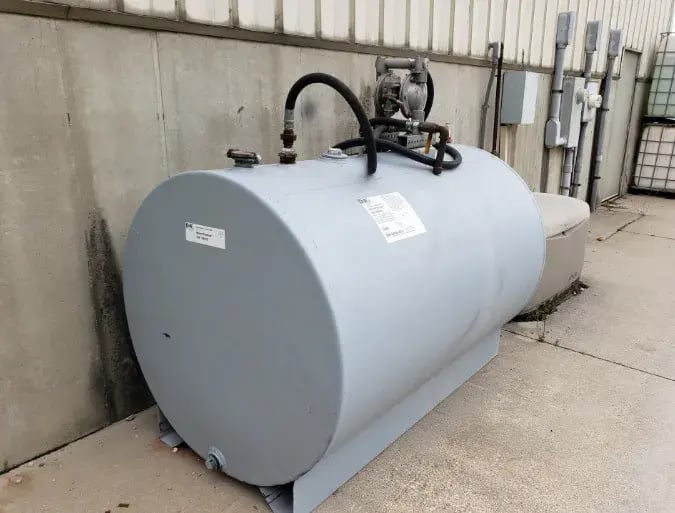
Oil doesn't have to be sitting in a storage tank to count. Oil-filled equipment like transformers, hydraulic systems, and the fuel tanks that feed backup generators adds to your total. Our article on emergency backup generators and environmental permits explains how generators fit in. Here's where oil tends to hide at different kinds of facilities:
| Type of Site |
Common Oil Containers That Count Toward the Total |
| Facilities with backup power |
Diesel sub-base tanks, day tanks, and bulk fuel tanks feeding generators |
| Electrical yards and substations |
Oil-filled transformers, breakers, and switches |
| Maintenance shops and fleet yards |
Drums and totes of motor oil and hydraulic oil, used oil tanks, aboveground fuel tanks |
| Food and beverage operations |
Cooking oil totes, used cooking oil tanks, grease containers |
| Manufacturing and concrete plants |
Hydraulic and lubricating oil reservoirs, diesel tanks for equipment, bulk lubricant storage |
How Do You Add Up Oil Storage Capacity Against the 1,320-Gallon SPCC Threshold?
Add up the shell capacity of every aboveground container that holds 55 gallons or more. If the total is more than 1,320 gallons, you've met the capacity test. The number is the total across the whole facility, not the size of your largest tank, so five 330-gallon totes put you over the line even though none of them looks large on its own.
Capacity counts, not contents. A 1,000-gallon tank sitting at 200 gallons counts as 1,000, and an empty tank still counts until it's been permanently closed. Containers smaller than 55 gallons, like 5-gallon pails and 30-gallon drums, don't count toward the total. Here's what the math looks like for a typical small facility:
| Container |
Capacity Counted (Gallons) |
| Diesel generator sub-base tank |
600 |
| Used oil tote |
275 |
| Six 55-gallon drums of lubricant and hydraulic oil |
330 |
| Oil-filled transformer |
250 |
| A dozen 5-gallon pails of oil |
0 (under 55 gallons each) |
| Total |
1,455, which is over the 1,320 threshold |
Tanks that are partially buried, bunkered, or sitting in a vault or basement count as aboveground storage. Portable containers like drums and totes count when they're stored at the facility. Completely buried tanks have their own threshold: more than 42,000 gallons of completely buried oil storage capacity meets the capacity test. Buried tanks that are subject to the federal underground storage tank rules in 40 CFR Part 280, or to an approved state program, don't count toward that number. In New Jersey, NJDEP runs the underground storage tank program under N.J.A.C. 7:14B. A facility with regulated buried tanks still counts its aboveground oil separately. Our article on 55-gallon drums and SPCC plans covers the drum question in more depth, and once you know you're covered, how big your secondary containment needs to be is the next question to answer.
Which Containers and Equipment Are Excluded From SPCC Capacity Calculations?
Several kinds of containers and facilities are carved out of the rule, and their capacity doesn't count toward the 1,320-gallon total. These are the exclusions you're most likely to run into:
| Exclusion |
What It Covers |
| Containers under 55 gallons |
Pails, small drums, and other containers below the 55-gallon cutoff |
| Permanently closed containers |
Containers that have been emptied, disconnected from piping, closed off, and marked as permanently closed |
| Motive power containers |
Onboard fuel tanks that power a moving vehicle, like a truck, forklift, or bulldozer |
| Hot-mix asphalt |
Hot-mix asphalt and any container holding it |
| Single-family residential heating oil |
Heating oil containers used solely at a single-family home, not at a business or multi-unit building |
| Pesticide application equipment |
Application equipment and related mix containers |
| Milk and milk product containers |
Containers plus their associated piping and appurtenances |
| Wastewater treatment facilities |
A facility, or part of one, used exclusively for wastewater treatment |
Two points tend to trip people up. The exclusions apply container by container, so exempt items come off your total but everything else stays on it. And the motive power exclusion is narrow. A fuel tank that powers a moving vehicle is exempt, but a diesel tank feeding a stationary generator isn't, and neither is the bulk tank you use to fuel your fleet. Even for a motive power container, the transfer of fuel into it at an otherwise regulated facility isn't excluded.
If you're close to the line, these exclusions can be what keeps you under it, so it's worth documenting which containers you've left out and why. If you're well over the line even after exclusions, the next question is location.
What Does "Reasonable Expectation of a Discharge" Mean for a New Jersey Facility?
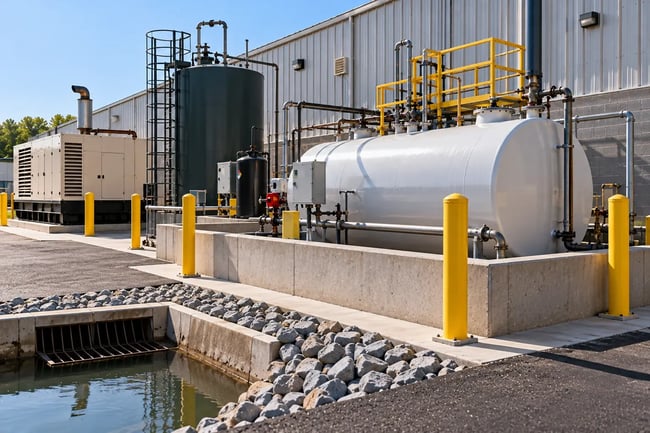
The third test asks whether a spill from your site could reasonably be expected to reach navigable waters of the United States or adjoining shorelines in harmful quantities. The rule doesn't define "reasonably expected," so EPA's guidance fills the gap. It points owners to geography and location: how far you are from water, which way the ground slopes, what the soil is like, and what drainage pathways connect your site to a creek, river, wetland, or bay. EPA's guidance says to judge this on location alone, which means you can't count dikes, curbs, berms, or other manmade structures as a reason a spill wouldn't get out.
New Jersey is a hard place to argue the location test away. The state is crisscrossed with streams, tidal marshes, ditches, and storm drains, and a storm drain in your parking lot that discharges to a creek is a pathway to water. A facility across the road from a stream, or on a lot that drains to a roadside ditch, can still meet the test. Which waters count under federal law has also shifted through court decisions and rulemaking in recent years, so we wouldn't base a decision on whether a nearby ditch looks like a stream. Once the capacity test is met, the location test rarely takes a New Jersey facility out of the rule. If you believe your site really can't reach water, write down your reasoning, because the determination is yours to make and EPA can review it.
Do New Jersey's Spill Act and DPCC Rules Apply Even If You Don't Need an SPCC Plan?
They can, because SPCC is only the federal layer. New Jersey's Spill Compensation and Control Act, usually called the Spill Act, covers petroleum and other hazardous substances, and it applies to you whether or not you need an SPCC Plan. The Spill Act holds anyone who discharges a hazardous substance, or is in any way responsible for one, strictly liable, jointly and severally, for cleanup and removal costs, regardless of fault. In general terms, that means the cost of a spill can land on you whether or not you caused it. Liability questions are a job for an environmental attorney, and we'd suggest talking to one if you're facing a real discharge.
Reporting is part of that. Under N.J.A.C. 7:1E-5.3, a person responsible for a discharge who knows or reasonably should know about it has to notify NJDEP immediately through its 24-hour hotline, 1-877-WARNDEP (1-877-927-6337). The rule includes narrow exceptions, so check it before assuming your spill qualifies for one. If a spill is an emergency, call 911 first. Our article on when you have to report an oil spill covers the federal side of reporting.
The bigger state requirement is for what NJDEP calls "major facilities" under N.J.A.C. 7:1E. A major facility has to prepare Discharge Prevention, Containment, and Countermeasure (DPCC) and Discharge Cleanup and Removal (DCR) plans and submit them to NJDEP for approval. Whether you're a major facility depends on your total storage capacity of petroleum and other hazardous substances. The long-standing thresholds are 200,000 gallons or more of all hazardous substances including petroleum, or 20,000 gallons or more of non-petroleum hazardous substances, but NJDEP has proposed amendments to these rules in recent years. Check the current text of N.J.A.C. 7:1E against your own inventory before relying on any number. A facility that's adding storage to reach major facility status has to submit its plans at least 180 days before it begins operating as a major facility. A DPCC and DCR plan is a separate state requirement, so your SPCC status doesn't answer the question either way.
Two other New Jersey pieces are worth knowing about. If a spill reaches soil or groundwater, cleanup in New Jersey is typically overseen through a Licensed Site Remediation Professional (LSRP). And local fire officials enforce the Uniform Fire Code on flammable and combustible liquid storage, which is a separate set of rules from SPCC. For the full New Jersey picture, see our article on SPCC plans in New Jersey.
What If You're Adding Oil Tanks or Opening a New Facility in New Jersey?
Capacity is counted as installed, so a project can push you over the threshold without anyone noticing. A site with 500 gallons of oil storage that adds a 1,000-gallon generator tank is now at 1,500. A new facility needs its SPCC Plan prepared and in place before oil operations begin, and an existing facility that adds tanks or changes how it handles oil usually has to amend its plan. Our article on updating an SPCC plan explains when an update is enough.
The construction side is separate, and it isn't something RMA handles. Installing tanks typically brings construction and fire permits from local officials, installing an underground tank requires NJDEP-certified contractors, and disturbing soil can trigger soil erosion and sediment control approval through the local Soil Conservation District along with construction stormwater coverage. We don't prepare those construction-phase permits and approvals. Most owners work with their engineer, contractor, or a soil erosion specialist on them, and we're glad to help you work out what the construction phase needs and point you toward the right people.
Where we help is once the facility is running. A new or expanded facility almost always needs operational plans and procedures, including an SPCC Plan or amendment, DPCC and DCR plans if it's a major facility, spill reporting procedures, inspections, and employee training. Many also have Community Right to Know reporting. Our online environmental training library covers the training piece, so your team is ready before the first delivery of oil arrives.
What Does an SPCC Plan Cost Once You Know You Need One?
For RMA's help, a new SPCC Plan generally runs from about $2,500 to $15,000. What moves the price is your total storage capacity, the number and type of containers, whether secondary containment needs to be evaluated, and whether a Professional Engineer has to certify the plan. Updating an existing plan is cheaper: a simple update costs about $1,500, and a complex update that needs PE certification starts around $7,500. Larger or more complex facilities need a licensed PE to review and certify the plan, and some consulting firms have an engineer on staff while others work with a trusted outside PE. It's worth asking any firm who's certifying your plan and how that affects the price. Our article on SPCC plan costs goes through the price factors, and the pricing calculator below shows what it would cost for RMA to help with your facility.
How Can RMA Help You Decide Whether You Need an SPCC Plan?
Plenty of facilities can do the math on their own. If you can list your containers and their capacities in an afternoon and you're clearly under 1,320 gallons, or everything you store is excluded, you may not need us at all. If the total is close, if you're not sure how the location test applies to your site, or if you'd like help sorting out how the federal SPCC rule and New Jersey's discharge rules stack together, we're glad to walk through it with you. We're a family-run firm based in New Jersey, we've been working with these rules since 1992, and senior staff do the work.
There's no pressure and no obligation. You can call, email, or fill out the form on our website, and we'll tell you where you stand. You can also browse our SPCC library for more guides, or contact RMA whenever you're ready.