How to Check Oil Storage Capacity, Regulated Containers, Discharge Potential, and Exclusions Before You Decide
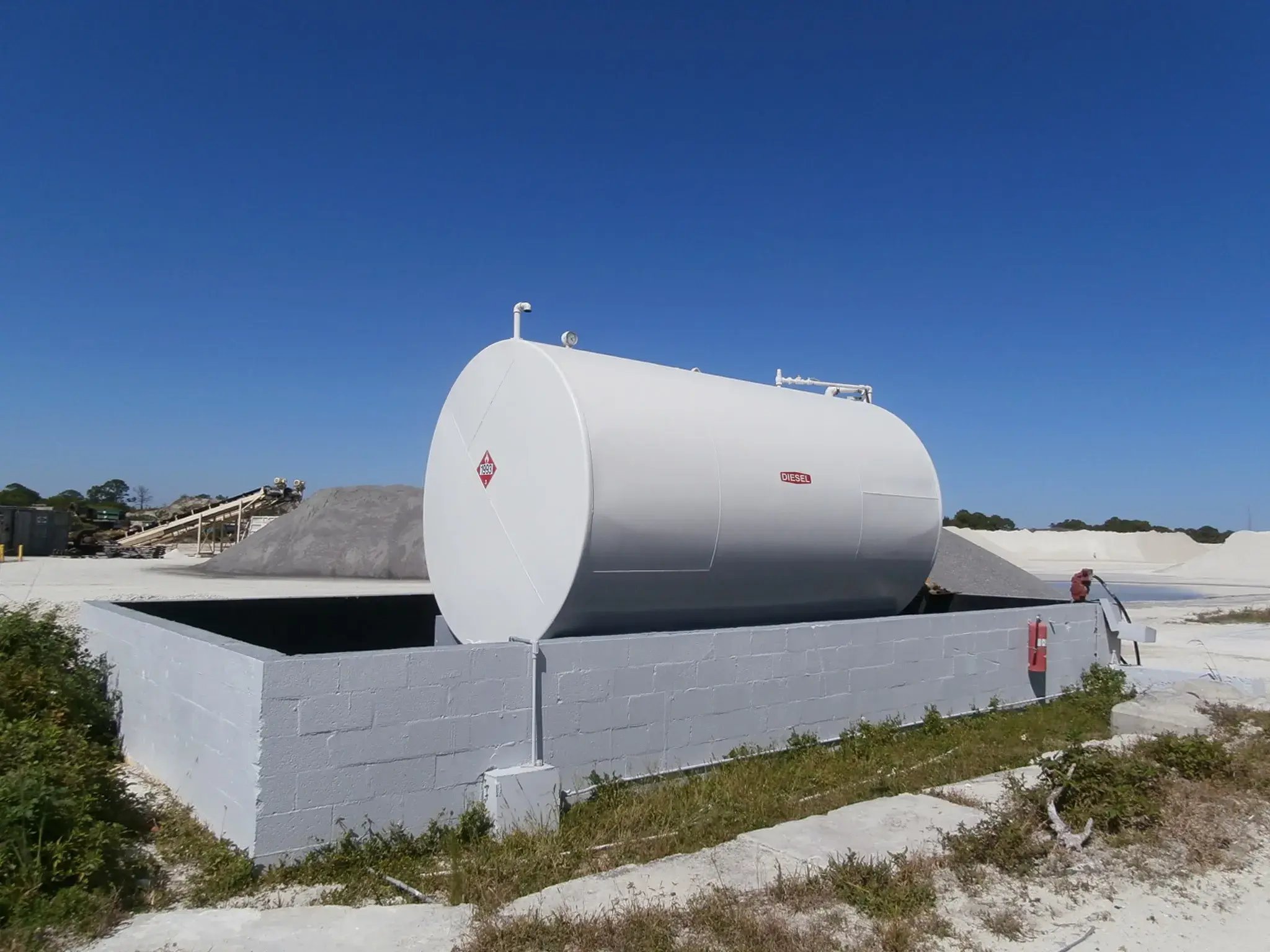
If your Pennsylvania facility stores diesel, hydraulic oil, lube oil, or even cooking oil, a federal oil spill rule may cover you without anyone ever telling you so. The rule is the Spill Prevention, Control, and Countermeasure rule, and the written oil spill plan it requires is called an SPCC Plan. The short answer is that you need one when your facility holds more than 1,320 gallons of oil in aboveground containers of 55 gallons or larger (or more than 42,000 gallons buried), and a spill could reasonably reach a creek, river, or other waterway. Nobody sends a letter when you cross that line. You make the call, and EPA decides later, usually at an inspection, whether you got it right.
This article walks through each test in order: the capacity threshold, what counts toward it, the chance of a discharge reaching water, and the exclusions that can take containers out of the math. We also cover how Pennsylvania's separate tank rules fit alongside the federal rule, and what changes if you're building or expanding. If you'd rather talk it through with someone, you can reach out to RMA, and if you land under the threshold we'll tell you that too. For a broader overview of the plan itself, see our guide on what an SPCC Plan is, or browse our SPCC resource library.
Table of Contents
TL;DR
A Pennsylvania facility needs an SPCC Plan when it has more than 1,320 gallons of aboveground oil storage, counting only containers of 55 gallons or more, or more than 42,000 gallons buried, and a spill could reasonably reach a waterway based on location alone. Capacity means what a container can hold, not what's in it, and oil-filled equipment, vegetable oils, and animal fats all count. Permanently closed containers, vehicle fuel tanks, and a handful of other items don't. Pennsylvania's DEP storage tank program is a separate set of rules that can apply even when the federal plan doesn't.
Who Decides Whether a Pennsylvania Facility Needs an SPCC Plan?
The SPCC rule lives in 40 CFR Part 112, and in Pennsylvania it's enforced by EPA Region 3 out of Philadelphia. EPA doesn't review or approve plans ahead of time, and you don't send yours to anyone. The owner or operator decides whether the rule applies, writes the plan, keeps a copy at the facility if the site is staffed at least four hours a day, and has it ready when an inspector asks to see it. EPA's Regional Administrator can also require a plan from a facility that didn't think it needed one. That's uncommon, but it's written into the rule.
A wrong guess costs you either way. If you assume you're covered when you aren't, you pay for a plan you didn't need. If you assume you're not covered when you are, you find out during an inspection or after a spill, which is a much worse time to learn it. The rest of this article is meant to help you land on the right answer and write down how you got there. Our guide on who enforces SPCC plans covers the enforcement side in more detail.
What Are the Three Tests for Needing an SPCC Plan?
A facility is covered when it passes all three tests below. Fail any one of them and the rule doesn't apply.
| Test |
What the rule asks |
| 1. Activity |
Is it a non-transportation-related facility that stores, transfers, distributes, processes, uses, or consumes oil? |
| 2. Capacity |
Does it have more than 1,320 gallons of aboveground oil storage (containers of 55 gallons or more only), or more than 42,000 gallons of completely buried storage? |
| 3. Location |
Could a spill reasonably be expected to reach navigable waters or adjoining shorelines in harmful quantities, judged by geography alone? |
The first test catches nearly every industrial and commercial site, because a facility that only burns fuel in a generator still "uses" oil. The second and third tests do the real sorting, and most of this article is about them. If you pass all three, the next question is what kind of plan you need. A facility with 10,000 gallons or less in total aboveground storage and a clean spill history can often self-certify its own plan, and a Tier I facility (no single container over 5,000 gallons) can use EPA's template to do it. Larger or more complicated sites need a licensed professional engineer to review and certify the plan. We break down the different types of SPCC plans in a separate guide, and plenty of facilities do write their own Tier I plan without any outside help.
How Do You Count Oil Storage Toward the 1,320-Gallon SPCC Threshold?
Start by listing every container at the facility that holds 55 gallons or more, then add up their full shell capacity. It's capacity that counts, not what's inside today, so a half-empty tank counts at its full size and an empty one counts too. Containers under 55 gallons are left out of the total, which means a shelf of five-gallon pails doesn't move the number but a single 55-gallon drum does. If drums are the main question at your site, our article on whether 55-gallon drums are included in SPCC plans goes through it.
Which Oils and Equipment Count Toward the Total?
"Oil" in this rule is broad. It covers petroleum products of every kind (diesel, gasoline, fuel oil, hydraulic oil, lube oil, mineral oil, synthetic oil, and used oil) and it also covers vegetable oils and animal fats. That's why a restaurant supplier or a food plant with large cooking oil tanks can be covered, and our piece on SPCC plans for cooking oil explains where that line falls. Propane and diesel exhaust fluid aren't oil, so they stay out of the count.
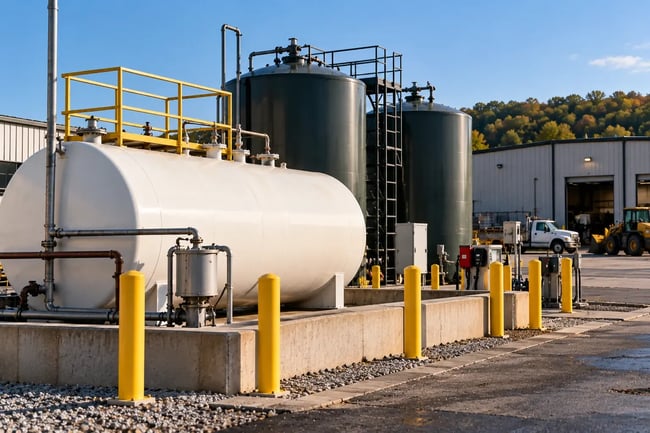
The oil inside equipment counts toward your total as well. Transformers, hydraulic systems, gearboxes, compressors, and machining coolant systems all hold oil that goes on the tally, even though the rule treats that equipment differently from a bulk storage tank when it comes to containment and inspections. Backup generators are a common surprise, since the sub-base tank, day tank, and any bulk tank feeding the unit all count. We cover the permitting side of those in our guide to emergency backup generators and environmental permits, and data centers, which often have several generators plus fuel storage, have their own SPCC guide.
What Counting Mistakes Push a Facility Over the Line?
A few details trip people up. Partially buried tanks, bunkered tanks, and tanks in vaults all count as aboveground containers. Standby, seasonal, and temporary storage counts too, so the tank you only fill in winter still goes on the list. And the rule defines a facility by ownership and operation rather than by the property line, so contiguous or non-contiguous buildings and parcels under the same operation can be treated as separate facilities. How you draw the boundary changes the total, so settle it before you start adding. The example below shows how a site that feels small can still tip over.
| Example item |
Capacity |
Counted? |
| Diesel generator tank |
500 gallons |
Yes, 500 |
| Hydraulic oil tote |
330 gallons |
Yes, 330 |
| Four drums of motor oil |
220 gallons |
Yes, 220 |
| Mineral oil transformer |
300 gallons |
Yes, 300 |
| Propane tank |
1,000 gallons |
No, not oil |
| Ten five-gallon pails |
50 gallons |
No, under 55 gallons each |
| Total counted |
|
1,350 gallons, over the 1,320 threshold |
What Does a Reasonable Expectation of an Oil Discharge Mean in Pennsylvania?
Passing the capacity test only matters if the third test applies too. The rule asks whether your facility, because of where it sits, could reasonably be expected to discharge oil in harmful quantities into navigable waters or onto adjoining shorelines. "Navigable waters" here means waters of the United States as defined in 40 CFR 120.2, which can include streams and some wetlands depending on how they connect to larger waters.
The key detail is what you're allowed to consider. The rule says the determination must rest solely on geography and location: how close you are to water, the contour of the land, and where drainage goes. It specifically tells you to ignore dikes, berms, containment, equipment, and other manmade structures that might hold a spill back. That catches a lot of people, because they point to their secondary containment as proof that oil could never leave the site. Containment is a requirement of the plan, not a way to avoid needing one.
Pennsylvania has creeks, ditches, and storm drains nearly everywhere, so plenty of facilities pass this test. Think about the path a spill would take. A paved lot that slopes to a storm drain, a swale that runs to a stream, or a roadside ditch that eventually connects to a creek can all be pathways. EPA's guidance materials treat a ditch that leads to a regulated water as a pathway even when the ditch itself isn't one, and they note that groundwater connected to surface water can matter too. There's no set distance. EPA Region 3 enforcement files describe Pennsylvania facilities by how far they sit from the nearest creek, such as one in Hazleton about 0.2 miles from Catawissa Creek, but a site farther away can still be covered when the drainage leads there.
This test is a judgment call, and the rule doesn't require you to write your conclusion down. We'd still recommend it, especially if you decide you're not covered. A short memo with a site map, a description of drainage, and the nearest water body gives you something to hand an inspector, and it's far easier to produce now than after the fact.
Which SPCC Exclusions and Exemptions Can Take Oil Out of the Count?
Several types of containers and operations are carved out of the rule, and removing them from your tally can drop a facility under the threshold. The table lists the ones we see most often, and the rule itself in 40 CFR 112.1(d) has the full list.
| Excluded or exempt item |
What to know |
| Containers under 55 gallons |
Left out of the capacity total. |
| Permanently closed containers |
Empty isn't enough. All liquid and sludge must be removed, lines disconnected and blanked off, valves closed and locked, and signs posted showing the container is permanently closed and the date. |
| Motive power containers |
The fuel tank on a truck or machine that powers its own movement. Fuel trailers, skid tanks, and mobile refuelers aren't exempt, and fueling a vehicle at an otherwise regulated facility isn't exempt either. |
| Completely buried tanks under the federal UST rules |
Tanks subject to all the technical requirements of 40 CFR Part 280 (or an approved state program) are excluded from SPCC. |
| Hot-mix asphalt and its containers |
Exempt from the rule. |
| Heating oil at a single-family residence |
Exempt, but only when used solely at the residence. |
| Pesticide application equipment and mix containers |
Exempt from the rule. |
| Milk and milk product containers |
Exempt, along with associated piping. |
| Wastewater treatment |
Covers a facility or part of one used exclusively for wastewater treatment. Producing, recovering, or recycling oil doesn't count as wastewater treatment. |
A few situations overlap with other regulators, and we won't try to settle them here. Oil production facilities have special SPCC provisions and also fall under DEP's oil and gas program. Mining sites can have their own state requirements alongside the federal rule. Storage tied to transportation, which DOT and the Coast Guard oversee, is treated differently from non-transportation storage, which is EPA's territory. If your operation sits near one of those lines, confirm which agency's rules govern each container before you subtract anything. The same goes for concrete and aggregate sites, where plant fuel storage and mobile equipment fueling are mixed together. Our article on whether a concrete plant needs an SPCC Plan walks through that setup.
How Do Pennsylvania's Storage Tank Rules Fit with the Federal SPCC Rule?
Pennsylvania has its own tank program, and it runs separately from the federal SPCC rule. DEP's Storage Tank Program operates under the Storage Tank and Spill Prevention Act of 1989 and its regulations at 25 Pa. Code Chapter 245. The state's tank rules took shape after the January 1988 collapse of a 3.5-million-gallon diesel tank in Floreffe, which sent nearly a million gallons toward the Monongahela River and pushed regulators at both the state and federal level to tighten oil storage requirements.
Under DEP's program, a regulated aboveground tank is one that's stationary, holds more than 250 gallons, contains a regulated substance such as petroleum, and doesn't qualify for an exemption in Chapter 245. Those tanks must be registered and permitted with DEP, and the installation and inspection work is done by DEP-certified individuals and companies. Facilities with more than 21,000 gallons of regulated substances in total aboveground capacity, along with any single tank above that size, also have to file a Spill Prevention Response Plan (SPRP) with DEP. DEP's Division of Storage Tanks answers questions at 1-800-42-TANKS.
The two programs overlap, but neither one satisfies the other. Depending on how a container is used and whether an exemption applies, a lone 500-gallon stationary diesel tank could be a DEP-regulated tank while sitting far below the federal SPCC threshold. In the other direction, a site holding thousands of gallons in portable totes and drums can need an SPCC Plan without having a stationary tank that DEP regulates. Pennsylvania also uses a Preparedness, Prevention, and Contingency (PPC) Plan concept in some settings, and whether your operations bring it into play is a question for DEP. Fire code rules for tanks are set locally and vary by municipality, so check with your local fire marshal as well.
What Changes If You're Building or Expanding a Pennsylvania Facility?
A new or expanded facility that will meet the SPCC tests has to have its plan prepared and implemented before it begins operating. That means the plan is part of the schedule for opening day, not something to sort out after the tanks are in.
The construction phase has its own set of requirements, and we want to be plain that RMA doesn't prepare them. Construction stormwater permitting, Pennsylvania's Chapter 102 erosion and sediment control program, building and fire permits for tank installation, and the tank installation itself (which in Pennsylvania may require DEP-certified installers) all sit with your engineer, your contractor, or a soil erosion specialist. We can help you figure out which of those your project is likely to need and point you toward the right construction-phase professionals, but we don't file or manage them.
What we do handle is everything a facility needs once it's running: the SPCC Plan or amendment, help working through DEP tank registration requirements, inspection and testing programs, staff training, and often Tier II reporting for diesel and other stored chemicals. One more case to know about is temporary fuel storage on a construction site, which can fall under SPCC on its own, and RMA can help with that plan even though we don't handle the construction permits. The difference between the two plan types is covered in our guide to the difference between an SPCC Plan and a SWPPP.
What Are the Penalties for Missing a Required SPCC Plan?
Under Clean Water Act section 311(b)(7)(C), failing to comply with the oil pollution prevention regulations carries a civil penalty of up to $59,114 per day of violation, based on the inflation adjustment EPA published in 40 CFR 19.4 in January 2025. EPA adjusts these figures every year, so the current number may be a bit higher. Missing a plan altogether is only one way to land in that range. Inspectors also write up secondary containment gaps, missing inspection records, and lapsed training, and our breakdown of the top SPCC plan violations and fines covers the usual findings. As one EPA Region 3 example, the agency proposed a $46,769 penalty against a bulk plant operator for violations that included missing secondary containment on several tanks and gaps in rainwater drainage records.
Once you have a plan, it needs a fresh look every five years, and our guide on SPCC plan 5-year reviews explains what that involves. If you've received an EPA inspection notice or information request, it can make sense to talk with an environmental attorney before you respond.
What Does an SPCC Plan Cost If Your Facility Needs One?
Our SPCC Plans run from about $1,500 to $15,000 depending on the facility, and Tier I plans typically fall around $1,500 to $4,000. Where you land inside that range depends on a handful of things:
| Factor |
Pushes the price up |
Keeps it down |
| Storage capacity |
Large bulk tanks and total capacity well above 10,000 gallons |
Total capacity at or under 10,000 gallons |
| Number of containers |
Many tanks, totes, drums, and oil-filled equipment spread across the site |
A few containers in one area |
| PE certification |
A plan that needs a professional engineer to review, stamp, and seal it |
A Tier I or Tier II facility that can self-certify |
| Secondary containment |
Containment that has to be evaluated and sized |
Simple, already adequate containment |
We don't have a professional engineer on staff, so when a plan needs PE certification we work with an outside licensed engineer in the state the plan is for. Our team usually handles the site visit and builds the plan, then the engineer reviews, stamps, and seals it. That review is an added fee and adds some time. Our guide to professional engineers and SPCC plan requirements explains when it's required, and our full article on SPCC plan costs goes deeper on pricing. Initial SPCC training comes free with a new RMA plan. Our SPCC pricing calculator is below if you'd like a number for your own facility.
How Can RMA Help You Decide Whether You Need an SPCC Plan?
RMA is based in New Jersey and works with facilities across Pennsylvania. If you're not sure where your facility lands, we can walk through your containers, your site drainage, and any exclusions with you, and tell you plainly whether a plan is required. Sometimes the answer is no, and we'll say so. When the answer is yes, we can write the plan, coordinate the PE certification if one is needed, and train your staff, including through our online training library. You can call us at 888-RMA-0230, send an email, or fill out the form on our website, and there's no obligation either way. Whenever you're ready, get in touch with RMA and we'll help you figure out your next step.