How to Document Oil Storage Inspections, Handling Practices, Spill Response, Responsibilities, and Training at Your Pennsylvania Facility
Plenty of facilities that store oil have an SPCC plan sitting in a binder, and plenty of them have never written down what the people on site are supposed to do with it. The plan describes the tanks, the containment, and the site drawing. What it often leaves out is the daily routine: who walks the tanks, what they look for, where they write it down, and what happens in the first ten minutes after somebody spots oil on the ground. The federal rule expects those procedures to be written, and an inspector from EPA Region 3 will ask to see them alongside the records.
This article walks through how to build those procedures yourself. We'll cover how to document inspections, write handling and transfer practices, put together a spill response sheet, assign responsibilities, and train your people, using what 40 CFR Part 112 requires and how Pennsylvania's DEP fits around it. Many smaller sites can do a good share of this on their own. If you'd rather have someone look at your facility, you can reach out to RMA at any point.
Table of Contents
TL;DR
Federal SPCC rules require you to inspect your oil storage following written procedures, keep signed inspection records with your plan for three years, spell out how you'll respond to a spill, name one person accountable for preventing discharges, train your oil-handling staff, and hold a briefing at least once a year. In practice that means a simple inspection checklist, a one-page spill response sheet with phone numbers, and a training log. In Pennsylvania, serious spills go to the National Response Center and to DEP's 24-hour emergency hotline. Smaller facilities can often write all of this from EPA's template, while larger or more complex sites usually need a plan certified by a professional engineer.
What Must SPCC Inspection and Spill Response Procedures Cover?
SPCC stands for Spill Prevention, Control, and Countermeasure. It's the oil storage rule in 40 CFR Part 112, and it applies to facilities that store more than 1,320 gallons of oil aboveground in containers of 55 gallons or larger, or more than 42,000 gallons buried. Section 112.7(e) is the one that matters for this article. It says inspections and tests must follow written procedures that you or the certifying engineer develop for the facility, and that you keep those procedures and a record of each inspection or test, signed by the appropriate supervisor or inspector, with the SPCC Plan for three years. Records you already keep as part of normal business, like a maintenance log, satisfy this as long as they capture the right information.
The plan also has to describe how you handle oil day to day, how you'll discover, respond to, and clean up a discharge, how you'll dispose of what you recover, and who gets called. Response procedures have to be organized so they're usable in an emergency. Those are the pieces we'll turn into working documents below.
In Pennsylvania, EPA Region 3 enforces the federal rule. PA DEP runs a separate storage tank program under the Storage Tank and Spill Prevention Act and 25 Pa. Code Chapter 245, and some larger aboveground facilities also need a Spill Prevention Response Plan (SPRP). Whether a given tank falls under DEP's program depends on its size, type, and use, so confirm yours against DEP's storage tank program pages. The practical point is to keep one consistent set of procedures. If your SPCC plan, your DEP paperwork, and the laminated sheet on the wall tell staff three different things, someone will follow the wrong one on a bad day.
How Do You Document SPCC Inspections?
The rule leaves the schedule to you, within limits. Under 112.8(c)(6), each aboveground container has to be tested or inspected for integrity on a regular schedule and after material repairs, and you decide the qualifications, frequency, and type of testing based on industry standards, taking into account the container's size, design, and construction. You also have to frequently inspect the outside of each container for signs of deterioration, discharges, and oil collecting inside diked areas. A monthly visual walk-around is the common practice and the one we recommend for most facilities, but the regulation itself doesn't say "monthly." Whatever interval you pick, write it down and then stick to it, because an inspector will compare your records to your own procedure.
The table below shows what a written inspection procedure typically covers and where each item comes from in the rule.
| What to Inspect |
What the Inspector Looks For |
Rule Reference |
| Aboveground tanks and containers |
Seams, gaskets, bolts, rivets, staining, corrosion, leaks, and the condition of supports and foundations |
112.8(c)(6), 112.8(c)(10) |
| Secondary containment (dikes, curbs, drip pans) |
Cracks, gaps, standing water, oil in the containment, and drain valves closed |
112.7(c), 112.8(c)(2), 112.8(c)(3) |
| Aboveground valves, piping, and fittings |
Flange joints, valve glands and bodies, catch pans, pipe supports, valve locks, metal surfaces |
112.8(d)(4) |
| Overfill prevention and level gauges |
High-level alarms, cutoffs, or gauges tested and working |
112.8(c)(8) |
| Loading and unloading areas |
Hoses, connections, drains, containment, wheel chocks or barriers where used |
112.7(h) |
| Security |
Locks on master valves and pump controls, fencing, and lighting |
112.7(g) |
| Spill kits and response gear |
Stocked, reachable, and matched to what your plan says you have (good practice, tied to your response commitments) |
112.7(a)(3)(iv) |
What Should an SPCC Inspection Record Include?
Keep the record simple enough that people will fill it out. Each entry needs the date, the name and signature of the person who did the inspection, the tank or area checked, what was found, and what was done about it. A corrective action column earns its space, because 112.8(c)(10) requires you to promptly correct visible discharges from tanks, piping, pumps, and valves and promptly remove oil that collects in diked areas. Our article on the top 10 things to do during your SPCC monthly inspections goes through what a good walk-around looks like in more detail.
Formal integrity testing follows its own schedule on top of the walk-around. Facilities commonly look to industry standards like the Steel Tank Institute's SP001 for many shop-built tanks, and the comparison records belong in the same file as your monthly checklists.
How Do You Write Oil Handling and Transfer Procedures?
The plan has to address your routine handling of oil, including loading, unloading, and transfers between containers, and the best way to document it is as short step-by-step instructions that someone could follow standing at the tank. Fuel deliveries are the usual starting point. A good delivery procedure says who is on site during the delivery, how they confirm the tank has room for what's being delivered, that the containment drain valve is closed, that hoses and connections get a look before and after, and that nobody walks away from the truck while it's pumping. If a vehicle can leave before the hose is disconnected, say how you prevent that, since 112.7(h) calls for wheel chocks, barriers, interlocks, or warning signs at loading racks, and for a check of the truck's lowest drain and outlets before it departs.
Overfill prevention deserves its own written step. Section 112.8(c)(8) requires at least one device on each container installation, such as a high-level alarm, a pump cutoff, direct communication between the person gauging the tank and the person pumping, or a fast-response gauge, and the level sensing devices have to be tested regularly. Qualified Tier I facilities can instead use a documented overfill procedure and test it regularly. Either way, the procedure should say who tests, how often, and where the result gets logged.
Draining rainwater out of containment is where plenty of facilities get sloppy. The rule requires manual, open-and-closed valves on diked area drains, and flapper-type valves aren't allowed. Before you drain, someone has to inspect the retained water to make sure there's no oil or sheen, then open the valve under supervision, reseal it afterward, and keep a record of the event. Write that as a four-line procedure and post it at the containment. Security belongs in the same section: describe how you lock master flow and drain valves, control access to oil areas, and light the site well enough to deter vandals and spot discharges. If you want a deeper look at containment sizing, we cover it in how big your SPCC oil spill containment needs to be.
How Should You Write SPCC Spill Response Procedures?
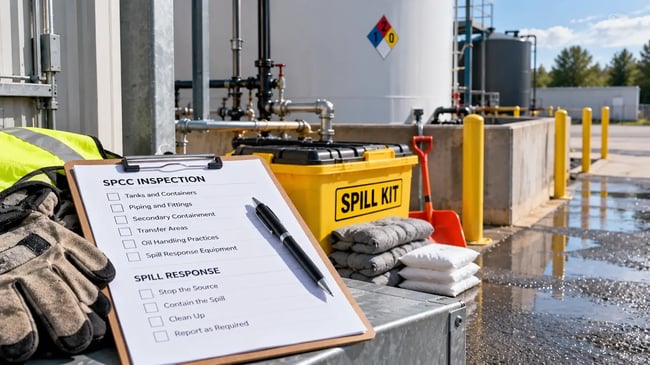
Start with safety. If there's a fire, an injury, strong vapors, or any threat to people, the first step in your procedure is to call 911 and get people clear, before anyone touches a spill kit. After that, the response sheet should walk staff through the same sequence every time: stop the source if it's safe to do so, keep oil out of storm drains and waterways with drain covers, berms, or sorbent, notify the person designated for discharge prevention, make the required agency calls, clean up, dispose of what you recovered under the applicable waste rules, and record what happened. Name your cleanup contractor and their phone number rather than writing "a qualified cleanup company."
Section 112.7(a)(4) also lists what the person reporting a spill should be ready to say: the facility address and phone number, the date and time, the type of material, the estimated total quantity and the quantity that reached water, the source, the media affected, the cause, any injuries or damage, what's being done to stop and clean up the discharge, whether an evacuation may be needed, and who else has been contacted. The easiest way to meet that is a fill-in-the-blank form kept next to the phone or posted with the response sheet, so the caller isn't trying to remember all of it under stress.
Who Do You Call After an Oil Spill in Pennsylvania?
Put these contacts on your response sheet. Which calls apply depends on where the oil went.
| Who |
When |
Contact |
| 911 / local fire department |
Fire, injury, vapors, or any immediate danger to people |
911 |
| National Response Center |
Immediately, when oil reaches navigable waters or adjoining shorelines and causes a sheen, film, discoloration, or sludge |
1-800-424-8802 (24 hours) |
| PA DEP emergency hotline |
Spills and other environmental emergencies, particularly when a spill causes or threatens pollution of waters |
1-800-541-2050 (24 hours) |
| EPA Regional Administrator (Region 3) |
Written report within 60 days after more than 1,000 gallons reach navigable waters in one discharge, or after two discharges of more than 42 gallons each reach navigable waters within 12 months |
Details in 40 CFR 112.4 |
| Your cleanup contractor |
Whenever the spill is beyond what your staff and spill kit can handle |
The contractor named in your plan |
The 1,000 and 42 gallon figures for the EPA report count oil that reached navigable waters or adjoining shorelines, not the total amount spilled, so a 500 gallon spill that stays inside your containment doesn't trigger that report. The National Response Center call is triggered by a sheen, not a gallon count, so even a small spill that reaches a creek can be reportable. We explain that in when you have to report an oil spill. Spills that reach waters can also lead to agency follow-up and enforcement, so if you're dealing with an agency inquiry or a possible penalty, an environmental attorney is worth talking to alongside your consultant.
How Do You Assign SPCC Responsibilities and Train Your Staff?
Section 112.7(f) sets three requirements for people. You have to train your oil-handling personnel in how to operate and maintain equipment to prevent discharges, the discharge response protocols, the pollution control laws that apply, general facility operations, and what's in the SPCC Plan. You have to designate one person at the facility who is accountable for discharge prevention and who reports to facility management. And you have to hold discharge prevention briefings for oil-handling staff at least once a year, covering any known discharges, failures, malfunctioning components, and recently adopted precautions. The plan itself also needs the approval of management at a level that can commit the resources to carry it out, so someone with budget authority should sign off on it.
A short table keeps responsibilities from living in one person's head. This version works for most single-site facilities.
| Role |
Responsibility |
| Designated person for discharge prevention |
Owns the plan, reviews inspection records, schedules testing and training, and makes the agency calls or delegates them by name |
| Inspectors |
Complete and sign inspection checklists on schedule and flag problems the same day |
| Oil handlers and delivery receivers |
Follow the transfer procedures and know where the spill kit and response sheet are |
| Management |
Approves the plan, commits resources, and gets corrective actions funded |
Keep a training log with the date, the topics covered, the trainer, and a sign-in sheet of attendees, and file it with the plan and the inspection records. The rule doesn't set a retention period for training records the way it does for inspections, but an inspector asking about your annual briefing will want to see proof it happened, and a sign-in sheet answers that in seconds. If you need to build a program from scratch, our articles on annual SPCC training requirements and what SPCC training should include cover the content, and our online training library has courses staff can take on their own schedule.
Can You Write SPCC Inspection and Spill Response Procedures Yourself?
For a lot of smaller facilities, yes. A facility qualifies as a Tier I qualified facility if its total aboveground oil storage is 10,000 gallons or less, no single container is larger than 5,000 gallons, and it has a clean spill history (no single discharge to water over 1,000 gallons and no two over 42 gallons within 12 months in the prior three years). Those facilities can use the template in Appendix G of 40 CFR Part 112 and self-certify the plan, and the template walks through inspections, testing, overfill prevention, and spill response in a fill-in format. Self-certifying means the owner or operator is stating that they've visited the facility, prepared the plan to sound industry practice, set up the required inspection procedures, and will carry out the plan. Our article on Tier I self-certified SPCC plans explains where the line sits. If you have a couple of small tanks and a clean record, the template plus the procedures in this article may be all you need, and you don't need us.
Facilities above those limits, or ones that use alternatives like impracticability determinations for containment, need a plan certified by a licensed professional engineer. Even below the limits, capacity counting, containment sizing, and integrity testing schedules are the usual trouble spots. Our breakdown of the different types of SPCC plans helps you figure out which category you're in. When a PE-certified plan is needed, our staff typically do the site visit and develop the plan, and an outside professional engineer reviews, stamps, and seals it. That review adds time and cost, and we'll tell you up front when it applies.
Cost depends on the number of containers, total storage capacity, whether a PE needs to certify the plan, and whether secondary containment needs to be evaluated. Our Tier I plans generally run about $1,500 to $4,000, and SPCC plans overall range from about $1,500 to $15,000. Whatever route you take, the plan needs a review at least every five years, and your procedures should be revisited at the same time, along with any change to your tanks or operations. We cover how that works in SPCC plan five-year reviews.
How Can RMA Help With SPCC Inspection and Spill Response Procedures?
We help Pennsylvania facilities build SPCC plans with inspection checklists, handling procedures, and spill response sheets written for the way their site runs, then train the people who'll use them. Initial SPCC training is free with a new RMA plan. We can also review where your current procedures stand and tell you plainly whether they hold up or need work, and if you're in good shape and don't need us, we'll say that too.
If you'd like to talk it through, you can call us, send an email, or fill out the form on our website, and there's no obligation. Whether you have questions about your inspection schedule or you're starting from nothing, just contact the RMA team and we'll point you in the right direction.