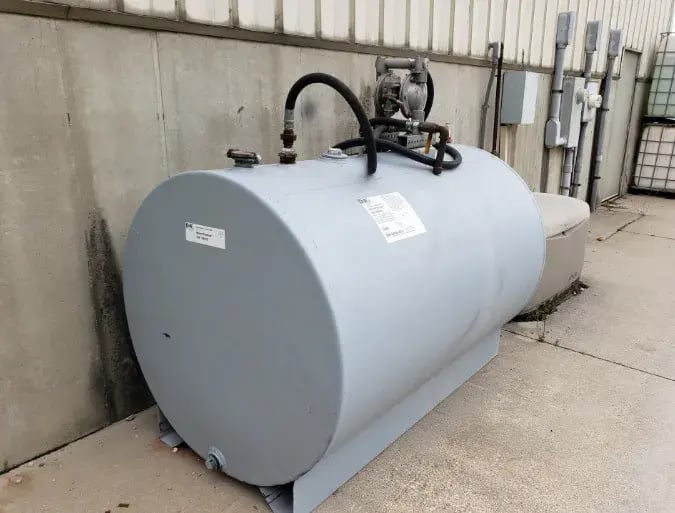
How to Check Dike Capacity, Rainfall Freeboard, and New Jersey's Six-Inch Rain Rule, and Know When the Math Needs an Engineer
Secondary containment looks like the simplest part of an SPCC plan, and it's the part that goes wrong most often. On paper it's a dike, a berm, a curb, or a double-walled tank that catches oil when the primary container fails. In practice, someone has to decide whether that structure holds enough once you account for rain, other tanks, drains, and the condition of the walls and floor. If you manage a New Jersey facility and your plan says the containment is adequate, this article shows you how to check that claim yourself.
The short version: find the largest container in each containment area, add room for rain, subtract the space other tanks take up, and confirm the walls, floor, and drains will hold and control oil. We'll also cover rainfall, New Jersey's added rules, a storm like Ida, and where the math gets tricky enough to need a Professional Engineer (PE). If you'd rather hand the evaluation to someone who does this every week, you can reach out to RMA at any point.
Table of Contents
TL;DR
To evaluate secondary containment, find the largest container in each containment area, add room for rain, subtract the space other tanks and equipment take up, and confirm the walls and floor are sufficiently impervious and the drains are controlled. The federal rule doesn't set a freeboard number, but EPA points to the 25-year, 24-hour storm as the proper standard. New Jersey major facilities must also add capacity for six inches of rain where rain can collect. When the numbers don't work, the containment is in rough shape, or you want to argue that containment isn't practicable, a Professional Engineer needs to be involved.
What Does the SPCC Rule Require for Secondary Containment?
The federal SPCC rule, 40 CFR Part 112, treats secondary containment in two ways, and mixing them up is where many evaluations go sideways. General containment applies to every area where a discharge could happen: transfer areas, oil-filled equipment, piping, and drum storage. Under 112.7(c), the whole system, walls and floor included, has to be capable of holding oil until cleanup happens, and you only need to address the typical failure mode and the most likely quantity of oil discharged.
Sized containment applies to bulk storage containers, and that's where the math lives. Under 112.8(c)(2), tank installations need secondary containment for the entire capacity of the largest single container plus sufficient freeboard to contain precipitation, and diked areas must be sufficiently impervious to contain oil. Section 112.8(c)(11) carries the same idea to mobile and portable containers. Tier I qualified facilities have their own version in 112.6(a)(3)(ii): the largest container plus additional capacity for precipitation.
The rule doesn't make you put containment calculations inside the plan, but EPA recommends keeping them available on site, and an inspector from EPA Region 2, which covers New Jersey, can ask how you got your numbers. Your plan type changes how much flexibility you have, so our guide to the different types of SPCC plans is a useful companion to this one.
How Do You Calculate SPCC Secondary Containment Capacity?
Work one containment area at a time. For each area, list every container inside it and identify the largest by shell capacity, not by how full it usually runs, because the rule counts what a container can hold. Convert that capacity to cubic feet (a cubic foot holds about 7.48 gallons), then measure the floor area inside the dike or curb. That floor area is your rain-catching area and the base for working out wall height.
Next, subtract anything that takes up room inside the walls. Other tanks in the same dike, concrete pads, pump skids, and equipment bases all displace volume that would otherwise hold oil or rain. That's why a dike that looks generous can come up short on paper. Add your rainfall allowance, divide the total by the floor area to get the required wall height, and compare it to the usable height. Our article on how big SPCC oil spill containment needs to be covers the basics.
The table below shows a simplified example: one 5,000-gallon tank in a dike with a 500 square foot floor (20 by 25 feet) and nothing else inside. It ignores displacement, so a real dike would need somewhat more.
| Planning approach |
Rain depth |
Rain volume |
Containment needed |
| Largest tank only |
None |
0 gallons |
5,000 gallons |
| 110 percent rule of thumb |
Flat 10 percent |
500 gallons |
5,500 gallons |
| New Jersey major facility six-inch rule |
6 inches |
1,870 gallons |
6,870 gallons |
| 25-year, 24-hour storm (example depth of 6.4 inches) |
6.4 inches |
1,995 gallons |
6,995 gallons |
In this example, a dike built to hold 110 percent of the tank falls roughly 1,350 to 1,500 gallons short of the rain-based approaches. That gap is why dikes sized years ago by the 110 percent rule often don't hold up under a fresh look.
How Much Freeboard and Rainfall Should SPCC Secondary Containment Allow For?
The rule says "sufficient freeboard to contain precipitation" and stops there. It doesn't define the term or give a number. EPA's stated position is that the proper standard is the amount needed to contain a 25-year, 24-hour storm, meaning the one-day rainfall total with a 4 percent chance of being reached or exceeded in any given year. EPA left it out of the rule because some facilities would struggle to get recent storm data. You can read EPA's wording on its page about bulk storage secondary containment specifications.
So you have a choice to make, and it has to be defensible. Many older plans used the 110 percent rule of thumb, and EPA's own sizing worksheets caution that it may not cover larger storms. For a conservative number, use the 25-year, 24-hour storm. NOAA's Precipitation Frequency Data Server gives point estimates for a specific location.
For a sense of scale, a 2004 New Jersey soil conservation bulletin listed 25-year, 24-hour depths from about 5.7 inches in Sussex County to about 6.7 inches in Ocean County. Treat those as a rough guide. NJDEP has said the NOAA rainfall values New Jersey relies on were last updated in 2006 and use data only through 1999, so a current lookup may come out higher. Whatever depth you choose, convert it to feet, multiply by the dike floor area, convert to gallons, and keep that worksheet with your plan records.
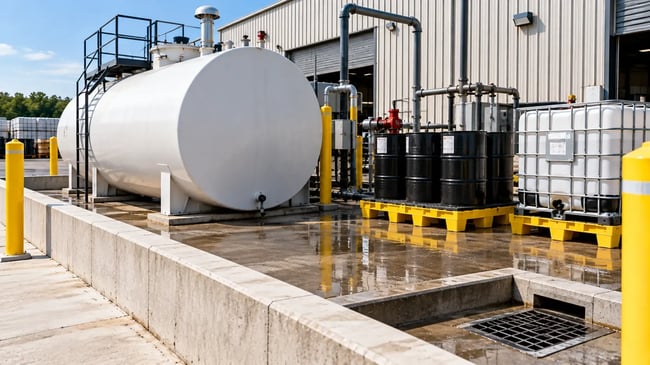
How Does New Jersey's Six-Inch Rain Rule Change SPCC Secondary Containment?
New Jersey adds its own layer for what the state calls major facilities. Under N.J.A.C. 7:1E, a major facility prepares a Discharge Prevention, Containment and Countermeasure (DPCC) plan and a Discharge Cleanup and Removal (DCR) plan, and the DPCC plan has to describe every secondary containment system, including capacity and materials of construction. Whether your facility counts as a major facility depends on its total storage capacity and what it stores, so check N.J.A.C. 7:1E against your own inventory.
The containment standard sits in N.J.A.C. 7:1E-2.6, and it's more prescriptive than the federal rule. It sets a fixed rain allowance instead of leaving freeboard to engineering judgment. If both programs apply to you, plan to meet whichever number is larger.
| Topic |
Federal SPCC rule |
New Jersey major facilities |
| Storage area sizing |
Largest single container |
Largest tank or container in the area |
| Rain allowance |
"Sufficient freeboard," with EPA pointing to the 25-year, 24-hour storm |
An additional six inches of rainwater where rain can collect |
| Loading areas |
Largest single compartment of a tank truck or tank car |
Largest compartment, plus the six-inch rain allowance where rain can collect |
| Wall and floor material |
Sufficiently impervious to contain oil |
Impermeable materials kept in impermeable condition, with limited exemptions for existing aboveground tank systems |
| Draining rainwater |
Sealed valve, inspection of the water, supervised drainage, records |
Hold precipitation until it's confirmed no hazardous substances will be discharged, unless a permitted treatment system intercepts it |
New Jersey also bars using containment as backup storage and keeps incompatible materials apart. Our article on SPCC plans in New Jersey gives the wider state picture.
How Should You Plan SPCC Secondary Containment for a Historic Storm?
Neither the federal rule nor New Jersey's requires you to design containment for a storm like Ida. Both are built around a lesser event. But Ida shows what the 25-year number leaves out. On September 1, 2021, Newark recorded 8.41 inches of rain, its wettest day on record, and USGS reported totals nearing 10 inches in some localized areas over 24 hours. An older state table lists about 6.4 inches for a 25-year, 24-hour storm in Essex County.
You don't have to size every dike for a once-in-a-lifetime storm, but a few decisions help you handle one. Large, open dikes with a small tank inside collect the most rain relative to the oil they protect, so they're the first places to consider a more conservative design depth. Covering a containment area cuts the rain it has to hold, though that's a construction decision. Your plan also needs a working procedure for draining rainwater. Under 112.8(c)(3), the bypass valve stays sealed closed, someone inspects the retained water before release, the valve is opened and resealed under responsible supervision, and you keep records.
If your containment sits in a flood-prone spot, the PE reviewing your plan should know that. Our list of the top 10 things to do during SPCC plan monthly inspections includes checks worth repeating after heavy rain.
How Do Containment Rules Vary for Drums, Portable Tanks, Loading Areas, and Transformers?
Drums, totes, and portable tanks count as mobile or portable containers under 112.8(c)(11). A drum storage area needs containment sized to the largest single container with freeboard for rain. Our article on 55-gallon drums and SPCC plans explains how they're counted. For major facilities, New Jersey separately requires containment for tote, drum, and other small container storage areas.
Loading and unloading racks follow their own sizing. If rack drainage doesn't flow to a catchment basin or treatment facility designed for discharges, the containment has to hold at least the largest single compartment of any tank truck or tank car loaded or unloaded at the facility. Oil-filled operational equipment, such as transformers and hydraulic systems, falls under general containment unless the facility qualifies for the alternative in 112.7(k). To qualify, no single discharge from that equipment can have exceeded 1,000 gallons in the three years before plan certification, and no two can each have exceeded 42 gallons within any 12-month period. Facilities using the alternative also need a documented monitoring program and an oil spill contingency plan.
Double-walled and vaulted tanks can sometimes serve as secondary containment, depending on the design. Have a PE confirm yours before you count on it.
How Do You Check Whether Existing Containment Is Sufficiently Impervious?
Capacity is only half the evaluation. The structure also has to hold oil long enough for cleanup, and a walk-through answers part of that question. On concrete, look for cracks, spalling, and failed joints. On earthen berms, look for erosion and animal burrows. Check every place a pipe passes through a wall, since New Jersey says pipes shouldn't pass through containment walls unless the containment's integrity isn't impaired.
Check drains and valves next. A drain valve that's left open, leaking, or the wrong design defeats the containment no matter how big it is. Look for oil sheen or stained soil outside the walls, and for anything stored inside, from spare drums to pallets, since stored items take capacity away. Section 112.8(c)(10) requires prompt removal of oil accumulations in diked areas. Document anything questionable with photos and notes. A hairline crack may need only a repair, while a failing wall or a liner of unknown age may need an engineer's review. The people who walk the containment each month are your best early warning, and our online environmental training library is one way to prepare them.
When Does SPCC Secondary Containment Need a Professional Engineer?
The containment requirements are the ones you can't talk your way out of. The rule lets a plan deviate from many requirements if it provides equivalent environmental protection, but that option excludes the containment requirements in 112.7(c) and (h)(1), 112.8(c)(2), and 112.8(c)(11). The only exit is an impracticability determination under 112.7(d). You have to explain in the plan why containment isn't practicable, do periodic integrity testing of containers and integrity and leak testing of valves and piping, and provide an oil spill contingency plan and a written commitment of manpower, equipment, and materials. Under that section, a PE has to certify the plan, or the relevant sections of it for a qualified facility. Self-certified Tier I and Tier II plans can't include impracticability determinations unless a PE has reviewed and certified each one.
Some SPCC firms have a PE on staff, and others work with a trusted outside PE. Either way, a PE has to review and approve the plan or the relevant sections. Our guide to professional engineers and SPCC plan requirements explains when that review is required. Outside of impracticability, bring in engineering help when your containment is undersized, when the displacement math is complicated, when you want to justify a different design storm, or when the walls, floor, or liner are in questionable shape. Building or modifying a dike is a construction job for your engineer and contractor, and local construction or fire permits may apply. RMA doesn't handle those construction-phase pieces.
On cost, the evaluation is usually part of a larger SPCC plan or update. We publish ranges of about $2,500 to $15,000 for SPCC plans, with PE-certified complex updates starting around $7,500, depending on how many containment areas and containers you have. Our SPCC plan cost guide goes through the factors, and the pricing calculator below shows what RMA's help would cost for your own facility.
How Can RMA Help You Evaluate SPCC Secondary Containment in New Jersey?
If you have a single tank in a sound dike, you may be able to run the numbers yourself. EPA publishes sizing worksheets for common tank layouts, and this article follows the same logic. We'd rather tell you that than sell you something you don't need.
When the evaluation gets harder, we can help. We're based in New Jersey and work with NJDEP's rules regularly, and we've handled complex secondary containment calculations for facilities across the country. We can review your existing plan and containment, work out capacity by area, flag condition issues worth a PE's attention, and work with the engineer who certifies the plan. There's no pressure and no obligation. You can call us at 888-RMA-0230, send an email, or fill out the form on our website. If you'd like a second opinion on your containment numbers, contact RMA and we'll take a look.