General vs. Sized Containment, Documenting What You Already Have, and When a Pennsylvania Facility Needs Calculations or an Engineer
The secondary containment section is where a lot of SPCC Plans get thin. A plan says "dike" or "spill pallets" and moves on, without saying what each one covers, how much it holds, or why that volume is enough. Inspectors read that section closely, because containment is what stands between a failed container and a discharge to water, and a plan that can't explain its containment is a plan that's easy to cite.
Evaluating your containment isn't a single calculation. It starts with knowing which of the rule's two containment standards applies to each piece of your facility, then documenting what you have, then checking the numbers where the rule requires a specific size. This article walks through that process, including how Pennsylvania's tank rules fit in and when the job is simple enough to handle yourself. If you'd rather have someone look at your site, you can reach out to RMA at any point.
Table of Contents
TL;DR
The SPCC rule has two containment standards. General containment applies to everything that could leak and is judged against the most likely spill, while sized containment applies to bulk storage containers and has to hold the largest container plus room for rain. To evaluate your facility, list every oil container and handling area, write down what contains each one and how it drains, and run the volume math wherever sized containment applies. Simple setups can often be handled in-house, but multi-tank dikes, questionable walls or floors, and any claim that containment isn't practical call for an engineer.
What Does SPCC Secondary Containment Have to Do?
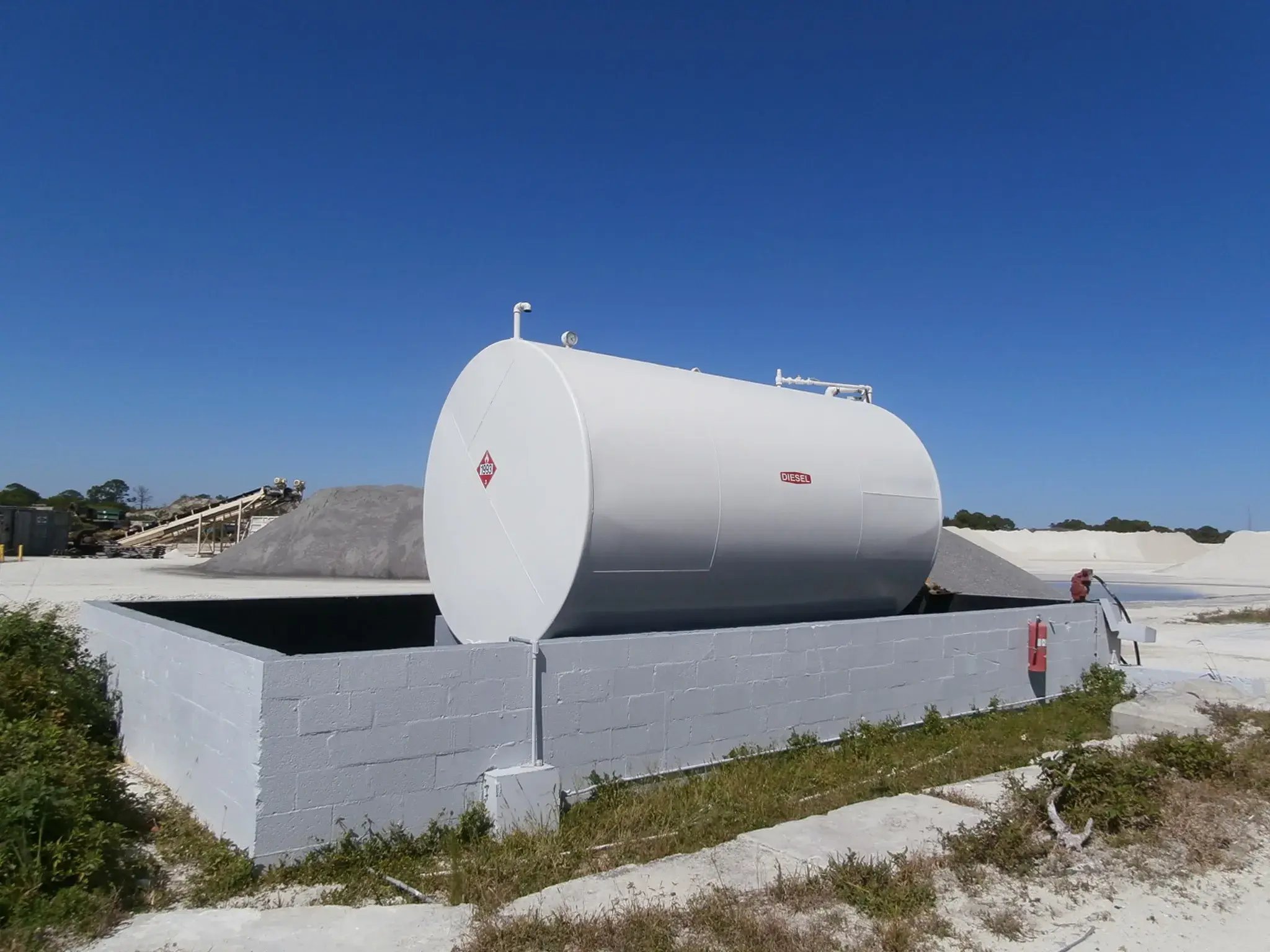
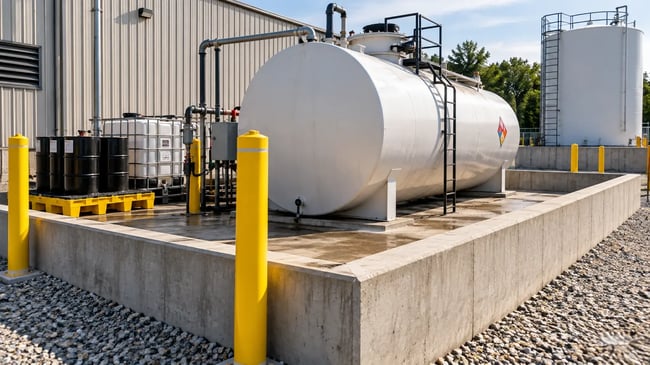
The rule's general containment language in 40 CFR 112.7(c) sets the basic job. The entire containment system, including walls and floor, has to be capable of containing oil, and it has to be built so a discharge from the primary container, such as a tank, doesn't escape before cleanup happens. Containment can be passive, meaning a permanent structure that works without anyone doing anything, or active, meaning something your staff has to deploy. The rule lists dikes, berms, and retaining walls, curbing or drip pans, sumps and collection systems, drainage systems, weirs and booms, diversion and retention ponds, and sorbent materials as the minimum menu, and "or its equivalent" leaves room for other methods that follow good engineering practice.
The rule doesn't require a concrete dike around every container, and it doesn't set one containment size for the whole facility. How much containment you need depends on which part of your facility you're looking at, and the rest of this article is built on that distinction. In Pennsylvania, EPA Region 3 is the agency that enforces the federal SPCC rule, so the federal standard is the one an inspector will measure your plan against, with DEP's tank rules layered on top for regulated tanks.
What Is the Difference Between General and Sized Secondary Containment?
EPA's inspector guidance describes two categories of containment requirements. The general provision covers every area and piece of equipment at a regulated facility that could discharge oil: bulk containers, drums, piping, oil-filled equipment, mobile refuelers, and transfer areas. It's judged against the typical failure mode and the most likely quantity of oil that would come out, so a hose leak at a fuel transfer point is designed for very differently than a split tank shell. The specific provisions, often called sized containment, are written for a major container failure and spell out the volume.
| Feature |
General Containment |
Sized Containment |
| Where it applies |
All oil handling areas: piping, oil-filled equipment, mobile refuelers, non-rack transfer areas, and bulk containers |
Bulk storage containers (55 gallons and up), mobile or portable containers, and tank truck loading racks |
| Design basis |
Typical failure mode and the most likely discharge |
A major container failure |
| Volume |
No set number. Engineering judgment, documented in the plan |
Largest single container or compartment, plus freeboard for precipitation (racks: largest tank truck compartment) |
| Active measures such as sorbents |
Allowed where they can handle the likely spill volume in time |
Rarely appropriate for large containers |
| Rule sections |
112.7(c) |
112.8(c)(2), 112.8(c)(11), 112.7(h)(1) |
Where sized containment applies, it also satisfies the general requirement for that area, so a bulk tank in a properly sized dike is covered by both. Mobile refuelers and oil-filled operational equipment, such as hydraulic systems and transformers, fall under general containment only. Facilities that meet the rule's discharge-history test for oil-filled equipment can use an alternative in 112.7(k) instead of physical containment: an inspection or monitoring program, a spill contingency plan, and a written commitment of resources. Our guide to the different types of SPCC plans covers how plan type changes who certifies these decisions.
How Do You Document the Secondary Containment You Already Have?
Start with a walk-through and an inventory. List every container of 55 gallons or more, every mobile or portable container, the piping between them, each transfer area, any loading rack, and all oil-filled equipment. For each item, write down what contains it, the dimensions and material of that containment, its condition, and where any liquid inside it would go. Then identify which standard applies, general or sized, and note the largest container sharing each containment area. That inventory becomes the backbone of the containment section, and it's the document an inspector will test against what they see on site.
The rule doesn't require your volume calculations to sit inside the plan, but EPA strongly recommends keeping them where you can hand them over during an inspection, and industry guidance suggests attaching them to the plan. The plan itself still has to describe the containment well enough to show it works. The table below covers the controls we see most often and what to record for each.
| Existing Control |
What to Record |
| Concrete or earthen dike around tanks |
Footprint, wall height, material, liner or basis for imperviousness, drain valve type, largest tank, other tanks sitting inside, and the capacity math |
| Spill pallets, berms, or a curbed area for drums and totes |
Containers covered, sump or basin capacity versus the largest container. EPA says drums don't each need their own containment, and a shared collection area can work |
| Shop-built double-walled tank |
Construction standard, overfill alarm, flow shutoff or restrictor, and how transfers are monitored. EPA's position is that these tanks can generally meet the rule, but the outer wall doesn't catch an overfill out of the vent or a leak in piping |
| Tank inside a building |
Liquid-tight walls and floor, doorways and other openings, and floor drains or sump pumps. EPA's guidance says open floor drains and automated sump pumps defeat the containment unless they lead to proper treatment, such as an oil-water separator |
| Curbing, drip pans, and sorbents at transfer areas and pumps |
The most likely discharge volume, where materials are stored, who deploys them, and how fast |
Drainage belongs in the same write-up. If rainwater collects in a dike, the rule requires that the drain valve be a manual, open-and-closed design (flapper-type valves aren't allowed), that the bypass valve stay sealed closed, that someone inspect the water for oil before releasing it, and that you keep a record of each drainage event. Plans often describe the dike beautifully and say nothing about the drain, which is exactly where inspectors look. Our walkthrough of monthly SPCC inspections shows how those checks fit into a routine, and our article on 55-gallon drums and SPCC plans covers the drum side in more detail.
How Do You Calculate Sized Secondary Containment and Freeboard?
For bulk storage containers, the standard in 112.8(c)(2) is containment for the entire capacity of the largest single container plus sufficient freeboard to contain precipitation. Permanently manifolded tanks, which function as one storage unit, count together as the largest container. The rule doesn't define sufficient freeboard. EPA's position in the 2002 rule preamble is that the amount needed to hold a 25-year, 24-hour storm is the proper standard, but EPA didn't make that an enforceable requirement. EPA's inspector guidance also calls a 110 percent rule of thumb acceptable in many situations, while warning that 110 percent can fall short of what a heavy storm delivers. Whichever method you pick, the guidance says the certifier decides what counts as sufficient and documents how that decision was made in the plan.
The math itself is plain geometry. Net containment volume is length times width times usable wall height, converted to gallons at 7.48 gallons per cubic foot, minus the space taken up by anything else sitting inside the dike below wall height, such as other tanks and foundations. Rain volume is the dike's surface area times the design rainfall depth, converted the same way. EPA's sample calculations show how close the two approaches can land: for a 20,000-gallon horizontal tank in a 45 by 20 foot dike, a 110 percent design needs a wall about 3.27 feet high, while a 4.5-inch rain design needs about 3.35 feet.
| Design Basis (EPA Sample: 20,000-Gallon Tank, 45 x 20 ft Dike) |
Wall Height Needed |
| Tank volume only (no freeboard) |
2.97 ft |
| 110 percent of tank capacity |
3.27 ft |
| Tank volume plus a 4.5-inch rain event |
3.35 ft |
Displacement is where multi-tank dikes get tricky. In another EPA example, a dike holding one 20,000-gallon tank and two 10,000-gallon tanks had a plan that promised 112 percent of the largest tank. After subtracting the volume the two smaller tanks displace, the dike's freeboard worked out to roughly 1.8 inches of rain, which may or may not be enough depending on where the facility sits. Containment also loses capacity every time it fills with rainwater, so how often you drain it affects the real margin. Indoor containment generally needs no precipitation freeboard, and the interstitial space of a double-walled tank isn't exposed to rain. Our article on how big SPCC oil spill containment needs to be goes through sizing from the owner's side.
How Do Pennsylvania Tank Rules Affect SPCC Secondary Containment?
The federal rule is only part of the picture for a Pennsylvania facility. DEP runs a storage tank program under the Storage Tank and Spill Prevention Act, with its technical rules in 25 Pa. Code Chapter 245. For aboveground tanks that fall under Chapter 245, DEP's rules include containment structure standards, and they're most detailed for large aboveground tanks, those over 21,000 gallons. A single tank, or a facility's regulated aboveground storage in total, over 21,000 gallons also triggers a Spill Prevention Response Plan (SPRP) that goes to DEP. Smaller aboveground tanks have alternate requirements. Whether a particular tank is regulated at all depends on its size, type, and use, and there are exclusions, so the safe move is to check each tank against DEP's storage tank program before assuming either way. Facilities with an NPDES permit may also carry a PPC plan that overlaps with parts of the SPCC plan.
Two practical points come out of that. First, a dike that satisfies the federal rule may still not satisfy DEP's standards for a tank in the program, so the SPCC plan's containment section shouldn't be written as if EPA is the only audience. Second, EPA's own inspector guidance points out that state rules can restrict using soil as containment, and it uses Pennsylvania's Storage Tank and Spill Prevention Act as an example. Earthen floors that look fine on a federal checklist deserve a second look in Pennsylvania. Fire code requirements for tanks are enforced locally and vary by municipality, and they sometimes dictate dike or drainage details, so confirm those with your local fire official. Our article on who enforces SPCC plans explains how the federal side works.
What Happens When SPCC Secondary Containment Isn't Practical?
Sometimes physical containment can't be built. A tank may sit on a site with no room for a dike, a local fire code may rule out a particular design, or safety may argue against it. Section 112.7(d) allows an impracticability determination in those cases. The plan has to clearly explain why containment isn't practicable. For bulk containers, the facility then has to do periodic integrity testing of the containers and periodic integrity and leak testing of valves and piping. Unless a Facility Response Plan has been submitted, the plan also needs an oil spill contingency plan and a written commitment of manpower, equipment, and materials to control and clean up a discharge.
EPA's guidance says cost can be one factor but can't be the only one, and that a contingency plan being cheaper than a dike isn't a valid reason on its own. A professional engineer has to be behind the determination. In a full PE-certified plan, the engineer's certification covers it. A Tier II qualified facility that self-certifies can include an impracticability determination only if a PE has reviewed and certified that portion in writing. A Tier I qualified facility that self-certifies can't use impracticability at all, so a facility in that situation needs a different plan type. Sorbent pads and drain covers are a poor substitute for a dike around a large tank, too. EPA notes that most commercial spill kits handle relatively small volumes, up to roughly 150 gallons of oil. Our article on professional engineers and SPCC plan requirements explains where the engineer's role begins and ends.
When Do You Need Containment Calculations or a Professional Engineer?
Plenty of facilities can handle their containment evaluation without an engineer. A Tier I qualified facility has no more than 10,000 gallons of aggregate aboveground storage, no single container over 5,000 gallons, and a clean recent spill history. It can self-certify its plan, and EPA publishes worksheets for the common dike scenarios. Those worksheets are simplified, though. They assume a flat floor, equal wall heights, and square corners, and they don't account for displacement from support structures or foundations. Once your setup strays from that, the work changes.
| Situation |
What It Usually Calls For |
| One tank or a few drums in a simple dike or on pallets, Tier I qualified |
Owner or consultant calculation using EPA's worksheets, self-certified |
| Several tanks in one dike, irregular shapes, foundations or equipment inside the containment |
A calculation that accounts for displacement. A PE may need to adjust EPA's sample methods |
| Aggregate storage over 10,000 gallons, or other facts that rule out qualified-facility status |
A full PE-certified plan, with the engineer verifying that the containment methods follow good engineering practice |
| No practical way to build containment |
A PE impracticability determination plus testing, contingency plan, and written resource commitment |
| Earthen floors, older walls, or concrete with cracks and open joints |
An imperviousness evaluation, which EPA says should ultimately be verified by a PE |
Where an engineer is involved, here's how it works with RMA. We don't employ a professional engineer ourselves. When a plan needs PE certification, we work with an outside engineer licensed in the state the plan is for. Our staff typically visit the site and develop the plan, and the engineer then reviews, stamps, and seals it. That review adds time and cost to the plan, which is why we'll tell you plainly when your facility doesn't need it. If an existing plan from another firm has a thin containment section, we usually rebuild it instead of patching it, and our article on updating an existing SPCC plan explains why.
If your evaluation shows you need to build or expand containment, that part is construction work. The design, the contractor, and any local building or fire permits for a new dike or tank sit with your engineer and contractor, and RMA doesn't prepare those permits or approvals. We handle the SPCC plan or amendment that reflects the finished containment, plus the inspections, testing, and training that go with it.
How Can RMA Help With an SPCC Secondary Containment Evaluation?
We help facilities walk through this process: building the container and containment inventory, working out which standard applies to each area, running the sizing math, and writing it up so the plan stands on its own. Pricing depends on how many containers and containment areas you have and whether a PE has to certify the plan. Tier I plans typically run about $1,500 to $4,000, and our overall SPCC range is about $1,500 to $15,000. We'll also tell you when your containment is fine as it is and doesn't need an engineer.
There's no obligation in reaching out. You can call us at 888-RMA-0230, email us, or fill out the form on our website, and a member of our team will talk through your setup with you. If you'd rather start by reading, our SPCC resource library has more guides, and you can contact RMA whenever you're ready.