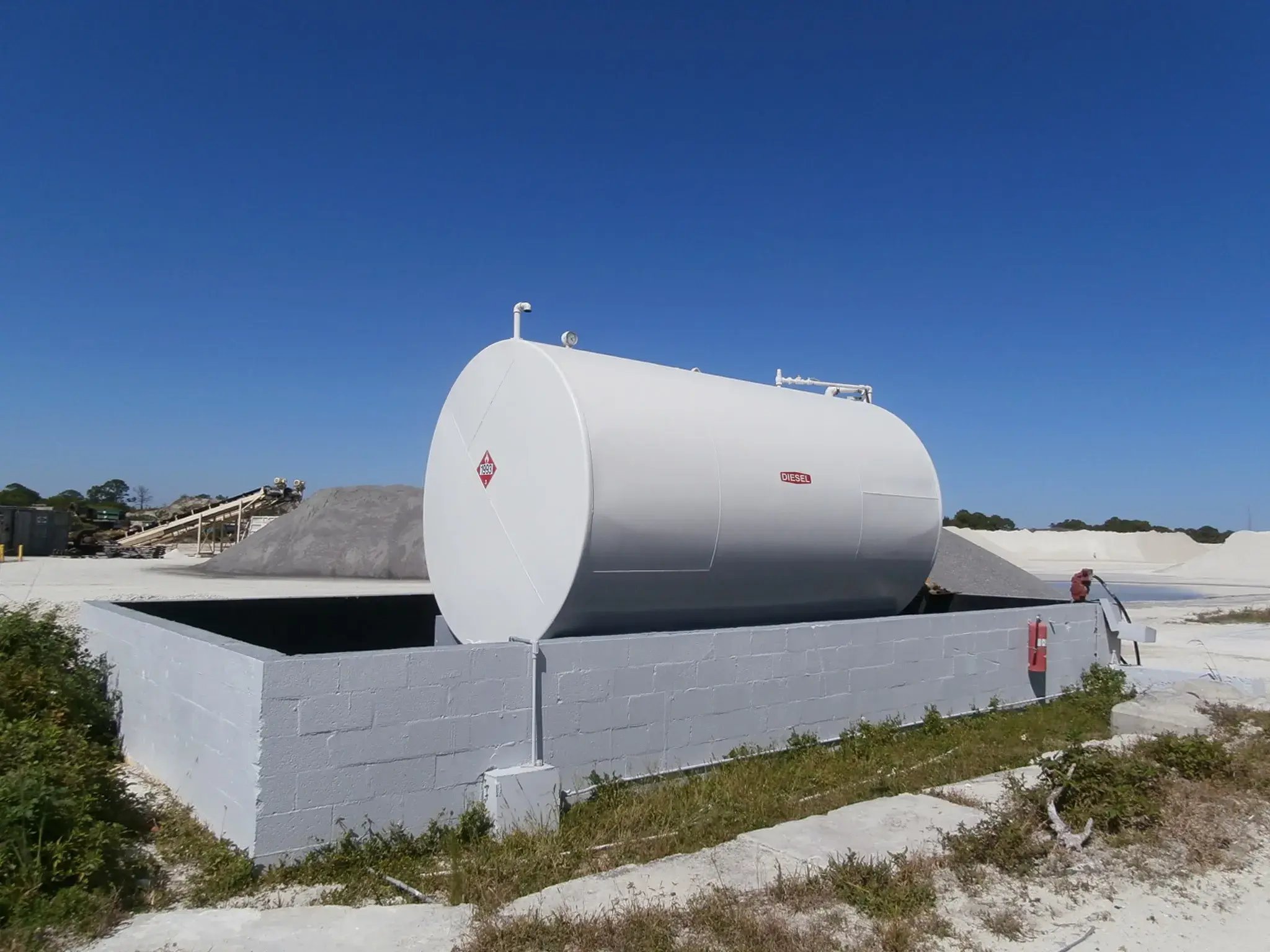
A Practical Walk-Through for Documenting Tanks, Drums, Totes, Hydraulic Equipment, Transformers, Capacities, and Locations
Every SPCC Plan, the written federal oil spill prevention plan required under 40 CFR Part 112, is built on one list: every container and piece of equipment on your site that holds oil. If that list is wrong, the plan is wrong. A missed hydraulic reservoir throws off the capacity total, a drum area that isn't marked on the diagram can't be inspected the way the rule expects, and a tank counted at the wrong size can push a facility over or under the 1,320 gallon threshold without anyone noticing. The inventory is a walk-around job, and for most facilities a manager can do the first pass without outside help.
This article covers how to find, measure, and record tanks, drums, totes, hydraulic equipment, and transformers, and how to carry those capacities and locations onto the facility diagram. We'll also show how Pennsylvania's tank registration program lines up with your list, since DEP counts tanks differently than EPA does. If you'd rather hand the walk-through to people who've done it at hundreds of sites, you can reach out to RMA at any point.
Table of Contents
TL;DR
An SPCC inventory lists every oil container of 55 gallons or more at your facility, plus oil-filled equipment of that size, counted at the full size the container is built to hold rather than the amount of oil inside. For each item, record the type of oil, the capacity, the location, and what contains a spill. Portable drums and totes can be tracked by storage area using a realistic maximum count, and everything gets marked on the facility diagram. Pennsylvania's DEP tank program uses its own size cutoff for stationary tanks, so keep a separate note on anything over 250 gallons.
What Counts Toward Your SPCC Oil Storage Inventory?
The federal rule counts aboveground oil storage by capacity, not contents. A 275 gallon tote that's a quarter full counts as 275 gallons, and an empty 500 gallon tank counts as 500. The rule calls this the shell capacity, meaning the size the container is built to hold. A facility needs a plan when its aboveground capacity is more than 1,320 gallons or its completely buried capacity is more than 42,000 gallons, and only containers of 55 gallons or more go into the total. A 5 gallon pail of hydraulic fluid doesn't count, and a shelf full of them doesn't add up to anything either.
"Oil" covers a lot more than diesel and motor oil. The definition takes in petroleum, synthetic and mineral oils, and animal fats and vegetable oils, so a grease tank or a tote of bulk cooking oil counts. Propane and DEF don't. The exclusions are a short list: containers that are permanently closed under the rule's definition (drained, disconnected, blanked off, locked, and posted with the closure date), motive power containers like the fuel tank that runs a truck, hot-mix asphalt, heating oil used solely at a single-family residence, pesticide application equipment, and milk containers. Fuel trailers and skid tanks that fuel other equipment don't get the motive power exemption, because they exist to store and transfer fuel rather than to move the vehicle. We cover the drum question in more detail in our article on whether 55-gallon drums are included in SPCC plans, and oil-type edge cases in our guide to SPCC plans for cooking oil.
| Item |
Counts Toward the Total? |
Note |
| Aboveground tank of 55 gallons or more (diesel, used oil, hydraulic oil) |
Yes |
Full shell capacity, even when empty |
| 55-gallon drum of oil |
Yes |
The cutoff is 55 gallons or greater |
| Tote (commonly 275 or 330 gallons) |
Yes |
Counts at full size |
| Transformer or hydraulic reservoir of 55 gallons or more |
Yes |
Oil-filled operational equipment |
| Generator base tank or day tank of 55 gallons or more |
Yes |
Often overlooked |
| Fuel trailer or skid tank used to fuel other equipment |
Yes |
Mobile refueler, no motive power exemption |
| Vegetable oil or animal fat container of 55 gallons or more |
Yes |
Non-petroleum oils are oil under the rule |
| 5-gallon pails and other containers under 55 gallons |
No |
Below the minimum size |
| Fuel tank that powers a truck or other vehicle |
No |
Motive power container |
| Permanently closed tank |
No |
Only if it meets the full closure definition |
| Propane or DEF tank |
No |
Not oil |
If you're not sure you're over the line at all, our four steps for figuring out if you need an SPCC plan start from the same counting rules. When the honest answer is that you're probably under 1,320 gallons, we'll tell you so.
How Do You Walk the Site and Find Every Oil Container?
Start with a site map or an aerial printout and a clipboard or tablet, then walk every building, yard, dock, and shop. Don't rely on one person's memory or on purchasing records alone. Walk with whoever knows the equipment best, usually the maintenance lead, and ask the same question at every stop: what in here holds oil? Look indoors as well as outside, since mechanical rooms, elevator machine rooms, and shop floors are where containers get missed.
Photograph each item with its nameplate in the frame. Nameplates give you capacity for transformers, tanks, and many reservoirs, and a photo saves a second trip. When there's no nameplate, measure the container and calculate its volume, or find the manufacturer's literature, and note how you got the number. The figure you write down has to hold up if an inspector shows up with a tape measure.
Ask about anything that isn't on site year round. Contractors bring fuel trailers, seasonal generators show up for the summer, and a rental compressor or a tote of hydraulic oil can arrive with a project. If it sits at your facility as part of your operation, it belongs on the list or in the portable container estimate covered below. Old SPCC Plans, tank registrations, and insurance schedules make good prompts too. Our overview of what an SPCC plan requires shows where the inventory fits in the larger document.
What Do You Record About Each Tank, Drum, and Tote?
The rule itself asks for the type of oil in each fixed container and its storage capacity, and the facility diagram has to mark each container's location and contents. A plan writer needs more than that to judge containment and inspections, so capture the rest while you're standing next to the container. Giving every item an ID that matches the diagram, such as AST-1 or Generator Day Tank, keeps the table and the drawing from drifting apart.
| Field |
What to Record |
| ID and name |
A short label that matches the diagram |
| Contents |
Type of oil (diesel, used oil, hydraulic oil, lube oil, vegetable oil) |
| Capacity |
Full shell capacity in gallons, and where the number came from |
| Construction |
Vertical or horizontal, shop-built or field-erected, single or double wall, steel, fiberglass, or plastic |
| Location |
Building or yard area, plus the position on the diagram |
| Containment |
Dike, double wall, curbed pad, drip pan, or nothing, with the size if you can measure it |
| Filling and piping |
Where and how it's filled, overfill protection, gauges, valves, and whether piping is above or below ground |
| Condition |
Install year if known, visible corrosion or staining, and any past inspection or testing |
| Drainage |
Nearby storm drains, ditches, or slopes that would carry a spill off the pad |
The containment and drainage notes feed directly into sizing. If you want to see how the numbers get used, our article on how big SPCC oil spill containment needs to be walks through it.
How Do You Inventory Mobile Drums and Totes in an SPCC Plan?
Drums and totes are where inventories go sideways, because they move. For portable containers the rule gives you two options: list the type of oil and capacity of each container, or give an estimate of the potential number of containers, the types of oil, and the anticipated capacities. A facility that keeps the same six drums on a rack can list each one. A shop that cycles dozens of drums and totes through every week is better off with the estimate.
To build the estimate, name each storage area and record the most you'd realistically have there on a busy day, not an average one. A drum rack in the maintenance garage that holds eight 55 gallon drums of motor oil, hydraulic oil, and used oil is one entry: location, oil types, drum size, maximum count of eight, maximum capacity of 440 gallons. A tote area with room for three 330 gallon totes is another entry at 990 gallons. Include used oil drums waiting for pickup, and count empty drums and totes of 55 gallons or more, since they count at full size. Used oil has its own handling rules, which we cover in our rundown of used oil regulations.
Each of those storage areas gets marked on the facility diagram, since the rule requires the diagram to show where mobile or portable containers are kept. How much secondary containment each area needs is a separate evaluation.
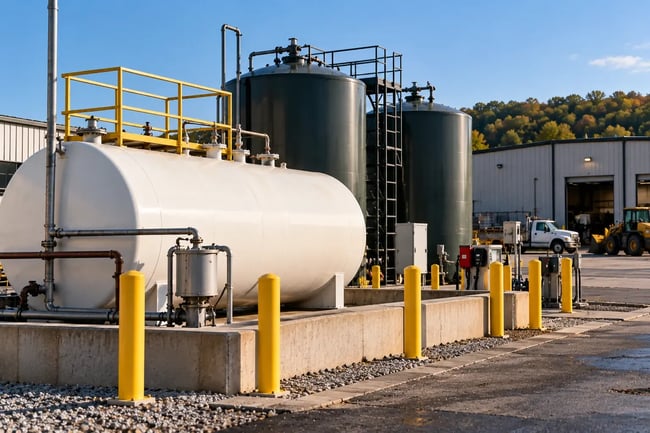
Oil-filled operational equipment is equipment where the oil is there only to make the machine work. The rule's definition lists hydraulic systems, lubricating systems, gear boxes, machining coolant systems, heat transfer systems, transformers, circuit breakers, and electrical switches. It isn't a bulk storage container, but it still counts toward your capacity total when the equipment holds 55 gallons or more of oil, and the plan covers it. A pad-mounted transformer with 300 gallons of mineral oil counts. A control cabinet with a quart of hydraulic fluid doesn't.
Look for hydraulic power units on presses and balers, hydraulic lifts and elevators, compressor sumps, gear boxes on conveyors and mixers, pad-mounted and pole-mounted transformers, and oil-filled switchgear. For each one, record the equipment ID, location, oil type, and the capacity of each reservoir from the nameplate. When one machine has several reservoirs, list them separately so whoever reviews the count can see how you got there. Note what the equipment sits on and what's around it, because containment for this equipment gets evaluated like any other oil container. Equipment that circulates oil as part of making a product is flow-through process equipment, which the rule treats differently, so flag it for review and don't guess.
Record spill history while you're at it. Facilities with qualified oil-filled operational equipment can choose an alternative to general secondary containment: a documented inspection or monitoring program, an oil spill contingency plan, and a written commitment of manpower, equipment, and materials. Qualifying depends on discharge history, specifically no single discharge over 1,000 gallons and no two discharges over 42 gallons each within any twelve month period, counting back three years from the plan's certification date and counting discharges of the kind that reach or threaten navigable waters. Knowing your history before the plan gets written keeps that option open.
How Do You Show Capacities and Locations on the SPCC Facility Diagram?
The facility diagram is where the inventory turns into something an inspector can use. The rule requires it to mark the location and contents of each fixed oil storage container and the storage areas where mobile or portable containers are kept. It also has to show transfer stations and connecting pipes, and underground tanks that are exempt because they fall under the federal underground tank rules or an approved state program have to be marked "exempt." A clean, legible sketch works fine as long as it shows the right things.
Give every item the same ID you used in the inventory, so AST-1 on the drawing is AST-1 in the table, and add a legend listing oil type and capacity. Show buildings, storm drains, nearby streams or ponds, roads, and the direction water flows off the property. Mark the spots where delivery trucks fill tanks and where drums sit. The plan has to deal with where a spill would head if it got loose, and the diagram is where a reviewer sees that most quickly.
Here's what a simple capacity roll-up looks like once the walk-through is done. This is an illustration, not a model for your site.
| Item |
Quantity |
Capacity Each |
Counted |
| Diesel aboveground tank |
1 |
500 gal |
500 gal |
| Used oil tank |
1 |
250 gal |
250 gal |
| 55-gallon drums (maximum in rack) |
8 |
55 gal |
440 gal |
| Hydraulic oil totes |
2 |
330 gal |
660 gal |
| Pad-mounted transformer |
1 |
300 gal |
300 gal |
| 5-gallon pails and truck fuel tanks |
Various |
Excluded |
0 gal |
| Total |
|
|
2,150 gal |
No single container here is large, and the facility is still well past 1,320 gallons. Once you're over the line, the type of plan you need depends on factors like total capacity and whether a PE has to certify it, which our guide to the different types of SPCC plans lays out.
How Does DEP's Storage Tank Program Overlap With Your SPCC Inventory?
EPA Region 3 enforces SPCC in Pennsylvania, while the state runs its own tank program through the Pennsylvania Department of Environmental Protection under the Storage Tank and Spill Prevention Act and the regulations at 25 Pa. Code Chapter 245. DEP's test isn't the same as EPA's. Regulated aboveground tanks are generally stationary tanks holding more than 250 gallons of a regulated substance, and those tanks have to be registered with DEP and carry an annual registration fee. The Act lists exemptions, including certain heating oil tanks and oil-filled operational equipment, so whether a particular tank is regulated depends on its size, type, and use. Check each one against DEP's storage tank program before you assume either way.
The practical move is to add one column to your SPCC inventory: stationary tank over 250 gallons, yes or no. A 275 gallon aboveground tank is counted for SPCC and is likely on DEP's registration list too. A drum or tote isn't a stationary tank, so it generally falls outside that count even though it counts toward your SPCC capacity. Very large systems add another layer. A single aboveground tank over 21,000 gallons, or a facility with a large enough combined regulated capacity, can bring a Spill Prevention Response Plan, called an SPRP, under DEP's rules. Local fire code also governs how tanks are installed and spaced, and requirements vary by municipality, so check with your local fire marshal.
If you're installing a new tank, Pennsylvania may require DEP-certified installers, and the construction side, including building and fire permits and the installation itself, belongs to your engineer and contractor. We don't prepare those. Once the tank is in service, the SPCC inventory, the plan, and the ongoing inspections are the pieces we help with, and the plan will need an amendment to reflect the new tank.
How Do You Keep Your SPCC Oil Inventory Current?
An inventory goes out of date the day someone buys a new tote. The rule requires you to amend the plan when a change in facility design, construction, operation, or maintenance materially affects the potential for a discharge. EPA's examples include commissioning or decommissioning containers, replacing or moving them, changing piping, construction or demolition that might alter containment, and changes of product or service. An amendment has to be prepared within six months and implemented as soon as possible, and no later than six months after it's prepared. Technical amendments generally need PE certification, with exceptions for certain smaller facilities that self-certify. When a plan needs a PE, we work with an outside professional engineer, who reviews, stamps, and seals the plan.
On a longer clock, the plan has to be reviewed at least every five years, and a five-year review is the right time to walk the whole inventory again and sign the review statement. Our article on SPCC plan five-year reviews explains when an update is enough and when a rebuild makes more sense. Between reviews, your regular inspections are the cheapest way to catch drift. Inspection and test records have to be kept with the plan for three years, and our list of the top 10 things to do during SPCC monthly inspections includes checking that what's on the pad matches what's on paper.
Pick one person to own the list, usually whoever is accountable for discharge prevention, and set a simple rule: nothing that holds 55 gallons or more of oil gets bought, moved, or retired without telling that person. Oil handlers also need annual briefings on the plan, and our online environmental training library is one way to cover it.
How Can RMA Help With Your SPCC Oil Inventory?
Plenty of Pennsylvania facility managers can do the first pass of this inventory themselves, and on a simple site we'd rather you did. If you want a second set of eyes, send us your list, photos, and a rough site sketch and we'll tell you what's missing. On larger or more complicated sites, our staff handle the site visit, measure and record each container and piece of equipment, build the facility diagram, and write the plan around an inventory we trust. For facilities spread across several locations, remote SPCC development can work from photos and a call. Our SPCC pricing page shows what the work typically costs.
There's no pressure and no obligation. You can call us at 888-RMA-0230, fill out the form on our website, or reach out to our team with questions about your own tanks, drums, and equipment. If your inventory shows you're under the threshold, we'll say that too.