A Plain Walk Through SPCC Applicability, Oil Inventories, Secondary Containment, Facility Diagrams, Spill Procedures, and the Certification That Makes the Plan Count
If your New Jersey facility stores oil, you've probably been told you need a Spill Prevention, Control, and Countermeasure (SPCC) Plan, which is the written oil spill plan EPA requires once a facility passes certain storage amounts. You've probably also seen what consultants charge and wondered whether you could do it yourself. You can. The federal rule doesn't require a consultant, and plenty of small facilities write their own plans. What it does require is a plan that's accurate, followed in the real world, and signed by the right person, and that last piece is where the do-it-yourself route either works or falls apart.
This guide follows the same sequence we use ourselves: working out whether the rule applies, inventorying your oil, sizing containment, drawing the facility, writing procedures, and getting the plan certified. We'll also cover the New Jersey spill rules that sit on top of the federal ones and what outside help costs. If you read this and decide you've got it handled, great. If you'd rather talk it through, you can always reach out to RMA.
Table of Contents
TL;DR
You can write your own SPCC Plan if your facility has more than 1,320 gallons of aboveground oil storage in containers of 55 gallons or more and a spill could reasonably reach water. The work is a site walk, a container inventory, containment math, a facility diagram, and written inspection, training, and spill response procedures. Facilities with 10,000 gallons or less of oil and a clean spill history can usually self-certify, and everyone else needs a licensed Professional Engineer to review and certify the plan. New Jersey adds its own spill reporting rules on top of the federal ones, so the plan should cover both.
Can You Write Your Own SPCC Plan in New Jersey?
Yes. The federal oil pollution prevention rule, 40 CFR Part 112, says the owner or operator has to prepare and implement the plan. It doesn't say a consultant has to write it. EPA Region 2, which enforces SPCC in New Jersey, even publishes a fill-in template that lets some small facilities complete and sign the plan themselves. Certification is where facilities split: most plans need review by a licensed Professional Engineer (PE), while smaller facilities that meet the federal qualified facility criteria can self-certify.
The real limit on writing it yourself is knowing the rule well enough to spot what you've left out. Inspectors cite the same gaps again and again: diagrams that don't match the site, containment that's too small, no integrity testing procedure, no training records. Our article on the most overlooked SPCC plan requirements covers the ones we see most.
How Do You Tell if Your Facility Needs an SPCC Plan?
The rule reaches a non-transportation-related facility that meets two tests. The first is storage: more than 1,320 gallons of oil in aboveground containers, counting only containers of 55 gallons or more, or more than 42,000 gallons of completely buried storage. The second is location: a spill from your facility could reasonably be expected to reach navigable waters or adjoining shorelines. Miss either one and the federal rule doesn't apply. Our guide to figuring out if you need an SPCC plan walks through the decision, and our piece on 55-gallon drums and SPCC plans covers the container counting question we hear most.
The threshold counts capacity, not contents, so an empty 5,000-gallon tank still counts. "Oil" covers far more than petroleum, and the location test ignores manmade barriers like dikes and drain valves. Storm drains, ditches, and streams are rarely far from an industrial site in New Jersey, so plenty of facilities meet the second test.
| Counts toward the 1,320 gallons |
Doesn't count |
| Aboveground tanks and totes, at full capacity |
Containers smaller than 55 gallons |
| Drums of 55 gallons or more, including used oil |
Propane, which is a gas |
| Generator tanks, hydraulic reservoirs, lube oil tanks |
Motive power containers, such as a vehicle's own fuel tank |
| Oil-filled equipment such as transformers |
Milk and milk product containers |
| Vegetable oil and cooking oil containers |
Buried tanks covered by federal or state UST rules, which are tracked separately |
How Do You Build the SPCC Oil Storage Inventory?
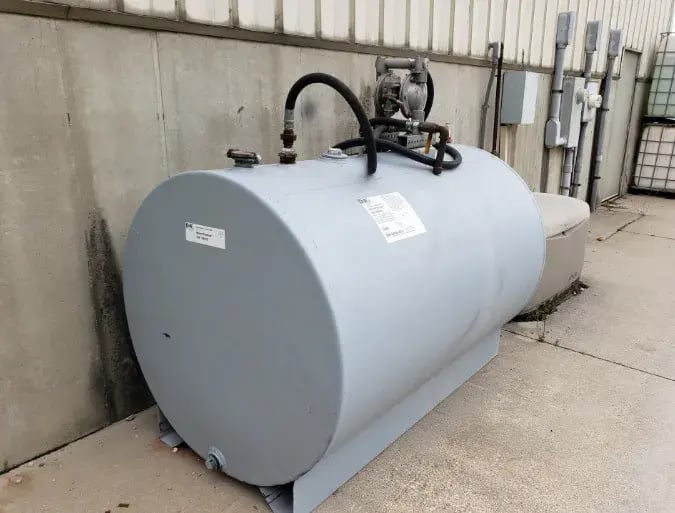
Start with a site walk, not a spreadsheet. Go through every building, yard, loading area, and utility room and write down every container of oil you find, including the ones nobody thinks of as storage: generator base tanks, hydraulic reservoirs on equipment, lube oil totes in the shop, used oil tanks, and drums stacked behind the warehouse. For each one, record its location, contents, shell capacity in gallons, type, and what sits under or around it for containment.
Use the nameplate capacity where you can find it. For a horizontal cylindrical tank without one, radius squared, times pi, times length, all in inches, divided by 231 gives gallons. For portable containers that come and go, count what you'd realistically have on site at once. Then total everything and compare it to three numbers: 1,320 gallons for the rule, 10,000 gallons for the qualified facility option, and 5,000 gallons for your largest single container. Those drive most of the decisions that follow.
How Do You Size SPCC Secondary Containment?
The rule asks for containment at two levels. Every covered facility needs general containment, such as dikes, berms, curbing, drip pans, or sumps suited to the way oil could escape. Bulk storage containers face a tighter test: secondary containment has to hold the entire capacity of the largest single container in the area plus enough freeboard for precipitation, and it has to be impervious enough to hold oil until you clean it up. Oil-filled electrical equipment is excluded from the bulk storage definition, so transformers fall under the general requirement.
The rule doesn't give a freeboard number. Most plans pick a design rainfall event for the area, calculate the extra volume, and document the choice. The example below uses an assumed six inches of rain only to show the math, for a 5,000-gallon diesel tank and a 2,000-gallon used oil tank sharing a 24 by 30 foot dike.
| Step |
Calculation |
Result |
| Largest single container |
Diesel tank capacity |
5,000 gallons |
| Rainfall volume (assumed 6 inches) |
720 sq ft x 0.5 ft x 7.48 gal per cu ft |
about 2,693 gallons |
| Volume the dike must hold |
5,000 + 2,693 |
about 7,693 gallons |
| Wall height needed |
7,693 / (720 x 7.48), before adding for space the tanks and pads take up |
about 1.4 feet or more |
You can drain rainwater from a dike only after checking it for sheen, keeping the drain valve closed otherwise, and logging each release. If your site can't physically fit compliant containment, the rule has an impracticability option, but it needs a contingency plan, extra testing, and engineer sign-off, so treat it as a last resort. Our guide on how big your SPCC oil spill containment needs to be goes deeper.
What Goes in the SPCC Facility Diagram, Inspection Procedures, and Training Records?
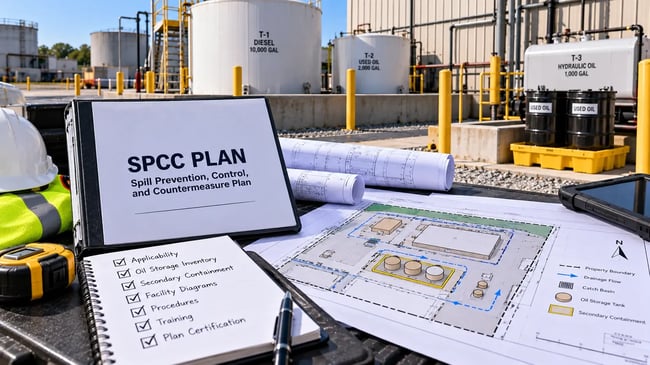
The rule requires a facility diagram that marks the location and contents of every fixed oil container, the storage area for mobile and portable containers, transfer stations, and connecting piping. Completely buried tanks that are exempt from SPCC still go on the diagram, labeled "exempt." It doesn't need to be an engineering drawing, but it has to match the ground, because inspectors walk the site with it in hand. Adding property lines, storm drains and where they flow, the nearest ditch or stream, containment structures, and spill kit locations makes it useful in a real spill. Your plan should also predict which direction oil would flow, and roughly how much could escape, for each way a tank or pipe could fail.
Then write down how and when you inspect each container, and do it. Many facilities inspect monthly. The plan also needs a procedure for testing aboveground containers for integrity on a regular schedule and after material repairs, usually following an industry standard such as STI SP001 or API 653 depending on the tank. Keep signed inspection and test records with the plan for three years. Our list of things to check during monthly SPCC inspections makes a solid checklist starter.
The plan also names a person accountable for discharge prevention who reports to management. Oil-handling employees need training on operating and maintaining equipment to prevent discharges, discharge procedures, applicable pollution control laws, and the contents of the plan, plus a discharge prevention briefing at least once a year. See what the rules say about annual SPCC training, or use our online training library. Finish with security measures such as fencing, locked valves, and lighting, plus loading and unloading procedures for truck areas.
How Do SPCC Certification and Professional Engineer Review Work?
The federal rule sorts facilities into three paths, and your inventory numbers decide which one you're on.
| Plan path |
Who it fits |
Who certifies |
| Tier I qualified facility |
10,000 gallons or less aboveground, no single container over 5,000 gallons, clean spill history |
Owner or operator self-certifies, and EPA's Appendix G template is available |
| Tier II qualified facility |
Same limits, but at least one container over 5,000 gallons |
Owner or operator self-certifies, but a PE must certify any environmental equivalence measures and any finding that containment is impracticable |
| Full plan |
Everyone else, including facilities over 10,000 gallons or with a reportable spill history |
A licensed Professional Engineer reviews and certifies the plan |
A clean spill history means no single discharge to navigable waters or adjoining shorelines of more than 1,000 gallons, and no two discharges of more than 42 gallons each within any twelve-month period, during the three years before you certify. Our article on the different types of SPCC plans goes further.
For full plans, a licensed PE has to review and certify the plan for it to count. By signing, the engineer attests that they've visited the facility, that the plan follows Part 112 and good engineering practice, and that it's adequate for the site. Be wary of anyone offering a stamp without a site visit. Some consulting firms keep a PE on staff and others work with a trusted outside PE, and either setup works as long as a licensed engineer reviews and approves the plan. Our article on professional engineers and SPCC plan requirements covers the roles. EPA also cautions that some states don't allow self-certification, so confirm New Jersey's position first, or take the safer path of a PE review.
One practical catch if you're planning to write a full plan yourself and then hand it to an engineer for the stamp: you'll rarely find a consultant or PE willing to sign off on a plan someone else developed. The certification puts the engineer's license behind every statement in the plan, so they'll want to do the site visit, check the containment math, and write it themselves. A draft you prepared might still save you something, but expect to pay for a full review at the least. If your facility needs PE certification, it usually makes more sense to bring the engineer or consultant in from the start.
How Do New Jersey's Spill Rules Change Your SPCC Plan?
Federal and state reporting are separate calls, and your plan should name both. Federally, an oil discharge that reaches navigable waters and causes a sheen goes to the National Response Center at 1-800-424-8802 right away. A single discharge to water of more than 1,000 gallons, or two of more than 42 gallons each within twelve months, also triggers a written report to EPA's Regional Administrator. Our article on the sheen rule covers the federal trigger.
New Jersey's Spill Compensation and Control Act, called the Spill Act, and its discharge rules at N.J.A.C. 7:1E cover petroleum and other hazardous substances and reach land as well as water. In general, anyone responsible for a discharge who knows or should know of it must notify NJDEP immediately through the 24-hour hotline, 1-877-WARNDEP (1-877-927-6337), with a few narrow exceptions. A spill that stays inside secondary containment is treated differently from one that reaches soil or water, so your response steps should show how your team tells them apart. The Spill Act can also hold the responsible party liable for cleanup costs, and discharge cleanups are generally overseen by a Licensed Site Remediation Professional (LSRP). An environmental attorney can explain your own exposure.
Two other layers can touch your plan. Facilities that qualify as major facilities under N.J.A.C. 7:1E, a threshold set well above the storage at a typical SPCC facility, must also submit Discharge Prevention, Containment, and Countermeasure (DPCC) and Discharge Cleanup and Removal (DCR) plans to NJDEP for approval, so check the rule's definition against your own inventory. Underground tanks fall under N.J.A.C. 7:14B, which calls for NJDEP-certified contractors for work like installation, and aboveground tanks are subject to the Uniform Fire Code, enforced by your local fire official. See our article on SPCC plans in New Jersey for how the pieces fit.
How Do You Keep an SPCC Plan Current After You Finish It?
You have to review the plan at least every five years and document it even when nothing changes. If the review turns up something to fix, you amend within six months. A site change that affects discharge potential, like adding a tank, moving containers, or rebuilding containment, triggers a technical amendment within six months too. A PE certifies technical amendments to a PE-certified plan, while qualified facilities can self-certify theirs. Our article on SPCC plan five-year reviews explains the update, renew, or redo question.
Keep the plan at the facility if someone's there at least four hours a day. If you're building a new facility, the plan has to be in place before operations begin. Construction-phase approvals like construction stormwater coverage, soil erosion certification, building and fire permits, and UST installation by NJDEP-certified contractors run through your engineer, contractor, and the local and state offices, and RMA doesn't prepare them. The operational plan, spill reporting, inspections, and training once the doors open are where we help.
Is Writing Your Own SPCC Plan Worth It, and What Does Help Cost?
Writing it yourself costs time instead of consulting fees, and sometimes that's the right trade. A small site with a handful of tanks or drums, under 10,000 gallons total, no spill history, and someone willing to read the rule is a realistic candidate. It gets harder with large tanks, loading racks, leased property, a recent spill, or doubtful containment, where PE review is required anyway.
If you do hire help, we publish our ranges. SPCC plans generally run $2,500 to $15,000, depending on total storage capacity, the number and type of containers, whether containment needs evaluating, and whether the plan needs PE certification. A simple Tier I update runs about $1,500, while PE-certified updates of complex plans start around $7,500. Our SPCC plan cost breakdown shows what moves the price. Be careful with the very cheap options, since a template or AI-generated draft hasn't been checked against your site. We tested this in our write-up on whether ChatGPT can write an SPCC plan. If you'd like a number for having us handle the work, our SPCC pricing calculator is below.
How Can RMA Help With Your SPCC Plan?
We write and review SPCC Plans for facilities in New Jersey and across the country, and we've been doing it since 1992. Some clients hand us the whole plan. Others write a draft and ask us to check the containment math, diagram, and procedures before it's signed, or want help training staff. If your site is simple enough to handle on your own, we'll tell you so. To talk it through, you can call, email, or fill out the form on our website with no obligation, and you can contact RMA whenever you're ready.