Smaller Oil Storage and a Clean Spill Record Can Mean You Self-Certify Your SPCC Plan Instead of Hiring a PE. Here's How to Tell, and What You Take On If You Do.
Most facilities that need an SPCC Plan assume a Professional Engineer has to certify it. That's the default under the federal oil spill prevention rule, but it isn't the only path. Facilities with limited oil storage and no significant spill history can write the Plan themselves and sign it as the owner or operator. EPA calls these qualified facilities, and if you run a shop, a small plant, a fleet yard, or a farm in Pennsylvania, you may be one without knowing it.
This article covers the qualified facility criteria, including total aboveground oil capacity, the 5,000 gallon container line that separates Tier I from Tier II, and the three-year spill lookback. We'll also cover how to check your spill history, what you're signing when you self-certify, the trade-offs, and how Pennsylvania's tank rules fit alongside the federal rule. If you'd rather talk it through with a person, you can reach out to RMA at any point.
Table of Contents
TL;DR
Your facility is a qualified facility under SPCC if its total aboveground oil storage is 10,000 gallons or less and, in the past three years, it hasn't had a single discharge to waters over 1,000 gallons or two discharges each over 42 gallons within 12 months. If no container holds more than 5,000 gallons, you're Tier I and can use EPA's template. If one does, you're Tier II. Qualifying lets you self-certify instead of hiring a PE, but you're the one vouching that the facility qualifies and the Plan follows the rule. Pennsylvania DEP's tank requirements are separate, so a self-certified SPCC Plan doesn't cover them.
What Is a Qualified Facility Under the SPCC Rule?
The Spill Prevention, Control, and Countermeasure (SPCC) rule is the federal oil spill prevention program in 40 CFR Part 112. It requires a written Plan from facilities that store enough oil and could reasonably be expected to discharge it to navigable waters or adjoining shorelines. EPA Region 3 enforces it in Pennsylvania. Under the standard path, a licensed Professional Engineer (PE) reviews and certifies your Plan. That's the picture most people have of an SPCC Plan.
The qualified facility provision in 40 CFR 112.3(g) is the exception. EPA wrote it for facilities with smaller storage and a clean recent record, on the theory that a simpler Plan signed by the owner or operator is enough for a site like that. Self-certifying is a choice, not an obligation, and you can still bring in a PE if you'd rather. Qualifying also doesn't excuse you from the rest of the rule. You still need a written Plan, secondary containment, inspections, and training, and the Plan has to be carried out, not just filed in a binder. Our guide to the different types of SPCC Plans shows how the qualified options sit next to the PE-certified one.
What Are the SPCC Qualified Facility Criteria for Capacity and Container Size?
Two numbers decide most of this. The first is total aboveground oil storage capacity, which has to be 10,000 gallons or less. The second is your largest single aboveground container. If none is over 5,000 gallons, you're a Tier I qualified facility. If even one is, you're Tier II. Go over 10,000 gallons in total and you're not a qualified facility at all, which means a PE-certified Plan.
How Do You Count Aboveground Oil Storage Capacity?
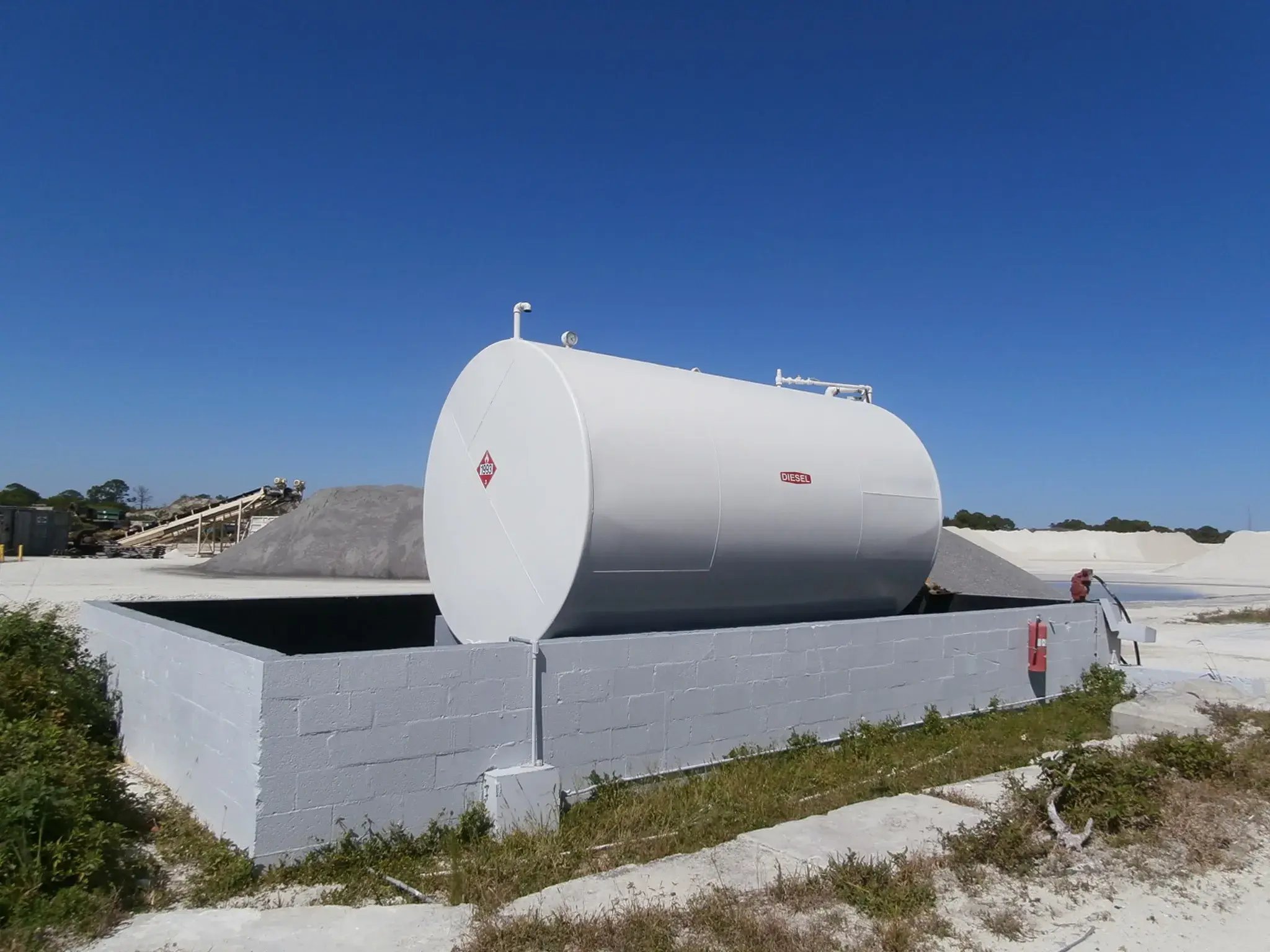
Capacity means what a container can hold, not what's in it today, so a half-empty tank counts at full size. Oil-filled equipment like transformers and hydraulic systems counts, and so do animal fats and vegetable oils. Propane and diesel exhaust fluid don't. Buried tanks aren't part of the 10,000 gallon figure, since the test is about aboveground capacity. Small details like closed containers and mobile equipment can change your total, so check the counting rules against your own inventory, and see our article on whether 55-gallon drums count toward SPCC. These examples show how it shakes out, though your own facts decide the answer.
| Example Facility |
Total Aboveground Capacity |
Largest Container |
Result |
| Fleet yard with a 2,000 gallon diesel tank and a 500 gallon waste oil tank, no spills |
2,500 gallons |
2,000 gallons |
Tier I |
| Small plant with a 6,000 gallon fuel tank and a 3,000 gallon hydraulic oil tank, no spills |
9,000 gallons |
6,000 gallons |
Tier II |
| Facility with five tanks totaling 12,000 gallons, no spills |
12,000 gallons |
Varies |
Not qualified, PE-certified Plan |
| The fleet yard above, but a 1,500 gallon diesel release reached a ditch two years ago |
2,500 gallons |
2,000 gallons |
Not qualified until the release ages out of the lookback |
How Do You Check Your Spill History for the SPCC Three-Year Lookback?
The test looks back three years from the date you self-certify, or back to when the facility became subject to the rule if that's shorter. You're out if the facility had a single discharge over 1,000 gallons, or two discharges each over 42 gallons within any 12-month period. Discharges caused by natural disasters, acts of war, or terrorism are carved out. Because the lookback runs from your certification date, a spill that's two years and eleven months old today won't count against a Plan you sign in a few months, but it will count against one you sign this week.
The word that trips people up is "discharge." The rule counts discharges as described in 40 CFR 112.1(b), meaning oil that reaches navigable waters or adjoining shorelines in harmful quantities. A spill that stays inside secondary containment and gets cleaned up generally isn't one. A spill that runs across pavement into a storm drain, a ditch, or a stream is, and the sheen rule in 40 CFR 110.3 sets a low bar for what's harmful. We walk through it in our explanation of the oil spill sheen rule.
Memory isn't a reliable record, especially at a site with turnover, so pull together what's on paper and ask the longest-tenured people on the yard. Useful sources include:
- Spill and incident logs, plus any reports filed with the National Response Center or Pennsylvania DEP.
- Cleanup contractor invoices, delivery vendor overfill reports, and insurance claims involving oil.
- Monthly inspection records and corrective action notes in your current or prior SPCC Plan.
- DEP inspection and violation records tied to your site, which you can look up in DEP's eFACTS database.
If you recently bought the site, ask the seller for their records too. Then keep a short written summary of what you checked and found. If an inspector asks how you decided the facility qualified, that summary is your answer.
What's the Difference Between a Tier I and Tier II Qualified Facility?
Both tiers share the same spill history test and the same 10,000 gallon ceiling, and the split comes from your largest container. Tier I facilities have simpler operations, so EPA gave them a fill-in template in Appendix G to 40 CFR Part 112. Tier II facilities write a full-length Plan under 40 CFR 112.7 and the applicable subparts, and they can still self-certify it.
| Feature |
Tier I |
Tier II |
| Total aboveground capacity |
10,000 gallons or less |
10,000 gallons or less |
| Largest single container |
5,000 gallons or less |
At least one over 5,000 gallons |
| Spill history, past three years |
No single discharge over 1,000 gallons, no two over 42 gallons within 12 months |
Same |
| Plan format |
EPA's Appendix G template, or an equivalent Plan |
Full-length Plan following the general rule requirements |
| Who certifies |
Owner or operator |
Owner or operator |
| Alternative measures, such as an impracticability determination for secondary containment |
Can't be self-certified, so you'd move to a Tier II or PE-certified Plan |
Allowed only if a PE reviews and certifies each one in writing |
Tier I isn't a free pass on the substance. Even with the template, you need secondary containment for the entire capacity of your largest container plus room for precipitation, a system or documented procedure to prevent overfills, and a failure analysis where experience points to likely equipment failures. We've written up what a Tier I self-certified Plan involves and how a Tier II self-certified Plan differs, and our guide to SPCC containment sizing will save you a few false starts.
What Are You Certifying When You Self-Certify an SPCC Plan?
Your signature isn't a formality. Under 40 CFR 112.6, a Tier I self-certifier states that they know the requirements of Part 112, have visited and examined the facility, and prepared the Plan following accepted and sound industry practices. They also state that inspection and testing procedures are in place, that they'll fully implement the Plan, and that the facility meets the Tier I criteria. The final two statements are that the Plan doesn't deviate from the rule, and that management has approved the Plan and committed the resources to carry it out. Tier II self-certifiers make a nearly identical set of statements.
Read that list the way an inspector would. Someone who's never walked the site can't truthfully sign it, and neither can someone with no budget for the containment work the Plan calls for. The qualification statement ties back to the earlier sections of this article, because you're certifying that your capacity count and three-year spill history are right.
The work continues after you sign. You keep the Plan at the facility if it's normally attended at least four hours a day, and have it available for EPA to review on site. You also keep inspection records, train oil-handling staff, and recertify any technical amendment when a change in design, construction, operation, or maintenance affects your discharge potential. The Plan needs a review at least every five years, which we cover in our guide to SPCC Plan 5-year reviews. For the training piece, our online environmental training library is one option.
What Are the Trade-Offs of Self-Certifying an SPCC Plan Versus Hiring a PE?
The upside is real. Self-certifying costs less, moves faster since you aren't waiting on a PE's schedule, and keeps the Plan in the hands of the people who run the facility. For a simple Tier I site with a few tanks, a clean record, and someone on staff who'll do the work carefully, it can be a sensible choice, and we'll tell you so when that's the case.
The downside is that nobody reviews your work before it counts. A PE's certification puts a second qualified person's judgment behind the Plan, while self-certification puts only yours. If you've miscounted capacity, missed a past discharge, or sized containment too small, the Plan isn't what you certified it to be, and the first to find out is often an EPA inspector. Federal civil penalties for violating the SPCC rule can reach $59,114 per day of violation under the current inflation-adjusted figures in 40 CFR Part 19, and what's assessed depends on the facts of the case. Our write-up of the top SPCC Plan violations and fines shows where facilities tend to get caught.
A few situations point toward a PE even if you technically qualify. A site that needs an alternative measure, like an impracticability determination for secondary containment, needs a PE for that piece anyway. A facility sitting near a threshold, with a spill history you can't fully reconstruct, carries more risk in the certification statement. Some lenders, insurers, and customers also simply ask for a PE-certified Plan, and our overview of professional engineers and SPCC Plans covers that side. And if you're tempted to have a chatbot draft the Plan, we tested that in our look at whether ChatGPT can write an SPCC Plan. The certification is still yours. If you're already dealing with an EPA inspection or enforcement letter, an environmental attorney is the right first call.
When Does a Facility Lose Qualified Facility Status Under SPCC?
Qualified status isn't permanent, because it depends on facts that change. If a Tier I facility adds a container over 5,000 gallons, or its aggregate capacity climbs past 10,000 gallons, you have six months after preparing the amendment to move to a Tier II Plan (if you still meet the Tier II criteria) or a full Plan certified by a PE. A Tier II facility that crosses 10,000 gallons has the same six months to get a PE-certified Plan in place.
A large spill carries its own duty. If a facility discharges more than 1,000 gallons in a single event, or more than 42 gallons in each of two discharges within 12 months, 40 CFR 112.4 requires specific information to go to the EPA Regional Administrator within 60 days, with a copy to the state agency. What a spill means for a Plan you've already self-certified depends on the details, so talk with us or with EPA before assuming you can keep relying on the old certification.
How Do Pennsylvania Tank Rules Fit With a Self-Certified SPCC Plan?
Self-certification is a federal option under 40 CFR 112.3(g). Pennsylvania adds its own layer through DEP's Storage Tank Program, which operates under the Storage Tank and Spill Prevention Act and 25 Pa. Code Chapter 245. DEP requires regulated aboveground storage tanks to be registered with an annual fee, certifies the installers and inspectors who work on them, and treats using an unregistered regulated tank as illegal. A self-certified SPCC Plan doesn't satisfy any of that, and DEP registration doesn't satisfy SPCC.
The two programs don't line up neatly. Whether a tank is DEP-regulated depends on its size, type, and use, so a tank that counts toward your SPCC capacity may not be regulated by DEP, or the reverse. Check your inventory against DEP's storage tank program pages or call the Division of Storage Tanks at 1-800-42TANKS (1-800-428-2657), and confirm with DEP that nothing at the state level changes how you approach your Plan. Local fire code adds a third layer, enforced municipality by municipality.
If you're adding a tank or building out a new facility, there's a piece we don't handle. Construction-phase permits and approvals, building and fire permits, and tank installation are work for your engineer, contractor, or a DEP-certified installer, and RMA doesn't prepare or manage them. What we do help with is what the facility needs once it's running: an SPCC Plan or amendment, inspections, training, and keeping your DEP registration current, which includes submitting an amended registration within 30 days of installing a new tank. We can also help you work out what the construction phase needs and point you toward the right people.
What Does Help With a Qualified Facility SPCC Plan Cost?
EPA's template is free, so a Tier I facility that does the work internally pays in staff time rather than fees. If you want help, our published range for SPCC Plans runs from $2,500 to $15,000. A simple Plan update, the kind a Tier I facility often needs, runs about $1,500, while a complex PE-certified update starts at $7,500 and up. Where a qualified facility lands depends on how many containers you have, whether your secondary containment needs evaluating or sizing, whether any alternative measure requires a PE, and how much of your capacity count and spill history we need to sort out first.
For a number tied to your own site, the pricing calculator below gives an estimate for getting our help. It's the cost of working with us, not the cost of the Plan itself, and you can see it before you ever talk to anyone.
How Can RMA Help With Your Qualified Facility SPCC Plan?
We're a family-run firm based in New Jersey, and we work with facilities across Pennsylvania. For qualified facilities, we can check your capacity count and spill history, write a Tier I or Tier II Plan, review a Plan you've written yourself, or prepare a PE-certified Plan when that's the better fit. Senior staff do the work, and we don't use AI to produce client deliverables. If you have a simple Tier I site and the time to do it right, we'll tell you that you may not need us and point you to EPA's template.
If you'd like a second set of eyes before you sign, there's no pressure and no obligation. You can call us at 888-RMA-0230, email us, or fill out the form on our website, and someone on our team will talk through your facility with you. Whenever you're ready, contact RMA and we'll help you work out the next step.