How to Standardize Plan Formats, Five-Year Reviews, Inspections, and New Jersey Tank and Spill Rules Across Every Site You Run
Most companies with several New Jersey sites never sat down and designed an oil spill plan program. It built itself over time. One location got a plan from a consultant in 2016, another came with an acquisition, a third has a template somebody found online, and a fourth is still working off a plan that describes tanks that were removed years ago. Then an insurer, a lender, or a corporate auditor asks which plans are current, and nobody can answer without a week of digging.
The plan in question is a Spill Prevention, Control, and Countermeasure (SPCC) plan, the federal oil spill prevention plan required under 40 CFR Part 112 for facilities that store more than 1,320 gallons of oil aboveground. Every site needs its own plan, but you can run all of them the same way. This article walks through how to standardize plan formats, track five-year reviews and amendments in one place, share inspection procedures, put real responsibility at the site level, and keep up with New Jersey's separate tank and spill rules. If you'd rather talk it through with someone who does this daily, reach out to RMA anytime.
Table of Contents
TL;DR
Each facility needs its own SPCC plan, but the way you manage them can be identical. Use one plan format, keep a central register of five-year review and amendment dates, run the same inspection checklist everywhere, and name an accountable person at every site. Then add a second tracking layer for New Jersey's own rules, which cover spill reporting, discharge prevention plans for major facilities, and underground tanks.
Why Do SPCC Plans Drift Apart Across Multiple New Jersey Facilities?
The SPCC rule is federal, and in New Jersey it's enforced by EPA Region 2. A facility needs a plan when it stores more than 1,320 gallons of oil aboveground, counting every container of 55 gallons or more, and the count is based on capacity, not on how full the containers are. A plan describes one site: its tanks, drums, oil-filled equipment, containment, drainage, and procedures. That's why there's no such thing as one company-wide SPCC plan that covers all your locations, and it's also why plans drift apart.
Drift usually comes from the same few causes. Different authors wrote the plans in different years, so the structure and level of detail vary. Acquired sites came with whatever the previous owner had. Local managers added a tank, moved a generator, or switched products without telling anyone, so the plan stopped matching the site. And some sites ended up with self-certified plans while others have plans certified by a Professional Engineer (PE), sometimes for good reasons and sometimes by accident. Our guide to the different types of SPCC plans explains which situations call for which type.
The problems that follow look the same from site to site: five-year reviews that were never signed, inspection records that don't exist, containers that aren't in the plan. Those are the findings we cover in our article on top SPCC plan violations and fines, and with eight sites you have eight chances to land on that list. If the state rules are new to you, our overview of SPCC plans in New Jersey covers the basics.
Standardizing doesn't mean copying one plan and changing the address. It means every plan uses the same skeleton, so anyone who has read one plan knows where to find things in the others. A good skeleton follows the order of the SPCC rule itself, so an inspector, an auditor, or a new site manager can check the plan against the requirements. Then it uses the same appendices everywhere: a container inventory with capacities, secondary containment calculations, a site drainage map, spill response contacts, a training log, inspection records, a five-year review log, and an amendment log.
The site-specific content is what changes. Container counts, containment sizing, drainage paths, nearby waterways, and spill response procedures all have to reflect the real site. If the plan for your Newark location mentions a tank that only exists at your Paulsboro location, you've copied too much, and an inspector will notice.
Plan type is the other piece to settle early. Smaller sites with simple setups may qualify for a self-certified plan, while larger or more complex sites need a PE-certified plan. With one layout everywhere, the type becomes a single field in your tracking register. If you're weighing a remote approach for sites with similar setups, we wrote about handling SPCC plans for multi-facility operations remotely.
How Do You Track SPCC Five-Year Reviews and Amendments Across Sites?
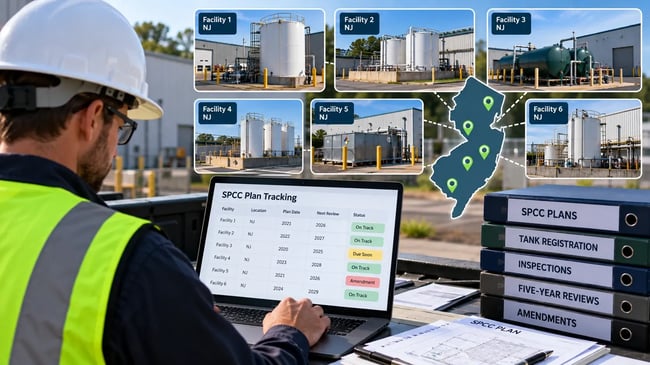
This is where a central register earns its keep. The SPCC rule requires a review and evaluation of each plan at least once every five years, and you have to document it with a signed statement saying whether you'll amend the plan as a result. If the review turns up field-proven technology that would significantly reduce the chance of a discharge, you amend the plan within six months of the review and put the change in place within six months after that. Separately, any change in design, construction, operation, or maintenance that materially affects the potential for a discharge triggers an amendment. Examples include adding, removing, or moving containers, replacing piping, changing containment, or switching products. Same clock: prepare it within six months, implement it within six months after that.
Technical amendments also need PE certification, except for certain qualified facilities. When your plans were written in different years, every site runs on its own clock, and nobody remembers which clock is closest to expiring. One spreadsheet or compliance tracking tool fixes that if it holds the right fields for each site.
| Register Field |
What It Tells You |
| Plan type and version |
Self-certified or PE-certified, and which edition is current |
| Last five-year review date |
When the signed review statement was completed |
| Next review due |
The date to schedule against, with a reminder well ahead of it |
| Last amendment and reason |
Whether the plan reflects the most recent site change |
| Open amendment deadlines |
Any six-month preparation or implementation clock currently running |
| Total aboveground oil capacity |
Whether the site still sits above the 1,320 gallon threshold or has moved closer to New Jersey's major facility range |
| Last PE certification date |
Whether technical changes have been certified |
The register only works if changes reach it. Give every site a short change notice form that managers fill out before they add, move, or remove a tank, drum area, or piece of oil-filled equipment. That one habit catches most amendment triggers before the six-month clock runs out. Our articles on SPCC five-year reviews and on when to update an SPCC plan go deeper on what counts as a review versus a full rewrite.
How Should You Standardize SPCC Inspection Procedures at Every Site?
The SPCC rule requires written inspection and testing procedures, and it requires records of those inspections, signed by the appropriate supervisor or inspector and kept for three years. It doesn't hand you one checklist for every container at every site, so the content is up to you and your plan. What matters is that whatever your plan says you'll do, you do and document. A plan that promises monthly visual inspections and has records for three of the last twelve months is worse off than a plan that promised less and delivered it.
That's the argument for one shared inspection procedure. Build a single checklist that covers the common items: tanks and drums, valves and piping, secondary containment condition, drainage valves, loading and unloading areas, oil-filled equipment, and spill kit contents. Add a short site-specific section for anything unusual. Many facilities use monthly visual inspections for their oil containers and tie formal integrity testing of larger tanks to recognized industry standards, but the frequency you choose should match what your plan commits to, and similar sites should use the same frequency unless there's a reason not to. Our guide to the top 10 things to do during monthly SPCC inspections is a good starting point for building the checklist.
Training works the same way. The rule calls for discharge prevention briefings for oil-handling personnel at least once a year, and running one shared course across all sites keeps the content, dates, and sign-in records consistent. Our post on annual SPCC training explains what the rule expects, and RMA's online training library can reach multiple sites without scheduling a trainer for each one. Have corporate pull a sample of inspection records from each site every quarter, so gaps show up before an inspector finds them.
Who Should Be Responsible for SPCC Compliance at Each Site?
Corporate can own the templates and the register, but corporate can't see a leaking drum. The SPCC rule expects a designated person at each facility who is accountable for discharge prevention and who reports to facility management. It also expects the plan to carry management approval at a level with the authority to commit the resources needed to carry it out. In a multi-site company, those two requirements point toward the same structure: a named person at each site doing the daily work, and someone with budget authority standing behind the program.
| Task |
Site Coordinator |
Corporate EHS or Operations |
| Inspections and records |
Performs and signs them |
Samples records quarterly |
| Site changes |
Submits a change notice before work starts |
Decides whether an amendment is needed |
| Training |
Makes sure oil-handling staff attend |
Supplies the course and tracks completion |
| Plan templates and the register |
Confirms site details are accurate |
Maintains templates and review dates |
| Spill response and reporting |
Acts first and makes the required calls |
Supports the response and follow-up |
Turnover is where sites fall apart. When the site coordinator leaves, the inspection binder and the spill contacts often leave with them. Name a backup at every site, and add a handoff step to your offboarding checklist so the plan and training records pass to a person, not a drawer.
How Do You Track New Jersey's Tank and Spill Rules Across Facilities?
Federal SPCC compliance is the base layer. New Jersey adds state programs that run on their own schedules and apply to different sites in different ways, which is why your register needs a second set of columns for them. Three programs matter most for oil storage.
The first is spill reporting under the Spill Compensation and Control Act (the Spill Act) and N.J.A.C. 7:1E. Discharges of petroleum and other hazardous substances generally have to be reported to the NJDEP hotline immediately, at 1-877-WARNDEP (1-877-927-6337). The rule has exemptions that depend on the facility and the circumstances, so check them against each site before relying on one. The state duty is also separate from the federal one, which has different triggers, as we explain in our article on when you have to report an oil spill. Write one spill response procedure for all sites that covers both, so employees aren't deciding on their own whether a spill "counts."
The second is the discharge prevention program for major facilities under N.J.A.C. 7:1E. A major facility has to prepare a Discharge Prevention, Containment and Countermeasure (DPCC) plan and a Discharge Cleanup and Removal (DCR) plan and submit them to NJDEP. Whether a site is a major facility depends on its total storage capacity and what it stores, so check the rule against each site's inventory. A non-major facility that adds enough storage becomes one, which is another reason the register should track total capacity. Once approved, these plans have to be renewed every three years, with the renewal submitted at least 180 days before the plans expire, and plans that aren't renewed on time are treated as expired. NJDEP has also been revising these rules, so work from the current rule text and not an older copy.
The third is the underground storage tank (UST) program under N.J.A.C. 7:14B. Regulated USTs have to be registered with NJDEP, and certain work on them has to be done by NJDEP-certified individuals and firms. Some heating oil tanks fall outside the regulated program depending on their size and use, so look at each tank individually. Completely buried tanks that are subject to UST requirements are generally treated differently under the SPCC rule than aboveground oil, with conditions, so one site can end up with an SPCC plan for its aboveground oil and separate UST obligations for its buried tanks. Check each tank's status against the rule and don't assume.
| New Jersey Program |
Applies To |
Track for Each Site |
| Spill Act discharge reporting |
Every site that stores or handles petroleum or other hazardous substances |
Posted reporting procedure, hotline number, current contact list, staff training |
| DPCC and DCR plans (N.J.A.C. 7:1E) |
Major facilities only |
Major facility status, approval date, three-year renewal deadline, drill records |
| UST program (N.J.A.C. 7:14B) |
Sites with regulated underground tanks |
Tank-by-tank regulated status, registration, certified contractor records, release detection |
A few other New Jersey items belong on the same register for sites where they apply: Community Right to Know reporting, Uniform Fire Code requirements that your local fire official enforces, and the Industrial Site Recovery Act (ISRA) if you ever sell or close a covered site. Spill Act liability can be strict and can reach more than one party, so if you suspect a missed report or a past discharge at any site, talk with an environmental attorney before deciding how to proceed.
What Does It Cost to Bring Multiple SPCC Plans Into Line?
RMA's published ranges give you a starting point. A full SPCC plan runs from about $2,500 to $15,000 depending on the facility. A simple Tier I update is around $1,500, and a complex plan that needs PE certification starts at $7,500 and goes up from there. We cover the factors behind those numbers in our SPCC plan cost guide.
For a multi-site company, the total depends on how many sites you have, how much oil each one stores, how many containers are involved, whether PE certification is needed, whether secondary containment has to be evaluated, and how alike the sites are. Similar sites can often move faster than a set of one-offs. Many companies phase the work, bringing each plan onto the common format as it comes due for its five-year review or needs an amendment anyway. The SPCC pricing calculator below shows what RMA's help with a plan would run for a given site, and running it for two or three representative locations gives you a workable estimate for the whole group.
How Can RMA Help You Manage SPCC Plans Across Your New Jersey Sites?
We're based in New Jersey and we've worked with NJDEP and EPA requirements for more than 30 years, so the state and federal layers aren't new to us. For multi-site companies, we can review the plans you already have, tell you which are current and which have slipped, and build or update them on a common format. We can also help you set up the register, the inspection checklist, and the training schedule, and where a plan needs PE certification, a PE has to review and approve it, so we help you plan for that step in the timeline.
We'll also tell you when you don't need us. If you have two sites with current plans, a spreadsheet and a shared checklist may be all you need. If you're not sure where you stand, you can call us at 888-RMA-0230, email info@rmagreen.com, or fill out the form on our website. There's no obligation, and we're glad to answer questions even if you end up handling everything yourself.