A Printable Monthly SPCC Inspection Checklist for Pennsylvania Facilities, Built Around What Your Plan Typically Requires
If you store oil and have a Spill Prevention, Control, and Countermeasure (SPCC) Plan, someone at your facility is supposed to walk the site on a regular schedule, look over the tanks, containment, piping, and transfer areas, and write down what they find. The rule tells you to do it and to keep the records, but it doesn't hand you a form. Plenty of facilities end up with a half-page sheet somebody wrote years ago, a generic template that doesn't match the equipment on site, or a habit and a good memory. None of those hold up well when an inspector from EPA Region 3 asks to see the last three years of records.
This article is the checklist. Below you'll find a short explanation of what the rule requires and where your inspection frequency comes from, followed by seven checklists organized by area: tanks and containers, secondary containment, valves and piping, overfill prevention, drums and portable containers, loading and unloading areas, and security and spill response readiness. Every table has columns for findings and corrective actions, so you can print the page, take it on your walk, and file it afterward. If you'd like a checklist tailored to your site and Plan, or a second set of eyes on what you've been doing, you can reach out to RMA at any time.
Table of Contents
TL;DR
A monthly SPCC inspection is a routine walk-around of your tanks, containers, containment, piping, transfer areas, and security, recorded on a signed form that you keep for at least three years. The SPCC rule doesn't set a monthly schedule on its own. Your frequency comes from your SPCC Plan and the industry standard it follows, and monthly is the common interval. The checklist below covers seven areas with room for findings and corrective actions, and it should be adjusted to match the equipment, procedures, and schedule in your own Plan.
What Does the SPCC Rule Say About Routine Inspections?
The federal SPCC rule, 40 CFR Part 112, talks about routine inspections in three places. Section 112.8(c)(6) says each aboveground container has to be tested or inspected on a regular schedule, and that you also need to frequently look over the outside of the container for deterioration, discharges, and oil collecting inside diked areas. That same paragraph covers the container's supports and foundations. Section 112.8(d)(4) covers valves and piping, and it's specific about what an inspector should look at: flange joints, expansion joints, valve glands and bodies, catch pans, pipeline supports, whether valves are locked, and metal surfaces. Section 112.7(e) ties it together by requiring that inspections follow written procedures and that you keep those procedures and a signed record of each inspection with the Plan for three years. Records you already keep as part of normal business practice satisfy that requirement.
The rule never says "monthly," and it doesn't hand you a form. It uses phrases like "regular schedule" and "frequently" and leaves the details to your Plan and to industry standards. If you have a Tier I qualified facility using the EPA template, the Plan also has to describe a system or documented procedure to prevent overfills and say how you test it. If your Plan is PE-certified, the inspection procedures are written by you or the certifying engineer. Which of these applies depends on the type of SPCC Plan you have, and the checklist below should be trimmed or expanded to match it.
How Often Should You Run an SPCC Inspection?
Your inspection frequency comes from your SPCC Plan, and your Plan usually takes it from an industry standard. For shop-built tanks, the most common one is STI SP001, which calls for routine monthly and annual inspections by the owner's personnel and formal inspections by a qualified inspector on longer intervals that depend on tank size, design, and containment. Larger field-erected tanks are often tied to API 653. That's why monthly shows up so often: it's what the standards most Plans cite call for, not a number printed in the federal rule. EPA describes the frequent visual inspection as a routine walk-around that includes the container's supports and foundations, so a quick glance from the gate won't meet it.
| Inspection or review |
Typical frequency |
Who usually does it |
Where it comes from |
| Routine visual walk-around (this checklist) |
Monthly is the common default. Your Plan sets the interval. |
Trained facility staff |
40 CFR 112.8(c)(6) and 112.8(d)(4), your Plan, and the industry standard it follows |
| More frequent checks on active areas |
Weekly or daily at some facilities, such as generators, used oil tanks, and busy transfer areas |
Facility staff |
A choice written into your Plan |
| Event-driven checks |
After heavy rain, storms, vehicle impacts, or any release |
Facility staff |
Common practice, and often written into the Plan |
| Annual inspection |
Once a year where your standard calls for it |
Trained staff or a qualified inspector, depending on the standard |
Industry standards such as STI SP001 |
| Formal integrity inspection or testing |
Set by container size, design, and the standard your Plan names |
A qualified inspector. For DEP-regulated tanks, a DEP-certified inspector. |
40 CFR 112.8(c)(6) and 25 Pa. Code Chapter 245 |
| Discharge prevention briefing |
At least once a year |
Oil-handling personnel |
40 CFR 112.7(f)(3) |
| Plan review |
Every five years |
Owner or operator |
SPCC rule |
Whatever interval your Plan states is the one you'll be held to, so check that the Plan and the practice match. A Plan that promises monthly inspections while the site only walks it quarterly is a bigger problem than a Plan that says quarterly up front and follows through (though a quarterly schedule has to be defensible under the standard you cite). For a shorter rundown of what experienced inspectors look for on the walk itself, see our top 10 things to do during your SPCC monthly inspections.
How Do You Use This Monthly SPCC Inspection Checklist?
Start by laying the checklist next to your Plan. Open the inspection section and the facility diagram, then delete any rows for equipment you don't have (no loading rack, no drums, no overfill alarm) and add rows for anything unique to your site. If your Plan names a different interval or a specific form, follow the Plan. This page covers what SPCC Plans typically require, and it works as a starting point, not a replacement for the procedures in your own document.
Walk the site in the same order every month so nothing gets skipped. For each row, mark OK, Issue, or N/A. Any time you mark Issue, write what you saw in the Findings column, such as a location, a size, and whether oil was present, and write what you'll do and the date it was finished in the last column. A photo taped to the form or saved with it makes the record much more useful next month. Fill in the header block below first, then sign and date the form when you finish. Routine inspections like this can typically be done by trained facility staff who know what a deficiency looks like. Print the page and use one copy per inspection.
| Facility name |
|
Inspector name |
|
| Inspection date and time |
|
Weather and recent rainfall |
|
| Plan date and version |
|
Inspector signature |
|
| Supervisor review and date |
|
Number of open items from last month |
|
SPCC Tank and Container Inspection Checklist
Start with the containers themselves, since the rule asks you to frequently inspect the outside of each one for deterioration, discharges, and oil collecting in diked areas. Walk the full circumference, look at the base and supports as well as the shell, and note the date of the last formal integrity inspection recorded in your Plan files so you can see whether the next one is coming up. Oil-filled equipment like transformers and hydraulic units counts toward your oil totals, so it belongs on the walk too.
| What to check |
Status |
Findings |
Corrective action and date completed |
| Shell and walls. Look for dents, bulges, cracks, rust blisters, flaking paint, and weeping at seams on every aboveground container. |
☐ OK
☐ Issue
☐ N/A |
|
|
| Stains and drips. Check on and under each tank, at seams, gaskets, bolts, rivets, and fittings, for wet oil, dark staining, or oily soil. |
☐ OK
☐ Issue
☐ N/A |
|
|
| Supports, legs, and foundations. Check for settling, cracked pads, rusted legs or saddles, undermined soil, and water pooling at the base. |
☐ OK
☐ Issue
☐ N/A |
|
|
| Base and ground contact. On tanks sitting close to grade, check for standing water, vegetation, and corrosion where the tank meets the pad. |
☐ OK
☐ Issue
☐ N/A |
|
|
| Vents, caps, and manways. Vents should be clear of debris and insect nests, caps and hatches closed, and gaskets intact. |
☐ OK
☐ Issue
☐ N/A |
|
|
| Double-wall tanks. If the tank has an interstitial space or monitor, confirm no liquid is showing and the gauge or alarm reads normal. |
☐ OK
☐ Issue
☐ N/A |
|
|
| Impact protection and labels. Bollards and barriers undamaged, contents and capacity labels legible, no signs of a vehicle strike. |
☐ OK
☐ Issue
☐ N/A |
|
|
| Oil-filled equipment and generators. Check transformers, hydraulic units, compressors, generator day tanks, and drip pans for leaks and staining. |
☐ OK
☐ Issue
☐ N/A |
|
|
SPCC Secondary Containment Inspection Checklist
Secondary containment has to hold the entire capacity of the largest single container plus enough freeboard for precipitation, and it has to be impervious enough to keep oil in until someone cleans it up. The rule is also specific about water. Diked areas drain through manual open-and-closed valves, flapper-type drain valves aren't allowed, and rainwater can only leave if the bypass valve is normally sealed closed, the water is inspected, the valve is reopened and resealed under supervision, and the event is recorded. If you're not sure your containment is large enough for the tanks inside it, read up on how big your SPCC containment needs to be.
| What to check |
Status |
Findings |
Corrective action and date completed |
| Walls, dikes, berms, and curbs. Look for cracks, gaps, erosion, burrowing animal holes, and low spots that would let oil out. |
☐ OK
☐ Issue
☐ N/A |
|
|
| Floor or liner. Check for cracks, coating failure, deteriorated joints, and liner tears or punctures. |
☐ OK
☐ Issue
☐ N/A |
|
|
| Pipe and conduit penetrations. Confirm anything passing through a wall or floor is sealed and not weeping. |
☐ OK
☐ Issue
☐ N/A |
|
|
| Accumulated rainwater. Note how much water is in the containment and whether there's any sheen, odor, or oil film on it. |
☐ OK
☐ Issue
☐ N/A |
|
|
| Accumulated oil. Any oil in the containment should be removed promptly. Record where it came from if you can tell. |
☐ OK
☐ Issue
☐ N/A |
|
|
| Drain valve. Manual open-and-closed design, not a flapper type. It should be closed and locked or sealed per your Plan. |
☐ OK
☐ Issue
☐ N/A |
|
|
| Drainage log. If rainwater was released since the last inspection, confirm the date, the sheen check, the person supervising, and the closed valve are all recorded. |
☐ OK
☐ Issue
☐ N/A |
|
|
| Usable capacity. Check that stored materials, equipment, snow, ice, or debris aren't taking up room the containment needs. |
☐ OK
☐ Issue
☐ N/A |
|
|
| Pumps and ejectors. Any pump used to empty the containment should be started by hand only after someone looks at what's in it. |
☐ OK
☐ Issue
☐ N/A |
|
|
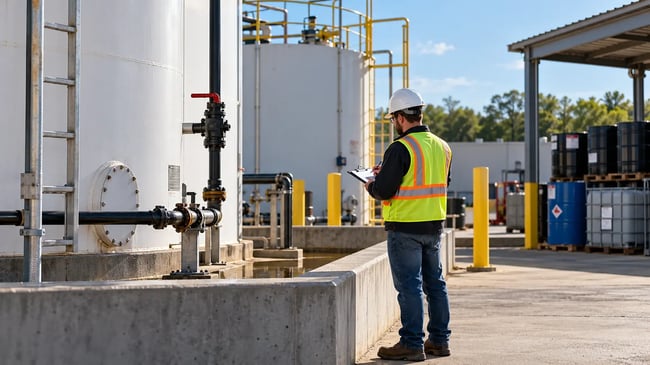
SPCC Valve, Piping, and Transfer Point Inspection Checklist
This section follows the list in 112.8(d)(4). Joints and fittings are where valves and piping tend to show problems first, so slow down at flanges, glands, and connections and look underneath them as well as at them. Staining on a catch pan or a damp spot on gravel under a joint is often the first sign.
| What to check |
Status |
Findings |
Corrective action and date completed |
| Flanges and gaskets. Check flange joints and expansion joints for weeping, staining, loose bolts, or damaged gaskets. |
☐ OK
☐ Issue
☐ N/A |
|
|
| Valve bodies and glands. Look for leaks at valve glands, packing, and bodies, plus corrosion and handles that don't operate freely. |
☐ OK
☐ Issue
☐ N/A |
|
|
| Piping surfaces. Check aboveground pipe for corrosion, coating loss, dents, sagging, and signs of rubbing. |
☐ OK
☐ Issue
☐ N/A |
|
|
| Pipe supports. Supports should be present, secure, and not abrading the pipe or corroding. |
☐ OK
☐ Issue
☐ N/A |
|
|
| Catch pans and drip pans. Pans under valves, pumps, and connections should be in place, undamaged, and free of oil and water. |
☐ OK
☐ Issue
☐ N/A |
|
|
| Valve locking. Master flow and drain valves should be locked or secured the way your Plan describes. |
☐ OK
☐ Issue
☐ N/A |
|
|
| Out-of-service piping. Lines not in use should be capped or blank-flanged and marked to show where they come from. |
☐ OK
☐ Issue
☐ N/A |
|
|
| Pumps. Check seals and fittings for leaks, and confirm starter controls are secured against unauthorized use. |
☐ OK
☐ Issue
☐ N/A |
|
|
| Vehicle protection. Barriers, bollards, or signs should protect aboveground piping and transfer points from traffic. |
☐ OK
☐ Issue
☐ N/A |
|
|
| Exposed buried piping. If a section of buried line was uncovered for any reason, record that someone examined it for deterioration. |
☐ OK
☐ Issue
☐ N/A |
|
|
SPCC Overfill Prevention and Gauge Inspection Checklist
Filling a tank is when a lot can go wrong at once, so the rule asks for at least one overfill device for each bulk container, such as a high-level alarm, a pump cutoff, direct communication between the person gauging and the person pumping, or a fast-response gauging system with someone watching. Whichever you use, the rule says to test liquid level sensing devices regularly, and Tier I facilities have to test their overfill system or documented procedure. Test logs are easy to let slide, so for more on the items that tend to get missed, see our article on the most overlooked SPCC requirements.
| What to check |
Status |
Findings |
Corrective action and date completed |
| High-level alarm. Audible or visual alarm is in place, unobstructed, and can be heard or seen by the person doing the filling. |
☐ OK
☐ Issue
☐ N/A |
|
|
| Pump cutoff or shutoff device. If your Plan relies on a high-level cutoff, confirm it's installed and set to the level the Plan states. |
☐ OK
☐ Issue
☐ N/A |
|
|
| Gauges and sight glasses. Readable, clean, and in agreement with a manual check such as a dipstick, where your procedure uses one. |
☐ OK
☐ Issue
☐ N/A |
|
|
| Test records. Confirm the last test of the alarm, sensor, or gauge is logged with a date and result, on the schedule in your Plan. |
☐ OK
☐ Issue
☐ N/A |
|
|
| Fill procedure. The written delivery and filling procedure is posted or at hand, and it matches what drivers and staff do in practice. |
☐ OK
☐ Issue
☐ N/A |
|
|
| Fill ports and spill buckets. Caps in place, spill buckets clean and empty, and nothing leaking around the fill connection. |
☐ OK
☐ Issue
☐ N/A |
|
|
| Audible vents. Where a vent whistle or alarm is part of the system, confirm it isn't blocked or damaged. |
☐ OK
☐ Issue
☐ N/A |
|
|
SPCC Drum and Portable Container Inspection Checklist
Drums, totes, and other mobile containers are easy to forget because they move around. The rule requires secondary containment for mobile or portable containers sized for the largest single container or compartment, with freeboard for rain, and it asks you to position them so a discharge can't reach water. Containers of 55 gallons or more count toward your facility's total capacity, so it matters which ones you have and where they sit, which is covered in our article on how 55-gallon drums count toward your SPCC totals.
| What to check |
Status |
Findings |
Corrective action and date completed |
| Storage location. Containers are in the designated area shown on the facility diagram, not scattered around the site. |
☐ OK
☐ Issue
☐ N/A |
|
|
| Container condition. Check for rust, dents, bulging, loose bungs, damaged lids, and any weeping or wet spots. |
☐ OK
☐ Issue
☐ N/A |
|
|
| Labels. Contents are marked and legible, and used oil containers are labeled as used oil. |
☐ OK
☐ Issue
☐ N/A |
|
|
| Secondary containment. Pallets, berms, or pans are in place, undamaged, and free of oil and water. |
☐ OK
☐ Issue
☐ N/A |
|
|
| Containment capacity. Check that the containment still holds the largest single container with room for rain, if your Plan relies on it. |
☐ OK
☐ Issue
☐ N/A |
|
|
| Mobile and portable tanks. Totes, skid tanks, and fuel trailers are positioned away from drains, ditches, and drainage paths. |
☐ OK
☐ Issue
☐ N/A |
|
|
| Rain protection. Covers, lids, or shelter are in place on outdoor drums and totes. |
☐ OK
☐ Issue
☐ N/A |
|
|
| Empty and out-of-service drums. Remove empties and damaged containers from the storage area, and note where they went. |
☐ OK
☐ Issue
☐ N/A |
|
|
| Spill kit. A stocked spill kit is within reach of the storage area. |
☐ OK
☐ Issue
☐ N/A |
|
|
SPCC Loading and Unloading Area Inspection Checklist
Many facilities don't have a formal loading rack but still take oil deliveries by truck or fill tanks from a tanker, and the same common-sense controls apply. Where the rack rules in 112.7(h) apply to you, they call for quick drainage or containment sized for the largest compartment of the truck, warning signs or barriers, wheel chocks or a brake interlock, and a check of the vehicle's lowest drain and outlets before it leaves. Delete the rows that don't fit your operation and keep the ones that do.
| What to check |
Status |
Findings |
Corrective action and date completed |
| Drainage and containment. Check curbing, trench drains, sumps, or catchment where trucks load, unload, or fuel. Look for oil in them. |
☐ OK
☐ Issue
☐ N/A |
|
|
| Drain valves. Valves on loading area drains should be closed, with no oil sitting above them. |
☐ OK
☐ Issue
☐ N/A |
|
|
| Warning devices. Signs, wheel chocks, barriers, or interlocks are in place and being used. |
☐ OK
☐ Issue
☐ N/A |
|
|
| Hoses and fittings. Check transfer hoses for cracks, kinks, bulges, and leaking couplings, and confirm they're stored with ends capped. |
☐ OK
☐ Issue
☐ N/A |
|
|
| Unused connections. Loading and unloading connections not in use should be capped or blank-flanged. |
☐ OK
☐ Issue
☐ N/A |
|
|
| Pre-departure check. Where trucks load at a rack, confirm the lowermost drain and all outlets are checked for leaks before the truck leaves. |
☐ OK
☐ Issue
☐ N/A |
|
|
| Delivery supervision. Someone from the facility is present during deliveries, and the driver and attendant follow the written procedure. |
☐ OK
☐ Issue
☐ N/A |
|
|
| Dispenser and fueling equipment. Check nozzles, hoses, dispenser housings, and shutoffs for leaks and damage. |
☐ OK
☐ Issue
☐ N/A |
|
|
| Spill materials. Sorbents, drain covers, and cleanup supplies are stocked at the transfer area. |
☐ OK
☐ Issue
☐ N/A |
|
|
SPCC Security, Signage, and Spill Response Readiness Checklist
Section 112.7(g) asks your Plan to describe how you control access to oil areas, secure master flow and drain valves, protect pump starter controls, secure loading connections, and light the area well enough to discourage vandalism and help staff spot a discharge. The last rows on the form check that you can respond if something does go wrong: supplies stocked, contacts current, and people trained. Staff who do the monthly walk and handle oil should also receive annual SPCC training, and our online training library has courses for teams that want a ready-made option.
| What to check |
Status |
Findings |
Corrective action and date completed |
| Fencing, gates, and access. Fences and gates are intact, and oil handling and storage areas are locked or controlled as your Plan describes. |
☐ OK
☐ Issue
☐ N/A |
|
|
| Lighting. Lights cover oil storage and transfer areas, work after dark, and aren't blocked or broken. |
☐ OK
☐ Issue
☐ N/A |
|
|
| Pump starter controls. Controls are locked, covered, or otherwise out of reach of unauthorized people. |
☐ OK
☐ Issue
☐ N/A |
|
|
| Emergency contacts. The contact list in your Plan is current, including the response coordinator, cleanup contractor, and agency numbers. |
☐ OK
☐ Issue
☐ N/A |
|
|
| Plan and records on site. A current copy of the Plan is accessible, and the last three years of inspection records are filed with it. |
☐ OK
☐ Issue
☐ N/A |
|
|
| Spill response supplies. Spill kits, sorbents, booms, and drain covers are stocked, accessible, and inventoried. |
☐ OK
☐ Issue
☐ N/A |
|
|
| Nearby storm drains. Drains near oil areas are identified and can be covered or protected quickly. |
☐ OK
☐ Issue
☐ N/A |
|
|
| Housekeeping. Vegetation, trash, pallets, and stored materials aren't piling up around tanks, containment, or piping. |
☐ OK
☐ Issue
☐ N/A |
|
|
| Training. New oil-handling staff have been trained, and the date of the last annual discharge prevention briefing is on file. |
☐ OK
☐ Issue
☐ N/A |
|
|
What Should You Do With Findings and Corrective Actions From an SPCC Inspection?
The rule is direct about what happens next. Visible discharges that cause a loss of oil from a container, including leaks at seams, gaskets, piping, pumps, valves, rivets, and bolts, have to be promptly corrected, and oil collecting in diked areas has to be promptly removed. Write down what you did and the date you did it, and have the appropriate supervisor review and sign the form. A finding that stays open across three monthly forms in a row reads badly to anyone reviewing your records, so give each one an owner and a completion date. Keep the signed forms with the Plan for at least three years. EPA also recommends keeping formal integrity test reports for the life of the container.
Some findings are bigger than a repair. If you're adding a tank, changing how deliveries work, or moving equipment, your Plan may need a technical amendment, and the five-year review is a good time to check that the whole document still matches the site. If oil leaves the facility or reaches water, or you see a sheen, reporting duties may apply, and our guide to reporting an oil spill and the sheen rule walks through the triggers. Spills, penalties, and liability can raise legal questions, so an environmental attorney may be appropriate if you're dealing with a release or an agency inquiry. For a look at the issues that tend to draw penalties, see our article on SPCC violations and fines.
How Do Pennsylvania DEP Storage Tank Rules Fit With SPCC Inspections?
EPA Region 3 enforces the federal SPCC rule in Pennsylvania, and you can read more about who enforces SPCC Plans. Pennsylvania adds its own layer for tanks. The Department of Environmental Protection runs the storage tank program under the Storage Tank and Spill Prevention Act and 25 Pa. Code Chapter 245. Whether a particular aboveground tank falls under that program depends on its size, type, and use, so confirm yours against DEP's storage tank program pages before assuming either way.
For tanks DEP regulates, periodic in-service inspections have to be done by a DEP-certified aboveground storage tank inspector, and DEP's rules keep a certified inspector from being an employee of the tank owner. That means your monthly walk-around and a certified inspection are two different things. Your checklist doesn't replace the certified inspection, and a certified inspection doesn't replace your monthly checks. DEP also publishes a sample monthly maintenance checklist for owners of small aboveground tanks on its aboveground storage tank inspections page, so you can compare it against the one in this article. Fire code requirements for tanks are enforced locally and vary by municipality, so check with your local fire marshal about anything beyond SPCC and DEP.
How Can RMA Help With SPCC Inspections and Your SPCC Plan?
You can run this checklist yourself, and plenty of facilities do it well without any outside help. If that's you, print it, adjust it to match your Plan, and keep the signed forms in a binder. Where we come in is when the Plan and the practice have drifted apart. We can review the inspection section of your Plan against what your staff does on the walk, build a site-specific checklist for your equipment, train the people doing the inspections, and write a new Plan if yours is out of date. Initial SPCC training is free with a new RMA Plan. If another firm wrote your Plan and it no longer matches the site, we usually rebuild it from scratch instead of patching it, and we'll tell you up front which makes more sense for your facility.
There's no pressure and no obligation. You can call us, send an email, or fill out the form on our website, and a senior team member will talk through your situation. If you'd like a rough idea of cost first, try our SPCC pricing calculator, browse our SPCC resource library, or contact RMA when you're ready to talk.


